
The short answer
If you remember one thing, remember this: sumimasen is your default. It works with strangers, shop staff, colleagues, neighbours and passers-by, it works for excuse me and for sorry, and it will never be badly wrong. Gomen nasai is what you say to someone you are close to, about something you did to them. Mōshiwake arimasen is the workplace and customer register. Shitsurei shimasu is not an apology at all.
The reason the choice feels hard in English is that English uses sorry for all of these. Japanese splits the job by relationship and by weight, not by the size of the mistake alone. A tiny fault at work may still take the formal phrase, and a large mistake against a close friend may still take gomen, because what changes is who you are speaking to.
| Phrase | Register | Core job | Typical listener |
|---|---|---|---|
| すみません sumimasen | Polite, neutral | Excuse me, sorry, and thank you | Anyone, including strangers |
| すいません suimasen | Polite, spoken | Same as above, relaxed pronunciation | Staff, casual settings |
| ごめんなさい gomen nasai | Polite, personal | A real apology to someone close | Friends, family, partner |
| ごめん gomen | Casual | Light apology between friends | Friends of the same age |
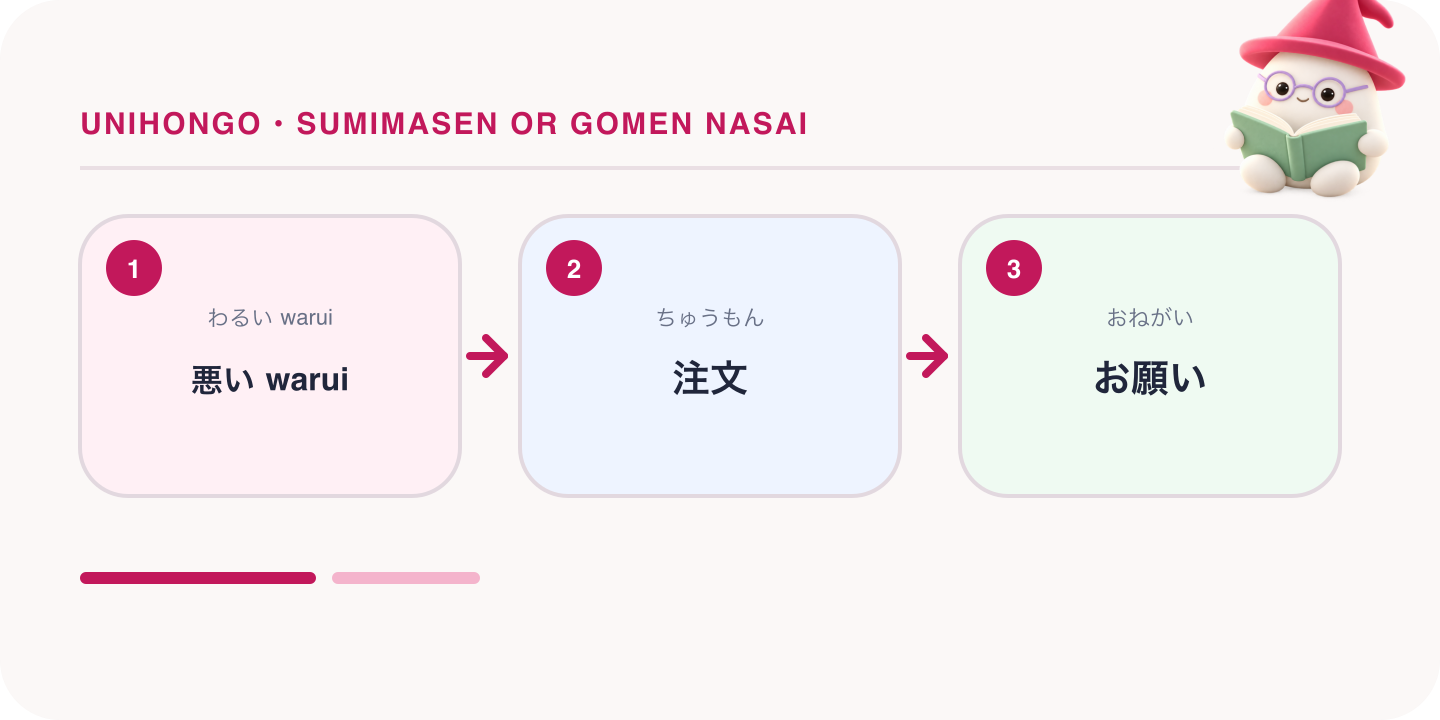
| 悪い warui | Casual, blunt | My bad, for a small thing | Close friends, often male speech |
| 申し訳ありません mōshiwake arimasen | Formal | A serious apology with consequences | Boss, client, customer |
| 申し訳ございません mōshiwake gozaimasen | Most formal | Service and business apology | Customers, senior people |
| 失礼します shitsurei shimasu | Polite | Excusing a social intrusion | Colleagues, anyone in a room |
What sumimasen actually covers
Sumimasen does at least three separate jobs, and Japanese speakers move between them without noticing. It gets attention, as when calling a waiter or stopping a stranger. It apologises for a small intrusion or fault. And it thanks, when someone has gone out of their way for you. The tone and the situation tell the listener which one you mean, so you do not have to choose a different word.
In speech you will constantly hear suimasen, with the u dropped, which is simply the relaxed pronunciation and not a different word. Written and in formal settings, sumimasen is the safer form. Learners often under-use this phrase because sorry feels excessive in English; in Japanese it is closer to a piece of punctuation between people.
| Japanese | Romaji | Meaning |
|---|---|---|
| すみません、注文お願いします。 | Sumimasen, chūmon onegai shimasu. | Excuse me, I would like to order. |
| すみません、ちょっと通ります。 | Sumimasen, chotto tōrimasu. | Excuse me, coming through. |
| すみません、道を教えていただけますか。 | Sumimasen, michi o oshiete itadakemasu ka. | Excuse me, could you tell me the way? |
| すみません、遅くなりました。 | Sumimasen, osoku narimashita. | Sorry, I am late. |
| すみません、助かりました。 | Sumimasen, tasukarimashita. | Thank you, that really helped me. |
| どうもすみません。 | Dōmo sumimasen. | Thank you so much. / I am very sorry. |
Gomen nasai is personal
Gomen nasai apologises for something you did to a particular person, and it carries warmth. That is why it sits naturally between friends, partners, family members and with children, and why it can sound slightly intimate or slightly childlike if you aim it at a stranger or a superior. Nobody will be offended by it, but it can mark you as not quite reading the distance.
The casual family runs gomen ne, gomen and, more bluntly, warui. Warui literally means bad and functions like my bad; it is casual, it leans towards male and younger speech, and it is far too light for anything that actually cost someone something. Warukatta is the past version for a mistake already made.
| Japanese | Romaji | Meaning |
|---|---|---|
| ごめんなさい、忘れていました。 | Gomen nasai, wasurete imashita. | I am sorry, I forgot. |
| ごめんね、待たせちゃって。 | Gomen ne, matasechatte. | Sorry for keeping you waiting. (casual) |
| この間はごめん。言い過ぎた。 | Kono aida wa gomen. Iisugita. | Sorry about the other day. I went too far. (casual) |
| 悪い、ちょっと遅れる。 | Warui, chotto okureru. | My bad, I will be a bit late. (casual) |
| 昨日は悪かった。 | Kinō wa warukatta. | Sorry about yesterday. (casual) |
| 本当にごめんなさい。私が悪かったです。 | Hontō ni gomen nasai. Watashi ga warukatta desu. | I am truly sorry. It was my fault. |
Moushiwake arimasen and the formal register
Mōshiwake arimasen literally says there is no excuse, and that is exactly its function: it removes the defence before anyone has to knock it down. Mōshiwake gozaimasen is the same thing one step more formal, and it is what you hear from staff in shops, hotels and stations. Both belong to situations where your mistake has cost someone time, money or trouble.
The structure of a good formal apology is short. Name the trouble, apologise, then say what you will do. Explanations come after, and only if asked. A learner who reverses that order, explaining first, sounds as though they are defending themselves, which is the one thing this phrase exists to avoid. There is a separate post on workplace apologies that goes further into the follow-up.
| Japanese | Romaji | Meaning |
|---|---|---|
| ご迷惑をおかけして申し訳ありません。 | Go-meiwaku o okake shite mōshiwake arimasen. | I am very sorry for the trouble I have caused. |
| 遅れて申し訳ございません。 | Okurete mōshiwake gozaimasen. | I am very sorry for being late. |
| 確認不足でした。申し訳ありません。 | Kakunin busoku deshita. Mōshiwake arimasen. | I did not check carefully enough. I am very sorry. |
| すぐに対応いたします。 | Sugu ni taiō itashimasu. | I will deal with it immediately. |
| 以後、気をつけます。 | Igo, ki o tsukemasu. | I will be careful from now on. |
| 二度とないようにいたします。 | Nido to nai yō ni itashimasu. | I will make sure it does not happen again. |
Do not stack these. One mōshiwake arimasen followed by a concrete fix is stronger than three apologies in a row, which can read as panic rather than responsibility.
Shitsurei shimasu is not an apology
Shitsurei shimasu means something close to I am about to be impolite, and it announces a small intrusion rather than regretting a fault. You say it entering a manager's office, leaving the office before your colleagues, passing in front of someone seated, ending a phone call, or stepping past a person in a narrow corridor. Nothing has gone wrong; you are simply marking the crossing of someone's space.
The past form shitsurei shimashita does apologise, lightly, for an intrusion that has already happened, and it is a useful, unfussy way to close a small awkward moment. Shitsurei desu ga is a different creature again: it prefaces a question that might be too personal, such as asking someone's age or company.
| Japanese | Romaji | Meaning |
|---|---|---|
| 失礼します。 | Shitsurei shimasu. | Excuse me. (entering a room or stepping past) |
| お先に失礼します。 | O-saki ni shitsurei shimasu. | Excuse me for leaving before you. |
| 失礼しました。 | Shitsurei shimashita. | Sorry about that. (for a small intrusion just now) |
| 失礼ですが、お名前は何とおっしゃいますか。 | Shitsurei desu ga, o-namae wa nan to osshaimasu ka. | Excuse me for asking, but what is your name? |
| それでは失礼します。 | Sore de wa shitsurei shimasu. | I will say goodbye there. (ending a call) |
Past forms and how much weight they add
Sumimasen deshita moves the apology into the past, and it does two things at once: it marks that the matter is finished and it adds weight. You use it when the trouble has already happened and you are closing it, such as after arriving late, after a favour, or on leaving a place where you have been a nuisance. Sumimasen alone in the same moment sounds slightly casual.
The same shift works right through the family. Gomen nasai becomes gomen ne for a small thing already done, mōshiwake arimasen becomes mōshiwake arimasen deshita when the incident is closed, and shitsurei shimasu becomes shitsurei shimashita. As a rule, present tense apologises for a state, past tense apologises for a completed act.
| Japanese | Romaji | Meaning |
|---|---|---|
| 先ほどはすみませんでした。 | Sakihodo wa sumimasen deshita. | I am sorry about earlier. |
| お待たせしてすみませんでした。 | O-matase shite sumimasen deshita. | I am sorry for keeping you waiting. |
| ご迷惑をおかけしました。 | Go-meiwaku o okake shimashita. | I caused you trouble. |
| 昨日は申し訳ありませんでした。 | Kinō wa mōshiwake arimasen deshita. | I am very sorry about yesterday. |
| 長々と失礼しました。 | Naganaga to shitsurei shimashita. | Sorry for taking up so much of your time. |
Why sorry so often means thank you
The most useful idea in the whole apology system is that a Japanese apology is often not about guilt. Sumimasen can be read as this is not settled between us: you did something for me, the balance is uneven, and I am acknowledging it. That is why it appears when someone holds a lift, carries your bag, or gives you a gift, where English would only say thank you.
Once you see that, the choice between sumimasen and arigatō gozaimasu stops being about right and wrong. Arigatō gozaimasu is warmer and celebrates the kindness. Sumimasen is more deferential and acknowledges the cost to the other person. Saying both together is extremely common and always safe. The separate post on thank you and sorry in Japanese treats the gratitude side in more detail.
| Japanese | Romaji | Meaning |
|---|---|---|
| すみません、ありがとうございます。 | Sumimasen, arigatō gozaimasu. | Sorry to trouble you, and thank you. |
| わざわざすみません。 | Wazawaza sumimasen. | Thank you for going out of your way. |
| 恐れ入ります。 | Osoreirimasu. | I am much obliged. (formal thanks or request) |
| お気遣いありがとうございます。 | O-kizukai arigatō gozaimasu. | Thank you for your thoughtfulness. |
| すみません、こんなに気を使っていただいて。 | Sumimasen, konna ni ki o tsukatte itadaite. | I am sorry, you have gone to so much trouble for me. |
The situation map
This is the table to memorise. Read it as a set of defaults rather than laws, since a warm boss and a distant friend will each pull the choice one step in the other direction.
| Situation | Best choice | Why |
|---|---|---|
| Bumping into someone on a train | すみません sumimasen | Small, impersonal, stranger |
| Squeezing past a seated person | 失礼します shitsurei shimasu | An intrusion, not a fault |
| Calling a waiter | すみません sumimasen | Getting attention, no apology meant |
| Receiving a gift or a favour | すみません plus ありがとうございます | Acknowledges the trouble and thanks |
| Being late for work | 遅れて申し訳ありません | Work register, real cost to others |
| Being late to meet a friend | ごめん、遅れた | Casual and personal |
| Breaking something you borrowed | 本当にすみません plus an offer to replace | Fault with a cost; the fix matters most |
| Handling a customer complaint | 申し訳ございません | Service register, highest formality |
| Hurting a friend's feelings | ごめんなさい | Personal, warm, about the relationship |
| Entering your manager's office | 失礼します shitsurei shimasu | Announcing an intrusion |
| Cancelling plans at short notice | 急で申し訳ありません | Formal enough to show the cost |
| Leaving the office first | お先に失礼します | Fixed workplace phrase, not an apology |
Full exchanges to practise
An apology is half a conversation. If you only rehearse your line you will freeze when the reply comes, so learn both sides. The replies below are the ones you will actually hear, and most of them are forms of do not worry about it, which you should also be able to say when someone apologises to you.
| Japanese | Romaji | Meaning |
|---|---|---|
| すみません。 | Sumimasen. | Sorry. (after bumping someone) |
| いえ、大丈夫です。 | Ie, daijōbu desu. | No, it is fine. (their reply) |
| すみません、注文いいですか。 | Sumimasen, chūmon ii desu ka. | Excuse me, may I order? |
| はい、ただいま伺います。 | Hai, tadaima ukagaimasu. | Yes, I will be right with you. (staff reply) |
| 遅れて申し訳ありません。電車が止まっていました。 | Okurete mōshiwake arimasen. Densha ga tomatte imashita. | I am very sorry for being late. The trains were stopped. |
| 分かりました。次から気をつけてください。 | Wakarimashita. Tsugi kara ki o tsukete kudasai. | Understood. Please be careful next time. (their reply) |
| 借りた傘を壊してしまいました。本当にすみません。 | Karita kasa o kowashite shimaimashita. Hontō ni sumimasen. | I broke the umbrella I borrowed. I am truly sorry. |
| 新しいものを買ってお返しします。 | Atarashii mono o katte o-kaeshi shimasu. | I will buy a new one and return it to you. |
| 気にしないでください。古いものですから。 | Ki ni shinaide kudasai. Furui mono desu kara. | Please do not worry. It was an old one. (their reply) |
| ご迷惑をおかけして申し訳ございません。すぐに交換いたします。 | Go-meiwaku o okake shite mōshiwake gozaimasen. Sugu ni kōkan itashimasu. | We are very sorry for the trouble. We will exchange it at once. |
| この間は本当にごめん。傷つけるつもりはなかった。 | Kono aida wa hontō ni gomen. Kizutsukeru tsumori wa nakatta. | I am really sorry about the other day. I did not mean to hurt you. (casual) |
| ううん、私こそごめん。 | Uun, watashi koso gomen. | No, I am the one who should apologise. (casual reply) |
| こんなにいただいて、すみません。 | Konna ni itadaite, sumimasen. | Thank you, this is too kind of you. |
| いえいえ、ほんの気持ちです。 | Ieie, hon no kimochi desu. | Not at all, it is only a small thing. (their reply) |
Replies you should be able to give
Half the time you will be on the receiving end, and silence after someone apologises reads as coldness. These four cover almost everything: one that waves it away, one that says it was nothing, one that returns the apology, and one that accepts it properly at work.
| Japanese | Romaji | Meaning |
|---|---|---|
| 大丈夫ですよ。 | Daijōbu desu yo. | It is quite all right. |
| 気にしないでください。 | Ki ni shinaide kudasai. | Please do not worry about it. |
| とんでもないです。 | Tondemonai desu. | Not at all. |
| こちらこそすみません。 | Kochira koso sumimasen. | I should be the one apologising. |
| 分かりました。次回は気をつけましょう。 | Wakarimashita. Jikai wa ki o tsukemashō. | Understood. Let us be careful next time. |
The mistakes learners make
- Using gomen nasai with strangers and staff, where sumimasen is the natural choice.
- Reaching for mōshiwake gozaimasen after a tiny bump, which sounds theatrical.
- Explaining before apologising at work, which turns the apology into a defence.
- Repeating sumimasen four or five times instead of naming what you will do next.
- Never saying sumimasen for a kindness, so gratitude sounds thinner than intended.
- Forgetting o-saki ni shitsurei shimasu when leaving, and appearing to slip out.