
Kagami biraki in four words
Kagami mochi is the decoration, kagami biraki is the day it is opened, and two more words, the mallet and the sweet soup, complete the story. Biraki is hiraki, from the verb hiraku, to open, softened when it joins kagami.
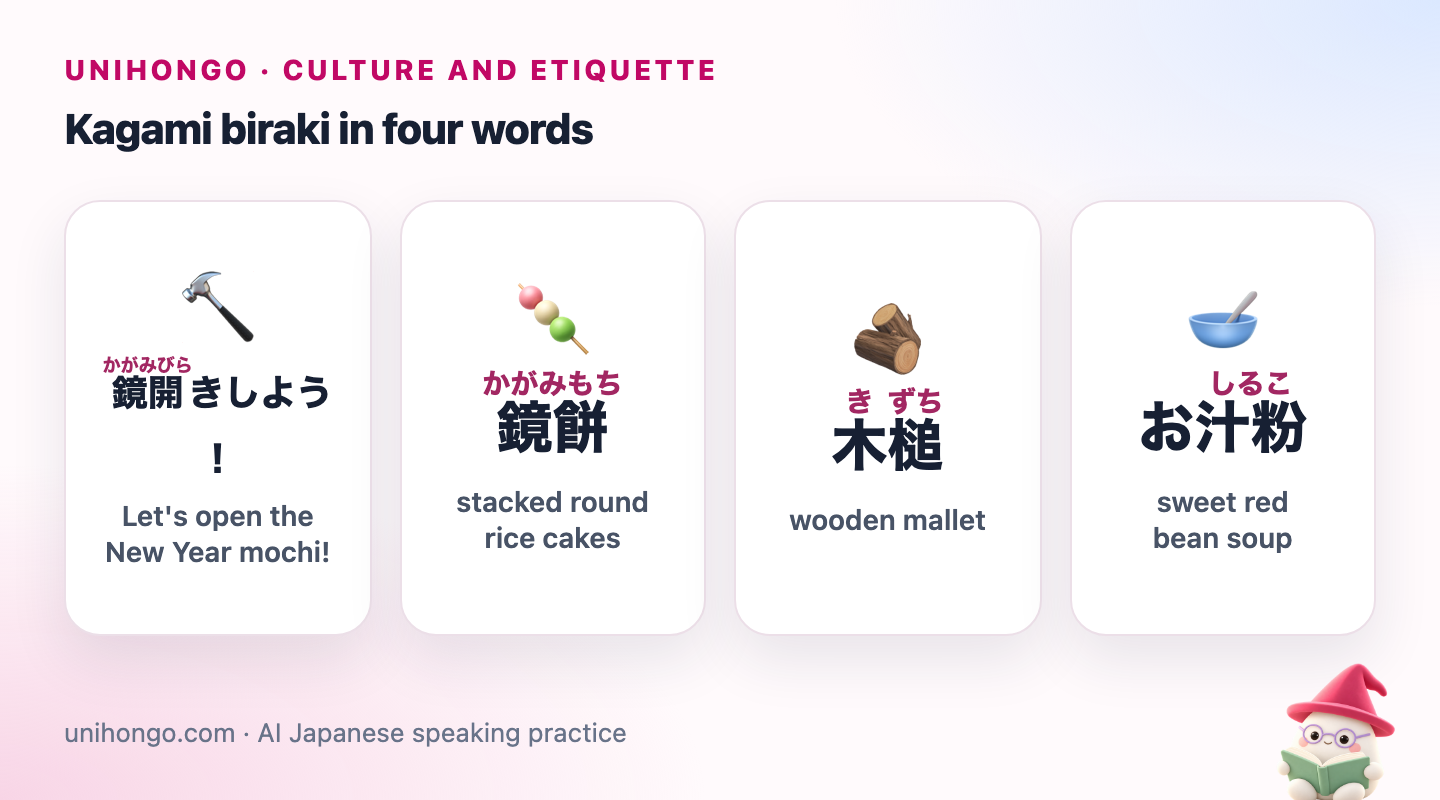
| Japanese | Romaji | Meaning |
|---|---|---|
| 鏡開きしよう! | Kagami biraki shiyō! | Let's open the New Year mochi! |
| 鏡餅 | kagami mochi | stacked round rice cakes |
| 木槌 | kizuchi | wooden mallet |
| お汁粉 | oshiruko | sweet red bean soup |
| お餅 | omochi | rice cake |
What kagami mochi is, from bottom to top
A traditional kagami mochi sits on a sanbō, a small wooden stand, covered with shihōbeni, a square of white paper with red edges, and urajiro fern leaves. On top are two round mochi, the larger below, and on top of those a daidai, a bitter orange, although many families use a mandarin. Some add a strip of kelp or a folded paper decoration. It is placed in the tokonoma alcove, the living room or a family altar, and many homes also put a small one in the kitchen.
The meaning most often given is that the round mirror shape holds the spirit of the New Year god during the holiday, and that the orange, whose name also means generation after generation, wishes the family a long line of descendants.
| Japanese | Romaji | Meaning |
|---|---|---|
| 大小二つのお餅を重ねます。 | Daishō futatsu no omochi o kasanemasu. | You stack a large and a small mochi. |
| 丸い形は昔の鏡を表しています。 | Marui katachi wa mukashi no kagami o arawashite imasu. | The round shape represents an old mirror. |
| 床の間に飾ります。 | Tokonoma ni kazarimasu. | We display it in the alcove. |
| Part | What it is | Meaning often given |
|---|---|---|
| sanbō | Small wooden stand | A stand for offerings to the gods |
| shihōbeni | White paper with red edges | Wards off misfortune from all four directions |
| Two round mochi | A large one and a small one | Like an old round mirror; good things piling up |
| daidai | Bitter orange on top | Generation after generation |
| urajiro | White-backed fern | Purity and a long life together |
Real mochi or a plastic one?
Real kagami mochi made from fresh rice cakes dries out over the holiday, cracks and can grow mould, which people simply scrape off. Today many families buy a packaged kagami mochi instead: a plastic shell in the classic shape with individually wrapped mochi inside, which stays clean and is easy to open. Supermarkets sell both from mid-December, along with tiny versions for desks and kitchens.
| Japanese | Romaji | Meaning |
|---|---|---|
| 中に小さいお餅が入っています。 | Naka ni chiisai omochi ga haitte imasu. | There are small mochi inside. |
| カビが生えないので便利です。 | Kabi ga haenai node benri desu. | It's handy because it doesn't go mouldy. |
| 本物のお餅はひびが入ります。 | Honmono no omochi wa hibi ga hairimasu. | Real mochi cracks. |
| 小さい鏡餅を机に置きました。 | Chiisai kagami mochi o tsukue ni okimashita. | I put a little kagami mochi on my desk. |
Kagami biraki: the date and the words
In much of Japan, kagami biraki is on 11 January, after matsu no uchi, the decoration period, ends. A popular explanation is that it was once held on the 20th and moved to the 11th in the Edo period because the 20th became associated with a shōgun's death, but accounts differ. In parts of western Japan, where matsu no uchi often runs to the 15th, many families open it on the 15th or the 20th, and in Kyoto some open it on the 4th.
The word choice matters. Waru, to break or split, is avoided because it suggests a split, and kiru, to cut, because a blade feels violent towards a sacred offering. Instead people say hiraku, to open, which also suggests opening up good fortune. Words avoided for luck like this are called imikotoba.
| Japanese | Romaji | Meaning |
|---|---|---|
| 鏡開きは一月十一日です。 | Kagami biraki wa ichigatsu jūichinichi desu. | Kagami biraki is on 11 January. |
| 包丁は使いません。 | Hōchō wa tsukaimasen. | We don't use a kitchen knife. |
| 「割る」ではなく「開く」と言います。 | "Waru" de wa naku "hiraku" to iimasu. | We say open, not break. |
| 地域によって日にちが違います。 | Chiiki ni yotte hinichi ga chigaimasu. | The date differs by region. |
| Date | Where it is common |
|---|---|
| 4 January | Some families in Kyoto |
| 11 January | Much of Japan, including the Tokyo area |
| 15 or 20 January | Parts of the Kansai region and elsewhere |
How to eat it, safely
By January, real kagami mochi is rock hard. Break it into pieces with a mallet or your hands, soak the pieces in water for several hours or heat them gently, and then cook. The classic dish is oshiruko or zenzai, sweet red bean soup with soft mochi; the names differ by region and by how thick the soup is. Others put it in ozōni, grill it and dip it in soy sauce, or fry small dried pieces into crunchy okaki.
Every New Year, Japanese news and local governments warn about choking on mochi, especially for older people and small children. Cut it small, chew well and do not eat mochi alone if you are at risk.
| Japanese | Romaji | Meaning |
|---|---|---|
| 硬いから、水につけておこう。 | Katai kara, mizu ni tsukete okō. | It's hard, so let's soak it in water. |
| お汁粉に入れよう。 | Oshiruko ni ireyō. | Let's put it in sweet red bean soup. |
| 焼いて、しょうゆをつけて食べます。 | Yaite, shōyu o tsukete tabemasu. | We grill it and dip it in soy sauce. |
| 小さく切って、よくかんで食べてね。 | Chiisaku kitte, yoku kande tabete ne. | Cut it small and chew well, OK? |
| のどに詰まらせないように気をつけて。 | Nodo ni tsumarasenai yō ni ki o tsukete. | Be careful not to choke. |
The other kagami biraki: sake barrels at a celebration
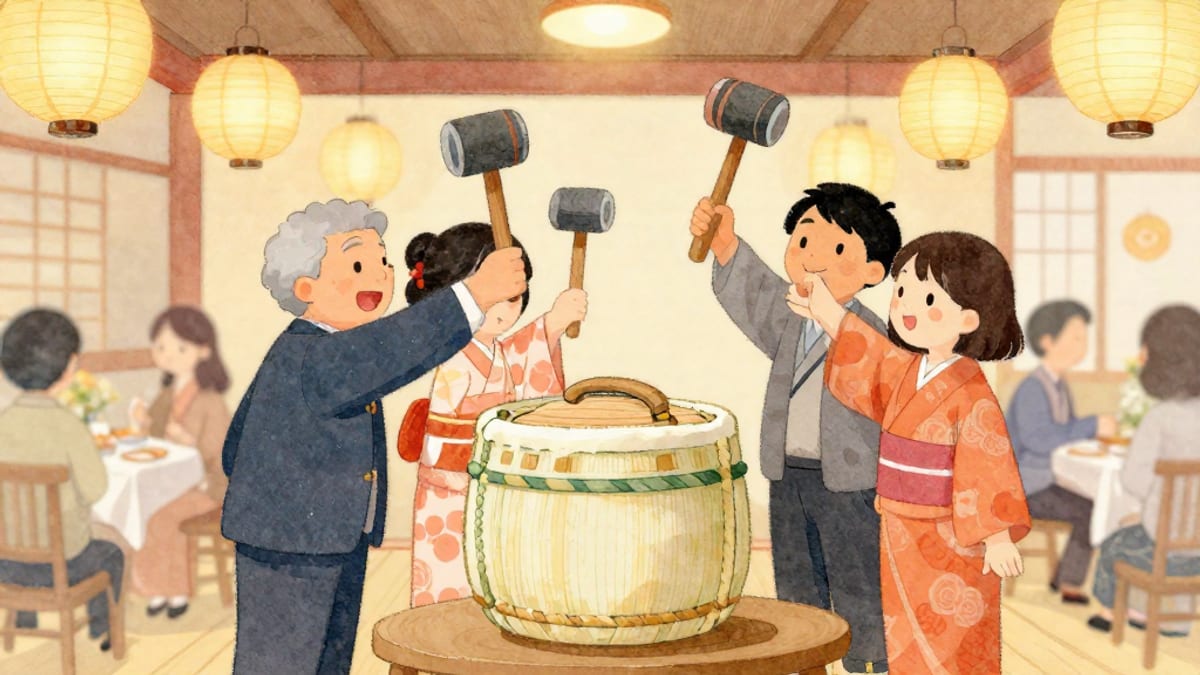
At weddings, opening ceremonies, New Year parties and sports victories, you may see a different kagami biraki: a group of people stand behind a large barrel of sake and break its round wooden lid, also called kagami, with wooden mallets, on a count. Then everyone toasts from small square wooden cups called masu. Martial arts clubs also hold a kagami biraki in January to mark their first practice of the year.
| Japanese | Romaji | Meaning |
|---|---|---|
| それでは、鏡開きを行います。 | Sore de wa, kagami biraki o okonaimasu. | Host: We will now open the sake barrel. |
| せーの! | Sē no! | Ready, go! (count before a joint action) |
| よいしょ! | Yoisho! | Heave-ho! |
| おめでとうございます! | Omedetō gozaimasu! | Congratulations! |
| 枡でどうぞ。 | Masu de dōzo. | Please have some from a wooden cup. |
Sē no is the count Japanese people use before doing anything together, from lifting a sofa to jumping into a photo. Everyone acts on the no.
Mini dialogue: 11 January at home
| Japanese | Romaji | Meaning |
|---|---|---|
| 今日は鏡開きだね。 | Kyō wa kagami biraki da ne. | Host mother: Today's kagami biraki. |
| 包丁で切ってもいいですか。 | Hōchō de kitte mo ii desu ka. | You: May I cut it with a knife? |
| 鏡餅は木槌で開くのよ。 | Kagami mochi wa kizuchi de hiraku no yo. | Host mother: We open kagami mochi with a mallet. |
| へえ、知りませんでした。やってみたいです。 | Hē, shirimasen deshita. Yatte mitai desu. | You: Oh, I didn't know. I'd like to try. |
| どうぞ。終わったら、お汁粉にしようね。 | Dōzo. Owattara, oshiruko ni shiyō ne. | Host mother: Go ahead. Then we'll make red bean soup. |
Notice the host mother's no yo, a soft, explanatory ending often heard from women of her generation. You answer politely with desu and masu.
Learn the mirror kanji with Mocchi
Mocchi, Unihongo's round little study assistant, is named after mochi, so this is a fitting topic to bring to the chat. Type /kanji 鏡 to see the meaning, readings and common words of mirror, then /kanji 餅 for rice cake. Ask Mocchi to quiz you on the parts of the decoration; it notes the ones you miss and brings them back next time.
Add the words to your flashcards and run them in Vocabulary Dash, the 3D word runner, until kizuchi, sanbō and oshiruko come without thinking.
Common learner mistakes
- Saying kagami mochi o kiru, to cut it. Use hiraku, or say you are doing kagami biraki.
- Eating it straight from the decoration. Real kagami mochi is rock hard and may have mould; soak, clean and cook it first.
- Swallowing large pieces. Cut it small and chew well; mochi is a real choking risk.
- Reading 鏡開き as kagami hiraki. When the words join, it is kagami biraki.
- Assuming every area uses 11 January. Ask: kono hen de wa itsu kagami biraki o shimasu ka.