
A loanword is a Japanese word
The mental model that causes trouble is that a loanword is an English word being used in Japanese. It is not. It is a Japanese word with a foreign origin, with Japanese sounds, Japanese timing and often a Japanese meaning that has drifted from the original.
Once you accept that, the pronunciation question resolves itself. You would not pronounce a Japanese word in English, and a loanword is a Japanese word.
This also explains the common experience of not being understood. Your English pronunciation is not a clearer version of the Japanese word; it is a different sequence of sounds with a different number of beats, and the listener has no reason to connect it.
How a word gets reshaped
The reshaping follows rules, and knowing them lets you predict the Japanese form of a word you have not met yet, which is a genuinely useful skill in a technical field.
The largest change is vowel insertion. Japanese syllables are mostly consonant plus vowel, so any consonant cluster gets a vowel between its parts, and every inserted vowel is another beat.
| Rule | English | Japanese | Beats |
|---|---|---|---|
| Insert u after most consonants | desk | デスク | 3 |
| Insert o after t and d | hint | ヒント | 3 |
| l becomes r | hotel | ホテル | 3 |
| th becomes s or z | three | スリー | 3 |
| v becomes b | video | ビデオ | 3 |
| Final consonant gets a vowel | cup | コップ | 3 |
The beat column is the important one. An English one-syllable word routinely becomes three or four Japanese beats, and compressing them back is what makes it unrecognisable.
Counting the beats
The single most useful exercise with loanwords is counting. Say the word, count the moras on your fingers, and check that you produced every one at full length.
Learners systematically undercount, because the English word is shorter and it is sitting underneath the Japanese one interfering.
| Japanese | Romaji | Meaning |
|---|---|---|
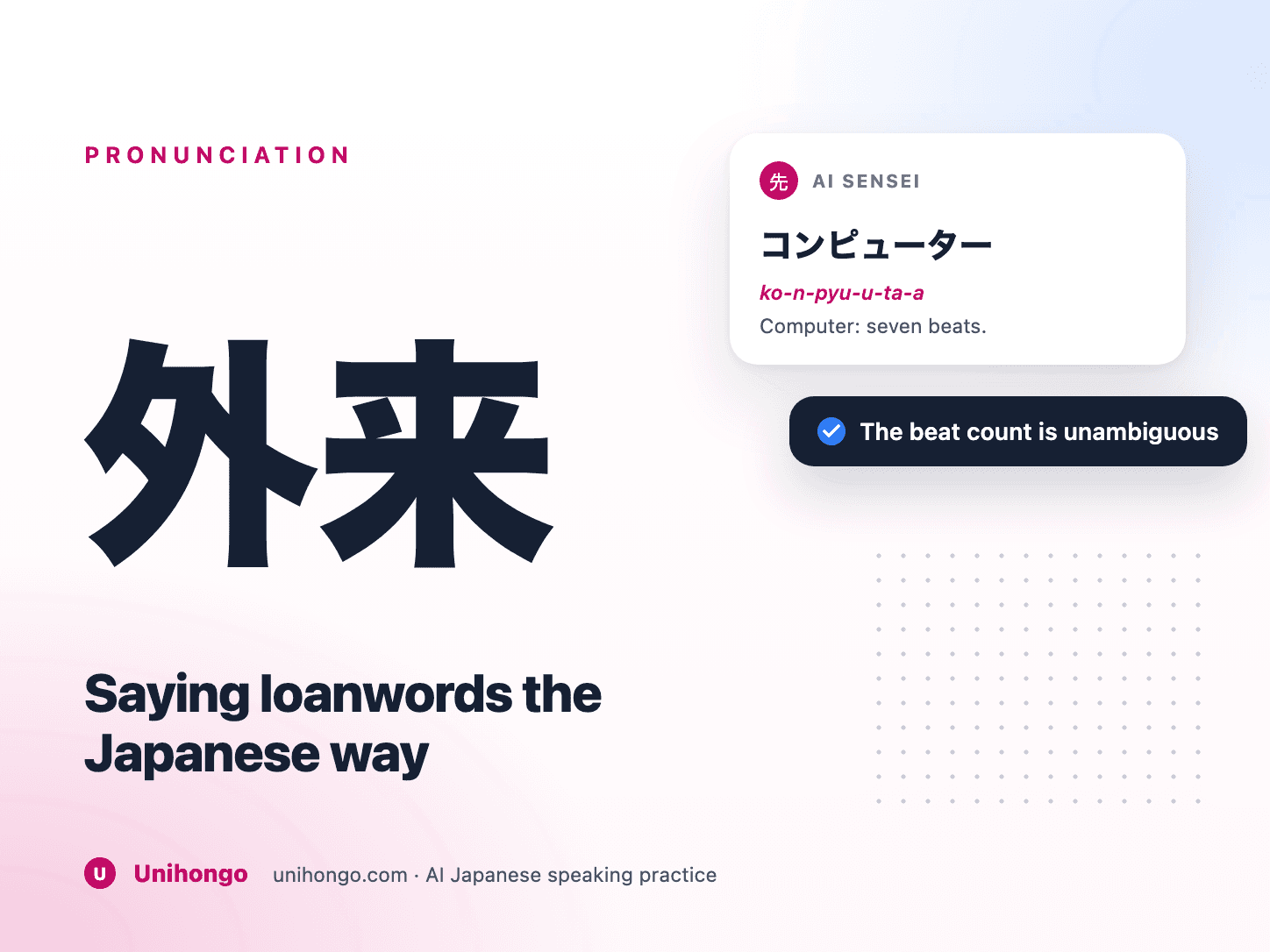
| コンピューター | ko-n-pyu-u-ta-a | Computer: seven beats |
| インターネット | i-n-ta-a-ne-tto | Internet: seven beats |
| スケジュール | su-ke-ju-u-ru | Schedule: five beats |
| サービス | sa-a-bi-su | Service: four beats |
| マクドナルド | ma-ku-do-na-ru-do | McDonald's: six beats |
| アルバイト | a-ru-ba-i-to | Part-time job: five beats |
Words that have shifted meaning
Form is only half of it. Many loanwords have narrowed, shifted or been assembled in Japan, so a word you recognise may not mean what you assume.
This is a vocabulary matter rather than a pronunciation one, but it belongs here because the same false confidence causes both errors: the word looks familiar, so it is not learned.
| Japanese | Romaji | Meaning |
|---|---|---|
| マンション | manshon | An apartment building, not a mansion |
| ペーパードライバー | pēpā doraibā | Someone licensed who does not drive |
| サラリーマン | sararīman | A salaried office worker |
| ワンピース | wanpīsu | A dress |
| コンセント | konsento | A power outlet |
| クーラー | kūrā | An air conditioner |
Several of these were assembled in Japan and have no English original at all, which is why guessing from the parts does not work.
Shortening, which Japanese does aggressively
Long loanwords are frequently shortened, usually to four moras, and the shortened form is often the only one in daily use. A learner who knows the full form and not the abbreviation will not recognise the word when it is said.
There is a rough pattern: take the first two moras of each element of a compound. It is not reliable enough to generate new abbreviations, but it makes existing ones much easier to remember.
| Japanese | Romaji | Meaning |
|---|---|---|
| パソコン | pasokon | Personal computer |
| エアコン | eakon | Air conditioner |
| リモコン | rimokon | Remote control |
| コンビニ | konbini | Convenience store |
| スマホ | sumaho | Smartphone |
| ファミレス | famiresu | Family restaurant |
Unlearning the English underneath
The difficulty with loanwords is interference rather than ignorance. You already know the word, and that knowledge actively pulls your pronunciation back towards English, particularly when you are speaking quickly or under pressure.
That makes repetition with feedback more useful here than explanation. Unihongo's pronunciation lab is well suited to it because the beat count is unambiguous: a compressed syllable shows up in the score, where it would be inaudible to you.
The place it matters most is technical vocabulary in your own field, where loanwords cluster and where being misunderstood is expensive. Twenty words from your own work, drilled to full length, is a small piece of work with a disproportionate effect on how professional you sound.
Expect the English version to keep interfering under pressure long after the drills are correct. That is normal, and it fades with conversation volume rather than with more drilling.