
Why maps make place names sound wrong
English maps and most station signs in Latin letters write Tokyo, Kyoto and Osaka without long-vowel marks. That is convenient for typing, but it hides a beat. In Japanese a long vowel takes twice the time of a short one, so Tōkyō has four beats, not two or three. Say the long vowels and you immediately sound like you have been listening to Japanese rather than reading English.
The second habit to drop is English stress. English speakers tend to say o-SA-ka or hi-ro-SHI-ma with one loud syllable. Japanese keeps the beats even and uses gentle pitch movement instead, and the exact pitch pattern can differ between local speakers and people from elsewhere. Even beats are the part that matters most.
| Japanese | Romaji | Meaning |
|---|---|---|
| 東京駅はどこですか。 | Tōkyō eki wa doko desu ka. | Where is Tokyo Station? |
| とうきょう | Tōkyō | Tōkyō: to-o-kyo-o, four beats |
| ひろしま | Hiroshima | Hiroshima: four even beats |
The four big names with long vowels
These four are the names travellers say most often, and all four have a long vowel that English spelling leaves out.
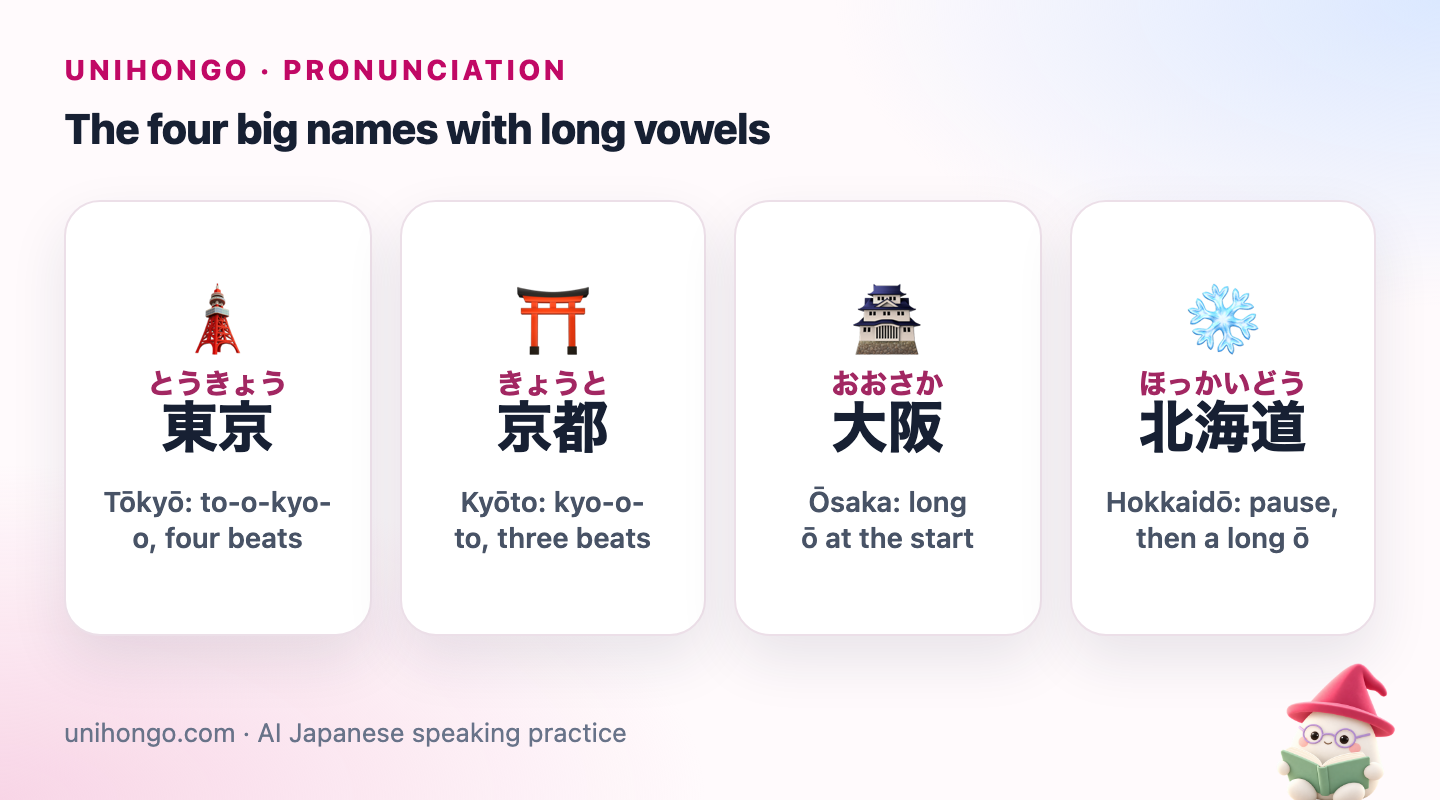
| Japanese | Romaji | Meaning |
|---|---|---|
| 東京 | Tōkyō | Tōkyō: to-o-kyo-o, four beats |
| 京都 | Kyōto | Kyōto: kyo-o-to, three beats |
| 大阪 | Ōsaka | Ōsaka: long ō at the start |
| 北海道 | Hokkaidō | Hokkaidō: pause, then a long ō |
Notice that Tōkyō and Kyōto share the kanji 京, capital. Tōkyō means eastern capital and Kyōto means capital city. In both, kyō is one blended beat plus a long vowel, so do not split it into ki-yo.
Hokkaidō also has a small tsu: ho-k-ka-i-do-o, six beats. The pause before ka and the long ō at the end are what make it sound Japanese. Kōbe (神戸) and Nikkō (日光) follow the same rules: Kōbe is ko-o-be, and Nikkō has both a pause and a long vowel, ni-k-ko-o.
The endings that build thousands of names
Japanese place names are usually built from a few common parts. Once you know them, you can read a name like Sumidagawa as Sumida plus river, and you know what kind of place to expect.
| Japanese | Romaji | Meaning |
|---|---|---|
| 富士山 | Fujisan | Mount Fuji |
| 隅田川 | Sumidagawa | the Sumida River |
| 宮島 | Miyajima | Miyajima island |
| 金閣寺 | Kinkakuji | Kinkaku-ji, the Golden Pavilion temple |
| 日本橋 | Nihonbashi | Nihonbashi, a district in Tokyo |
| Kanji | Ending | Meaning | Example |
|---|---|---|---|
| 駅 | -eki | station | Shinjuku eki |
| 区 / 市 / 県 | -ku / -shi / -ken | ward / city / prefecture | Shibuya-ku, Yokohama-shi, Nagano-ken |
| 寺 | -ji or -dera | Buddhist temple | Kinkakuji, Kiyomizudera |
| 神社 | -jinja | Shinto shrine | Yasaka jinja |
| 山 | -san or -yama | mountain | Fujisan, Arashiyama |
| 川 | -kawa or -gawa | river | Kamogawa, Sumidagawa |
| 島 | -shima or -jima | island | Miyajima, Hiroshima |
| 橋 | -hashi or -bashi | bridge | Nihonbashi |
The change from kawa to gawa and from shima to jima is called rendaku. It happens often in compounds, but not always, and there is no rule you can apply blindly: Hiroshima keeps shima, while Miyajima has jima. Treat each name as a word to learn, and use the pattern as a guess, not a guarantee.
Temples are a good example of two readings for one kanji. Kinkakuji uses ji, while Kiyomizudera uses dera. Both mean temple; the name decides which one you say.
Quiet vowels and small pauses in station names
Two features of normal Japanese speech surprise learners in place names. The first is vowel devoicing: an i or u between certain voiceless consonants is often whispered, so 浅草 Asakusa sounds close to a-sa-k-sa, and 秋葉原 Akihabara can sound like a-k-ha-ba-ra. This is natural; you do not have to copy it, but you should recognise it when the train announcement says it.
The second is the small tsu, a short pause before a consonant. 札幌 Sapporo is sa-p-po-ro, and 六本木 Roppongi is ro-p-po-n-gi. Skipping the pause turns them into Saporo and Rōpongi, which sound clearly wrong to a Japanese ear.
| Japanese | Romaji | Meaning |
|---|---|---|
| 浅草 | Asakusa | Asakusa: the ku is often whispered |
| 秋葉原 | Akihabara | Akihabara: the ki is often whispered |
| 札幌 | Sapporo | Sapporo: pause before po |
| 六本木 | Roppongi | Roppongi: pause before po, then n |
| 新宿 | Shinjuku | Shinjuku: shi-n-ju-ku, four beats |
| 渋谷 | Shibuya | Shibuya: three even beats |
Short names English speakers stretch
Short place names are easy to say badly because English wants to put a heavy stress somewhere. Hakone becomes ha-KO-nee, Nara becomes NAH-ruh, and Kanagawa gets a big push on the third syllable. In Japanese, every beat stays short and clear, and the final vowel is a pure e or a, never ee or uh.
Prefecture names follow the same rules, and you will hear them with ken (prefecture) on the end in announcements and on forms. Say the name first, then a short, clear ken.
| Japanese | Romaji | Meaning |
|---|---|---|
| 箱根 | Hakone | Hakone: ha-ko-ne, short final e |
| 奈良 | Nara | Nara: na-ra, two short beats |
| 名古屋 | Nagoya | Nagoya: na-go-ya, three even beats |
| 福岡 | Fukuoka | Fukuoka: fu-ku-o-ka, four beats |
| 長崎 | Nagasaki | Nagasaki: na-ga-sa-ki, four beats |
| 神奈川県 | Kanagawa ken | Kanagawa Prefecture |
Fukuoka is worth practising slowly: the u in fu is light and the o and ka are separate beats, so do not merge them into one syllable. With longer names like Kanagawa or Nagasaki, keep a steady rhythm, like a clock ticking, rather than speeding up at the end.
Asking the way with a place name
Place names matter most when you need help. A short, polite question with the name said clearly gets you further than a long one. Station staff and passers-by are used to helping travellers, and they will often repeat the name back to you, which is your chance to hear the right pronunciation.
| Japanese | Romaji | Meaning |
|---|---|---|
| すみません、浅草へはどう行けばいいですか。 | Sumimasen, Asakusa e wa dō ikeba ii desu ka. | Excuse me, how do I get to Asakusa? |
| この電車は品川に止まりますか。 | Kono densha wa Shinagawa ni tomarimasu ka. | Does this train stop at Shinagawa? |
| 次は渋谷ですか。 | Tsugi wa Shibuya desu ka. | Is the next stop Shibuya? |
| この駅の名前は何と読みますか。 | Kono eki no namae wa nan to yomimasu ka. | How do you read the name of this station? |
| 札幌まで大人一枚お願いします。 | Sapporo made otona ichimai onegai shimasu. | One adult ticket to Sapporo, please. |
Mini dialogue: in a taxi
| Japanese | Romaji | Meaning |
|---|---|---|
| どちらまで行かれますか。 | Dochira made ikaremasu ka. | Driver: Where would you like to go? (polite) |
| 浅草寺までお願いします。 | Sensōji made onegai shimasu. | You: To Sensō-ji, please. |
| せんそうじですね。かしこまりました。 | Sensōji desu ne. Kashikomarimashita. | Driver: Sensō-ji. Certainly. |
| どのくらいかかりますか。 | Dono kurai kakarimasu ka. | You: About how long will it take? |
| 道が空いていれば十五分くらいです。 | Michi ga suite ireba jūgofun kurai desu. | Driver: About fifteen minutes if the roads are clear. |
浅草寺 is a good test of everything in this post. It is the temple in Asakusa, but the temple's own name is read Sensōji: se-n-so-o-ji, five beats with a long vowel. The same kanji as Asakusa, read a completely different way. Sensōji is what the driver, the guidebooks and the temple itself use.
Common learner mistakes
- Saying Tokyo and Kyoto with short vowels and English stress: toe-KEY-oh instead of to-o-kyo-o.
- Splitting kyō into two syllables, ki-yo, which adds a beat that is not there.
- Skipping the small tsu in Sapporo, Roppongi, Hokkaidō and Nikkō.
- Applying rendaku everywhere: not every kawa becomes gawa, and not every shima becomes jima.
- Assuming one spelling has one reading: Nihonbashi in Tokyo, Nipponbashi in Osaka.
- Reading Fujisan as Fujiyama. Japanese speakers say Fujisan.
Turn your route into a Mocchi quiz
- Paste the stations on your line or trip into Mocchi and type: "Quiz me on how to read these place names, then tell me which ones have long vowels or a small tsu." Mocchi keeps track of the names you miss and brings them back in later reviews.
- Ask /kanji 島 or /kanji 川 to see the readings and other words that use the kanji, so new names on the map start to make sense.
- When the names feel easy, try the Ask the Way to the Station mission in AI Sensei. Ibuki-sensei can play a busy commuter, and you finish the mission by asking for a station by name and understanding the reply.