
The season vocabulary in one table
Almost everything said about the blossoms in spring reuses this short list. Learn the stage words first, because they are what people compare notes on, and the variety names second, since they let you say why one tree looks different from another. The readings matter: sakura appears inside compounds where it voices to zakura, as in yozakura and hazakura, and the bloom-fraction words use the counter reading bu rather than fun.
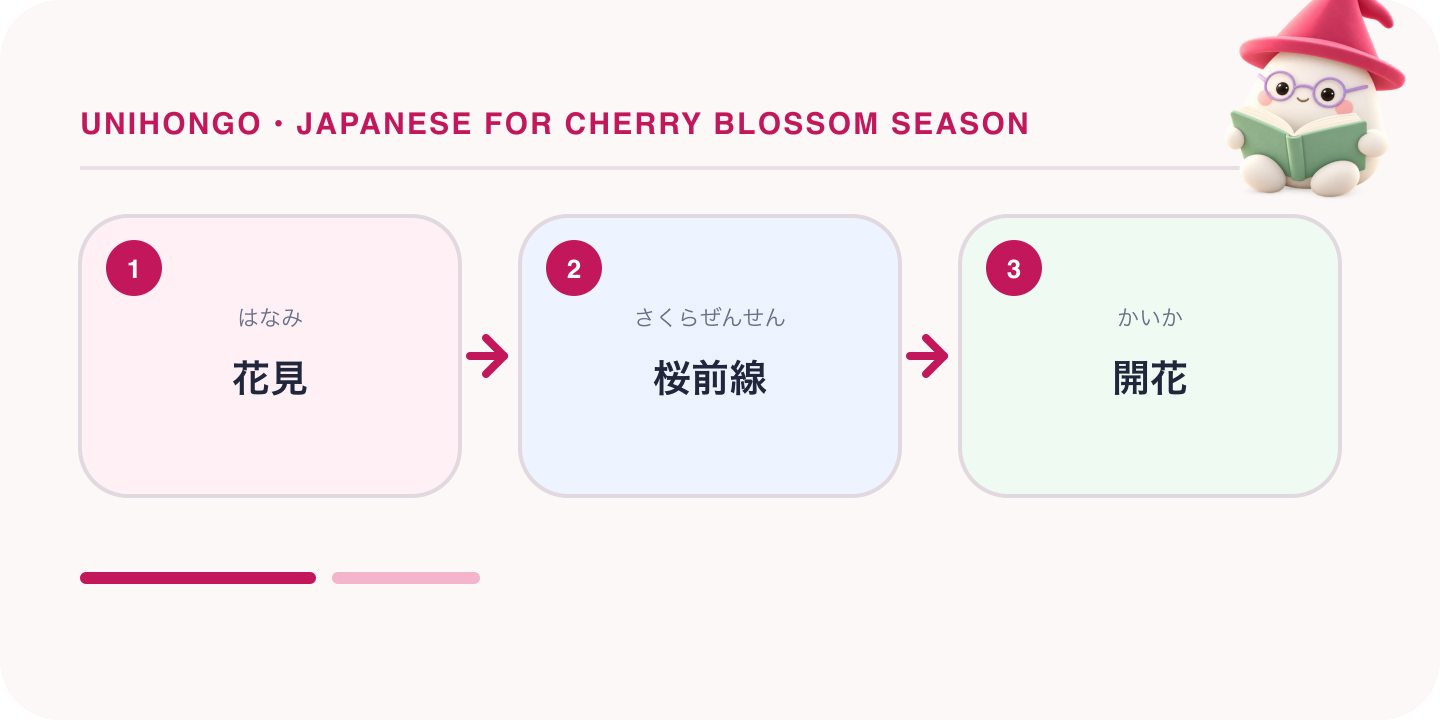
| Japanese | Romaji | Meaning |
|---|---|---|
| 桜 | Sakura | Cherry blossom, cherry tree |
| 花見 | Hanami | Blossom viewing, a blossom picnic |
| 桜前線 | Sakura zensen | The blossom front moving across the country |
| 開花 | Kaika | First blooming |
| 開花宣言 | Kaika sengen | The official announcement that blooming has begun |
| 三分咲き | Sanbu-zaki | About thirty per cent open |
| 五分咲き | Gobu-zaki | About half open |
| 七分咲き | Shichibu-zaki | About seventy per cent open |
| 満開 | Mankai | Full bloom |
| 見頃 | Migoro | The best time to see them |
| 散る | Chiru | To fall, of petals |
| 花びら | Hanabira | Petal |
| 花吹雪 | Hanafubuki | Petals blowing like snow |
| つぼみ | Tsubomi | Bud |
| 葉桜 | Hazakura | Trees after the petals, showing leaves |
| 夜桜 | Yozakura | Cherry blossoms at night |
| ライトアップ | Raito appu | Evening illumination |
| 花冷え | Hanabie | A cold spell during blossom season |
| ソメイヨシノ | Somei Yoshino | The most widely planted variety |
| 八重桜 | Yaezakura | Double-flowered cherry, usually later |
| しだれ桜 | Shidarezakura | Weeping cherry |
| 山桜 | Yamazakura | Mountain cherry |
| 場所取り | Basho-tori | Going early to hold a spot |
| レジャーシート | Rejā shīto | Picnic sheet |
| お花見弁当 | Ohanami bentō | A packed lunch box for hanami |
| 花より団子 | Hana yori dango | Dumplings over flowers, said of people there for the food |
Talking about the forecast
Every spring the weather services publish blossom forecasts, and people repeat them to each other constantly. You do not need technical language for this: the useful pattern is sō desu, which reports what you heard, and it keeps you safely away from stating anything as fact. Dates and predictions change as the weather turns, so hedging is not just politeness, it is accuracy.
| Japanese | Romaji | Meaning |
|---|---|---|
| 今年の開花はいつごろですか? | Kotoshi no kaika wa itsu-goro desu ka? | About when will they bloom this year? |
| 来週の水曜日ごろだそうです。 | Raishū no suiyōbi-goro da sō desu. | Around Wednesday next week, apparently. |
| 今年は例年より少し早いそうです。 | Kotoshi wa reinen yori sukoshi hayai sō desu. | This year is said to be a little earlier than usual. |
| 週末が見頃だと思います。 | Shūmatsu ga migoro da to omoimasu. | I think the weekend will be the best time. |
| もう開花宣言が出ましたか? | Mō kaika sengen ga demashita ka? | Has the blooming announcement come out yet? |
| まだつぼみですね。 | Mada tsubomi desu ne. | They are still buds. |
Note the difference between da sō desu and mitai desu. The first reports information from a forecast or another person, which is what you want when repeating a prediction. The second gives your own impression from looking at the tree, so sakura ga sakisō desu means the tree itself looks about to open.
Inviting people to a hanami
Invitations in Japanese are usually negative questions, because asking will you not come sounds softer than asking will you come. Mi ni ikimasen ka combines the verb stem with ni to mean go in order to see, and it works for anything worth going to look at. If you are inviting a superior, add a reason and leave more room to decline.
| Japanese | Romaji | Meaning |
|---|---|---|
| 今度、お花見に行きませんか? | Kondo, ohanami ni ikimasen ka? | Would you like to go to a hanami sometime? |
| 週末に桜を見に行きませんか? | Shūmatsu ni sakura o mi ni ikimasen ka? | Shall we go and see the cherry blossoms at the weekend? |
| 土曜日にお花見をする予定です。よかったら来てください。 | Doyōbi ni ohanami o suru yotei desu. Yokattara kite kudasai. | We are planning a hanami on Saturday. Please come if you like. |
| 部署のみんなで行きます。ご都合はいかがですか? | Busho no minna de ikimasu. Go-tsugō wa ikaga desu ka? | The whole team is going. Would that suit you? |
| いいですね。ぜひ行きたいです。 | Ii desu ne. Zehi ikitai desu. | That sounds good. I would love to come. |
| すみません、その日は予定があります。また誘ってください。 | Sumimasen, sono hi wa yotei ga arimasu. Mata sasotte kudasai. | Sorry, I have plans that day. Please invite me again. |
| 雨だったらどうしますか? | Ame dattara dō shimasu ka? | What happens if it rains? |
| 雨なら来週に延期します。 | Ame nara raishū ni enki shimasu. | If it rains we will postpone to next week. |
Organising the picnic
The organising conversation is short and repeats every year: what time, which gate, who goes early to hold the space, and who brings what. Basho-tori is the part that needs the most care, because in popular parks it can mean someone sitting alone for hours, and some parks limit or ban it. Ask before you volunteer anyone, and check the park's own notices first.
| Japanese | Romaji | Meaning |
|---|---|---|
| 何時に集合しますか? | Nan-ji ni shūgō shimasu ka? | What time shall we meet? |
| 十一時に東門に集合です。 | Jūichi-ji ni higashi-mon ni shūgō desu. | We meet at the east gate at eleven. |
| 場所取りは誰がしますか? | Basho-tori wa dare ga shimasu ka? | Who is going early to hold the spot? |
| 私が朝から場所を取ります。 | Watashi ga asa kara basho o torimasu. | I will hold a spot from the morning. |
| 何を持って行きましょうか? | Nani o motte ikimashō ka? | What should I bring? |
| 飲み物を買って行きます。 | Nomimono o katte ikimasu. | I will buy drinks and bring them. |
| お弁当は各自で用意してください。 | Obentō wa kakuji de yōi shite kudasai. | Please each bring your own lunch. |
| レジャーシートとゴミ袋は私が持って行きます。 | Rejā shīto to gomi-bukuro wa watashi ga motte ikimasu. | I will bring the picnic sheet and rubbish bags. |
| 会費はあとで集めます。 | Kaihi wa ato de atsumemasu. | We will collect everyone's share afterwards. |
| 場所が決まったら連絡します。 | Basho ga kimattara renraku shimasu. | I will message you once the spot is decided. |
Kakuji de means each person individually, and it is the standard way to say bring your own without sounding stingy. Note motte ikimasu for carrying something away from where you are and motte kimasu for bringing it here; learners often use the wrong one and end up telling colleagues to bring food to the wrong place.
Park etiquette in plain terms
Rules genuinely differ from park to park and from year to year, so the safest habit is to read the signs at the entrance and follow what the people around you are doing. What is broadly expected in most places is simple: take your rubbish with you or sort it into the bins provided, keep the volume reasonable, especially in residential areas and after dark, and leave the trees alone. Pulling down a branch for a photograph is the one thing that reliably upsets people.
| Japanese | Romaji | Meaning |
|---|---|---|
| ここに座ってもいいですか? | Koko ni suwatte mo ii desu ka? | Is it all right to sit here? |
| どうぞ、空いていますよ。 | Dōzo, aite imasu yo. | Go ahead, it is free. |
| すみません、少し詰めていただけますか? | Sumimasen, sukoshi tsumete itadakemasu ka? | Excuse me, could you shuffle along a little? |
| ゴミは持ち帰りましょう。 | Gomi wa mochikaerimashō. | Let us take our rubbish home. |
| 枝を折らないでください。 | Eda o oranaide kudasai. | Please do not break the branches. |
| この公園はお酒が禁止だそうです。 | Kono kōen wa osake ga kinshi da sō desu. | Alcohol is not allowed in this park, apparently. |
| 公園のルールを確認しましょう。 | Kōen no rūru o kakunin shimashō. | Let us check the park rules. |
| そろそろ静かにしましょうか。 | Sorosoro shizuka ni shimashō ka. | Shall we quieten down now? |
- Check the park notices for rules on alcohol, cooking, music and reserving spots.
- Keep your sheet within the space you actually need and off the tree roots.
- Take rubbish home if bins are absent or already overflowing.
- Do not break, shake or climb the branches, and do not pick blossoms.
- Lower your voices in the evening, particularly near houses.
- Leave the ground as you found it, including bottle caps and skewers.
Small talk the season hands you
For about a month the blossoms are a free conversation opener with neighbours, shopkeepers and colleagues, and the exchange is short by design. One observation, one ne, one agreement. The value for a learner is that the topic is visible to both of you, so you can speak without inventing content, and the same three or four sentences work with anyone.
| Japanese | Romaji | Meaning |
|---|---|---|
| 桜が咲きましたね。 | Sakura ga sakimashita ne. | The cherry blossoms have come out. |
| もう満開ですね。 | Mō mankai desu ne. | They are already in full bloom. |
| 駅前の桜がきれいですよ。 | Ekimae no sakura ga kirei desu yo. | The cherry trees in front of the station are lovely. |
| 今日は花冷えですね。 | Kyō wa hanabie desu ne. | It has turned cold again for blossom season. |
| 上着があってよかったです。 | Uwagi ga atte yokatta desu. | I am glad I brought a jacket. |
| そろそろ散り始めましたね。 | Sorosoro chirihajimemashita ne. | They are starting to fall now. |
| 風で花びらが舞っていますね。 | Kaze de hanabira ga matte imasu ne. | The petals are swirling in the wind. |
| お花見はもう行きましたか? | Ohanami wa mō ikimashita ka? | Have you been to a hanami yet? |
| いいえ、まだです。来週行く予定です。 | Iie, mada desu. Raishū iku yotei desu. | Not yet. I am planning to go next week. |
| 毎年ここで見ています。 | Maitoshi koko de mite imasu. | I come and see them here every year. |
Chirihajimeru is the verb stem chiri plus hajimeru, begin. The same construction gives sakihajimemashita, they have started to blossom, which is the sentence you will use most in the first week. Our small talk guide covers the general weather-opener pattern; the blossom version simply swaps in the tree.
Taking photographs politely
Parks in blossom season are full of people photographing each other, so asking a stranger is normal and briefly rehearsing the request pays off. Totte itadakemasu ka is the humble request form and is safe with anyone. If you appear in someone else's frame, stepping aside with a quick sumimasen is all that is needed, and if you want to photograph people you do not know, ask first.
| Japanese | Romaji | Meaning |
|---|---|---|
| すみません、写真を撮っていただけますか? | Sumimasen, shashin o totte itadakemasu ka? | Excuse me, could you take a photo for us? |
| はい、いいですよ。ここでいいですか? | Hai, ii desu yo. Koko de ii desu ka? | Yes, of course. Is here all right? |
| 桜が入るように撮ってください。 | Sakura ga hairu yō ni totte kudasai. | Please frame it so the blossoms are in shot. |
| もう一枚お願いします。 | Mō ichi-mai onegaishimasu. | One more, please. |
| ありがとうございます。助かりました。 | Arigatō gozaimasu. Tasukarimashita. | Thank you. That was a great help. |
| 写真を撮ってもいいですか? | Shashin o totte mo ii desu ka? | Is it all right if I take a photo? |
| あとで写真を送りますね。 | Ato de shashin o okurimasu ne. | I will send you the photos later. |
Night blossoms and the end of the season
Many parks and temples light the trees in the evening, and yozakura is a different social occasion: colder, quieter in some places and busier in others. Illumination times vary and are usually posted locally, so ask rather than assume. Once the petals go, the vocabulary changes within a week, and being able to name that change is a small but convincing sign of fluency.
| Japanese | Romaji | Meaning |
|---|---|---|
| 夜桜も見に行きませんか? | Yozakura mo mi ni ikimasen ka? | Shall we go and see the blossoms at night as well? |
| ライトアップは何時からですか? | Raito appu wa nan-ji kara desu ka? | What time does the illumination start? |
| 夜は冷えるので、暖かくしてきてください。 | Yoru wa hieru node, atatakaku shite kite kudasai. | It gets cold at night, so please dress warmly. |
| もう葉桜になりましたね。 | Mō hazakura ni narimashita ne. | The trees have gone to leaf already. |
| 八重桜はこれからですよ。 | Yaezakura wa kore kara desu yo. | The double-flowered cherries are still to come. |
| 今年は花見ができてよかったです。 | Kotoshi wa hanami ga dekite yokatta desu. | I am glad we managed a hanami this year. |
The words that follow in early summer
Seasonal small talk does not stop when the petals do. The next few weeks bring their own set of openers, and using them keeps the habit going all year. Wisteria and azaleas come first in many places, then the fresh green of new leaves, then the rainy season and hydrangeas. As with the blossoms, the timing moves around by region and year, so keep the same hedged phrasing.
| Japanese | Romaji | Meaning |
|---|---|---|
| 新緑がきれいな季節になりましたね。 | Shinryoku ga kirei na kisetsu ni narimashita ne. | It has become the season of lovely fresh greenery. |
| 藤の花が咲いていますね。 | Fuji no hana ga saite imasu ne. | The wisteria is in flower. |
| ツツジがそろそろ見頃ですね。 | Tsutsuji ga sorosoro migoro desu ne. | The azaleas are about at their best. |
| もうすぐ梅雨ですね。 | Mō sugu tsuyu desu ne. | The rainy season is nearly here. |
| 紫陽花が咲き始めましたね。 | Ajisai ga sakihajimemashita ne. | The hydrangeas have started to bloom. |
| 初夏らしい天気ですね。 | Shoka rashii tenki desu ne. | The weather feels like early summer. |
Kisetsu ni narimashita ne, it has become the season of, is a reusable frame: put any seasonal noun in front of it with no and you have a natural opener for the rest of the year.
A four-week plan for the season
- Week one: name the stage of one tree out loud each morning, from tsubomi to mankai.
- Week two: send one real invitation in Japanese, even to a friend who speaks your language.
- Week three: run the organising questions as a script, playing both the organiser and the person answering.
- Week four: ask a stranger to take a photo, then use the season opener with two neighbours.
- All month: collect any blossom sentence you overhear and repeat it back the next day.