
One relationship, four forms
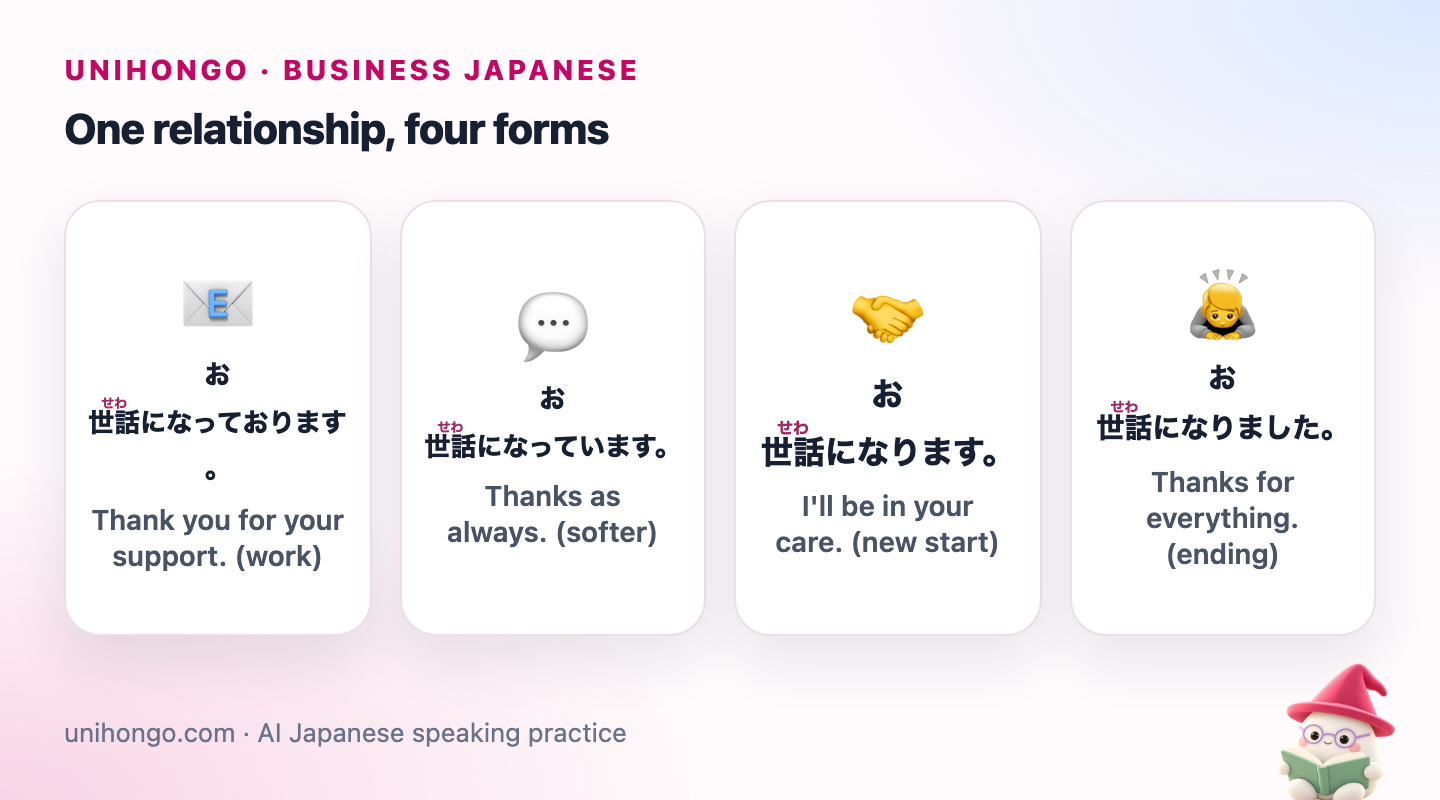
The verb phrase osewa ni naru, to be in someone's care, changes shape with time and politeness. The four forms below are the ones you need. The humble ongoing form is the business opener. The plain polite ongoing form is a little softer and is common in spoken Japanese with people you know. The future form is said at the start of a relationship, and the past form at the end of one.
| Japanese | Romaji | Meaning |
|---|---|---|
| お世話になっております。 | Osewa ni natte orimasu. | Thank you for your support. (work) |
| お世話になっています。 | Osewa ni natte imasu. | Thanks as always. (softer) |
| お世話になります。 | Osewa ni narimasu. | I'll be in your care. (new start) |
| お世話になりました。 | Osewa ni narimashita. | Thanks for everything. (ending) |
What the words really say
世話 (sewa) means care or looking after, the same word as in 犬の世話, taking care of a dog. The polite prefix o makes it osewa. Ni naru here means to receive or be on the receiving end, so osewa ni naru is to be looked after by someone. Orimasu is the humble form of imasu, and with the te form it marks an ongoing state that lowers the speaker politely.
Put together, it is a modest statement of fact: I am in a state of receiving your care. Nobody thinks about the literal meaning in daily use, but it explains why the line suits clients so well. It frames the writer as the one receiving help, which is the humble position in Japanese business.
| Japanese | Romaji | Meaning |
|---|---|---|
| 世話 | sewa | care, looking after |
| 犬の世話をする | inu no sewa o suru | to look after a dog |
| お世話になる | osewa ni naru | to be in someone's care |
Who says it, and to whom
The line points outward. Use it with clients, suppliers, business partners, customers, a school or nursery that looks after your child, or a landlord's management company. It is said by everyone from a new hire to the company president, because it describes the relationship between organisations rather than personal favours.
Inside your company it is out of place. Colleagues and bosses open internal emails and chats with otsukaresama desu, and a first internal email to a new team might begin with a short self-introduction. Parents use a family version with teachers: itsumo musume ga osewa ni natte orimasu, thank you for looking after my daughter.
| Japanese | Romaji | Meaning |
|---|---|---|
| いつも娘がお世話になっております。 | Itsumo musume ga osewa ni natte orimasu. | Thank you for always looking after my daughter. |
| お疲れ様です。営業部のリーです。 | Otsukaresama desu. Eigyōbu no Rī desu. | Hello, this is Lee from Sales. (internal) |
| 初めてご連絡いたします。 | Hajimete gorenraku itashimasu. | I am contacting you for the first time. |
| Who you are writing to | Natural opener | Notes |
|---|---|---|
| A client or partner company | Itsumo osewa ni natte orimasu | The standard choice |
| Someone at a company you have never contacted | Hajimete go-renraku itashimasu | No relationship yet |
| Your boss or a colleague | Otsukaresama desu | Internal messages |
| Your child's teacher | Itsumo (child) ga osewa ni natte orimasu | Names the child who is looked after |
| A friend | Genki? or the usual casual hello | Business openers sound cold |
On the phone: the opening and the reply
On a business call, the caller gives their company and name, then says the line. The person who answers says it back, often with kochira koso, likewise, in front. Then the caller asks for the person they want. The exchange is so fixed that you can learn it as one block.
If the person who answers says the line first, which receptionists often do as soon as they hear a company name, you simply reply with kochira koso. Do not worry about who says it first; the important thing is that both sides say it.
| Japanese | Romaji | Meaning |
|---|---|---|
| 株式会社さくら物産のスミスと申します。 | Kabushiki gaisha Sakura Bussan no Sumisu to mōshimasu. | You: This is Smith from Sakura Bussan. |
| いつもお世話になっております。 | Itsumo osewa ni natte orimasu. | You: Thank you for your continued support. |
| こちらこそ、お世話になっております。 | Kochira koso, osewa ni natte orimasu. | Receptionist: Thank you too. (likewise) |
| 山田様はいらっしゃいますか。 | Yamada sama wa irasshaimasu ka. | You: Is Mr or Ms Yamada available? |
| 少々お待ちください。 | Shōshō omachi kudasai. | Receptionist: One moment, please. |
The past tense in December and at goodbyes
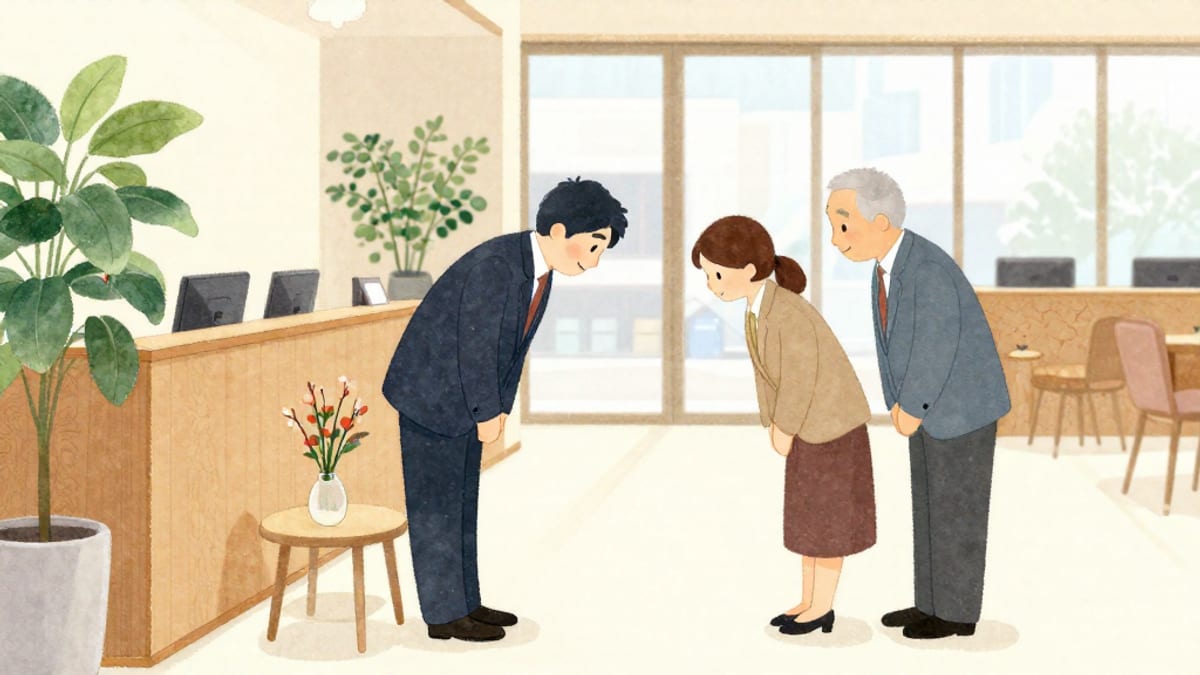
Osewa ni narimashita comes into its own at endings. In the last days of December, people say kotoshi mo osewa ni narimashita, thank you for everything this year, to clients and colleagues alike, because the past form now refers to the year that is closing. You also hear it when someone leaves a company, when a project ends, when a guest checks out of a ryokan where they were well looked after, and when a homestay comes to an end.
The future form osewa ni narimasu is its mirror image. A new employee says kyō kara osewa ni narimasu on the first day, and someone moving into a share house might say it to the other residents.
| Japanese | Romaji | Meaning |
|---|---|---|
| 今年も大変お世話になりました。 | Kotoshi mo taihen osewa ni narimashita. | Thank you so much for everything this year. |
| 今日からお世話になります。 | Kyō kara osewa ni narimasu. | Starting today, I'll be in your care. (first day) |
| 三年間、本当にお世話になりました。 | Sannenkan, hontō ni osewa ni narimashita. | Thank you for these three years. (leaving) |
| 二日間、お世話になりました。 | Futsukakan, osewa ni narimashita. | Thank you for these two days. (checking out) |
Stronger and lighter versions in emails
The basic line can be dialled up or down. Adding taihen, greatly, makes it warmer and is common when the relationship is important or you are about to ask for something. Heiso yori, always (literally from ordinary times), is a written, formal touch often seen in company announcements. At the other end, the plain polite osewa ni natte imasu is common in chats and quick emails with people you work with every week, and some people in fast-moving teams drop the opener entirely after the first message of the day.
Choose one level and keep it. A very formal opener followed by a casual body sounds odd, and so does a casual opener in a formal apology.
| Japanese | Romaji | Meaning |
|---|---|---|
| 大変お世話になっております。 | Taihen osewa ni natte orimasu. | Thank you very much for your support. (warmer) |
| 平素より大変お世話になっております。 | Heiso yori taihen osewa ni natte orimasu. | Thank you for your continued support. (formal, written) |
| いつもお世話になっています。 | Itsumo osewa ni natte imasu. | Thanks as always. (lighter, regular contacts) |
| 先日はお世話になりました。 | Senjitsu wa osewa ni narimashita. | Thank you for your help the other day. |
Mini dialogue: the first email exchange of the week
Here are the opening lines of a short email exchange between a supplier and a client. Notice that both sides use the opener, then the name, then go straight to the point. Japanese business emails are often more direct after this ritual than learners expect.
| Japanese | Romaji | Meaning |
|---|---|---|
| 山田様 | Yamada sama | Supplier: Dear Mr or Ms Yamada, |
| いつもお世話になっております。さくら物産の佐藤です。 | Itsumo osewa ni natte orimasu. Sakura Bussan no Satō desu. | Supplier: Thank you for your support. This is Sato from Sakura Bussan. |
| 見積書をお送りいたします。 | Mitsumorisho o ookuri itashimasu. | Supplier: I am sending you the quotation. |
| お世話になっております。山田です。 | Osewa ni natte orimasu. Yamada desu. | Client: Thank you for your email. This is Yamada. |
| 見積書、確かに受け取りました。 | Mitsumorisho, tashika ni uketorimashita. | Client: I have received the quotation. |
Common learner mistakes
- Opening an internal email to your manager with osewa ni natte orimasu. Use otsukaresama desu.
- Using it in a true cold email to a company you have no link with. Start with hajimete go-renraku itashimasu or totsuzen no go-renraku shitsurei itashimasu.
- Saying osewa ni narimashita at the start of an ongoing relationship. The past form signals an ending, which can sound like goodbye forever.
- Repeating the opener in every reply of a fast email thread. After the first exchange of the day, many people drop it or shorten it.
- Writing it to friends. It sounds like a company newsletter. A casual hello is warmer.
Drill the opener with Mocchi and AI Sensei
Ask Mocchi something like: Give me six business situations and let me choose between osewa ni natte orimasu, osewa ni narimashita, otsukaresama desu and hajimete go-renraku itashimasu. Mocchi explains each answer, keeps track of the situations you miss, and can add a short business-email step to your personal plan so the review comes back next week.
Because the phrase has to come out smoothly on the phone, finish with a spoken round. Pick Ibuki-sensei in AI Sensei and ask for a business call where the Sensei plays a client's receptionist; the session report will flag any place where your opener or your reply was off.