
The office day as a fixed script
Most beginner greeting lessons teach konnichiwa and sayōnara, and neither is used much inside a Japanese company. The office has its own set, and that set is closed. Colleagues are not choosing words creatively; they are marking transitions, the way a hospital ward marks a shift handover. That is good news for a learner. You do not have to improvise. You need roughly ten fixed lines and the reflex to produce the matching answer when one is aimed at you.
The second thing to notice is that these lines are addressed to the room as much as to a person. They are said while walking, while taking off a coat, while passing a desk, and nobody stops work to discuss them. A greeting that arrives late, too quietly, or only at the one colleague you like is far more noticeable than a slightly awkward one delivered on time to everyone in earshot. The separate keigo guide covers the polite verb forms behind these lines; here the point is the script itself.
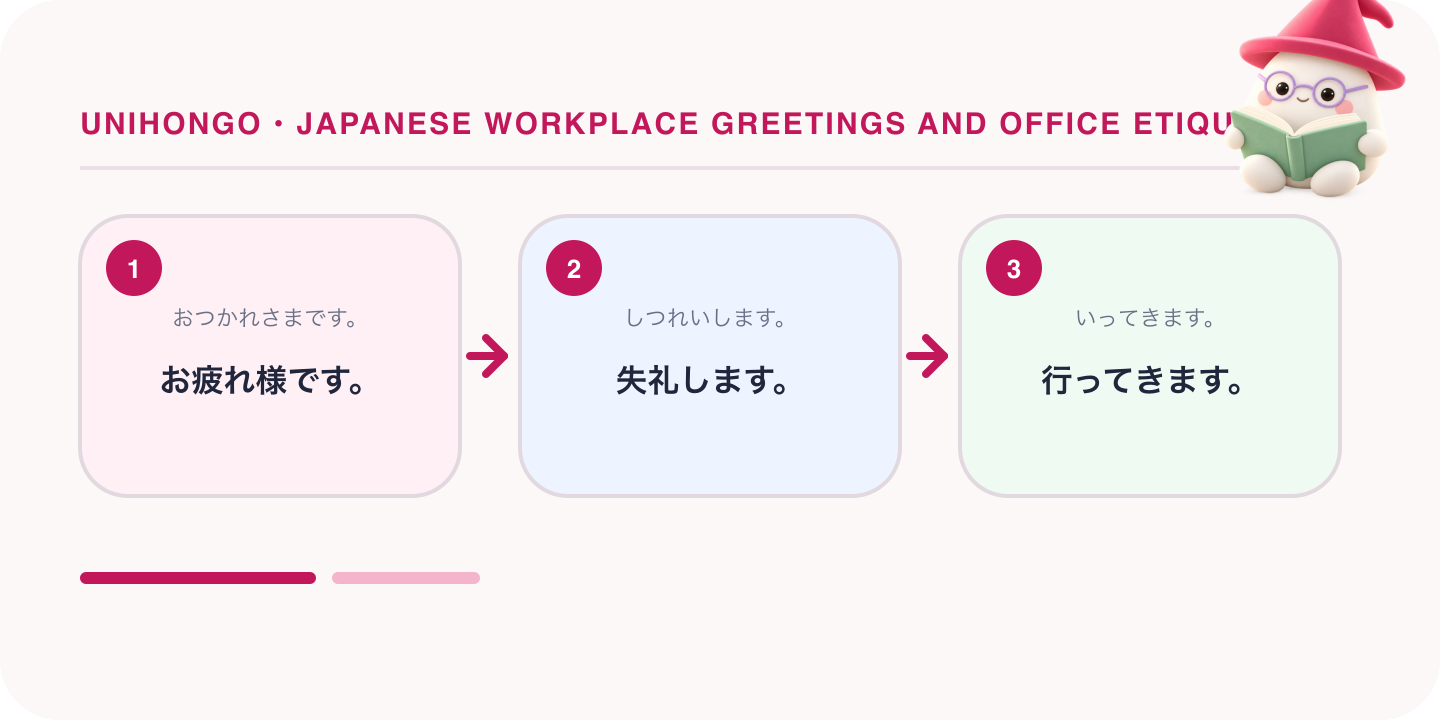
Every moment of the day and its phrase
| Moment | Japanese | Romaji | What it does |
|---|---|---|---|
| Arriving for your shift | おはようございます。 | Ohayō gozaimasu. | The arrival greeting at any hour |
| Passing a colleague | お疲れ様です。 | Otsukaresama desu. | Neutral acknowledgement in both directions |
| Entering an office or meeting room | 失礼します。 | Shitsurei shimasu. | Announces that you are crossing into their space |
| Stepping out to a client or to lunch | 行ってきます。 | Ittekimasu. | Tells the room you are leaving and returning |
| Seeing someone off | 行ってらっしゃい。 | Itterasshai. | The fixed reply to ittekimasu |
| Coming back to the office | ただいま戻りました。 | Tadaima modorimashita. | Reports your return to the room |
| Welcoming someone back | お帰りなさい。 | Okaerinasai. | The fixed reply to tadaima modorimashita |
| Finishing a meeting or a handover | お疲れ様でした。 | Otsukaresama deshita. | Marks a piece of work as finished |
| Leaving before your colleagues | お先に失礼します。 | Osaki ni shitsurei shimasu. | Apologises for going first |
| Seeing a colleague leave | お疲れ様でした。 | Otsukaresama deshita. | The reply to osaki ni shitsurei shimasu |
| Ending a call or a visit | 失礼いたします。 | Shitsurei itashimasu. | Closes the exchange formally |
Read the right-hand column rather than the translations. Each line is doing a job in the room, and the English equivalent is often misleading: ittekimasu is not really goodbye, and otsukaresama desu is not really thank you. Learn each one as the sound that belongs to a moment, and the day starts to run on rails.
Ohayō gozaimasu belongs to your shift, not the morning
Ohayō gozaimasu is the arrival greeting. In offices, kitchens, studios and broadcasting it is said at the start of whatever shift you are on, so someone clocking in at nine in the evening still says it. Dropping the gozaimasu is possible downward in a relaxed workplace, but ohayō alone to a manager sounds abrupt, and the full form costs half a second. If people are on calls when you walk in, greet the nearest colleagues at normal volume instead of announcing yourself to the floor.
| Japanese | Romaji | Meaning |
|---|---|---|
| おはようございます。 | Ohayō gozaimasu. | Good morning. (at the start of your shift, whatever the hour) |
| おはようございます。今日もよろしくお願いします。 | Ohayō gozaimasu. Kyō mo yoroshiku onegai shimasu. | Good morning. I look forward to working with you again today. |
| おはようございます、部長。 | Ohayō gozaimasu, buchō. | Good morning, sir. (addressing a department manager by title) |
| 失礼します。 | Shitsurei shimasu. | Excuse me. (said as you enter an office or meeting room) |
Otsukaresama desu, the word that does most of the work
Otsukaresama desu literally acknowledges that the other person is tired from their effort, but in practice it functions as a general-purpose office marker. It is hello in a corridor, thank you after a handover, the opening line of an internal phone call, and goodbye at the door. If you are unsure what to say to a colleague in a work context, this is almost always the correct line, and saying it slightly too often is invisible while saying nothing is not.
The tense carries real information. Otsukaresama desu covers work still in progress, so it fits the corridor at eleven in the morning. Otsukaresama deshita marks something completed: a meeting that has just ended, a delivery made, a colleague putting on a coat. Saying deshita to someone with six hours left can sound like you are sending them home, and saying desu to someone walking out of the building sounds like you did not notice they were leaving.
| Japanese | Romaji | Meaning |
|---|---|---|
| お疲れ様です。 | Otsukaresama desu. | Hello. / Thanks for your work. (in passing, mid-shift) |
| お疲れ様でした。 | Otsukaresama deshita. | Thank you for your work. (once something has finished) |
| 会議、お疲れ様でした。 | Kaigi, otsukaresama deshita. | Good work in that meeting. |
| お疲れ様です。営業部の田中です。 | Otsukaresama desu. Eigyōbu no Tanaka desu. | Hello, this is Tanaka from the sales department. (internal call) |
| お疲れ様です。今、お時間よろしいでしょうか。 | Otsukaresama desu. Ima, ojikan yoroshii deshō ka. | Excuse me. Do you have a moment now? |
Why otsukaresama and gokurōsama are not interchangeable
Gokurōsama desu has the same surface meaning, thank you for your trouble, but it travels downward. It is what a manager says to staff, what a company says to a delivery driver, and what a homeowner says to a repair worker. Aimed upward it reads as praising your superior for their effort, which quietly puts you in the seat of the person handing out approval. Nothing about the sentence is impolite; the direction is the problem.
The safe rule for a learner is to avoid gokurōsama at work in either direction. Otsukaresama covers every case and is never rude upward, so there is nothing to gain by producing the other one. You will hear managers use it, and understanding it is enough. The same asymmetry governs acknowledgements: ryōkai desu is flat and slightly casual, while shōchi itashimashita and kashikomarimashita are what a senior or a client expects to hear.
| Japanese | Romaji | Meaning |
|---|---|---|
| ご苦労様です。 | Gokurōsama desu. | Thanks for your trouble. (said downward, so avoid it upward) |
| お疲れ様です。 | Otsukaresama desu. | Thanks for your work. (safe in every direction) |
| 承知いたしました。 | Shōchi itashimashita. | Understood. (to a manager or a client) |
| かしこまりました。 | Kashikomarimashita. | Certainly. (to a customer) |
| 了解です。 | Ryōkai desu. | Got it. (peers or downward only) |
Stepping out and coming back
Japanese offices announce movement. When you leave the building for a client visit, an errand or lunch, you tell the room, and the room answers you. Ittekimasu is the everyday form; itte mairimasu is its humble version, used when the person you are leaving behind is a manager or when clients are present. The reply, itterasshai, is fixed, and you are expected to give it when somebody else goes out, not only to receive it.
| Japanese | Romaji | Meaning |
|---|---|---|
| 行ってきます。 | Ittekimasu. | I am off, and I will be back. |
| 行ってまいります。 | Itte mairimasu. | I am heading out. (humble, to a manager or before clients) |
| 行ってらっしゃい。 | Itterasshai. | See you when you get back. (the fixed reply) |
| ただいま戻りました。 | Tadaima modorimashita. | I am back. |
| お帰りなさい。 | Okaerinasai. | Welcome back. (the fixed reply) |
| 少し席を外します。 | Sukoshi seki o hazushimasu. | I will be away from my desk for a moment. |
| 本日は直帰いたします。 | Honjitsu wa chokki itashimasu. | I will go straight home from the client today. |
Learners often produce ittekimasu confidently and then freeze when a colleague leaves, because the answer has to be instant and translates to nothing in English. Drill the pairs together rather than one side at a time. The same applies to tadaima modorimashita and okaerinasai: whoever is at a desk answers, and a returning colleague met with silence reads it as being ignored rather than as everyone being busy.
Leaving for the day
Going home before your colleagues carries a built-in apology, and osaki ni shitsurei shimasu is that apology: excuse me for going first. Use shitsurei itashimasu when a manager or a client is in the room. The people staying answer with otsukaresama deshita, often followed by oki o tsukete. In a busy period it is normal to check whether anything is outstanding before you say your line, and offering once is enough; hovering afterwards helps nobody.
| Japanese | Romaji | Meaning |
|---|---|---|
| 何かお手伝いできることはありますか? | Nanika otetsudai dekiru koto wa arimasu ka? | Is there anything I can help with? |
| お先に失礼します。 | Osaki ni shitsurei shimasu. | Excuse me for leaving before you. |
| お先に失礼いたします。 | Osaki ni shitsurei itashimasu. | Excuse me for leaving first. (more formal) |
| お疲れ様でした。 | Otsukaresama deshita. | Thank you for your work today. (the reply from those staying) |
| お気をつけて。 | Oki o tsukete. | Take care on the way home. |
| 本日はありがとうございました。 | Honjitsu wa arigatō gozaimashita. | Thank you for today. |
Arriving late, taking leave and coming back
Lateness and absence follow a pattern: a message or call before your shift starts, a short apology on arrival, and a brief thank-you the next working day. Notice that you apologise for the disruption rather than explaining at length; one clause of reason is plenty. Leave is talked about with yasumi o itadaku, receiving a day off, because the time was granted to you, and saying yasumimasu flatly to a manager can sound like an announcement rather than a request.
| Japanese | Romaji | Meaning |
|---|---|---|
| 電車が遅れておりまして、十五分ほど遅れます。 | Densha ga okurete orimashite, jūgo-fun hodo okuremasu. | The train is delayed, so I will be about fifteen minutes late. |
| 遅くなりまして申し訳ありません。 | Osoku narimashite mōshiwake arimasen. | I am sorry for being late. |
| ご迷惑をおかけしました。 | Gomeiwaku o okake shimashita. | I am sorry for the trouble I caused. |
| 体調が悪いので、本日はお休みさせていただきます。 | Taichō ga warui node, honjitsu wa oyasumi sasete itadakimasu. | I am unwell, so I would like to take today off. |
| 本日はお休みをいただきます。 | Honjitsu wa oyasumi o itadakimasu. | I will be taking the day off today. |
| 昨日はお休みをいただき、ありがとうございました。 | Kinō wa oyasumi o itadaki, arigatō gozaimashita. | Thank you for the day off yesterday. |
The line after leave matters more than learners expect. Your absence was covered by somebody, so the first thing you say on returning is the thank-you, before you open your inbox. If a specific colleague carried your work, add their name and the task: Tanaka-san, taiō shite itadaki arigatō gozaimashita, thank you for handling it for me.
Greeting order, volume and timing
- Greet first if you are the one arriving, entering, or junior. Waiting to be greeted is read as reluctance, not modesty.
- Use normal speaking volume aimed at the nearest people, and keep moving. A shout across an open-plan floor is as awkward as silence.
- Add a shallow nod and a moment of eye contact. Deep bows belong to clients and real apologies, not the corridor.
- Return every greeting you receive, even mid-task. A nod plus otsukaresama desu costs one second.
- Address managers by title and colleagues by surname plus san. First names are unusual at work unless invited.
- Match the room over time: if your floor shortens to a quick otsukare between peers, following the local habit is better than staying formal on principle.
Food, cleaning and shared spaces
The courtesies around lunch, tea and shared equipment are where colleagues quietly decide whether you are easy to work beside, and most of them are one line long. Itadakimasu and gochisōsama deshita are said over your own lunch, even alone at your desk, and gochisōsama deshita is also what you say to whoever paid. Omiyage, a small box of individually wrapped sweets brought back from a trip or a period of leave, is left in the shared area with a short line.
| Japanese | Romaji | Meaning |
|---|---|---|
| いただきます。 | Itadakimasu. | Said before eating. |
| ごちそうさまでした。 | Gochisōsama deshita. | Said after eating, and to whoever paid. |
| ご一緒してもよろしいですか? | Goissho shite mo yoroshii desu ka? | May I join you? (at lunch) |
| お土産です。よろしければどうぞ。 | Omiyage desu. Yoroshikereba dōzo. | I brought back a souvenir. Please help yourself. |
| お先にどうぞ。 | Osaki ni dōzo. | After you. (at a lift, a printer or a doorway) |
| コピー機、お使いになりますか? | Kopīki, otsukai ni narimasu ka? | Would you like to use the copier? |
| お茶をお持ちしましょうか。 | Ocha o omochi shimashō ka. | Shall I bring you some tea? |
| 給湯室、片付けておきました。 | Kyūtōshitsu, katazukete okimashita. | I have tidied the kitchen area. |
Two habits count for more than any phrase. Leave shared space cleaner than you found it, including the sink and the microwave, so that nobody has to discover your mess. And take the visible small job without being asked: refilling the paper, carrying the boxes, wiping the meeting table. In a Japanese office this is read as a statement about your attitude to the team, and it earns more goodwill than fluent grammar does.
How to make the script automatic
- Write your real day down the left of a page and the exact line beside each moment. Ten rows is the whole script.
- Drill in pairs, never singly: ittekimasu with itterasshai, tadaima modorimashita with okaerinasai, osaki ni shitsurei shimasu with otsukaresama deshita.
- Say each line while performing the action, standing up, lifting a bag, opening a door, so the movement becomes the cue.
- Spend one week on tense alone: decide desu or deshita for otsukaresama before you open your mouth.
- Record your own departure line and check that it sounds unhurried rather than mumbled into your collar.