

Go-meiwaku o okake shimashita: the core apology
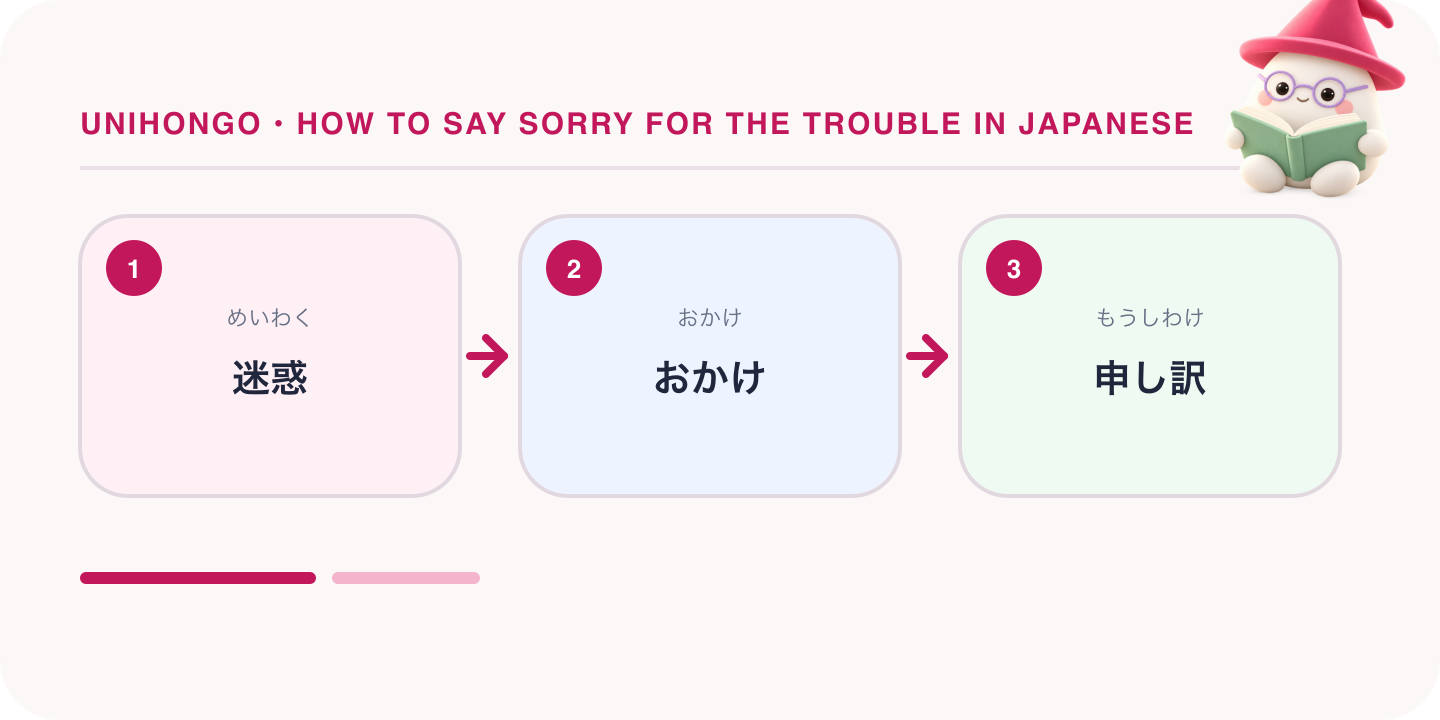
迷惑 (meiwaku) means trouble, nuisance or inconvenience. The phrase 迷惑をかける (meiwaku o kakeru) means to cause someone trouble, literally to hang trouble on them. In polite speech it becomes ご迷惑をおかけしました (go-meiwaku o okake shimashita), with the honorific go and the humble o-...suru form showing respect to the person affected.
On its own, go-meiwaku o okake shimashita states what happened. To make it a full apology, add mōshiwake arimasen deshita, I'm truly sorry, or sumimasen deshita. The combined line, go-meiwaku o okake shite mōshiwake arimasen deshita, is one of the most common apologies in Japanese working life.
Before the trouble happens, the same phrase works in the future: go-meiwaku o okake shimasu ga, I'm sorry for the inconvenience, but. You will see it on signs for roadworks and building repairs.
| Japanese | Romaji | Meaning |
|---|---|---|
| ご迷惑をおかけしました。 | Go-meiwaku o okake shimashita. | I'm sorry for the trouble I caused. |
| ご迷惑をおかけして、申し訳ありませんでした。 | Go-meiwaku o okake shite, mōshiwake arimasen deshita. | I'm truly sorry for the trouble. |
| ご迷惑をおかけしますが、よろしくお願いします。 | Go-meiwaku o okake shimasu ga, yoroshiku onegai shimasu. | Sorry for the inconvenience, and thank you for your understanding. |
| 工事中はご迷惑をおかけします。 | Kōji-chū wa go-meiwaku o okake shimasu. | We apologise for the inconvenience during construction. |
| この度はご迷惑をおかけし、誠に申し訳ございません。 | Kono tabi wa go-meiwaku o okake shi, makoto ni mōshiwake gozaimasen. | We sincerely apologise for the trouble we have caused. (very formal) |
Casual: gomen, meiwaku kakete
With friends and family, drop the honorifics: gomen, meiwaku kakete, sorry for the trouble. Men sometimes say warui, meiwaku kakete, which is brisker. If a friend helped you move house or waited for you in the rain, this is the natural line.
Often, Japanese speakers pair a casual apology with thanks: gomen ne, arigatō, sorry, and thank you. Thanking the person for their effort can matter as much as apologising for the trouble.
| Japanese | Romaji | Meaning |
|---|---|---|
| ごめん、迷惑かけて。 | Gomen, meiwaku kakete. | Sorry for the trouble. (casual) |
| 迷惑かけちゃってごめんね。 | Meiwaku kakechatte gomen ne. | Sorry I caused you trouble. |
| 悪い、迷惑かけた。 | Warui, meiwaku kaketa. | My bad, I caused you trouble. (casual, often male) |
| 手伝ってくれてありがとう。助かった。 | Tetsudatte kurete arigatō. Tasukatta. | Thanks for helping. You saved me. |
| いつもごめんね。 | Itsumo gomen ne. | Sorry, as always. |
O-tesū o okake shimasu: sorry for the bother
手数 (tesū) is effort, the number of hands a task takes. お手数をおかけします (o-tesū o okake shimasu) means sorry to put you to the trouble, and it is used when you ask someone to do something for you: fill in a form, resend a file, check some details. It is extremely common in business emails.
The difference from meiwaku is important. Meiwaku implies you caused a problem. Tesū only implies you are asking for effort. If you ask a colleague to review your document, say o-tesū o okake shimasu ga, kakunin o onegai dekimasu ka; go-meiwaku would suggest you had done something wrong.
Similar phrases include o-te o wazurawasete sumimasen, sorry to bother you with this, and o-isogashii tokoro sumimasen, sorry to bother you when you are busy.
| Japanese | Romaji | Meaning |
|---|---|---|
| お手数をおかけします。 | O-tesū o okake shimasu. | Sorry to put you to the trouble. |
| お手数ですが、ご確認をお願いします。 | O-tesū desu ga, go-kakunin o onegai shimasu. | Sorry to trouble you, but please check this. |
| お手数をおかけしますが、再送していただけますか。 | O-tesū o okake shimasu ga, saisō shite itadakemasu ka. | Sorry for the bother, but could you resend it? |
| お忙しいところすみません。 | O-isogashii tokoro sumimasen. | Sorry to bother you when you're busy. |
| お手数をおかけしました。 | O-tesū o okake shimashita. | Thank you for taking the trouble. |
O-sewa ni narimasu: thanks for your help
お世話になります (o-sewa ni narimasu) and お世話になっております (o-sewa ni natte orimasu) mean I am in your care or thank you for your continued support. They are not apologies, but they sit in the same family: they acknowledge that someone has done something for you.
At work, o-sewa ni natte orimasu is the standard opening for emails and phone calls with other companies. When someone has helped you over a long period, such as a teacher, a landlord or a colleague who is leaving, o-sewa ni narimashita, thank you for everything, is the natural phrase. It is also what you say to neighbours when you move out.
| Japanese | Romaji | Meaning |
|---|---|---|
| お世話になっております。 | O-sewa ni natte orimasu. | Thank you for your continued support. (business) |
| 大変お世話になりました。 | Taihen o-sewa ni narimashita. | Thank you so much for everything. |
| これからお世話になります。 | Kore kara o-sewa ni narimasu. | I'll be in your care from now on. |
| いつもお世話になっています。 | Itsumo o-sewa ni natte imasu. | Thank you for always helping me. |
Sumimasen for small everyday inconveniences
For small trouble, such as squeezing past someone on a train, asking a stranger to take a photo or dropping something near their feet, a simple すみません (sumimasen) is enough. It covers excuse me, sorry and thank you at the same time.
Use the larger phrases only when the trouble is real. Saying go-meiwaku o okake shimashita to someone you brushed past in a shop would sound strangely heavy.
| Japanese | Romaji | Meaning |
|---|---|---|
| すみません、通ります。 | Sumimasen, tōrimasu. | Excuse me, coming through. |
| すみません、ありがとうございます。 | Sumimasen, arigatō gozaimasu. | Sorry, and thank you. |
| どうもすみません。 | Dōmo sumimasen. | Sorry about that. |
| お騒がせしました。 | O-sawagase shimashita. | Sorry for the fuss. |
With neighbours: noise, rubbish and moving
Neighbour relations in Japan often run on small courtesies. When you move in, it is common to introduce yourself with a small gift and kore kara o-sewa ni narimasu, especially in houses and smaller buildings; in large apartment blocks, practice varies. Before building work or a party, a short warning is appreciated.
If you cause a problem, such as noise, rubbish put out on the wrong day or a bicycle blocking the path, apologise in person, briefly and specifically, and say what you will do next. Excuses matter less than the promise to be careful: kongo ki o tsukemasu.
| Japanese | Romaji | Meaning |
|---|---|---|
| 昨夜はうるさくて、ご迷惑をおかけしました。 | Sakuya wa urusakute, go-meiwaku o okake shimashita. | I'm sorry for the noise last night. |
| ごみの日を間違えてしまって、すみませんでした。 | Gomi no hi o machigaete shimatte, sumimasen deshita. | Sorry, I put the rubbish out on the wrong day. |
| 今後気をつけます。 | Kongo ki o tsukemasu. | I'll be careful from now on. |
| 来週工事があるので、ご迷惑をおかけします。 | Raishū kōji ga aru no de, go-meiwaku o okake shimasu. | There's building work next week, so sorry in advance. |
| 隣に越してきました。よろしくお願いします。 | Tonari ni koshite kimashita. Yoroshiku onegai shimasu. | I've just moved in next door. Nice to meet you. |
What people say back
Replies are usually reassuring and short. Among friends, ii yo, ki ni shinaide, it's fine, don't worry, is the standard. In polite speech, iie, daijōbu desu yo, or the more formal iie, o-ki ni nasaranaide kudasai, please don't let it worry you.
In business, the reply to o-tesū o okake shimasu is often kashikomarimashita, understood, followed by doing the task. Colleagues might say tondemonai desu, not at all, when you thank them for their trouble.
| Japanese | Romaji | Meaning |
|---|---|---|
| いいよ、気にしないで。 | Ii yo, ki ni shinaide. | It's fine, don't worry about it. |
| いいえ、大丈夫ですよ。 | Iie, daijōbu desu yo. | No, it's fine. |
| どうぞお気になさらないでください。 | Dōzo o-ki ni nasaranaide kudasai. | Please don't worry about it. (formal) |
| とんでもないです。 | Tondemonai desu. | Not at all. |
| かしこまりました。 | Kashikomarimashita. | Certainly. (business) |
| お互い様ですよ。 | O-tagai-sama desu yo. | We all need help sometimes. |
Common learner mistakes
These are the mistakes that make trouble apologies sound off.
- Saying meiwaku desu when you mean sorry for the trouble. Meiwaku desu means you are a nuisance, which is a complaint.
- Using go-meiwaku when you just ask for help. Use o-tesū o okake shimasu; meiwaku implies you did something wrong.
- Dropping the verb: go-meiwaku, sumimasen. Say the full okake shimashita.
- Using the formal apology for tiny things. For a small bump or favour, sumimasen is enough.
- Treating o-sewa ni natte orimasu as an apology. It is a greeting and a thank you.
- Apologising with excuses first. Apologise, then explain briefly, then say what you will do.
When in doubt, go-meiwaku o okake shite sumimasen deshita, followed by thanks, will fit most real situations.