
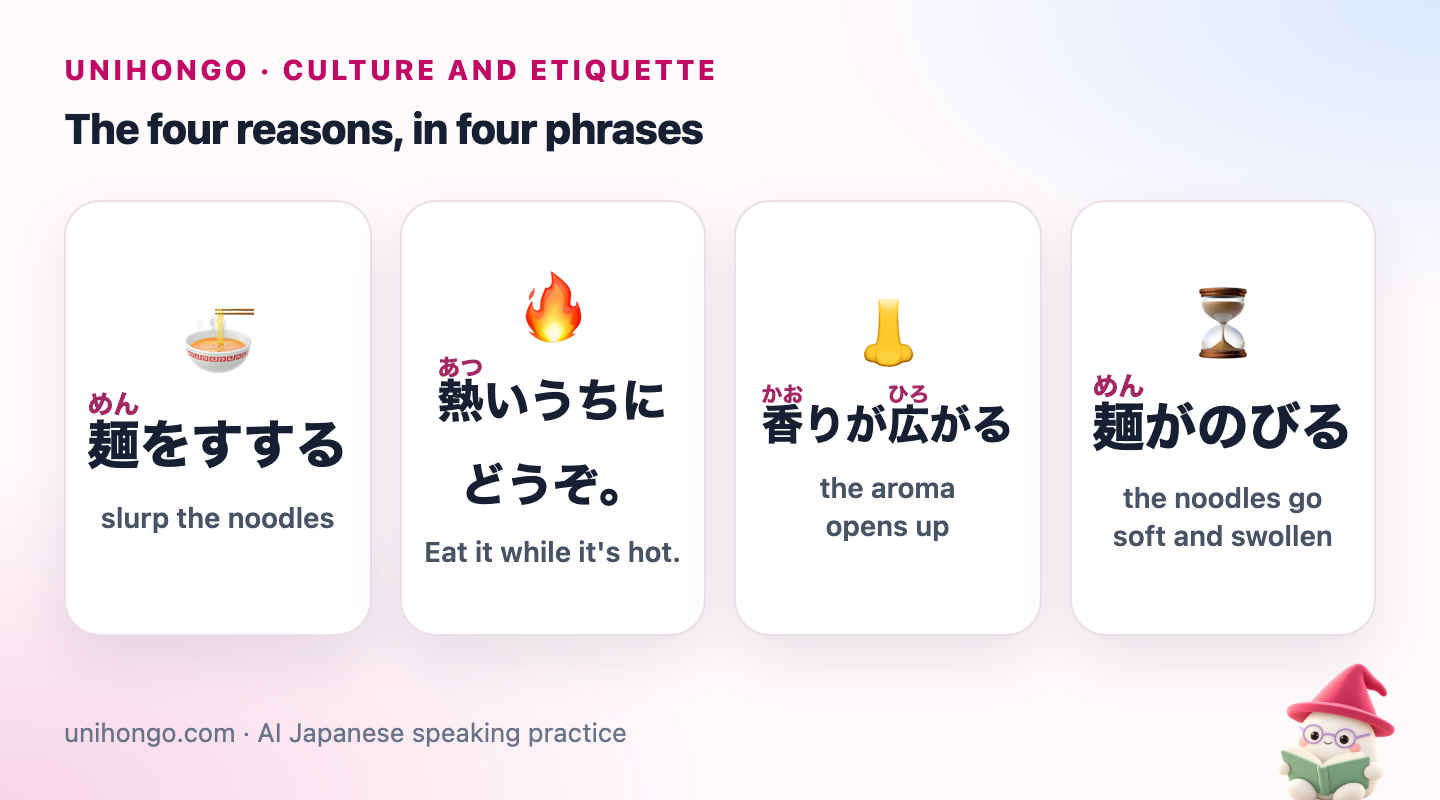
The four reasons, in four phrases
Ask a ramen fan why they slurp and you will hear a mix of practical and sensory reasons. These four lines sum them up: slurping is how noodles are eaten, it helps you eat them while they are hot, it opens up the aroma, and it beats the clock before the noodles go soft.
| Japanese | Romaji | Meaning |
|---|---|---|
| 麺をすする | men o susuru | slurp the noodles |
| 熱いうちにどうぞ。 | Atsui uchi ni dōzo. | Eat it while it's hot. |
| 香りが広がる | kaori ga hirogaru | the aroma opens up |
| 麺がのびる | men ga nobiru | the noodles go soft and swollen |
Nobiru literally means to stretch. Said of noodles, it means they have soaked up too much soup and gone soft, which noodle fans see as a small tragedy. Atsui uchi ni, while it is hot, is something a host or chef says when serving, and it is a gentle hint to start eating now.
Why slurping works
Ramen is served very hot, and noodles straight from the soup can burn your mouth. Slurping draws cool air in with them, so you can eat at the right temperature without blowing on each mouthful. The same air carries the smell of the broth, garlic, sesame or spring onions up to your nose, and much of what we call flavour is actually smell.
Time matters too. Noodles keep cooking in hot soup, and the ideal texture lasts only a few minutes. Eating with a steady slurp means you finish the bowl while the noodles still have their bite. With cold zaru soba, dipped in sauce, slurping pulls the sauce up along the noodles, so each mouthful is evenly flavoured.
Some people also say slurping shows the cook that you are enjoying the food. That is a nice idea and some chefs certainly like hearing it, but most Japanese people slurp simply because that is how they learned to eat noodles as children.
| Japanese | Romaji | Meaning |
|---|---|---|
| ずるずる | zuruzuru | the sound of loud slurping |
| つるつるの麺 | tsurutsuru no men | smooth, slippery noodles |
| もちもちしていますね。 | Mochimochi shite imasu ne. | They're nice and chewy, aren't they? |
| スープがよく絡みます。 | Sūpu ga yoku karamimasu. | The soup clings to the noodles well. |
Which foods to slurp, and which not to
Slurping is for noodles. Other foods have their own quiet manners, and the contrast is what matters to a visitor.
| Japanese | Romaji | Meaning |
|---|---|---|
| パスタはすすらない人が多いです。 | Pasuta wa susuranai hito ga ōi desu. | Many people don't slurp pasta. |
| お味噌汁は静かに飲みます。 | Omisoshiru wa shizuka ni nomimasu. | You drink miso soup quietly. |
| スープまで全部飲みました。 | Sūpu made zenbu nomimashita. | I drank every drop of the soup. |
| Food | Slurp? | Notes |
|---|---|---|
| Ramen | Yes, normal | Use the spoon for soup; sipping from the bowl is fine |
| Soba and udon, hot or cold | Yes, normal | With small bowls, people often lift the bowl to drink the broth |
| Sōmen and cold noodles | Yes, normal | Dip a small amount in the sauce at a time |
| Pasta | Usually not | Many people eat it quietly, especially in Western-style restaurants |
| Miso soup | No loud slurping | Drink quietly from the lifted bowl |
| Rice | No | Hold the bowl and eat with chopsticks |
In the mid-2010s, a jokey online word, nūhara (noodle harassment), appeared to describe people bothered by slurping. It shows that a few people find the sound unpleasant, but it never changed how noodles are eaten in Japan. At a noodle shop, slurping is still the default.
How to slurp without splashing
If slurping simply feels wrong to you, put a few noodles on the spoon, let them cool for a moment and eat them quietly. Nobody in the shop will mind. What does look odd is cutting noodles with a knife or twirling ramen on the spoon like spaghetti for a long time while it goes soft.
- Lift a modest amount of noodles with your chopsticks, about a mouthful, not a whole tangle.
- Bring your head a little closer to the bowl so the noodles do not swing.
- Put the ends of the noodles in your mouth and draw them in with a short breath, guiding them with the chopsticks.
- Keep the ramen spoon, the renge, under the noodles if you are worried about drips.
- Biting the noodles off is fine; try not to let half the mouthful fall back into the soup.
- Practise at home with cooler noodles first. The sound will come naturally; you do not need to make it loud.
Ordering at a ramen or soba shop
Many ramen shops use a ticket machine, a shokkenki, at the entrance: you buy a ticket, hand it to the staff, and they may ask how you want your noodles. Hakata-style tonkotsu shops often offer kaedama, an extra serving of noodles added to your leftover soup. At soba shops, you may be brought sobayu at the end, the hot water the soba was boiled in, which you pour into your leftover dipping sauce and drink.
| Japanese | Romaji | Meaning |
|---|---|---|
| ラーメン一つ、硬めでお願いします。 | Rāmen hitotsu, katame de onegai shimasu. | One ramen, firm noodles, please. |
| 麺の硬さはどうしますか。 | Men no katasa wa dō shimasu ka. | Staff: How firm would you like your noodles? |
| 普通でお願いします。 | Futsū de onegai shimasu. | Regular, please. |
| 替え玉ください。 | Kaedama kudasai. | An extra serving of noodles, please. |
| ネギ多めにできますか。 | Negi ōme ni dekimasu ka. | Could I have extra spring onions? |
| そば湯をください。 | Sobayu o kudasai. | Could I have some soba water, please? |
Mini dialogue: first ramen with a friend
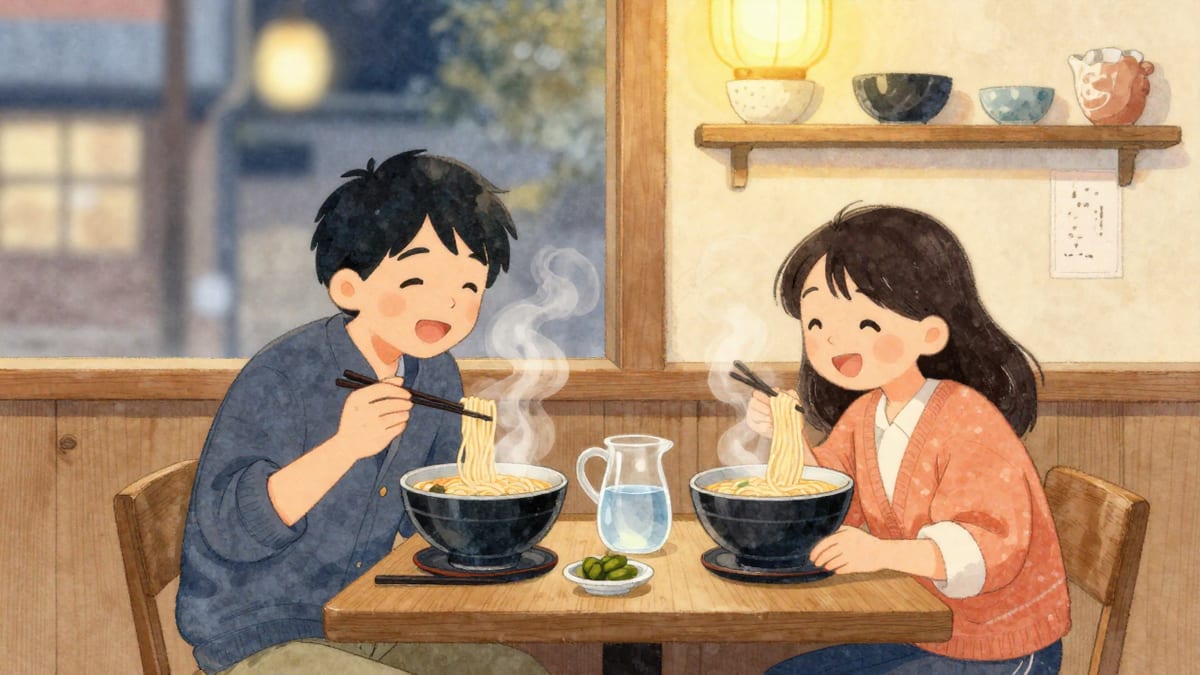
A Japanese friend takes you to their favourite shop. Here is how the conversation might go once the bowls arrive.
| Japanese | Romaji | Meaning |
|---|---|---|
| いただきます! | Itadakimasu! | Both: Let's eat! |
| 音を立てて食べてもいいの? | Oto o tatete tabete mo ii no? | You: Is it OK to make noise when I eat? |
| もちろん。ラーメンはすすって食べるものだよ。 | Mochiron. Rāmen wa susutte taberu mono da yo. | Friend: Of course. Ramen is meant to be slurped. |
| 熱っ!でも、おいしい! | Atsu! Demo, oishii! | You: Hot! But it's delicious! |
| のびる前に食べよう。 | Nobiru mae ni tabeyō. | Friend: Let's eat before the noodles go soft. |
| ごちそうさまでした。 | Gochisōsama deshita. | Both: Thank you for the meal. |
Mono da yo after a verb states how things are normally done: ramen is the kind of thing you slurp. It is casual and friendly; a teacher or older person might say mono desu yo.
Common learner mistakes
- Slurping everything. Rice, miso soup and most Western food are eaten quietly.
- Thinking you must slurp to be polite. It is normal, not a test of manners.
- Waiting a long time to start, chatting or taking photos while the noodles go soft. A quick photo is fine, then eat.
- Blowing your nose loudly at the counter. Many people find this unpleasant at the table; step away or dab quietly with a tissue.
- Saying oishii only. Try a texture word, tsurutsuru or mochimochi, or praise the soup: sūpu ga oishii desu.
A bowl of noodle words with Mocchi
Type /explain followed by a line from this post, such as rāmen wa susutte taberu mono da yo, and Mocchi breaks it into chunks, names the te-form and mono da pattern, and tells you how casual it sounds. Ask for a /quiz on noodle words afterwards; Mocchi remembers which ones you mixed up, such as katame and futsū, and brings them back in your next review.
For a quick, playful round, try Sushi Sort in the games section: you read a short Japanese order and send the right plate, which trains the same habit of reading food words fast.