

The four phrases and where each one lives
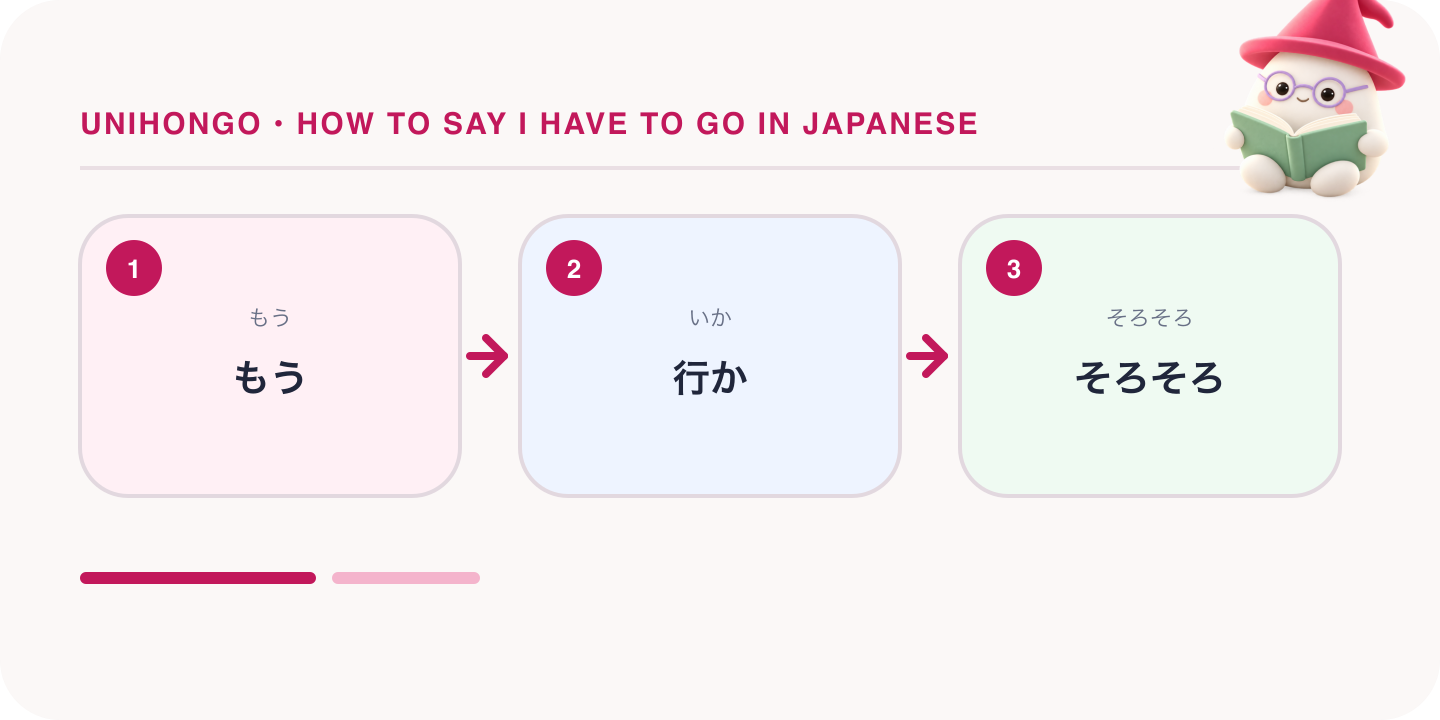
Japanese has a small family of phrases for I have to go, sorted by relationship. Mō ikanakya is what you say to a friend: a contraction of ikanakereba naranai, must go, with mō, now, in front. Sorosoro ikimasu is the neutral polite version, I will be going soon. Sorosoro shitsurei shimasu replaces the verb of going with shitsurei shimasu, excuse me, and is the one for hosts, teachers, seniors and anyone you address with masu. O-saki ni shitsurei shimasu is the office phrase, excuse me for going before you.
None of them is really a statement of obligation. English I have to go blames the clock; Japanese leave-taking apologises for breaking the shared time. That is why shitsurei shimasu, literally I am doing a rudeness, appears in the polite forms: leaving is your small rudeness and you are sorry for it.
| Japanese | Romaji | Meaning |
|---|---|---|
| もう行かなきゃ。 | Mō ikanakya. | I have to go now. |
| そろそろ行きます。 | Sorosoro ikimasu. | I'll be going soon. |
| そろそろ失礼します。 | Sorosoro shitsurei shimasu. | It's about time I took my leave. |
| お先に失礼します。 | O-saki ni shitsurei shimasu. | Excuse me for leaving before you. |
| もう行かないと。 | Mō ikanai to. | I've got to go. |
Sorosoro: the word that does the real work
Sorosoro means little by little, and in leave-taking it means the moment is approaching. It is the most important word in this topic, because it turns an announcement into a warning. Sorosoro ikimasu tells the listener you will leave in the next few minutes, which gives them time to fetch your coat or finish the story. Kaerimasu on its own sounds like you are already halfway out.
Because sorosoro is a signal rather than the exit itself, it often appears as a fragment. Sorosoro, with nothing after it and a glance at the clock, is a complete sentence between adults. Sorosoro desu ne, said by the host, means the same thing from the other side, a gentle release that lets the guest leave without guilt.
Mō sorosoro adds a touch of already, so mō sorosoro shitsurei shimasu is a shade firmer, useful when you have said it once and been kept another twenty minutes.
| Japanese | Romaji | Meaning |
|---|---|---|
| そろそろ…。 | Sorosoro... | Well, it's about that time... |
| そろそろですね。 | Sorosoro desu ne. | It's about that time, isn't it? |
| もうそろそろ失礼します。 | Mō sorosoro shitsurei shimasu. | I really should be going now. |
| そろそろお暇します。 | Sorosoro o-itoma shimasu. | I'll be taking my leave now. (formal, at someone's home) |
| そろそろ時間なので。 | Sorosoro jikan na node. | It's about time, so... |
Mō ikanakya and other ways to leave friends
With friends the vocabulary loosens and the reason moves to the front. Mō ikanakya is the everyday phrase, and ikanai to means the same; the dropped ending is what makes them casual. Young speakers also use ikanakucha, and in the Kansai region ikana akan. Attach the reason with kara, as in densha ga aru kara mō ikanakya, or simply state the time: yabai, mō jūji da.
A second casual pattern uses kaeru, go home: mō kaeru ne, or sorosoro kaerō ka na, thinking aloud about leaving. Kaeru is warmer than iku because it says where you are going. A third is to name the next thing: kono ato baito da kara, I have a shift after this. Friends do not expect an apology; they expect a reason and a promise to meet again, mata ne.
Avoid shitsurei shimasu with friends. It marks distance, and a friend who hears it will wonder whether they have offended you.
| Japanese | Romaji | Meaning |
|---|---|---|
| 電車があるから、もう行かなきゃ。 | Densha ga aru kara, mō ikanakya. | I've got a train, so I have to go. |
| やばい、もう十時だ。帰るね。 | Yabai, mō jūji da. Kaeru ne. | Oh no, it's already ten. I'm off home. |
| この後バイトだから、先に行くね。 | Kono ato baito da kara, saki ni iku ne. | I've got a shift after this, so I'll head off first. |
| そろそろ帰ろうかな。 | Sorosoro kaerō ka na. | I might head home soon. |
| 今日は楽しかった。また連絡するね。 | Kyō wa tanoshikatta. Mata renraku suru ne. | Today was fun. I'll message you. |
Ending a visit to someone's home
Leaving a Japanese home is a small ritual with three beats. The first is the signal: sorosoro shitsurei shimasu, or the more formal sorosoro o-itoma shimasu, said while still seated. The host will usually protest once, mō sukoshi ii ja nai desu ka, and you decline with a reason: ashita hayai node, I have an early start. The second beat is the thanks at the door: gochisōsama deshita if you ate, osoku made sumimasen deshita if it is late. The third is the farewell itself, shitsurei shimasu with a bow.
A reason that points at your own duties, an early start, a train, a child to collect, is a soft reason: it says nothing negative about the visit. A reason that points at the host, such as being tired of the conversation, is not. Keep it short and about you.
If you are the host and the guest says sorosoro, one protest is polite and two is pressure. Then walk them to the door and say ki o tsukete.
| Japanese | Romaji | Meaning |
|---|---|---|
| そろそろ失礼します。明日、朝が早いので。 | Sorosoro shitsurei shimasu. Ashita, asa ga hayai node. | I should be going. I have an early start tomorrow. |
| もう少しいいじゃないですか。 | Mō sukoshi ii ja nai desu ka. | Why not stay a little longer? |
| ありがとうございます。でも、終電がありますので。 | Arigatō gozaimasu. Demo, shūden ga arimasu node. | Thank you, but I need to catch the last train. |
| 今日はごちそうさまでした。 | Kyō wa gochisōsama deshita. | Thank you for the meal today. |
| 遅くまですみませんでした。 | Osoku made sumimasen deshita. | Sorry for staying so late. |
| 気をつけて帰ってくださいね。 | Ki o tsukete kaette kudasai ne. | Get home safely. |
At work: o-saki ni shitsurei shimasu
Leaving the office in Japan has its own fixed phrase. O-saki ni shitsurei shimasu, excuse me for going before you, is what you say to colleagues who are still at their desks. It acknowledges that they are still working. The reply is otsukaresama deshita. You say it once to the room or to each nearby colleague, with a small bow, and leave; there is no need to explain at a normal hour.
When you leave early, or before your manager on a busy day, a check and a reason go in front: nani ka arimasu ka, is there anything you need, then byōin no yoyaku ga aru node, I have a hospital appointment. Seniors leaving before juniors say the same phrase, often shortened to o-saki ni.
Two things not to say. Sayōnara at the office sounds like you are not coming back. And kaerimasu on its own sounds as if you were talking to yourself; shitsurei shimasu is what makes the exit belong to the group.
| Japanese | Romaji | Meaning |
|---|---|---|
| お先に失礼します。 | O-saki ni shitsurei shimasu. | Excuse me, I'm heading off before you. |
| お疲れ様でした。 | Otsukaresama deshita. | Good work today. (the reply) |
| 何かありますか。なければ、お先に失礼します。 | Nani ka arimasu ka. Nakereba, o-saki ni shitsurei shimasu. | Is there anything you need? If not, I'll head off. |
| 今日は病院の予約があるので、お先に失礼します。 | Kyō wa byōin no yoyaku ga aru node, o-saki ni shitsurei shimasu. | I have a hospital appointment today, so I'll leave before you. |
| 明日もよろしくお願いします。 | Ashita mo yoroshiku onegai shimasu. | See you tomorrow. (literally, please treat me well tomorrow too) |
Leaving phrases by situation
The table below matches each common situation to the phrase that fits, with a note on tone.
| Situation | Reading | Phrase and tone |
|---|---|---|
| 友達とカフェで | tomodachi to kafe de | Mō ikanakya, casual, add a reason with kara |
| 友達の家で | tomodachi no ie de | Sorosoro kaeru ne, warm, then mata ne |
| 友達の親の家で | tomodachi no oya no ie de | Sorosoro shitsurei shimasu, polite, then thanks |
| 上司や先生の家で | jōshi ya sensei no ie de | Sorosoro o-itoma shimasu, formal |
| 会社を出るとき | kaisha o deru toki | O-saki ni shitsurei shimasu, to colleagues still there |
| 会議の途中で | kaigi no tochū de | Mōshiwake arimasen, chūza shimasu, formal apology |
| 友達との電話 | tomodachi to no denwa | Ja, sorosoro kiru ne, casual |
| 丁寧な電話 | teinei na denwa | Dewa, shitsurei itashimasu, formal close |
| 飲み会の途中で | nomikai no tochū de | Sumimasen, o-saki ni shitsurei shimasu, polite |
| チャットやLINE | chatto ya rain | Sorosoro neru ne or mata ne, casual |
Ending calls and chats
On the phone the verb is often kiru, hang up, rather than iku. To a friend, ja, sorosoro kiru ne, then mata ne. To someone you address politely, sorosoro shitsurei shimasu, or dewa, shitsurei itashimasu at the formal end, followed by a thank you for their time. Custom holds that the caller ends the call and lets the other person hang up first, so pause a moment after your last phrase.
In messaging apps, leaving is lighter. Sorosoro neru ne, I am going to sleep now, ends an evening chat, and mata ne closes it. If you must stop mid-conversation, gomen, chotto yōji, then ato de mata, is enough. With a teacher or a client, sorosoro shitsurei shimasu still fits, and a sticker does not.
In every channel, the soft reason is what stops the exit sounding cold. Node and kara attach it to the leaving phrase; n desu adds explanation without excuse. Densha no jikan na n desu is friendlier than a bare shitsurei shimasu.
| Japanese | Romaji | Meaning |
|---|---|---|
| じゃ、そろそろ切るね。またね。 | Ja, sorosoro kiru ne. Mata ne. | Well, I'll hang up now. See you. |
| では、失礼いたします。 | Dewa, shitsurei itashimasu. | Well then, I'll say goodbye. (formal phone close) |
| そろそろ寝るね。おやすみ。 | Sorosoro neru ne. Oyasumi. | I'm going to sleep now. Night. |
| ごめん、ちょっと用事。あとでまた。 | Gomen, chotto yōji. Ato de mata. | Sorry, something's come up. Talk later. |
| 電車の時間なんです。 | Densha no jikan na n desu. | It's time for my train. |
Mistakes that make leaving feel abrupt
The first mistake is skipping the signal. Standing up and saying shitsurei shimasu with no sorosoro before it feels like a door slamming, however polite the words. The second is over-explaining: one short reason is enough, three sound like a cover story. The third is the wrong level: shitsurei shimasu to a close friend creates distance, and ikanakya to a manager sounds like a teenager.
There is also a timing mistake: announcing sorosoro and then staying another half hour. Once you have said it, be at the door within a few minutes. If you truly want to stay, do not say it yet.
- Say sorosoro first, then the leaving phrase, then thanks
- Give one reason about yourself, never about the host or the food
- Match the level: ikanakya for friends, shitsurei shimasu for everyone else
- Answer o-saki ni shitsurei shimasu with otsukaresama deshita
- Drop sayōnara unless you will not meet again for a long time
If you get it wrong, a quick shitsurei shimashita at the door, or a thank-you message the next day, repairs it completely.