

Omatase shimashita: the core phrase
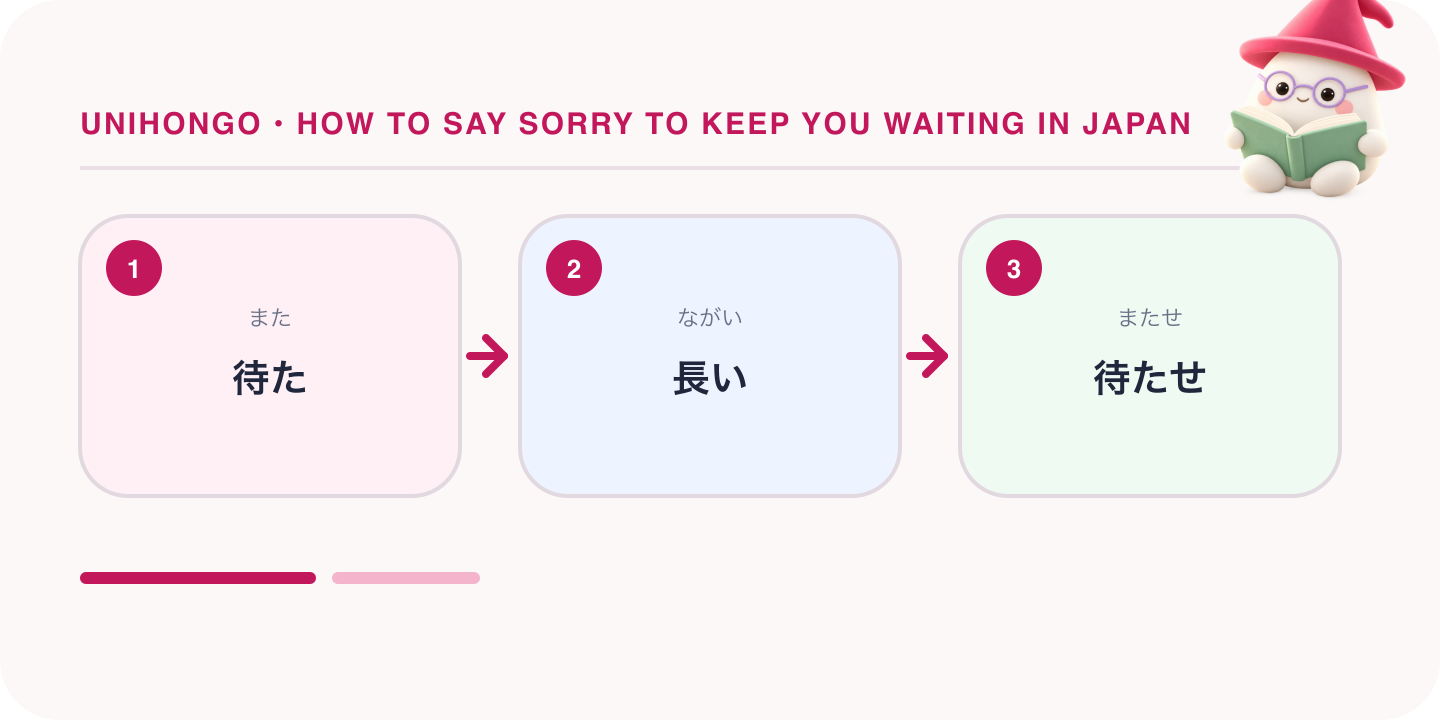
The verb 待つ (matsu) means to wait. Its causative form, 待たせる (mataseru), means to make someone wait. Put the honorific o in front and the humble shimasu after it and you get お待たせしました (omatase shimashita): I have made you wait.
Unlike English, the phrase does not contain the word sorry. It is an acknowledgement of the other person's time, and that acknowledgement is what makes it polite. English speakers sometimes add sumimasen in front, and that is natural too: sumimasen, omatase shimashita.
You use it the moment the wait ends: when you arrive at a meeting spot, return to the phone after putting someone on hold, come back from the kitchen, or finally have the document someone asked for.
| Japanese | Romaji | Meaning |
|---|---|---|
| お待たせしました。 | Omatase shimashita. | Sorry to keep you waiting. |
| すみません、お待たせしました。 | Sumimasen, omatase shimashita. | Sorry, I kept you waiting. |
| 長い間お待たせしました。 | Nagai aida omatase shimashita. | Sorry to have kept you waiting so long. |
| お待たせしてすみません。 | Omatase shite sumimasen. | I'm sorry to make you wait. |
Casual: omatase and gomen, omatase
With friends and family, the phrase shrinks to お待たせ (omatase), often with a quick ごめん (gomen) in front. You might say it as you jog up to a friend at the ticket gate, or as you come back from the toilet at a café.
Young people also say omatase with a long final vowel, omatasē, or add ne. If you are genuinely late, not just a minute behind, gomen, okurete, sorry I'm late, is a more fitting apology, and you can combine the two.
| Japanese | Romaji | Meaning |
|---|---|---|
| お待たせ! | Omatase! | Sorry to keep you waiting! (casual) |
| ごめん、お待たせ。 | Gomen, omatase. | Sorry, kept you waiting. |
| ごめん、遅れて。 | Gomen, okurete. | Sorry I'm late. |
| 待った? | Matta? | Did you wait long? |
| 電車が遅れちゃって。 | Densha ga okurechatte. | The train was delayed. |
| あと5分で着く! | Ato go-fun de tsuku! | I'll be there in five minutes! |
Formal: taihen omatase itashimashita
In business and customer service, the phrase becomes more humble. 大変 (taihen) means greatly, and いたしました (itashimashita) is the humble form of shimashita. Taihen omatase itashimashita is what a call centre agent says when they come back on the line, and what a clerk says after a long wait at a counter.
Choose the level to match the length of the wait and the relationship. A short delay with a colleague needs only omatase shimashita. A client who waited in reception for ten minutes deserves taihen omatase itashimashita, often followed by a brief reason and thanks.
| Japanese | Romaji | Meaning |
|---|---|---|
| 大変お待たせいたしました。 | Taihen omatase itashimashita. | I'm very sorry to have kept you waiting. (formal) |
| お待たせいたしました。 | Omatase itashimashita. | Thank you for waiting. (humble) |
| お待たせして申し訳ございません。 | Omatase shite mōshiwake gozaimasen. | I sincerely apologise for the wait. |
| お忙しいところ、お待たせいたしました。 | O-isogashii tokoro, omatase itashimashita. | Sorry to keep you waiting when you are busy. |
| 前の会議が長引いてしまいまして。 | Mae no kaigi ga nagabiite shimaimashite. | My previous meeting ran over. |
Before the wait: o-machi kudasai
The natural partner of omatase is a request to wait. 少々お待ちください (shōshō o-machi kudasai), please wait a moment, is the phrase you will hear from shop staff, receptionists and people on the phone. In more humble business speech, it becomes shōshō o-machi itadakemasu deshō ka, could I ask you to wait a moment?
Casually, friends say chotto matte, wait a sec, or chotto matte te, wait there a moment. The full cycle in a shop or office usually goes: shōshō o-machi kudasai as the clerk leaves, then omatase itashimashita as they return.
| Japanese | Romaji | Meaning |
|---|---|---|
| 少々お待ちください。 | Shōshō o-machi kudasai. | Please wait a moment. |
| 少々お待ちいただけますか。 | Shōshō o-machi itadakemasu ka. | Could you wait a moment? |
| こちらでお待ちください。 | Kochira de o-machi kudasai. | Please wait here. |
| ちょっと待って。 | Chotto matte. | Wait a sec. (casual) |
| すぐ戻ります。 | Sugu modorimasu. | I'll be right back. |
| 確認いたしますので、少々お待ちください。 | Kakunin itashimasu no de, shōshō o-machi kudasai. | I'll check, so please wait a moment. |
In restaurants and shops
Restaurant staff use omatase shimashita constantly: when they seat you after a queue, when they bring drinks and when they set down each dish. Here it is closer to here you are than to a real apology, so do not worry that anything has gone wrong. Staff often add the name of the dish: omatase shimashita, ramen desu.
At a shop counter, staff often call the next customer with omatase itashimashita, tsugi no o-kyaku-sama dōzo, thank you for waiting, next customer please. As a customer you do not need to reply, though a nod or a quiet arigatō gozaimasu is friendly.
| Japanese | Romaji | Meaning |
|---|---|---|
| お待たせしました、ラーメンです。 | Omatase shimashita, rāmen desu. | Here's your ramen. |
| お待たせいたしました。次のお客様どうぞ。 | Omatase itashimashita. Tsugi no o-kyaku-sama dōzo. | Thank you for waiting. Next customer, please. |
| 何名様ですか。 | Nanmei-sama desu ka. | How many people? |
| ただいま満席ですので、少々お待ちください。 | Tadaima manseki desu no de, shōshō o-machi kudasai. | We're full right now, so please wait a moment. |
| あとどのくらい待ちますか。 | Ato dono kurai machimasu ka. | About how much longer is the wait? |
At work: meetings, emails and phone calls
At work, omatase shimashita covers late arrivals to meetings, delayed replies and slow deliverables. When you join a meeting late, say it as you sit down, with a small bow. If you were more than a minute or two late, add a clear apology and a short reason: densha ga okurete shimai, mōshiwake arimasen deshita, the train was delayed, I'm very sorry.
In emails, a delayed reply often opens with go-henshin ga osoku nari, mōshiwake gozaimasen, I apologise for my late reply. Omatase is less common at the start of emails, but you will see omatase itashimashita when someone finally sends something that was promised, such as a quote or a revised document.
| Japanese | Romaji | Meaning |
|---|---|---|
| お待たせしました。始めましょう。 | Omatase shimashita. Hajimemashō. | Sorry to keep you waiting. Let's begin. |
| 遅れて申し訳ありません。 | Okurete mōshiwake arimasen. | I'm very sorry for being late. |
| ご返信が遅くなり、申し訳ございません。 | Go-henshin ga osoku nari, mōshiwake gozaimasen. | I apologise for my late reply. |
| お待たせいたしました。資料をお送りします。 | Omatase itashimashita. Shiryō o o-okuri shimasu. | Thank you for waiting. I'm sending the materials. |
| 少し遅れそうです。 | Sukoshi okuresō desu. | I think I'll be a little late. |
What people say back
Replies to omatase are usually reassuring. Friends say daijōbu, it's fine, or ima kita tokoro, I've only just arrived, even if they have been waiting a while. Colleagues and acquaintances say iie, daijōbu desu yo, not at all, it's fine. In business, a guest might reply iie, iie, o-isogashii tokoro arigatō gozaimasu, not at all, thank you for making time when you're busy.
If the wait was genuinely long, people still usually reply politely. Complaints about waiting tend to be indirect, so a slightly tight smile or a remark like chotto shinpai shita yo, I was a bit worried, may be as far as it goes.
| Japanese | Romaji | Meaning |
|---|---|---|
| 大丈夫、今来たところ。 | Daijōbu, ima kita tokoro. | It's fine, I've only just got here. |
| 全然待ってないよ。 | Zenzen matte nai yo. | I didn't wait at all. |
| いいえ、大丈夫ですよ。 | Iie, daijōbu desu yo. | Not at all, it's fine. |
| いえいえ、お気になさらず。 | Ie ie, o-ki ni nasarazu. | Please don't worry about it. |
| ちょっと心配したよ。 | Chotto shinpai shita yo. | I was a little worried. |
Common learner mistakes
These are the slips that make learners sound unnatural with this phrase.
- Saying machimashita, I waited, instead of omatase shimashita. The first sounds like a complaint; the second takes responsibility.
- Saying omatase shimasu before the wait. Before the wait, ask with o-machi kudasai; omatase shimashita is for when the wait ends.
- Using plain omatase with a manager or client. Use omatase shimashita at least, or taihen omatase itashimashita.
- Treating omatase as a full apology for being very late. Add okurete sumimasen or mōshiwake arimasen.
- Replying to restaurant staff with a long answer. A nod or arigatō gozaimasu is enough.
- Forgetting the causative. Matase, not mate: the point is that you made the other person wait.