
The yes words and where each one belongs
Japanese has three everyday words for yes and they are not interchangeable. Hai is the neutral polite one and works with anyone, including strangers and superiors. Ee is softer and slightly warmer, common between colleagues and in relaxed polite speech, though it can sound too casual when a manager asks you a direct question. Un is the plain form used with friends and family, produced as a short hum rather than a crisp word.
Register matters more than meaning here. Using un with a customer sounds careless, and using hai with a close friend all afternoon sounds oddly stiff. Choose the yes word that matches the ending of the sentences around it: if you are speaking in masu forms, stay with hai or ee; if you have moved into plain forms, un fits.
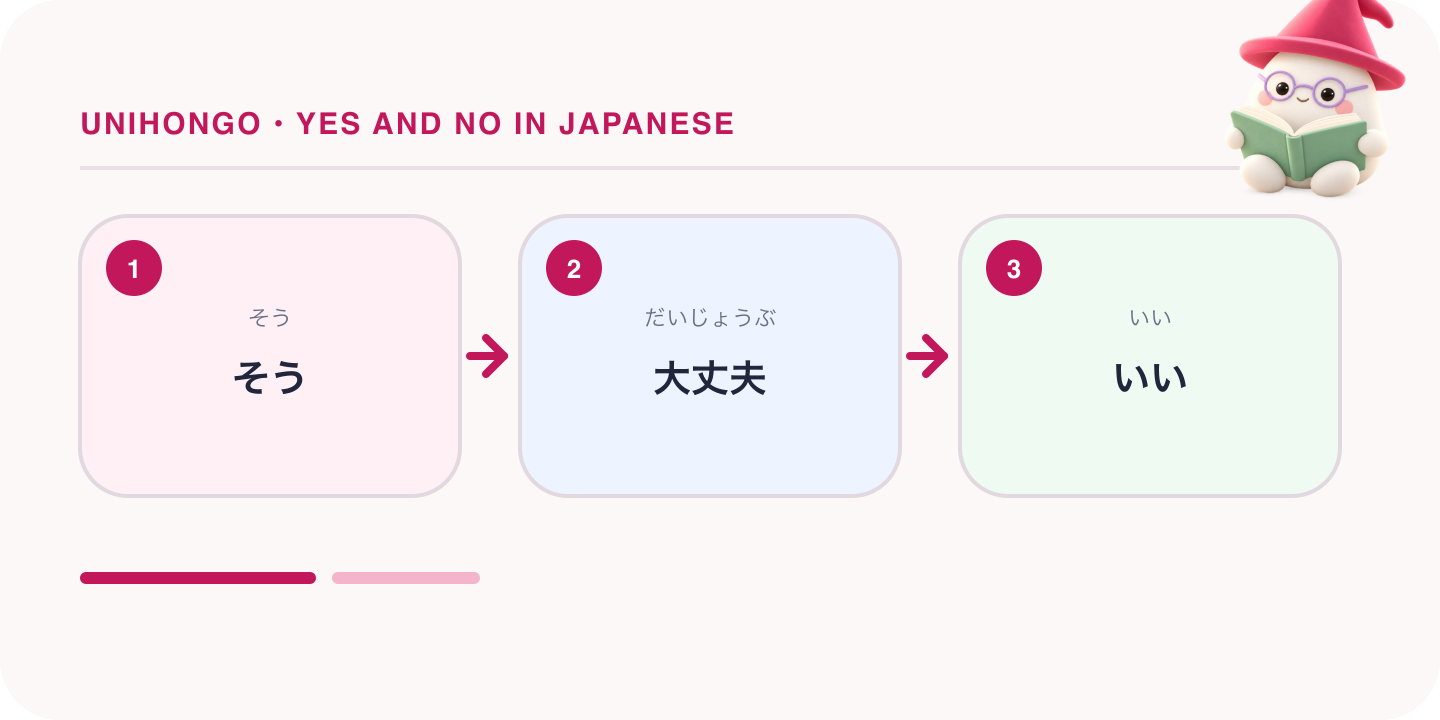
| Japanese | Romaji | Meaning |
|---|---|---|
| はい、そうです。 | Hai, sō desu. | Yes, that is right. |
| はい、大丈夫です。 | Hai, daijōbu desu. | Yes, that is fine. |
| ええ、いいですよ。 | Ee, ii desu yo. | Yes, that works. (soft polite) |
| うん、行くよ。 | Un, iku yo. | Yeah, I am going. (casual) |
| ううん、行かない。 | Uun, ikanai. | No, I am not going. (casual) |
Hai often means I am listening
A large share of the hai you hear is not agreement at all. It is the spoken equivalent of a nod: the listener marking that the message arrived. Japanese conversation expects frequent short signals from the listener, so a speaker who hears silence assumes the line dropped or the listener is unhappy. This is why staff on the phone produce a steady stream of hai, hai while you explain your problem, long before they know whether they can help.
The practical consequence is that you cannot treat someone's hai as a commitment. If a colleague says hai while you describe a deadline, you have confirmation that they followed you, not that the date works. Ask a closing question to convert listening into agreement, and expect the real answer to arrive in the sentence after the hai rather than in the hai itself.
| Japanese | Romaji | Meaning |
|---|---|---|
| はい、はい。 | Hai, hai. | Mm-hm, go on. (listening) |
| はい、分かりました。 | Hai, wakarimashita. | Yes, understood. |
| はい、承知しました。 | Hai, shōchi shimashita. | Yes, I have noted that. (polite, to a superior or client) |
| それで大丈夫でしょうか。 | Sore de daijōbu deshō ka. | Is that actually all right for you? |
| 金曜日で問題ないですか。 | Kinyōbi de mondai nai desu ka. | Is Friday genuinely no trouble? |
The last two lines are your conversion questions. Use them after a string of hai when you need a decision rather than a nod, and listen for whether the reply repeats your terms back to you. A reply that restates the day or the amount is agreement; a reply that starts with sō desu ne and a pause usually is not.
Why iie almost disappears from real conversation
Iie is a real word and it is not impolite in itself, but it does one job bluntly: it denies the whole statement. Because Japanese conversation prefers to leave the other person's position intact, speakers reach for it mainly to correct a fact about themselves, to deny a mistaken assumption, or to wave away thanks and praise. Almost nobody uses it to turn down an invitation.
You will hear it most in fixed pairs. Iie, chigaimasu corrects wrong information, iie, kekkō desu declines something offered, and iie, tondemonai desu deflects praise. Outside those, a plain iie in answer to a request lands hard, and the person who hears it will often assume you are annoyed rather than merely unavailable.
| Japanese | Romaji | Meaning |
|---|---|---|
| いいえ、違います。 | Iie, chigaimasu. | No, that is not correct. |
| いいえ、私ではありません。 | Iie, watashi de wa arimasen. | No, that was not me. |
| いいえ、とんでもないです。 | Iie, tondemonai desu. | Not at all. (deflecting praise or thanks) |
| いや、大丈夫。 | Iya, daijōbu. | Nah, it's fine. (casual) |
The negative question trap
This is the single most reliable source of misunderstanding between English and Japanese speakers. When the question contains a negative, Japanese answers the question rather than the underlying fact. Hai means your negative statement is right, and iie means your negative statement is wrong. English does the opposite: yes attaches to the positive fact no matter how the question was phrased.
So when someone asks mada tabete inai n desu ka, meaning you have not eaten yet, have you, a Japanese speaker who has not eaten answers hai. An English speaker's instinct is to say no, I have not, and the two people walk away with opposite conclusions. The safest habit is to add the verb after your yes word, because the verb removes all ambiguity even if you pick the wrong particle of agreement.
| Question asked | Your situation | Natural Japanese answer | English instinct that misfires |
|---|---|---|---|
| 行きますか (Are you going?) | You are going | はい、行きます。 | None, this pair matches |
| 行きますか (Are you going?) | You are not going | いいえ、行きません。 | None, this pair matches |
| 行かないんですか (You are not going?) | You are not going | はい、行きません。 | Saying no, I am not |
| 行かないんですか (You are not going?) | You are going | いいえ、行きます。 | Saying yes, I am |
| まだですか (Not yet?) | Still not done | はい、まだです。 | Saying no, not yet |
| 嫌いじゃないですか (You don't dislike it?) | You like it | はい、好きです。 | Saying no, I like it |
| 一緒に行きませんか (Won't you come along?) | You accept | ええ、行きます。 | Hearing it as a real negative |
The last row is a different creature. A negative ending on an invitation, such as ikimasen ka or tabemasen ka, is not asking about a negative fact at all; it is the standard polite way to invite someone. Answer it as you would a positive invitation, and never reply hai, ikimasen unless you truly want to decline.
Confirming instead of answering
Much of what looks like yes and no in Japanese is actually confirmation of a statement. When someone offers a guess about you, they usually finish with desu ka or desu ne, and the expected reply is sō desu to accept the description or chigaimasu to correct it. These two carry more information than hai and iie because they point at the content, not at the question shape, so they survive negative questions intact.
Soften the correction when the other person has made an honest mistake. Chigaimasu on its own is direct enough to sound like a rebuke in customer-facing situations, so staff and careful speakers prefer chigau to be wrapped: sō de wa nai n desu or a simple restatement of the correct fact. The correction lands, and nobody is contradicted head-on.
| Japanese | Romaji | Meaning |
|---|---|---|
| そうです。 | Sō desu. | That is right. |
| はい、そうですね。 | Hai, sō desu ne. | Yes, that is how it is. |
| そうなんです。 | Sō nan desu. | Yes, exactly that. (confirming with feeling) |
| 違います。 | Chigaimasu. | That is not the case. |
| いえ、そうではないんです。 | Ie, sō de wa nai n desu. | No, that is not quite it. (softened) |
| すみません、火曜日ではなく水曜日です。 | Sumimasen, kayōbi de wa naku suiyōbi desu. | Sorry, it is Wednesday rather than Tuesday. |
The refusal system: chotto, muzukashii, kangaete okimasu
Japanese refusals work by naming an obstacle instead of naming a decision. Chotto marks that something stands in the way and is usually left unfinished, with the voice trailing down. Muzukashii desu says the thing is difficult, which in practice means it will not happen. Kangaete okimasu promises to think about it, and in most workplace and sales contexts it closes the matter rather than opening it.
Learners often read these as maybe and keep pushing, which is the mistake that damages relationships fastest. To a Japanese listener each of these is a complete no delivered courteously, and repeating the request forces the other person to refuse again more explicitly, which is exactly what the formula was designed to avoid. Treat the first soft refusal as final unless the speaker themselves reopens the topic.
| Japanese | Romaji | Meaning |
|---|---|---|
| 今週はちょっと……。 | Konshū wa chotto...... | This week is a bit... (declining) |
| それはちょっと難しいですね。 | Sore wa chotto muzukashii desu ne. | That would be difficult. |
| ちょっと予定が入っていて。 | Chotto yotei ga haitte ite. | I have something on, I'm afraid. |
| 考えておきます。 | Kangaete okimasu. | I will think it over. (usually a no) |
| 社内で検討させていただきます。 | Shanai de kentō sasete itadakimasu. | We will consider it internally. (business no) |
| また今度お願いします。 | Mata kondo onegaishimasu. | Another time, please. |
| せっかくですが、今回は遠慮しておきます。 | Sekkaku desu ga, konkai wa enryo shite okimasu. | It is kind of you, but I will pass this time. |
| 申し訳ありませんが、今回は見送らせてください。 | Mōshiwake arimasen ga, konkai wa miokurasete kudasai. | I am sorry, but let us set this one aside. |
Notice how many of these end in a conjunction or a trailing particle rather than a full stop. The unfinished sentence is the politeness: it invites the listener to supply the refusal themselves, so no one has to say the word no aloud.
Declining food, drink and help
Turning down something offered to you is the friendliest kind of no, and it has its own vocabulary. Kekkō desu is the standard polite decline and works at a shop counter or a colleague's desk. Daijōbu desu has become extremely common for the same job in casual and service situations, though it is ambiguous enough that staff sometimes confirm which way you meant it. Okamainaku tells a host not to go to any trouble.
Always attach a thank-you, because in Japanese the refusal and the gratitude travel together. A bare kekkō desu with a flat face can read as displeasure, while arigatō gozaimasu, demo kekkō desu is warm and completely clear. If someone insists once, that is normal hospitality; declining a second time with the same smile is expected and not awkward.
| Japanese | Romaji | Meaning |
|---|---|---|
| いいえ、結構です。 | Iie, kekkō desu. | No thank you. |
| ありがとうございます、でも大丈夫です。 | Arigatō gozaimasu, demo daijōbu desu. | Thank you, but I am fine. |
| もうお腹いっぱいです。 | Mō onaka ippai desu. | I am full already. |
| お構いなく。 | Okamainaku. | Please do not go to any trouble. |
| 袋は大丈夫です。 | Fukuro wa daijōbu desu. | I do not need a bag. |
| 手伝いましょうか。 | Tetsudaimashō ka. | Shall I help you? (what you hear) |
| 大丈夫です、ありがとうございます。 | Daijōbu desu, arigatō gozaimasu. | I am fine, thank you. |
Declining a request at work
Refusing a task is harder than refusing a coffee, because the other person needs a workable outcome, not just a polite exit. The reliable shape has three parts: an apology or a cushion, a concrete reason with a time in it, and an alternative you can actually deliver. That third part is what stops the refusal from sounding like avoidance, and it is the part learners most often leave out.
Keep the reason specific and short. Ima betsu no shiryō o tsukutte imasu names the obstacle without inviting negotiation, while a vague isogashii desu can sound like an excuse. If the answer really is no with no alternative, say so early rather than letting a soft refusal be mistaken for a delay, because a late no costs your colleague more than a direct one.
| Japanese | Romaji | Meaning |
|---|---|---|
| 申し訳ありませんが、今日は難しいです。 | Mōshiwake arimasen ga, kyō wa muzukashii desu. | I am sorry, but today is not possible. |
| 今、別の資料を作っています。 | Ima, betsu no shiryō o tsukutte imasu. | I am working on another document right now. |
| 明日の午前中なら対応できます。 | Ashita no gozenchū nara taiō dekimasu. | I can handle it tomorrow morning. |
| 先に鈴木さんに確認してもいいですか。 | Saki ni Suzuki-san ni kakunin shite mo ii desu ka. | May I check with Suzuki first? |
| 私には判断できないので、上司に聞きます。 | Watashi ni wa handan dekinai node, jōshi ni kikimasu. | I cannot decide this, so I will ask my manager. |
| すみません、その件はお受けできません。 | Sumimasen, sono ken wa ouke dekimasen. | I am sorry, I cannot take that on. |
| 分かりました、じゃあ他を当たります。 | Wakarimashita, jā hoka o atarimasu. | Understood, I will try elsewhere. (their likely reply) |
A model exchange with both traps in it
| Japanese | Romaji | Meaning |
|---|---|---|
| 今日、まだ昼ご飯食べていないんですか。 | Kyō, mada hirugohan tabete inai n desu ka. | You still have not had lunch today? (colleague) |
| はい、まだです。 | Hai, mada desu. | That's right, not yet. |
| じゃあ、一緒に行きませんか。 | Jā, issho ni ikimasen ka. | Then shall we go together? (colleague) |
| ええ、ぜひ。 | Ee, zehi. | Yes, gladly. |
| ラーメンでいいですか。 | Rāmen de ii desu ka. | Is ramen all right? (colleague) |
| すみません、ラーメンはちょっと……。パスタはどうですか。 | Sumimasen, rāmen wa chotto....... Pasuta wa dō desu ka. | Sorry, ramen is a bit... How about pasta? |
| いいですね。辛いのは苦手じゃないですよね。 | Ii desu ne. Karai no wa nigate ja nai desu yo ne. | Sounds good. You do not mind spicy food, do you? (colleague) |
| はい、大丈夫です。何でも食べます。 | Hai, daijōbu desu. Nan demo tabemasu. | Right, I am fine with it. I eat anything. |
Two traps appear in eight lines. The first answer confirms a negative, so hai is correct where English would say no. The sixth line refuses with chotto and immediately offers an alternative, which is what keeps a refusal friendly. The seventh line is another negative question, and hai again agrees with the questioner's framing.
Making sure your own no is understood
- Pair every soft refusal with a reason and, where possible, a counter-offer, so the other person knows what to do next.
- Do not smile and say hai while meaning no; the mismatch is read as agreement and the misunderstanding surfaces later.
- For anything with money or a deadline attached, repeat the decision as a plain sentence: kyō wa okurimasen, meaning I will not send it today.
- If you must refuse a superior, lead with mōshiwake arimasen ga and keep the sentence short rather than piling up excuses.
- When you decline an invitation you would accept another time, say mata sasotte kudasai so the person knows to ask again.
Hearing someone else's no
- Treat chotto, muzukashii, kentō shimasu and kangaete okimasu as no unless the speaker gives you a date.
- Listen for a sentence that stops before its verb; the unfinished ending is doing the refusing.
- Watch for sō desu ne followed by a pause, which almost always introduces a disagreement rather than an agreement.
- Count how many hai you get before a decision word; a long run of hai with no wakarimashita is listening, not consent.
- If you genuinely cannot tell, ask for the outcome rather than the opinion: itsu made ni henji o itadakemasu ka.