
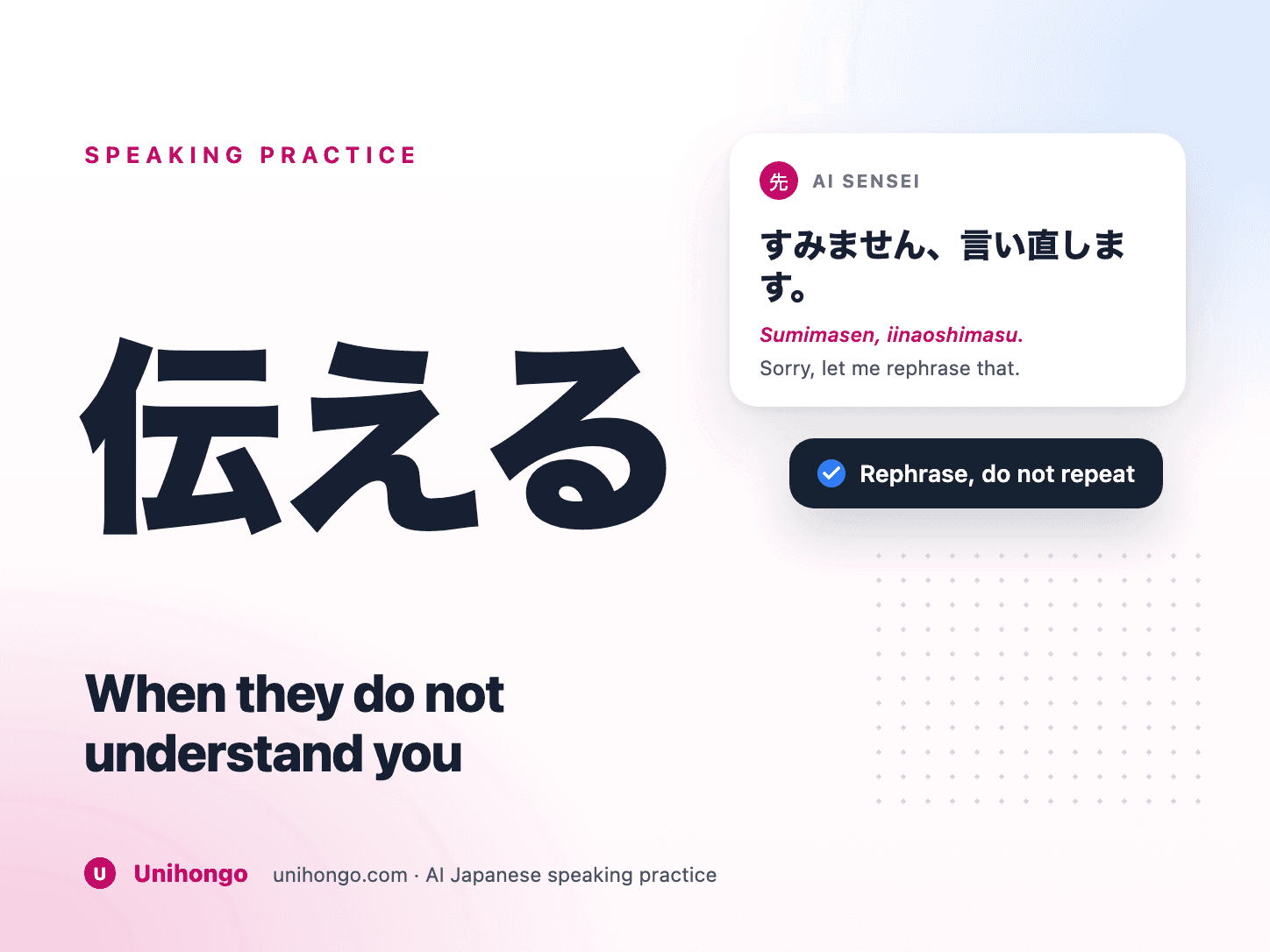
What actually causes the blank look
Learners usually assume the problem is grammar, and it usually is not. Japanese listeners are good at reconstructing a sentence with a wrong particle, because word order and context carry a great deal. What they cannot reconstruct is a word whose vowel lengths are wrong, because that is not a damaged version of the word; it is a different word or none at all.
The second common cause is missing context. Japanese sentences typically open with a topic that orients the listener, and learners often start with the detail. A sentence beginning with a verb, with no topic and no time phrase, gives the listener nothing to hang the rest on and doubles the work.
| Cause | Example of the problem | Fix |
|---|---|---|
| Vowel length | おばさん and おばあさん confused | Hold long vowels a full extra beat |
| Doubled consonants | きて and きって confused | Pause on the small tsu |
| Missing topic | Starting with the verb | Open with a topic or a time phrase |
| Sentence too long | Three clauses before the verb | Two short sentences instead |
| Unexpected word | A dictionary word nobody uses | Choose the everyday word |
| Too quiet or too fast | Trailing off at the sentence end | Keep volume up on the last syllables |
The last row is worth taking seriously. Japanese puts the decisive information at the end of the sentence, so trailing off removes exactly the part the listener needs most.
The two seconds after it fails
The instinct is to repeat, and repetition is the least effective response. If the sentence did not parse the first time, the same sounds in the same order will usually not parse the second time either. What works is changing something: the words, the length, or the order.
The most reliable repair is to break the sentence into two shorter ones and put a topic in front. That single move fixes a surprising proportion of breakdowns, because it gives the listener an anchor and halves the amount they must hold at once.
| Japanese | Romaji | Meaning |
|---|---|---|
| すみません、言い直します。 | Sumimasen, iinaoshimasu. | Sorry, let me say that again differently. |
| つまり、こういうことです。 | Tsumari, kō iu koto desu. | In other words, it is like this. |
| 簡単に言うと、 | Kantan ni iu to, | Put simply, |
| 例えば、こういう場合です。 | Tatoeba, kō iu baai desu. | For example, in a case like this. |
| 別の言い方をします。 | Betsu no iikata o shimasu. | Let me put it another way. |
| ゆっくり言いますね。 | Yukkuri iimasu ne. | I will say it slowly. |
Rephrase down, not up
When rephrasing, go simpler rather than more precise. The instinct is to add detail in the hope that more information will help, and the effect is usually the opposite: a longer sentence with more places to go wrong.
Strip to the core. Name the topic, use the most common verb that will do, drop the modifiers, and say it in under six words. Once that lands, you can add the detail in a second sentence, which is now much easier to follow because the frame already exists.
| Japanese | Romaji | Meaning |
|---|---|---|
| この機械の調子が悪いんです。 → 機械が壊れました。 | Kono kikai no chōshi ga warui n desu. → Kikai ga kowaremashita. | The machine is not in good condition. → The machine is broken. |
| 予約を変更したいのですが。 → 予約、変えたいです。 | Yoyaku o henkō shitai no desu ga. → Yoyaku, kaetai desu. | I would like to change my reservation. → Reservation, I want to change it. |
| 来週の水曜日は都合が悪くて。 → 水曜日はだめです。 | Raishū no suiyōbi wa tsugō ga warukute. → Suiyōbi wa dame desu. | Next Wednesday is inconvenient. → Wednesday is no good. |
| 電車が遅れたので遅刻しました。 → 電車が遅れました。遅くなりました。 | Densha ga okureta node chikoku shimashita. → Densha ga okuremashita. Osoku narimashita. | I was late because the train was delayed. → The train was delayed. I became late. |
Notice that every simplified version is two ideas at most and puts the topic first. That is the whole technique.
Fix the sound, not the volume
If a single word is the problem, the fix is length and pitch rather than force. Say the word on its own, slowly, holding the long vowels and pausing on the small tsu. Then put it back in the sentence. Isolating the word tells the listener that this is the piece to focus on.
Writing it is also legitimate and fast. Japanese speakers will often recognise a word in kana instantly that they could not parse in your pronunciation, and typing it on a phone takes four seconds. Nobody thinks less of you for it.
| Japanese | Romaji | Meaning |
|---|---|---|
| ええと、書きますね。 | Ēto, kakimasu ne. | Er, let me write it. |
| 「びょういん」です。病気の病院です。 | Byōin desu. Byōki no byōin desu. | Byōin. The byōin for illness. |
| 漢字だとこれです。 | Kanji da to kore desu. | In kanji it is this. |
| 発音が違いましたか。 | Hatsuon ga chigaimashita ka. | Was my pronunciation wrong? |
| なんて言えばいいですか。 | Nan te ieba ii desu ka. | How should I say it? |
Give the frame before the content
A single sentence with no context is much harder to understand than the same sentence after an orienting phrase. Announcing the subject first costs two seconds and dramatically improves your chances, particularly on the phone or in a noisy room.
Time phrases do the same job. Kinō no koto na n desu ga, this is about yesterday, tells the listener which frame to open before any content arrives. Learners often supply this at the end of the story instead, which is too late to help.
| Japanese | Romaji | Meaning |
|---|---|---|
| 予約のことなんですが。 | Yoyaku no koto na n desu ga. | This is about the reservation. |
| 昨日の件でお電話しました。 | Kinō no ken de odenwa shimashita. | I am calling about yesterday's matter. |
| ちょっと相談があるんですが。 | Chotto sōdan ga aru n desu ga. | I have something I would like to ask about. |
| 道を聞きたいんですが。 | Michi o kikitai n desu ga. | I would like to ask for directions. |
| 注文を変えたいんですが。 | Chūmon o kaetai n desu ga. | I would like to change my order. |
The pattern is X no koto na n desu ga: it is about X. Five words that make everything after them easier to follow.
Check you were actually understood
The mirror image of nodding when you did not understand is assuming a nod meant the other person did. Japanese listeners produce aizuchi continuously, and hai during your sentence means they are following your voice, not necessarily your meaning.
For anything that matters, ask a specific question rather than a general one. Asking someone to tell you the time you agreed confirms far more than asking whether they understood.
| Japanese | Romaji | Meaning |
|---|---|---|
| 伝わりましたか。 | Tsutawarimashita ka. | Did that come across? |
| 分かりにくかったですか。 | Wakarinikukatta desu ka. | Was that hard to follow? |
| 何時にしましょうか。もう一度言ってもらえますか。 | Nan-ji ni shimashō ka. Mō ichido itte moraemasu ka. | What time shall we make it? Could you say it back? |
| 私の日本語、変じゃないですか。 | Watashi no nihongo, hen ja nai desu ka. | Is my Japanese not odd? |
| おかしかったら直してください。 | Okashikattara naoshite kudasai. | Please correct me if it sounds wrong. |
When they switch to English
This happens, it is meant kindly, and it is not a verdict on your Japanese. Sometimes it is about their own wish to practise. You can steer it back, and asking directly is more effective than persisting in Japanese and hoping.
Judge the situation. In a shop with a queue, let them use English and get the transaction done. In a conversation with time, asking to continue in Japanese is almost always respected and often appreciated.
| Japanese | Romaji | Meaning |
|---|---|---|
| すみません、日本語で練習してもいいですか。 | Sumimasen, nihongo de renshū shite mo ii desu ka. | Sorry, may I practise in Japanese? |
| 日本語で大丈夫です。ゆっくりお願いします。 | Nihongo de daijōbu desu. Yukkuri onegaishimasu. | Japanese is fine. Slowly, please. |
| 勉強中なので、日本語でお願いできますか。 | Benkyō-chū na node, nihongo de onegai dekimasu ka. | I am studying, so could we speak in Japanese? |
| ありがとうございます。でも日本語で頑張ります。 | Arigatō gozaimasu. Demo nihongo de ganbarimasu. | Thank you. But I will keep trying in Japanese. |
| 急いでいるので、英語でお願いします。 | Isoide iru node, eigo de onegaishimasu. | I am in a hurry, so English please. |
The last one matters too. Choosing English deliberately when the situation calls for it is a decision, not a failure.