
Why the opening decides the rest
In the first minute your listener is making three judgements: how much Japanese you have, what register to use with you, and how much effort the conversation will take. All three are provisional, and all three are hard to revise later. A slow, uncertain opening sets a low estimate that then shapes everything they say to you.
This is why rehearsing openings is worth more than its share of your practice time. The content is almost fixed, so it can be made automatic, and automatic speech at the start buys you the goodwill and the register you want for the unpredictable part that follows.
The greeting and the pivot
Greetings are the easy part, and most learners have them. The pivot is where openings fail: the moment after the greeting when someone has to introduce a topic. If you leave that to the other person every time, the conversation becomes their work.
The pivot can be almost anything: the weather, the place you are both in, the reason you are there, or a direct question. What matters is that you produce one rather than waiting.
| Japanese | Romaji | Meaning |
|---|---|---|
| はじめまして、田中です。よろしくお願いします。 | Hajimemashite, Tanaka desu. Yoroshiku onegai shimasu. | Nice to meet you, I am Tanaka. |
| お名前、もう一度いいですか。 | Onamae, mō ichido ii desu ka. | Could I have your name once more? |
| 今日は暑いですね。 | Kyō wa atsui desu ne. | It is hot today, is it not? |
| ここ、よく来られるんですか。 | Koko, yoku koraeru n desu ka. | Do you come here often? |
| さっきの話、面白かったです。 | Sakki no hanashi, omoshirokatta desu. | What you said earlier was interesting. |
| ちょっとお聞きしてもいいですか。 | Chotto okiki shite mo ii desu ka. | May I ask you something? |
The last one is a general-purpose pivot. It works with strangers, colleagues and shop staff, and it signals that a question is coming so the listener is ready.
Answers that give the listener something
The most common conversation-killer is the accurate one-word answer. Asked where you are from, you say the country; asked how long you have been here, you say the number. Both are correct and both leave the other person to find the next question alone.
The fix is a fixed shape: answer, then one more sentence. The extra sentence can be a reason, a comparison, a detail or a small opinion. It does not need to be complex, and it does most of the work of making you sound conversational.
| Japanese | Romaji | Meaning |
|---|---|---|
| ベトナムから来ました。ホーチミンの出身です。 | Betonamu kara kimashita. Hōchimin no shusshin desu. | I am from Vietnam, from Ho Chi Minh City. |
| 三年になります。思ったより長くなりました。 | San-nen ni narimasu. Omotta yori nagaku narimashita. | It has been three years, longer than I expected. |
| エンジニアです。主にアプリを作っています。 | Enjinia desu. Omo ni apuri o tsukutte imasu. | I am an engineer, mainly building apps. |
| 独学です。毎日少しずつやっています。 | Dokugaku desu. Mainichi sukoshi zutsu yatte imasu. | Self-taught, a little every day. |
| 寿司が好きです。特に光り物が。 | Sushi ga suki desu. Toku ni hikarimono ga. | I like sushi, silver-skinned fish especially. |
| 近くに住んでいます。歩いて十分ぐらいです。 | Chikaku ni sunde imasu. Aruite juppun gurai desu. | I live nearby, about ten minutes on foot. |
Handing the turn back
After you answer, the turn has to go somewhere. Handing it back explicitly is easy in Japanese and keeps you out of the interview pattern where the other person supplies every question.
The simplest form is the mirror: answer, then return the same question. It costs nothing and works with any question you have just been asked.
| Japanese | Romaji | Meaning |
|---|---|---|
| 田中さんはどうですか。 | Tanaka-san wa dō desu ka. | How about you, Tanaka? |
| 田中さんは? | Tanaka-san wa? | And you? |
| 逆に、どう思われますか。 | Gyaku ni, dō omowaremasu ka. | Conversely, what do you think? |
| 前から気になっていたんですが…… | Mae kara ki ni natte ita n desu ga... | I have been wondering about something... |
| そういえば、聞いてもいいですか。 | Sō ieba, kiite mo ii desu ka. | That reminds me, may I ask you something? |
| もしよかったら、教えてください。 | Moshi yokattara, oshiete kudasai. | If you do not mind, please tell me. |
The bare name plus wa is the shortest handover in the language and sounds entirely natural. Use it when you have nothing else ready.
Recovering when the opening goes wrong
Openings fail in three ways: you did not catch what was said, you answered a different question, or your first sentence came out badly enough that the other person switched to English. All three are recoverable, and all three get worse if you go quiet.
Naming the problem is the repair. Japanese has short, polite ways to say that you missed something, and using one is far better received than a guess or a silence.
| Japanese | Romaji | Meaning |
|---|---|---|
| すみません、聞き取れませんでした。 | Sumimasen, kikitoremasen deshita. | Sorry, I did not catch that. |
| もう少しゆっくりお願いできますか。 | Mō sukoshi yukkuri onegai dekimasu ka. | Could you go a little more slowly? |
| あ、質問を勘違いしました。 | A, shitsumon o kanchigai shimashita. | Ah, I misunderstood the question. |
| 日本語で大丈夫です。 | Nihongo de daijōbu desu. | Japanese is fine. |
| 練習したいので、日本語でお願いします。 | Renshū shitai node, nihongo de onegai shimasu. | I want to practise, so Japanese please. |
| 最初からもう一度いいですか。 | Saisho kara mō ichido ii desu ka. | Could we go from the beginning again? |
Rehearsing openings until they run themselves
An opening is a performance you give hundreds of times, so it repays rehearsal more than any other part of your Japanese. Twenty repetitions of your own introduction, out loud, is one evening's work and lasts for years.
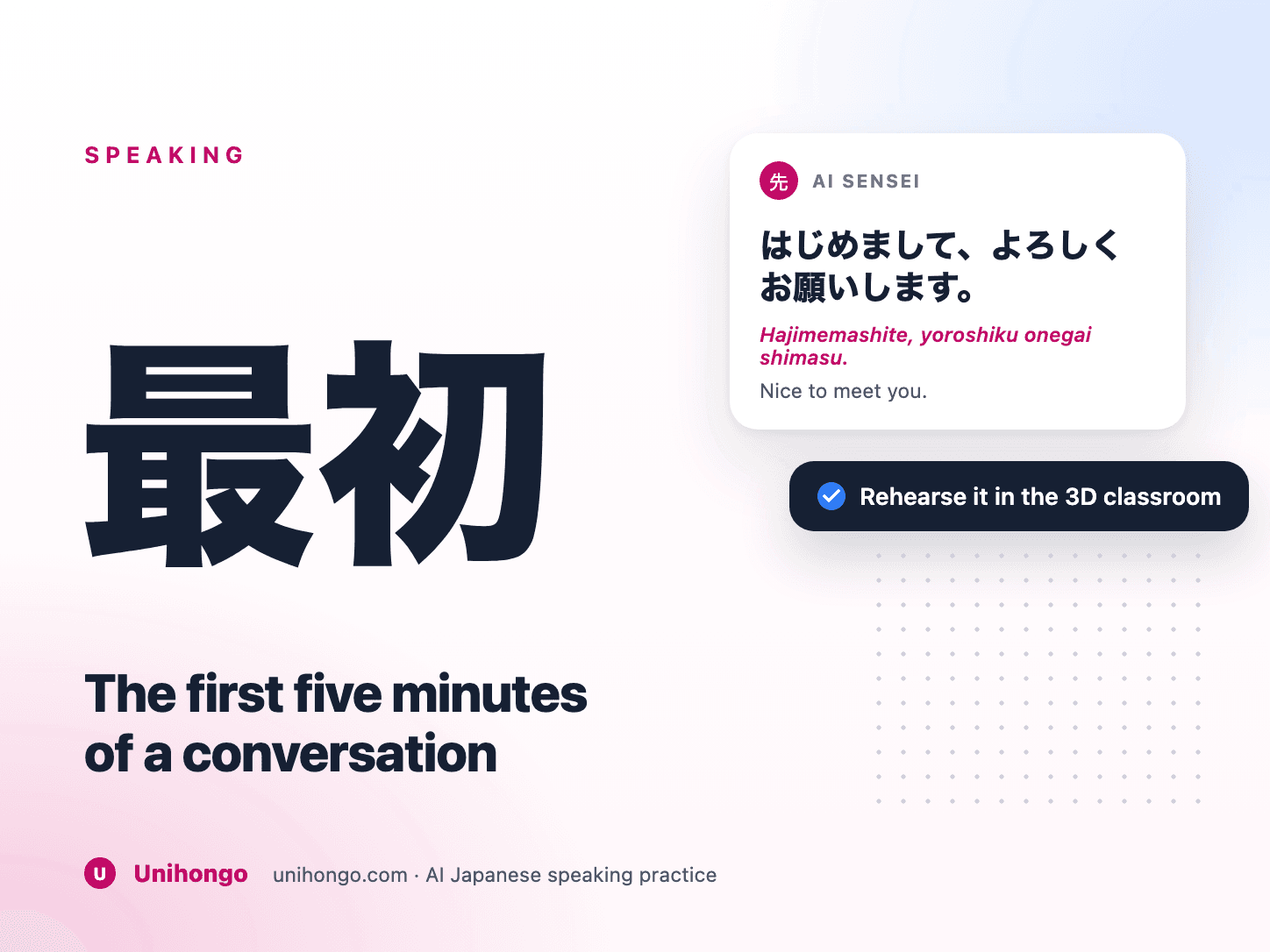
Rehearsal alone is not enough, because a real opening includes questions you did not choose. Practising first meetings with an AI Sensei in Unihongo's immersive 3D classroom gives you the unpredictable half: a different follow-up each time, spoken rather than typed, with the pressure of having to answer now. A text chatbot cannot reproduce that, because typing removes both the clock and the sound.
Afterwards the session report shows where the opening thinned out, usually the same two questions each time, and those answers are what to rehearse before the next session.
Once the first two minutes are automatic, the rest of the conversation is easier than it was, because you enter it with attention to spare.