
Gōkon in four words
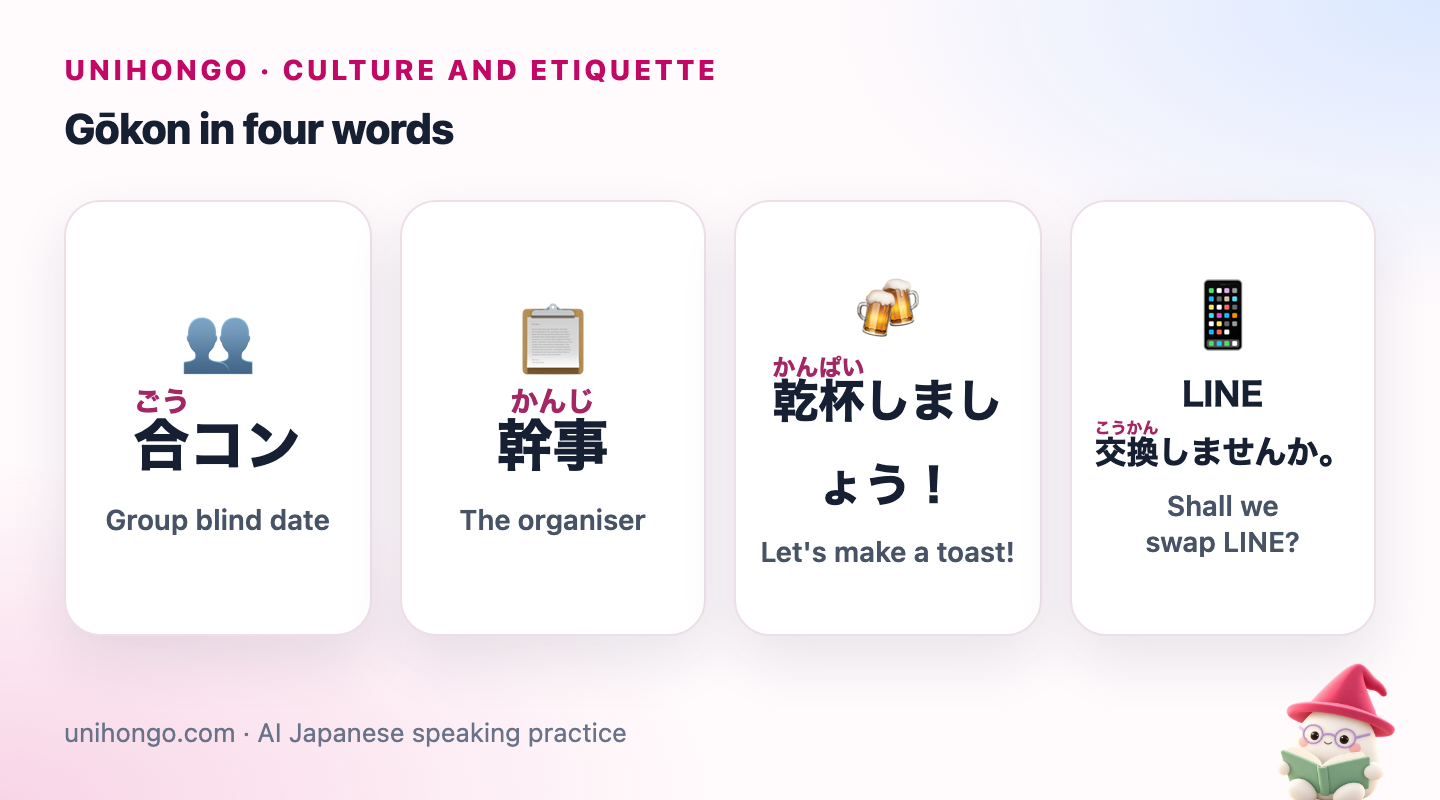
The word itself, the person who makes it happen, the line that starts it and the line that might lead somewhere: these four phrases sum up a gōkon. Note that the organiser, kanji (幹事), sounds exactly like kanji the writing system, but is written with different characters.
| Japanese | Romaji | Meaning |
|---|---|---|
| 合コン | gōkon | Group blind date |
| 幹事 | kanji | The organiser |
| 乾杯しましょう! | Kanpai shimashō! | Let's make a toast! |
| LINE交換しませんか。 | Rain kōkan shimasen ka. | Shall we swap LINE? |
LINE is the messaging app most people in Japan use, so swapping LINE is the everyday way to exchange contacts. It is written in Latin letters but pronounced rain. Shimasen ka, won't we?, makes it an invitation, easy to accept or decline.
How a gōkon usually works
Two organisers who know each other, often old classmates or coworkers, agree to bring the same number of friends, typically three or four each. The venue is usually an izakaya or a casual restaurant with a course menu and an all-you-can-drink plan, nomihōdai (飲み放題), so nobody has to think about ordering. Traditionally the men sit on one side of the table and the women on the other, and later in the evening people may change seats, sekigae (席替え), to talk with someone new.
After the first party, some groups move on to a second venue, the nijikai (二次会), often karaoke. Variations exist: machikon (街コン) are large events where many groups meet across a neighbourhood, and many gōkon today are less strictly organised than the classic version.
If a friend invites you, it may be because the group is one person short. Being asked to make up the numbers, ninzū awase (人数合わせ), is common and nothing to be offended by: it is how many people end up at their first gōkon. It is fine to ask the organiser what kind of evening it is, how many people are coming, and whether you need to bring anything. A simple sanka shimasu, I'll join, or a polite konkai wa enryo shite okimasu, I'll pass this time, are both acceptable answers.
| Japanese | Romaji | Meaning |
|---|---|---|
| 何人で来ますか。 | Nannin de kimasu ka. | How many people are coming? |
| どんな雰囲気ですか。 | Donna fun'iki desu ka. | What's the atmosphere like? |
| ぜひ参加します。 | Zehi sanka shimasu. | I'd love to join. |
| Word | Meaning | Note |
|---|---|---|
| 幹事 kanji | Organiser | One on each side |
| 飲み放題 nomihōdai | All-you-can-drink plan | Usually with a time limit |
| 席替え sekigae | Changing seats | Mixes up the conversation |
| 二次会 nijikai | Second party | Optional; leaving is fine |
| 街コン machikon | Large group-dating event | Organised by companies or towns |
The toast and self-introductions
Once drinks arrive, one of the organisers proposes a toast, and then everyone introduces themselves in turn. Self-introductions are short and polite: name, what you do, maybe where you are from and a hobby. Keep it light and specific. A detail people can ask about, such as a dish you can cook or a place you love in Japan, works better than a list.
| Japanese | Romaji | Meaning |
|---|---|---|
| じゃあ、乾杯しましょう! | Jā, kanpai shimashō! | Organiser: Right, let's toast! |
| かんぱーい! | Kanpāi! | Everyone: Cheers! |
| オリバーです。イギリスから来ました。 | Oribā desu. Igirisu kara kimashita. | I'm Oliver. I'm from the UK. |
| IT関係の仕事をしています。 | Aitī kankei no shigoto o shite imasu. | I work in IT. |
| 趣味は料理です。 | Shumi wa ryōri desu. | My hobby is cooking. |
| よろしくお願いします。 | Yoroshiku onegai shimasu. | Nice to meet you all. |
Small talk that keeps the table going
The best gōkon questions invite stories rather than one-word answers, and the best answers end with a question back. Reacting is as important as asking: hē!, sō nan desu ka, ii desu ne. As the drinks go round, people often suggest dropping polite speech with tameguchi de ii yo, casual talk is fine. That is a good sign, and you can switch too.
| Japanese | Romaji | Meaning |
|---|---|---|
| 休みの日は何をしているんですか。 | Yasumi no hi wa nani o shite iru n desu ka. | What do you do on your days off? |
| 出身はどこですか。 | Shusshin wa doko desu ka. | Where are you from originally? |
| 最近ハマっていることはありますか。 | Saikin hamatte iru koto wa arimasu ka. | Anything you're really into lately? |
| へえ、いいですね! | Hē, ii desu ne! | Oh, that sounds great! |
| タメ口でいいよ。 | Tameguchi de ii yo. | Casual speech is fine. |
Some groups play party games, such as quick quizzes or the king game, ōsama gēmu, where whoever draws the king gives the others silly orders. Many people find these old-fashioned now, and you can always join without taking it too far. Nobody should push you into anything you are not comfortable with.
Mini dialogue: talking to the person opposite
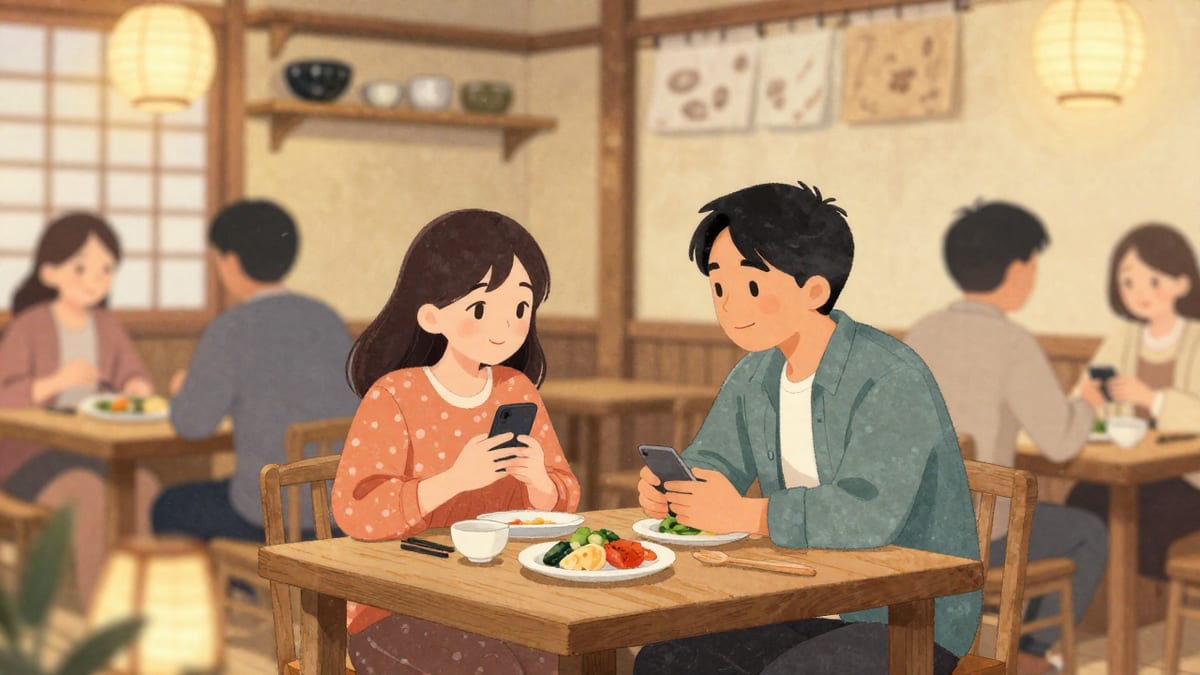
Introductions are over, and you are talking with the person sitting across from you. The conversation starts polite and slides towards casual as you find something in common.
| Japanese | Romaji | Meaning |
|---|---|---|
| 料理が趣味なんですか。何を作るんですか。 | Ryōri ga shumi nan desu ka. Nani o tsukuru n desu ka. | Her: Cooking's your hobby? What do you make? |
| カレーが多いです。スパイスから作ります。 | Karē ga ōi desu. Supaisu kara tsukurimasu. | You: Mostly curry. I make it from the spices. |
| すごい!私もカレー大好きです。 | Sugoi! Watashi mo karē daisuki desu. | Her: Amazing! I love curry too. |
| おすすめのお店、ありますか。 | Osusume no omise, arimasu ka. | You: Is there a place you'd recommend? |
| あるある!今度教えるね。 | Aru aru! Kondo oshieru ne. | Her: Yes, loads! I'll tell you sometime. |
| じゃあ、LINE交換しませんか。 | Jā, rain kōkan shimasen ka. | You: Then shall we swap LINE? |
| うん、いいよ。QRコード出すね。 | Un, ii yo. Kyūāru kōdo dasu ne. | Her: Sure. I'll bring up my QR code. |
Notice that the request for contacts follows naturally from a reason to stay in touch: a restaurant recommendation. That is the smoothest way to ask. In LINE, one person shows a QR code and the other scans it.
Swapping contacts and leaving politely
Contact swapping often happens near the end, sometimes as a group: the organisers make a group chat for everyone, a gurūpu rain. If you would rather not give your contact to someone, a gentle, vague answer such as gurūpu de tsunagarimashō, let's stay in touch through the group, avoids a direct refusal. When it is time to go, thank the organiser and leave with a soft excuse. You do not need to go to the nijikai.
| Japanese | Romaji | Meaning |
|---|---|---|
| グループLINE作りましょうか。 | Gurūpu rain tsukurimashō ka. | Shall we make a group chat? |
| 明日早いので、今日はこれで失礼します。 | Ashita hayai node, kyō wa kore de shitsurei shimasu. | I have an early start, so I'll head off now. |
| お会計はどうなりますか。 | Okaikei wa dō narimasu ka. | How are we handling the bill? |
| 今日は楽しかったです。ありがとうございました。 | Kyō wa tanoshikatta desu. Arigatō gozaimashita. | Today was fun. Thank you. |
| 幹事さん、ありがとう! | Kanji-san, arigatō! | Thanks to the organiser! |
Common mistakes and where to go next
If the gōkon goes well, the next steps are a one-to-one date and the language of dating, and if you meet people you want to stay friends with, the general phrases for exchanging contact details apply. Both have their own guides on this blog.
- Talking only to the person you like. Gōkon is a group event, so include everyone at the table.
- Staying in very formal keigo all night. Follow the table when it relaxes.
- Asking for contacts bluntly with no reason. Link it to something you talked about.
- Forgetting the organiser. A thank-you to the kanji, that night and the next day, matters.