
The visit in order
An onsen visit follows the same sequence almost everywhere, which is good news for a learner. You take your shoes off at the entrance, pay or buy a ticket, receive or rent towels, walk through the curtain for your side, undress in the changing room, wash thoroughly at a seated tap, then get into the bath. The small towel comes with you but never goes in the water. Afterwards you dry off in the changing room, get dressed, and often sit for a while in the rest area.
Practice varies by region and by type of place. A rural bathhouse used by locals can be more relaxed about details than a large resort, and a ryokan bath at night is a different setting from a busy city super sento. Treat everything here as what is commonly done rather than a rulebook, and when in doubt, copy the person who clearly comes every week.
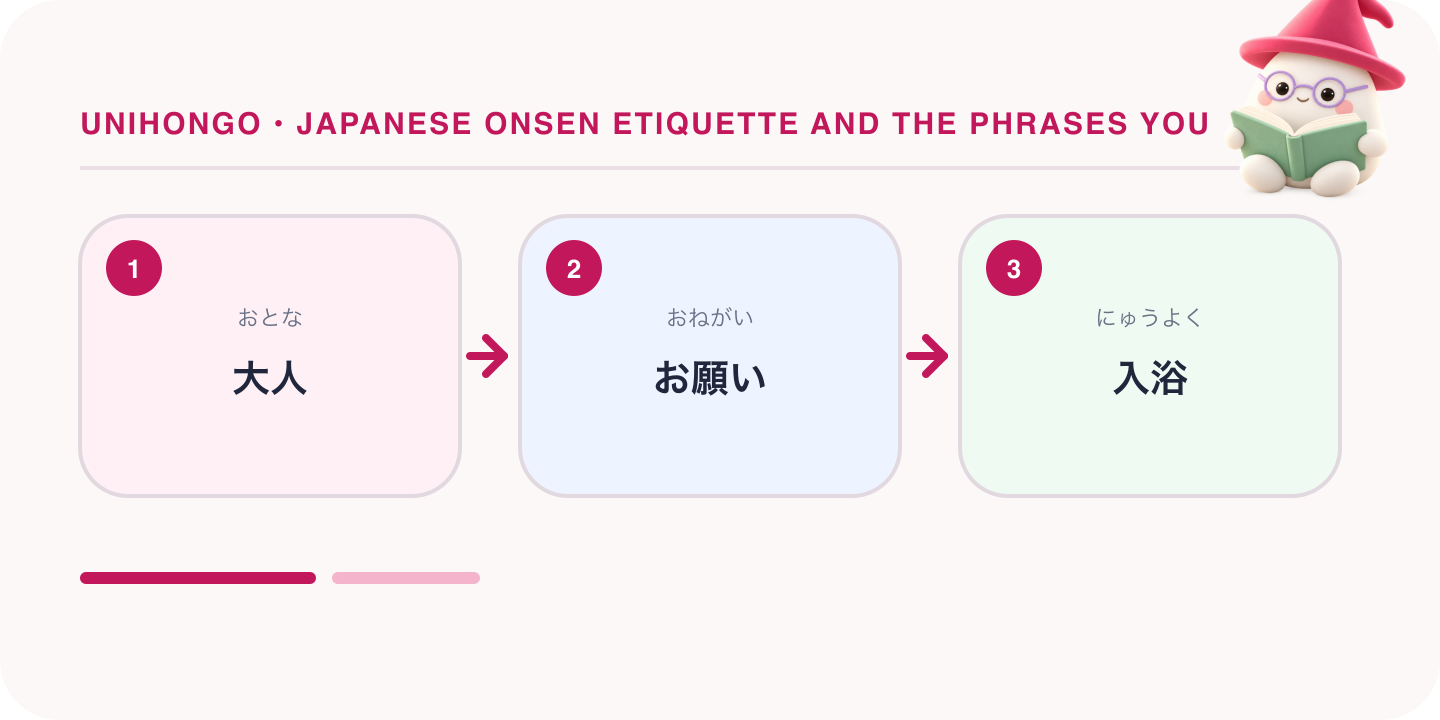
- Shoes off and into the getabako, the shoe locker, before reception.
- Pay, collect towels, confirm the closing time.
- Read the door: 男 for men, 女 for women.
- Undress fully in the datsuijo and leave the big towel there.
- Wash and rinse completely before touching the bath.
- Hair up, small towel out of the water, voice low.
Reception: paying and the towel question
The first exchange is about numbers and towels. State how many adults, then listen for the towel question, because it comes in two forms: some places ask whether you have brought one, and others tell you a towel is included or available for rent. Larger facilities send you to a ticket machine first, and the receptionist only takes the ticket. Have hitori or futari ready, and keep taoru wa tsuite imasu ka on the tip of your tongue, since a paid towel is the most common surprise on the bill.
| Japanese | Romaji | Meaning |
|---|---|---|
| 大人一人、お願いします。 | Otona hitori, onegai shimasu. | One adult, please. |
| 入浴料はいくらですか? | Nyūyokuryō wa ikura desu ka? | How much is the bathing fee? |
| 券売機で買ってください。 | Kenbaiki de katte kudasai. | Please buy a ticket at the machine. (staff) |
| タオルはお持ちですか? | Taoru wa o-mochi desu ka? | Do you have a towel with you? (staff) |
| タオルは付いていますか? | Taoru wa tsuite imasu ka? | Is a towel included? |
| 持っていません。レンタルはありますか? | Motte imasen. Rentaru wa arimasu ka? | I do not. Can I rent one? |
| タオルセットを一つお願いします。 | Taoru setto o hitotsu onegai shimasu. | One towel set, please. |
| 靴は下駄箱にお入れください。 | Kutsu wa getabako ni o-ire kudasai. | Please put your shoes in the shoe locker. (staff) |
Questions worth asking before you pay
Five questions save most of the awkward moments: tattoos, private baths, mixed bathing, towel rental, and closing times. Ask them before money changes hands, because the answer to the tattoo question may change your plans. Staff are used to these questions from visitors and will usually answer slowly, but be ready for a soft refusal phrased as a request to refrain, which is how a no is typically delivered. Thank them and move on; arguing the point does not go well anywhere.
The mixed bathing question matters more than people expect. Kon'yoku baths still exist, mostly at older or rural onsen, and some ask women to wear a wrap. If the answer is yes and you would rather not, ask about a women-only time slot, which many kon'yoku places set aside.
| Japanese | Romaji | Meaning |
|---|---|---|
| タトゥーがあっても入れますか? | Tatū ga atte mo hairemasu ka? | Can I go in even though I have a tattoo? |
| カバーシールを貼れば大丈夫です。 | Kabā shīru o hareba daijōbu desu. | It is fine if you cover it with a sticker. (staff) |
| 申し訳ありませんが、ご遠慮いただいております。 | Mōshiwake arimasen ga, go-enryo itadaite orimasu. | I am sorry, but we ask guests to refrain. (staff) |
| 貸切風呂はありますか? | Kashikiri-buro wa arimasu ka? | Is there a private bath? |
| 貸切風呂は予約が必要ですか? | Kashikiri-buro wa yoyaku ga hitsuyō desu ka? | Does the private bath need a reservation? |
| 混浴ですか? | Kon'yoku desu ka? | Is it mixed bathing? |
| 女性専用の時間はありますか? | Josei sen'yō no jikan wa arimasu ka? | Is there a women-only time? |
| 何時までですか? | Nan-ji made desu ka? | Until what time are you open? |
| 最終受付は何時ですか? | Saishū uketsuke wa nan-ji desu ka? | What time is last entry? |
Signs and words you will read
You will read far more than you say. The two door characters are the essential pair, and the rest of this table covers the labels on baths, taps, and corridors. Bath temperatures are usually posted as a number in degrees, but the words atsuyu and nuruyu on a bath edge tell you which one is safe to start with. Noren curtains often say 湯 or the hiragana ゆ, which just means hot water and marks the entrance to the baths.
| Sign | Reading | Meaning |
|---|---|---|
| 男 / 殿方 | otoko / tonogata | Men's bath |
| 女 / 婦人 | onna / fujin | Women's bath |
| 湯 / ゆ | yu | Hot water; marks the bath entrance |
| 大浴場 | daiyokujō | Main communal bath |
| 露天風呂 | rotenburo | Outdoor bath |
| 内湯 | uchiyu | Indoor bath |
| 脱衣所 | datsuijo | Changing room |
| 洗い場 | araiba | Washing area with seated taps |
| かけ湯 | kakeyu | Rinse water; rinse before entering |
| あつ湯 | atsuyu | Hot bath |
| ぬる湯 | nuruyu | Lukewarm bath |
| 水風呂 | mizuburo | Cold plunge bath |
| サウナ | sauna | Sauna |
| 休憩室 | kyūkeishitsu | Rest area |
| 貸切 | kashikiri | Private hire |
| 混浴 | kon'yoku | Mixed bathing |
| 貴重品 | kichōhin | Valuables |
| 清掃中 | seisōchū | Cleaning in progress |
| 源泉かけ流し | gensen kakenagashi | Spring water flowing straight through |
The changing room
The datsuijo is where you leave everything except the small towel. Lockers are typically coin operated, sometimes with a returnable coin, and baskets on open shelves are common in smaller places, so keep valuables at reception if that worries you. Phones stay in the locker; cameras of any kind in a changing room are a serious problem, not a minor faux pas. If someone speaks to you here, it is usually a member of staff pointing out the big towel rule or the hairdryer, and a simple hai and a nod carries you through.
| Japanese | Romaji | Meaning |
|---|---|---|
| このロッカー、使ってもいいですか? | Kono rokkā, tsukatte mo ii desu ka? | May I use this locker? |
| 空いていますよ。 | Aite imasu yo. | It is free. |
| 百円は戻りますか? | Hyaku-en wa modorimasu ka? | Does the hundred yen come back? |
| 貴重品はどこに預けられますか? | Kichōhin wa doko ni azukeraremasu ka? | Where can I leave valuables? |
| バスタオルは脱衣所に置いてください。 | Basu taoru wa datsuijo ni oite kudasai. | Please leave the bath towel in the changing room. (staff) |
Washing before you get in
Washing first is the rule everyone agrees on. Sit on a stool at a tap, soap and rinse the whole body, and rinse the stool and bowl for the next person. In a small bathhouse with only a kakeyu basin, scoop hot water and pour it over yourself several times instead. The mistake visitors make is standing to shower and spraying neighbours, or leaving suds on the floor. If the washing area is full, ask whether a seat is free rather than hovering; the answer is nearly always dōzo.
| Japanese | Romaji | Meaning |
|---|---|---|
| ここ、空いていますか? | Koko, aite imasu ka? | Is this seat free? |
| どうぞ。 | Dōzo. | Go ahead. |
| すみません、シャンプーはありますか? | Sumimasen, shanpū wa arimasu ka? | Excuse me, is there shampoo? |
| 入る前にかけ湯をしてください。 | Hairu mae ni kakeyu o shite kudasai. | Please rinse yourself before getting in. (sign or staff) |
In the bath: the towel, your hair, and your voice
Once you are in, the etiquette is mostly about what not to do. The small towel goes on your head or on the edge of the bath, not in the water. Long hair is tied up. Voices stay low because sound carries across a tiled room, and swimming, splashing, or stretching out across a small bath crowds everyone else. Get in slowly from the edge rather than stepping into the middle.
Whether to talk at all depends on the setting. Regulars at a neighbourhood bath chat freely; a resort bath at night is quieter. A soft comment on the water is the safest opener and needs no follow-up. If a neighbour asks where you are from, answer briefly and enjoy the moment; it is one of the more relaxed conversations you will have in Japan. When you leave, o-saki ni is a natural way to excuse yourself.
| Japanese | Romaji | Meaning |
|---|---|---|
| 失礼します。 | Shitsurei shimasu. | Excuse me. (getting in beside someone) |
| いいお湯ですね。 | Ii o-yu desu ne. | Lovely water, isn't it? |
| ちょっと熱いですね。 | Chotto atsui desu ne. | It is a bit hot, isn't it? |
| どちらからですか? | Dochira kara desu ka? | Where are you from? (a neighbour) |
| イギリスから来ました。 | Igirisu kara kimashita. | I am from the UK. |
| お先に失礼します。 | O-saki ni shitsurei shimasu. | Excuse me, I will head out first. |
| ごゆっくり。 | Goyukkuri. | Take your time. |
The outdoor bath and the sauna
The rotenburo is usually reached through a door from the indoor bath, and the path can be wet stone, so go slowly. In winter the trick is to keep your shoulders under the water and your towel on your head. Saunas are sometimes an extra charge and follow their own quiet rules: sit on your towel, do not pour water on the stones unless a sign invites it, and rinse off sweat before the cold plunge. The mizuburo is meant to be cold, and nobody minds if you skip it.
| Japanese | Romaji | Meaning |
|---|---|---|
| 露天風呂はどこですか? | Rotenburo wa doko desu ka? | Where is the outdoor bath? |
| 外に出て左です。 | Soto ni dete hidari desu. | Go outside and it is on the left. (staff) |
| サウナは別料金ですか? | Sauna wa betsu ryōkin desu ka? | Is the sauna an extra charge? |
| 水風呂は何度ですか? | Mizuburo wa nan-do desu ka? | What temperature is the cold bath? |
Ryokan bath timings
At a ryokan the bath is part of the stay, and the timings are worth confirming at check-in. Most places open the bath in the late afternoon until late evening, close it for cleaning overnight, and reopen early in the morning. Many also swap the men's and women's sides between night and morning so that every guest sees both baths, which is why the door sign can change. The usual rhythm is a soak before dinner, sometimes another before bed, and an early one before breakfast. You walk there in the yukata provided, which is expected inside the building.
| Japanese | Romaji | Meaning |
|---|---|---|
| お風呂は何時から何時までですか? | O-furo wa nan-ji kara nan-ji made desu ka? | What hours is the bath open? |
| 夜は十一時まで、朝は六時からです。 | Yoru wa jūichi-ji made, asa wa roku-ji kara desu. | Until eleven at night, and from six in the morning. (staff) |
| 男湯と女湯は入れ替わりますか? | Otoko-yu to onna-yu wa irekawarimasu ka? | Do the men's and women's baths swap over? |
| 夜と朝で入れ替わります。 | Yoru to asa de irekawarimasu. | They swap between night and morning. (staff) |
| 浴衣で行ってもいいですか? | Yukata de itte mo ii desu ka? | Is it all right to go in the yukata? |
| はい、館内は浴衣で大丈夫です。 | Hai, kannai wa yukata de daijōbu desu. | Yes, the yukata is fine inside the building. (staff) |
If you feel dizzy
Hot water, an empty stomach, and alcohol make people faint in onsen more often than you would think, and the Japanese word for it, noboseru, is one every bather knows. If your head goes light, get out slowly, sit on the edge or in the changing room, and drink water. Say so if anyone is nearby; nobody will think less of you. If you see someone else in trouble, a short call to staff is all that is needed, and the phrase for it is worth knowing before the day you need it.
| Japanese | Romaji | Meaning |
|---|---|---|
| ちょっとのぼせました。 | Chotto nobosemashita. | I have got a bit overheated. |
| 気分が悪いです。 | Kibun ga warui desu. | I feel unwell. |
| 少し休んでもいいですか? | Sukoshi yasunde mo ii desu ka? | May I rest for a bit? |
| 大丈夫ですか? | Daijōbu desu ka? | Are you all right? (someone asks) |
| 大丈夫です。少し休みます。 | Daijōbu desu. Sukoshi yasumimasu. | I am fine. I will rest a little. |
| すみません、人が倒れました。 | Sumimasen, hito ga taoremashita. | Excuse me, someone has collapsed. |
How to rehearse before you go
- Say the reception script aloud as a dialogue, taking both parts, until the towel question no longer surprises you.
- Write 男 and 女 on two cards and shuffle them daily for a week; reading them under pressure is the skill.
- Practise the tattoo question and both possible replies so a refusal does not knock you off balance.
- Rehearse ii o-yu desu ne and o-saki ni shitsurei shimasu quietly, at the volume you would actually use.