
The shape of an izakaya evening
An izakaya is a pub that serves food in small shared plates, and the evening there has a recognisable order. You are seated, a starter arrives, drinks come first and fast, the toast happens, and then food and further drinks are ordered in rounds over an hour or two. Later there is a bill, usually shared, and a question about whether to go somewhere else. Each stage has one or two lines you say and one or two you need to recognise.
The etiquette around drinking is real but not rigid. Younger colleagues pouring for seniors, waiting for the toast before drinking, and keeping an eye on other people's glasses are all commonly done, especially at work gatherings. Among friends it is looser, and in most places nobody expects a visitor to know every custom. What they do appreciate is the attempt, and a few lines said at the right moment carry you a long way.
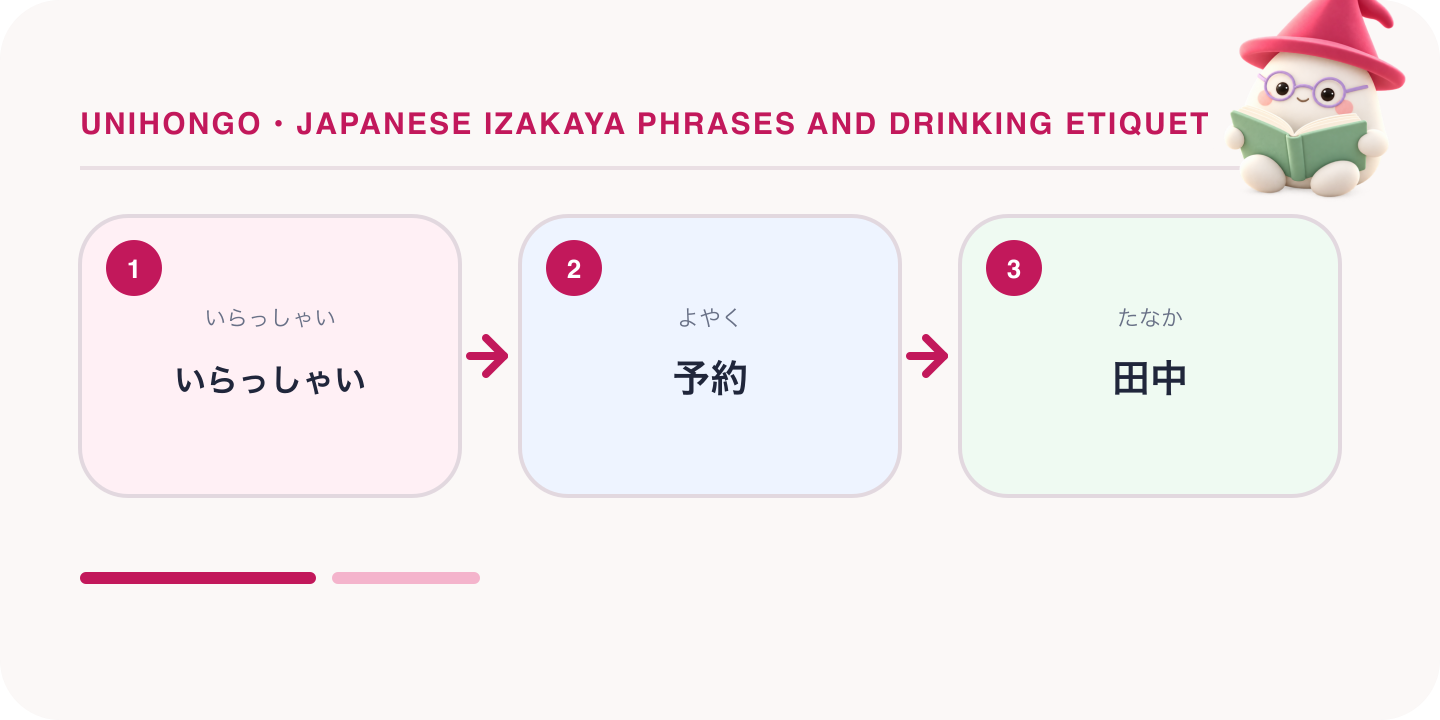
At the door: stating your party size
The first question is always how many. Staff use the counter mei with the honorific sama, and you answer with a plain number and person counter: hitori, futari, san-nin, yo-nin. If you booked, give the time and name. Busy izakaya may offer only the counter or a shared table, and they will ask if that is acceptable. Some have a raised tatami area where shoes come off at the step, and staff will say so as you approach; a short hai is all they need.
| Japanese | Romaji | Meaning |
|---|---|---|
| いらっしゃいませ。何名様ですか? | Irasshaimase. Nan-mei-sama desu ka? | Welcome. How many? (staff) |
| 二人です。 | Futari desu. | Two. |
| 四人です。予約していません。 | Yo-nin desu. Yoyaku shite imasen. | Four. We do not have a reservation. |
| 七時に予約した田中です。 | Shichi-ji ni yoyaku shita Tanaka desu. | I am Tanaka, with a seven o'clock booking. |
| カウンターでもよろしいですか? | Kauntā demo yoroshii desu ka? | Would the counter be all right? (staff) |
| はい、大丈夫です。 | Hai, daijōbu desu. | Yes, that is fine. |
The otōshi starter and how to ask about it
Soon after you sit down, a small dish arrives for each person. This is the otōshi, sometimes called tsukidashi in western Japan, and it is charged per head whether or not you eat it. First-time visitors sometimes think it is a free sample or a mistake and query the bill later, which is awkward for everyone. Asking what it is and how much at the moment it arrives is completely normal. If you have an allergy, this is also the moment to say so, since the starter is not chosen by you.
| Japanese | Romaji | Meaning |
|---|---|---|
| こちら、お通しです。 | Kochira, otōshi desu. | Here is your starter. (staff) |
| お通しは何ですか? | Otōshi wa nan desu ka? | What is the starter? |
| お通しはいくらですか? | Otōshi wa ikura desu ka? | How much is the starter charge? |
| お一人様三百円です。 | O-hitori-sama sanbyaku-en desu. | It is three hundred yen per person. (staff) |
| 貝のアレルギーがあります。 | Kai no arerugī ga arimasu. | I am allergic to shellfish. |
The first round and the toast
Drinks are ordered before anyone looks at the food menu, because the group wants to toast together and the toast waits until everyone has a glass. This is why toriaezu bīru, beer for now, is so common: it is the fastest way to get the first round on the table. You do not have to join in with beer. Say what you want in the same short form and the round still arrives together. Then someone, usually the most senior person or the host, raises a glass, says a few words, and everyone answers kanpai.
The mistake is starting your drink before the toast. Hold the glass, wait, clink lightly with the people near you, and drink after the word. At a work gathering the words before kanpai are often otsukaresama desu, thanking everyone for the day, so listen for that and repeat it back.
| Japanese | Romaji | Meaning |
|---|---|---|
| お飲み物はお決まりですか? | O-nomimono wa o-kimari desu ka? | Have you decided on drinks? (staff) |
| とりあえずビールで。 | Toriaezu bīru de. | Beer for now. |
| 生を二つお願いします。 | Nama o futatsu onegai shimasu. | Two draught beers, please. |
| 私はウーロン茶で。 | Watashi wa ūroncha de. | I will have oolong tea. |
| お疲れ様です。乾杯。 | Otsukaresama desu. Kanpai. | Thanks for today. Cheers. |
Ordering in rounds with the call button
Food comes in rounds rather than courses. Order three or four dishes to share, eat, then order again as glasses empty. Many tables have a call button; press it once, and a server arrives saying hai or o-ukagai shimasu. Without a button, a clear sumimasen across the room is expected and not rude. State dishes with the item plus onegai shimasu, use futatsu or mittsu for quantities, and close the order with ijō de so the server knows to stop writing. Near closing time you will hear rasuto ōdā, which is the moment to order anything else you want.
| Japanese | Romaji | Meaning |
|---|---|---|
| すみません、注文いいですか? | Sumimasen, chūmon ii desu ka? | Excuse me, can we order? |
| 枝豆と唐揚げをお願いします。 | Edamame to karaage o onegai shimasu. | Edamame and fried chicken, please. |
| 同じものをもう一つ。 | Onaji mono o mō hitotsu. | One more of the same. |
| ハイボールをおかわりお願いします。 | Haibōru o okawari onegai shimasu. | Another highball, please. |
| 以上でお願いします。 | Ijō de onegai shimasu. | That is all for now. |
| 以上でよろしいですか? | Ijō de yoroshii desu ka? | Will that be all? (staff) |
| ラストオーダーのお時間です。 | Rasuto ōdā no o-jikan desu. | It is time for last orders. (staff) |
The general guide to ordering food covers menus and dietary requests in more depth; here the point is the rhythm. Keep orders short, keep them coming, and do not try to order the whole evening at once, because the table fills up and the food goes cold.
Pouring for others and being poured for
When beer or sake comes in a shared bottle, people pour for each other rather than for themselves. Hold the bottle with both hands, or one hand with the other supporting it, and pour for the person beside you when their glass drops below half. When someone pours for you, lift your glass slightly with both hands, say a short thank you, and take a sip before setting it down. Pouring your own drink, tejaku, is fine among friends and increasingly common, but at a formal gathering let others do it and return the favour.
You can slow the refills without refusing anything. Leaving your glass full is the quiet signal that you are done, because nobody pours into a full glass. If someone insists anyway, a small sip and a smile keeps the peace without a word.
| Japanese | Romaji | Meaning |
|---|---|---|
| どうぞ。 | Dōzo. | Please, let me. (offering to pour) |
| お注ぎします。 | O-tsugi shimasu. | Let me pour for you. |
| あ、すみません、ありがとうございます。 | A, sumimasen, arigatō gozaimasu. | Oh, thank you, that is kind. |
| 手酌で大丈夫です。 | Tejaku de daijōbu desu. | I am happy to pour my own. |
| もう一杯いかがですか? | Mō ippai ikaga desu ka? | How about another? |
Declining more alcohol or saying you do not drink
Nobody sensible wants you to drink more than you want to, and Japanese gives you several soft ways to stop. The most useful pattern is a reason followed by node, which trails off politely and lets the other person fill in the rest: I am driving, I have an early start, I am not strong with alcohol. Non-drinkers are common and a plain o-sake wa nomenai n desu is accepted without fuss in most settings. Keep a soft drink in front of you so there is something to toast with, and pace yourself with water between rounds. A good evening ends with you able to find the station.
| Japanese | Romaji | Meaning |
|---|---|---|
| もう十分です。ありがとうございます。 | Mō jūbun desu. Arigatō gozaimasu. | I have had plenty, thank you. |
| お酒は飲めないんです。 | O-sake wa nomenai n desu. | I cannot drink alcohol. |
| お酒に弱いんです。 | O-sake ni yowai n desu. | I do not handle alcohol well. |
| 今日は車なので。 | Kyō wa kuruma na node. | I am driving today, so I will pass. |
| 明日早いので、これで最後にします。 | Ashita hayai node, kore de saigo ni shimasu. | I have an early start, so this is my last one. |
| ソフトドリンクでお願いします。 | Sofuto dorinku de onegai shimasu. | A soft drink for me, please. |
| お水をもらえますか? | O-mizu o moraemasu ka? | Could I have some water? |
All-you-can-drink plans and their time limits
Many izakaya offer nomihōdai, a fixed-price drinks plan for a set time, often paired with a food course for group bookings. The catch is the clock. The plan usually runs for a stated number of hours, with last orders called some minutes before the end, and staff will remind you as time runs down. Drinks come from a shorter dedicated menu, and everyone at the table normally has to join the same plan. Ask about the time limit and last orders when you sit down so the end of the plan does not arrive mid-round.
| Japanese | Romaji | Meaning |
|---|---|---|
| 飲み放題はありますか? | Nomihōdai wa arimasu ka? | Do you have an all-you-can-drink plan? |
| 二時間制です。 | Ni-jikan-sei desu. | It runs for two hours. (staff) |
| ラストオーダーは何時ですか? | Rasuto ōdā wa nan-ji desu ka? | What time is last orders? |
| あと三十分です。 | Ato sanjuppun desu. | Thirty minutes left. (staff) |
| 延長できますか? | Enchō dekimasu ka? | Can we extend? |
Asking for the bill and splitting it
Ask for the bill with o-kaikei onegai shimasu, or catch a server's eye and cross your index fingers in a small x, a gesture many people use in izakaya. Payment is often at the register near the door rather than at the table, and staff will say reji de onegai shimasu if so. Splitting varies: friends usually go warikan, evenly, with one person paying and everyone handing over their share; at work the senior person may pay, and the right reply is gochisōsama deshita rather than an argument over money. Ask about paying separately if you need to, and be ready for a polite no at busy places.
| Japanese | Romaji | Meaning |
|---|---|---|
| お会計お願いします。 | O-kaikei onegai shimasu. | The bill, please. |
| 別々にできますか? | Betsubetsu ni dekimasu ka? | Can we pay separately? |
| 割り勘にしましょう。 | Warikan ni shimashō. | Let's split it evenly. |
| 一人三千円です。 | Hitori sanzen-en desu. | It is three thousand yen each. |
| ここは私が払います。 | Koko wa watashi ga haraimasu. | I will get this one. |
| ごちそうさまでした。 | Gochisōsama deshita. | Thank you for the meal. |
The second venue and getting home
As the bill is settled, someone asks about nijikai, the second venue, which might be another bar, karaoke, or ramen. Going is not compulsory. The graceful exit is a reason plus a thank you: the last train, an early morning, or simply that you will call it a night here, followed by a request to be invited again. If you do go on, know your last train time before you leave the first place. Taxis are safe and easy to ask for, and staff at the venue will usually call one if you ask.
| Japanese | Romaji | Meaning |
|---|---|---|
| 二次会、行きますか? | Nijikai, ikimasu ka? | Are you coming to the second venue? |
| 今日はここで失礼します。 | Kyō wa koko de shitsurei shimasu. | I will call it a night here. |
| 終電があるので。 | Shūden ga aru node. | I have a last train to catch. |
| また誘ってください。 | Mata sasotte kudasai. | Please invite me again. |
| 終電は何時ですか? | Shūden wa nan-ji desu ka? | What time is the last train? |
| タクシーを呼んでもらえますか? | Takushī o yonde moraemasu ka? | Could you call a taxi for me? |
| 気をつけて帰ってください。 | Ki o tsukete kaette kudasai. | Get home safely. |
The evening in order
| Moment | Phrase | Reading | What it does |
|---|---|---|---|
| At the door | 二人です。 | Futari desu. | States your party size |
| Starter arrives | お通しは何ですか? | Otōshi wa nan desu ka? | Asks what the starter is |
| First round | とりあえずビールで。 | Toriaezu bīru de. | Gets the first drink ordered fast |
| Toast | お疲れ様です。乾杯。 | Otsukaresama desu. Kanpai. | Opens the drinking together |
| Ordering | すみません、注文いいですか? | Sumimasen, chūmon ii desu ka? | Calls the server for a round |
| Closing an order | 以上でお願いします。 | Ijō de onegai shimasu. | Tells the server you are done |
| Pouring | お注ぎします。 | O-tsugi shimasu. | Offers to fill a glass |
| Slowing down | もう十分です。 | Mō jūbun desu. | Declines a refill gently |
| Last orders | 延長できますか? | Enchō dekimasu ka? | Asks to extend a drinks plan |
| The bill | お会計お願いします。 | O-kaikei onegai shimasu. | Asks for the bill |
| Splitting | 割り勘にしましょう。 | Warikan ni shimashō. | Proposes an even split |
| Leaving | 今日はここで失礼します。 | Kyō wa koko de shitsurei shimasu. | Bows out of the second venue |
| Parting | 気をつけて帰ってください。 | Ki o tsukete kaette kudasai. | Sends everyone home safely |
Read the table aloud from top to bottom as one continuous evening, then again with the replies you expect at each step. The order is what makes the phrases stick, because each line cues the next one and the room supplies the rest.