
Four lines that carry you through a session
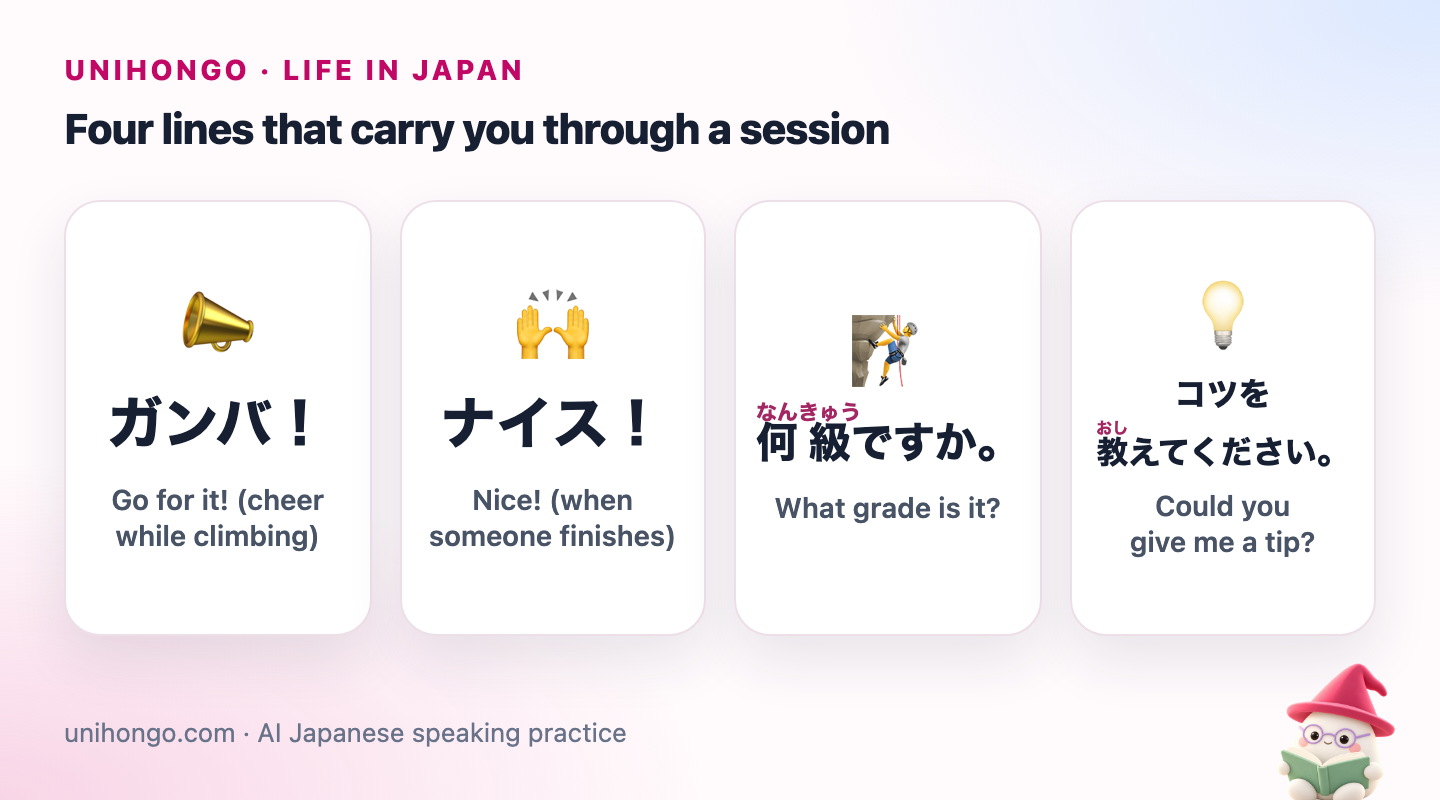
Bouldering talk happens in short bursts. Someone is on the wall, everyone else is sitting on the mat, and the words that matter are cheers, grades and questions about moves. These four lines alone will get you through your first afternoon and probably into your first conversation.
Ganba and naisu are casual, used between climbers of all ages. Nan-kyū desu ka and kotsu o oshiete kudasai are polite and fit anyone, including staff and older regulars.
| Japanese | Romaji | Meaning |
|---|---|---|
| ガンバ! | Ganba! | Go for it! (cheer while climbing) |
| ナイス! | Naisu! | Nice! (when someone finishes) |
| 何級ですか。 | Nan-kyū desu ka. | What grade is it? |
| コツを教えてください。 | Kotsu o oshiete kudasai. | Could you give me a tip? |
| 惜しい! | Oshii! | So close! |
| もう少し! | Mō sukoshi! | Almost there! |
Your first visit: registration and the safety briefing
On your first visit, staff will ask you to fill in a registration form and usually a waiver, called seiyakusho (誓約書). If you say hajimete desu, it is my first time, they will give you a short briefing. It is spoken quickly and contains several rules, so it helps to know the key words before you go. You can also rent shoes and buy or borrow chalk.
The main safety points are almost always the same: do not stand or sit under someone who is climbing, climb down rather than jump from the top when you can, land on your feet with your knees bent, and keep to one climber per area of the wall.
| Japanese | Romaji | Meaning |
|---|---|---|
| ボルダリングは初めてです。 | Borudaringu wa hajimete desu. | It's my first time bouldering. |
| シューズを借りたいです。 | Shūzu o karitai desu. | I'd like to rent shoes. |
| サイズは26です。 | Saizu wa nijūroku desu. | My size is 26 (centimetres). |
| スタッフ:登っている人の下には入らないでください。 | Sutaffu: Nobotte iru hito no shita ni wa hairanaide kudasai. | Staff: Don't go under people who are climbing. |
| スタッフ:上からはクライムダウンしてください。 | Sutaffu: Ue kara wa kuraimu daun shite kudasai. | Staff: Please climb down from the top. |
| すみません、もう一度お願いします。 | Sumimasen, mō ichido onegai shimasu. | Sorry, once more please. |
Grades, problems and the words on the wall
A problem is a kadai. Each one is marked with tape or tags showing the grade and the start holds. You start with the holds marked sutāto, with both hands as a rule, and you finish by holding the gōru, the top hold, with both hands under control. Japanese gyms usually use kyū grades, which count down as the problems get harder; above 1-kyū come dan grades. Many gyms add colours, and every gym sets its own scale, so do not be surprised if your grade changes from gym to gym.
| Word in romaji | Meaning | Notes |
|---|---|---|
| kadai | A problem or route | Literally task or assignment |
| kyū | Grade | Smaller number means harder |
| hōrudo | Hold | From English; also the colour-coded grips |
| sutāto | Start hold | Usually marked with tape near the bottom |
| gōru | Finish hold | Hold it with both hands to complete the problem |
| kanbō | Completing a problem | Written 完登; also called kuria (clear) |
| obuzabe | Reading the problem before climbing | Short for observation |
Kanbō shita, I sent it, is the climber's word. In a casual chat people also say kuria shita or simply nobotta, I climbed it.
Cheering and reacting like a regular
Japanese gyms are noisy in a good way. People who have never met will shout for each other on a hard move. You do not have to join in loudly, but a quiet ganba or a clap at the end makes you part of the room. Do not shout during the safety-critical moment of a jump or a fall; save it for when the climber is still in control.
| Japanese | Romaji | Meaning |
|---|---|---|
| ガンバー! | Ganbā! | Go for it! (stretched out) |
| いける! | Ikeru! | You can do it! |
| ナイスクライム! | Naisu kuraimu! | Nice climb! |
| すごい、一撃! | Sugoi, ichigeki! | Wow, first try! |
| 今のムーブ、きれいでしたね。 | Ima no mūbu, kirei deshita ne. | That move was beautiful. |
Ichigeki (一撃), one strike, means climbing a problem on your first attempt. Ikeru is casual; with staff or older climbers, ganbatte kudasai is gentler, but at the wall even polite people usually switch to casual cheers.
Asking for tips without being rude
Climbers love talking about moves, but some like to work things out themselves. A good habit is to ask whether someone minds before giving advice, and to ask for tips in a soft, polite way. In Japanese gyms you will hear kotsu (knack, trick), mūbu (move) and ashi (feet) constantly, as in ashi wa doko desu ka, where do the feet go?
| Japanese | Romaji | Meaning |
|---|---|---|
| ここの足はどこに置きますか。 | Koko no ashi wa doko ni okimasu ka. | Where do you put your feet here? |
| 最後の一手が届かないんです。 | Saigo no itte ga todokanai n desu. | I can't reach the last move. |
| 右手から行くんですか。 | Migite kara iku n desu ka. | Do you go with the right hand first? |
| アドバイスしてもいいですか。 | Adobaisu shite mo ii desu ka. | Do you mind if I give a tip? |
| 自分でやってみます。 | Jibun de yatte mimasu. | I'll try to figure it out myself. |
Scenario: a regular chats after you send a problem
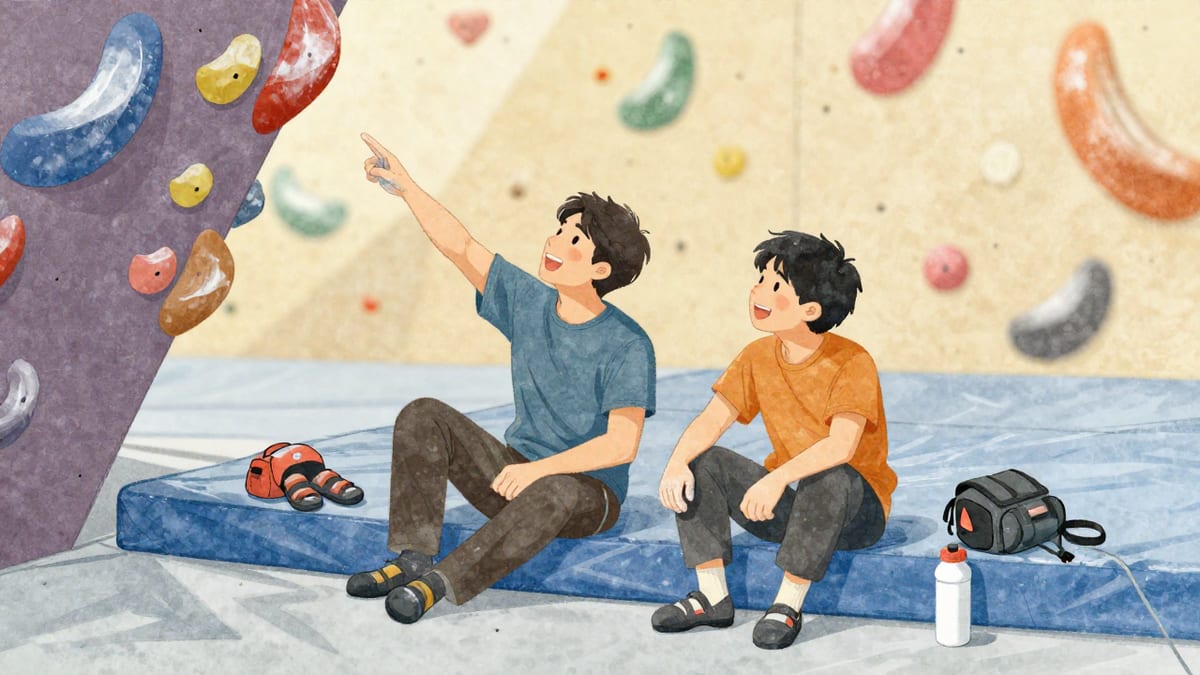
You have fallen off the same problem four times. On the fifth attempt your foot finally sticks, you grab the finish hold with both hands, and someone on the mat says naisu. When you climb down, a regular who has been working the problem next to you starts talking. This is the moment to use your questions, because they have just watched you and there is something real to talk about.
| Japanese | Romaji | Meaning |
|---|---|---|
| 常連:ナイスです!やっと登れましたね。 | Jōren: Naisu desu! Yatto noboremashita ne. | Regular: Nice! You finally got it. |
| あなた:ありがとうございます。足が難しくて。 | Anata: Arigatō gozaimasu. Ashi ga muzukashikute. | You: Thanks. The footwork was hard. |
| 常連:あそこ、ヒールフックを使うと楽ですよ。 | Jōren: Asoko, hīru fukku o tsukau to raku desu yo. | Regular: It's easier with a heel hook there. |
| あなた:なるほど。よく来るんですか。 | Anata: Naruhodo. Yoku kuru n desu ka. | You: I see. Do you come here often? |
| 常連:週に二回くらいですね。 | Jōren: Shū ni nikai kurai desu ne. | Regular: About twice a week. |
| あなた:その課題、ガンバです! | Anata: Sono kadai, ganba desu! | You: Good luck on that problem! |
Jōren (常連) means a regular. Sono kadai, ganba desu mixes the climbing cheer with polite desu; it sounds friendly and is something you will genuinely hear.
Talking about bouldering as a hobby
Once you climb regularly, coworkers and classmates will ask about it. Bouldering is popular enough in Japan that many people have tried it once, and some will want to come along. Talk about how often you go, your current grade, and what you enjoy about it. Kyū grades are easy to compare, so people may ask nan-kyū made nobotta, up to what grade have you climbed? Answer modestly; even strong climbers tend to say mada mada desu, I still have a long way to go.
Sore and soreness are a classic topic too. Kinnikutsū (筋肉痛) is muscle soreness, and the day after a first session almost everyone has it in their forearms.
| Japanese | Romaji | Meaning |
|---|---|---|
| 最近、ボルダリングにハマっています。 | Saikin, borudaringu ni hamatte imasu. | I've been really into bouldering lately. |
| 週に一回、ジムに通っています。 | Shū ni ikkai, jimu ni kayotte imasu. | I go to the gym once a week. |
| やっと四級が登れました。 | Yatto yonkyū ga noboremashita. | I finally climbed a 4-kyū. |
| まだまだです。 | Mada mada desu. | I've still got a long way to go. |
| 腕が筋肉痛です。 | Ude ga kinnikutsū desu. | My arms are sore. |
| 今度、一緒に行きませんか。 | Kondo, issho ni ikimasen ka. | Would you like to come with me sometime? |
Etiquette for taking turns
| Japanese | Romaji | Meaning |
|---|---|---|
| お先にどうぞ。 | Osaki ni dōzo. | After you. |
| 次、いいですか。 | Tsugi, ii desu ka. | May I go next? |
| 登ってもいいですか。 | Nobotte mo ii desu ka. | Is it OK if I climb? |
- One climber per section of the wall. If two problems cross, wait until the other person is finished.
- Look left and right before you start. If someone else is about to climb, say osaki ni dōzo (after you) or ask tsugi, ii desu ka (may I go next?).
- Do not hog a problem. After an attempt, rest on the side of the mat and let others go.
- Brush the holds you chalked heavily if the gym provides brushes.
- If you nearly cause a collision, a quick sumimasen is all that is needed.