
The real difficulty is the beat count
English speakers stress one syllable in a word and squeeze the rest. Japanese gives every beat, or mora, the same length. A long vowel is two beats, the small tsu (っ) is a silent beat, and n (ん) is a beat by itself. Most pronunciation mistakes that cause real misunderstanding are beat mistakes, not sound mistakes.
So before you say a tricky word, count it. The four cards below show the count for one word from each trouble group. If your version has a different number of beats, a listener may hear a different word.
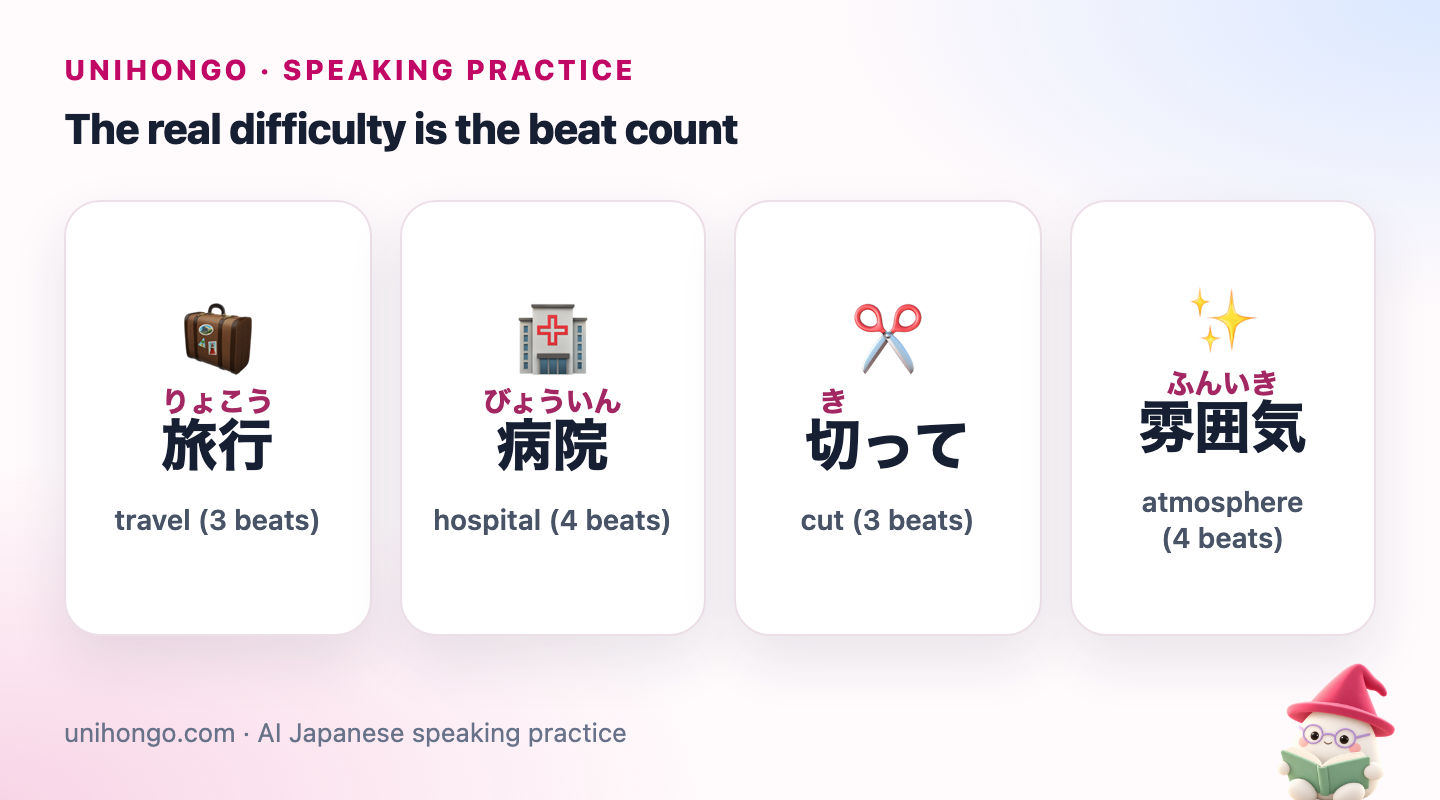
| Japanese | Romaji | Meaning |
|---|---|---|
| 旅行 | ryokō | travel (3 beats) |
| 病院 | byōin | hospital (4 beats) |
| 切って | kitte | cut (3 beats) |
| 雰囲気 | fun'iki | atmosphere (4 beats) |
Tsu against su: tsuzuku
Tsu (つ) starts with the tongue pressed behind the teeth, a brief stop, then a hiss. It is the sound at the end of English cats. Su (す) has no stop. Mix them up and tsuki (月), moon, becomes suki (好き), liking.
Tsuzuku (続く), to continue, is a classic stumbling block because tsu is followed at once by zu, its voiced partner. Learners often produce suzuku or tsutsuku. The word is written つづく, and in standard Japanese づ sounds the same as ず.
| Japanese | Romaji | Meaning |
|---|---|---|
| 続く | tsuzuku | to continue |
| 月 | tsuki | moon |
| 好き | suki | liking, fond of |
| 暑い | atsui | hot (weather) |
| 来月も続けます。 | Raigetsu mo tsuzukemasu. | I'll continue next month too. |
Ryo and ryu: ryokō, ryōri, ryūgaku
The Japanese r is a single quick tap of the tongue tip behind the upper teeth, close to the middle sound of American English butter or ladder. In ryo, ryu and rya that tap glides into y inside one beat.
Ryokō (旅行), travel, is three beats: ryo, ko, o. Learners often say ri-yo-kō, four beats, or use an English r followed by yo. Ryōri (料理), cooking, is harder still: tap, long vowel, tap again.
| Japanese | Romaji | Meaning |
|---|---|---|
| 料理 | ryōri | cooking, cuisine |
| 留学 | ryūgaku | study abroad |
| 両親 | ryōshin | parents |
| 旅行が好きです。 | Ryokō ga suki desu. | I like travelling. |
| 料理は得意ですか。 | Ryōri wa tokui desu ka. | Are you good at cooking? |
Long against short: obasan and obāsan, byōin and biyōin
Byōin (病院), hospital, is four beats: byo, o, i, n. Biyōin (美容院), hair salon, is five: bi, yo, o, i, n. The only difference is whether bi and yo share a beat. Tell a taxi driver the wrong one and you arrive at the wrong building.
The family words work the same way. One extra beat on the vowel moves a person up a generation.
| Japanese | Romaji | Meaning |
|---|---|---|
| おばさん | obasan | aunt, middle-aged woman |
| おばあさん | obāsan | grandmother, elderly woman |
| おじさん | ojisan | uncle, middle-aged man |
| おじいさん | ojiisan | grandfather, elderly man |
| 美容院 | biyōin | hair salon |
| 病院に行きます。 | Byōin ni ikimasu. | I'm going to the hospital. |
| 美容院に行きます。 | Biyōin ni ikimasu. | I'm going to the hair salon. |
The small tsu: kite, kitte, kiite
Three everyday te-forms differ only in timing. Kite (来て), come, is two beats. Kitte (切って), cut, is three: the small tsu is a silent beat in which you hold the t before releasing it. Kiite (聞いて), listen, is also three beats, but its extra beat is a longer i. Kitte is also the noun for a postage stamp (切手).
| Japanese | Romaji | Meaning |
|---|---|---|
| 来て | kite | come |
| 聞いて | kiite | listen |
| ここに来てください。 | Koko ni kite kudasai. | Please come here. |
| これを切ってください。 | Kore o kitte kudasai. | Please cut this. |
| よく聞いてください。 | Yoku kiite kudasai. | Please listen carefully. |
N before a vowel: gen'in and fun'iki
The sound n (ん) is a full beat, and before a vowel it does not join the next sound. Gen'in (原因), cause, is ge, n, i, n: four beats, with the first n hummed through the nose and the i started fresh. If you link them the English way you say genin, three beats, and the word falls apart. Romaji marks the break with an apostrophe.
Fun'iki (雰囲気), atmosphere or mood, is fu, n, i, ki. It is so awkward that many native speakers swap the middle sounds and say fuinki. That slip is famous in Japan, but the reading dictionaries give is fun'iki. Compare also kon'yaku (婚約), engagement, with konnyaku (こんにゃく), the jelly-like food: the first has n then ya, the second n then nya.
| Japanese | Romaji | Meaning |
|---|---|---|
| 原因 | gen'in | cause |
| 店員 | ten'in | shop clerk |
| 全員 | zen'in | everyone, all members |
| 婚約 | kon'yaku | engagement |
| いい雰囲気ですね。 | Ii fun'iki desu ne. | Nice atmosphere, isn't it? |
| 原因は何ですか。 | Gen'in wa nan desu ka. | What is the cause? |
Stacked syllables: atatakakatta, shinryaku, shujutsu
Atatakai (暖かい), warm, already repeats ta. Put it in the past tense and you get atatakakatta (暖かかった), with ta, ta, ka, ka in a row and a small tsu near the end: seven beats. In casual speech people often say attakai and attakakatta, which you may find easier, though the full form is the one to write.
Shinryaku (侵略), invasion, puts n directly before rya, so the tongue must hum and then tap. Shujutsu (手術), surgery, is the word Japanese speakers themselves joke about stumbling over, because shu and ju and tsu sit so close together.
| Japanese | Romaji | Meaning |
|---|---|---|
| 暖かい | atatakai | warm |
| 暖かかった | atatakakatta | was warm |
| 暖かくなかった | atatakaku nakatta | was not warm |
| 侵略 | shinryaku | invasion |
| 手術 | shujutsu | surgery |
| 昨日は暖かかったです。 | Kinō wa atatakakatta desu. | It was warm yesterday. |
A two-minute daily routine
- Pick one pair from this page, for example byōin and biyōin.
- Clap the beats slowly five times, saying the word in time.
- Say each word inside its sentence at normal speed, three times.
- Record one take and listen for the beat count, not for your accent.
- Tomorrow, take the next pair. In a week you have covered every group.
This post is a roundup. The blog has separate, deeper guides to long vowels, the small tsu, the r sounds and tongue twisters if one group keeps catching you.