
Shichi-Go-San in one minute
Shichi-Go-San is written with three numbers: 七 (seven), 五 (five) and 三 (three). It celebrates children who have reached these ages and thanks the gods for their health so far. In the past, when many small children did not survive, reaching three, five and seven was a real milestone, and families marked each step with a ceremony.
Today the day is a mix of shrine visit, family outing and photo shoot. The child wears formal clothes, the family visits a local shrine or a famous one, and everyone often goes out for a meal afterwards. Grandparents often attend and sometimes help pay for the kimono or the photos.
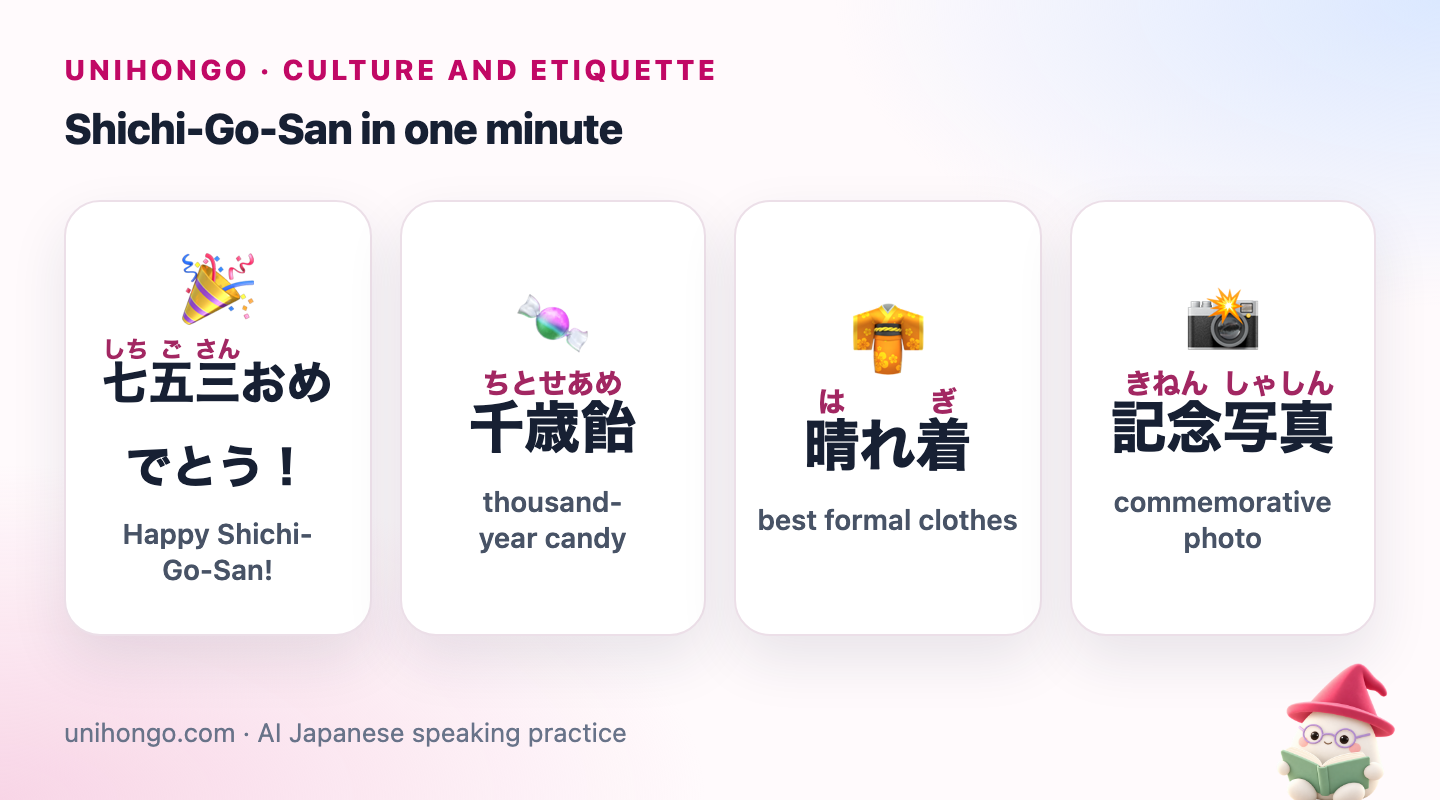
| Japanese | Romaji | Meaning |
|---|---|---|
| 七五三おめでとう! | Shichigosan omedetō! | Happy Shichi-Go-San! |
| 千歳飴 | chitose ame | thousand-year candy |
| 晴れ着 | haregi | best formal clothes |
| 記念写真 | kinen shashin | commemorative photo |
Why three, five and seven?
Each age once had its own ceremony, and the names are still used. Customs differ by region and family, so treat the table as the common pattern rather than a rule.
| Japanese | Romaji | Meaning |
|---|---|---|
| 今年は七五三です。 | Kotoshi wa shichigosan desu. | This year is our Shichi-Go-San. |
| 数え年でお祝いします。 | Kazoedoshi de oiwai shimasu. | We celebrate by the traditional age count. |
| 満年齢で行きます。 | Man nenrei de ikimasu. | We're going by her actual age. |
| Age | Who usually celebrates | Old ceremony and meaning |
|---|---|---|
| 3 | Girls, and often boys | Kamioki: children were allowed to start growing their hair |
| 5 | Boys | Hakamagi: a boy wears hakama trousers for the first time |
| 7 | Girls | Obitoki: a girl ties a proper kimono sash instead of cords |
Families also choose between two ways of counting. Kazoedoshi (数え年) is the traditional count, in which a baby is one at birth and everyone gets a year older at New Year. Man nenrei (満年齢) is the actual age. Many families now use the actual age, and some choose whichever year suits siblings or the child's temperament. A three-year-old who refuses to wear a kimono is a classic Shichi-Go-San story.
What happens at the shrine
Many families simply visit the shrine, rinse their hands, pray at the main hall and take photos. Others ask for a formal prayer, gokitō (ご祈祷), in which a priest reads a prayer for the child's health inside the hall. You apply at the reception, the uketsuke or shamusho, write the child's name and age on a form and pay a fee. The fee is usually called hatsuhoryō (初穂料) and is often handed over in an envelope; each shrine sets its own amount and explains it on request.
During busy weekends the prayer often takes place in groups, so you may wait with other families. The child usually receives a gift bag, often with chitose-ame and a charm inside.
| Japanese | Romaji | Meaning |
|---|---|---|
| 七五三のご祈祷をお願いしたいのですが。 | Shichigosan no gokitō o onegai shitai no desu ga. | I'd like a Shichi-Go-San prayer, please. |
| 受付はどちらですか。 | Uketsuke wa dochira desu ka. | Where is the reception? |
| お子さんのお名前と年齢を書いてください。 | Okosan no onamae to nenrei o kaite kudasai. | Staff: Please write your child's name and age. |
| 初穂料はおいくらですか。 | Hatsuhoryō wa oikura desu ka. | How much is the prayer offering? |
| 予約は必要ですか。 | Yoyaku wa hitsuyō desu ka. | Is a reservation necessary? |
Kimono, hakama and photo studios
Girls of three often wear a kimono with a padded sleeveless vest called a hifu (被布), which is easier for a small child than a full sash. Girls of seven wear a kimono with a proper obi. Boys of five wear a haori jacket and hakama trousers. Plenty of children wear Western party clothes instead, and nobody minds.
Photo studios are a big business at this time of year. Many offer maedori (前撮り), a photo session before the actual day, often cheaper and less crowded, and packages that include kimono rental, dressing (kitsuke) and hair setting. Book early for weekends in November.
| Japanese | Romaji | Meaning |
|---|---|---|
| 前撮りの予約をしたいです。 | Maedori no yoyaku o shitai desu. | I'd like to book an early photo session. |
| 着付けもお願いできますか。 | Kitsuke mo onegai dekimasu ka. | Can you also dress her in the kimono? |
| レンタルの着物はありますか。 | Rentaru no kimono wa arimasu ka. | Do you have kimono to rent? |
| 家族全員で撮りたいです。 | Kazoku zen'in de toritai desu. | We want a photo with the whole family. |
What to say to the family and the child
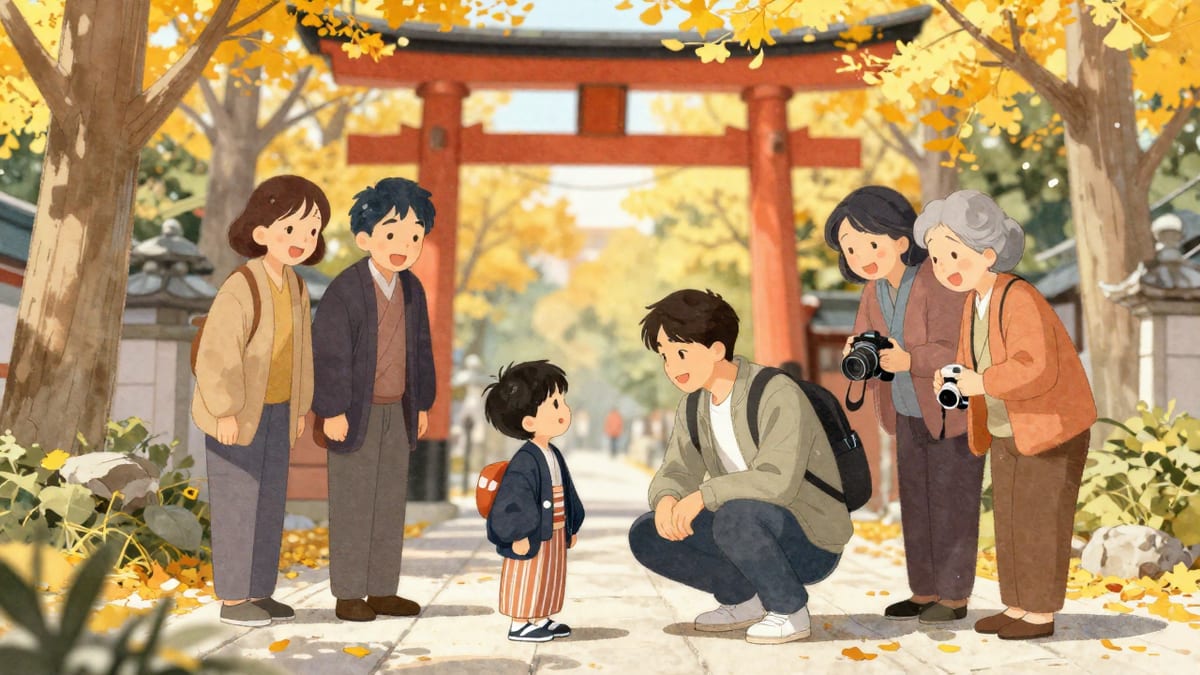
If a colleague, neighbour or friend mentions their child's Shichi-Go-San, a short congratulation is perfect. Use the polite form with the adults and something warm and simple with the child. Praising the clothes is the most natural compliment, because the family has put a lot of effort into them.
| Japanese | Romaji | Meaning |
|---|---|---|
| 七五三おめでとうございます。 | Shichigosan omedetō gozaimasu. | Congratulations on Shichi-Go-San. (polite) |
| お着物、よく似合ってるね。 | Okimono, yoku niatteru ne. | Your kimono really suits you. (to a child) |
| かっこいいね! | Kakkoii ne! | You look so cool! (to a boy in hakama) |
| 大きくなりましたね。 | Ōkiku narimashita ne. | Hasn't she grown! (to the parents) |
| 写真を撮ってもいいですか。 | Shashin o totte mo ii desu ka. | May I take a photo? |
| ありがとうございます。おかげさまで。 | Arigatō gozaimasu. Okagesama de. | Parent: Thank you. We've been fortunate. |
Okagesama de is the classic modest reply when someone congratulates you on your family's health or success. It means roughly thanks to you and everyone, and you will hear it from parents at Shichi-Go-San.
Mini dialogue: meeting a neighbour's family at the shrine
| Japanese | Romaji | Meaning |
|---|---|---|
| あ、こんにちは。七五三ですか。 | A, konnichiwa. Shichigosan desu ka. | You: Oh, hello. Is it Shichi-Go-San? |
| そうなんです。三歳になりました。 | Sō nan desu. Sansai ni narimashita. | Neighbour: That's right. She turned three. |
| おめでとうございます。かわいいですね。 | Omedetō gozaimasu. Kawaii desu ne. | You: Congratulations. She looks lovely. |
| ありがとうございます。着物を嫌がって大変でした。 | Arigatō gozaimasu. Kimono o iyagatte taihen deshita. | Neighbour: Thank you. She hated the kimono, it was hard work. |
| でも、とても似合っていますよ。 | Demo, totemo niatte imasu yo. | You: But it suits her beautifully. |
Common learner mistakes
- Photographing other families' children without asking. It is a public place, but parents are protective; always ask first, or photograph only your own group.
- Saying Happy Shichi-Go-San in English to a Japanese family. They will understand, but Shichigosan omedetō sounds warmer and costs you nothing.
- Asking how much the kimono or the photos cost. Families can spend a lot, and money talk feels out of place on the day.
- Treating chitose-ame as a sweet to hand out. It belongs to the child being celebrated, and the bag is often kept as a souvenir.
- Assuming every child must wear a kimono. Many wear suits or dresses, and both are fine.