
Four names carried by the wind
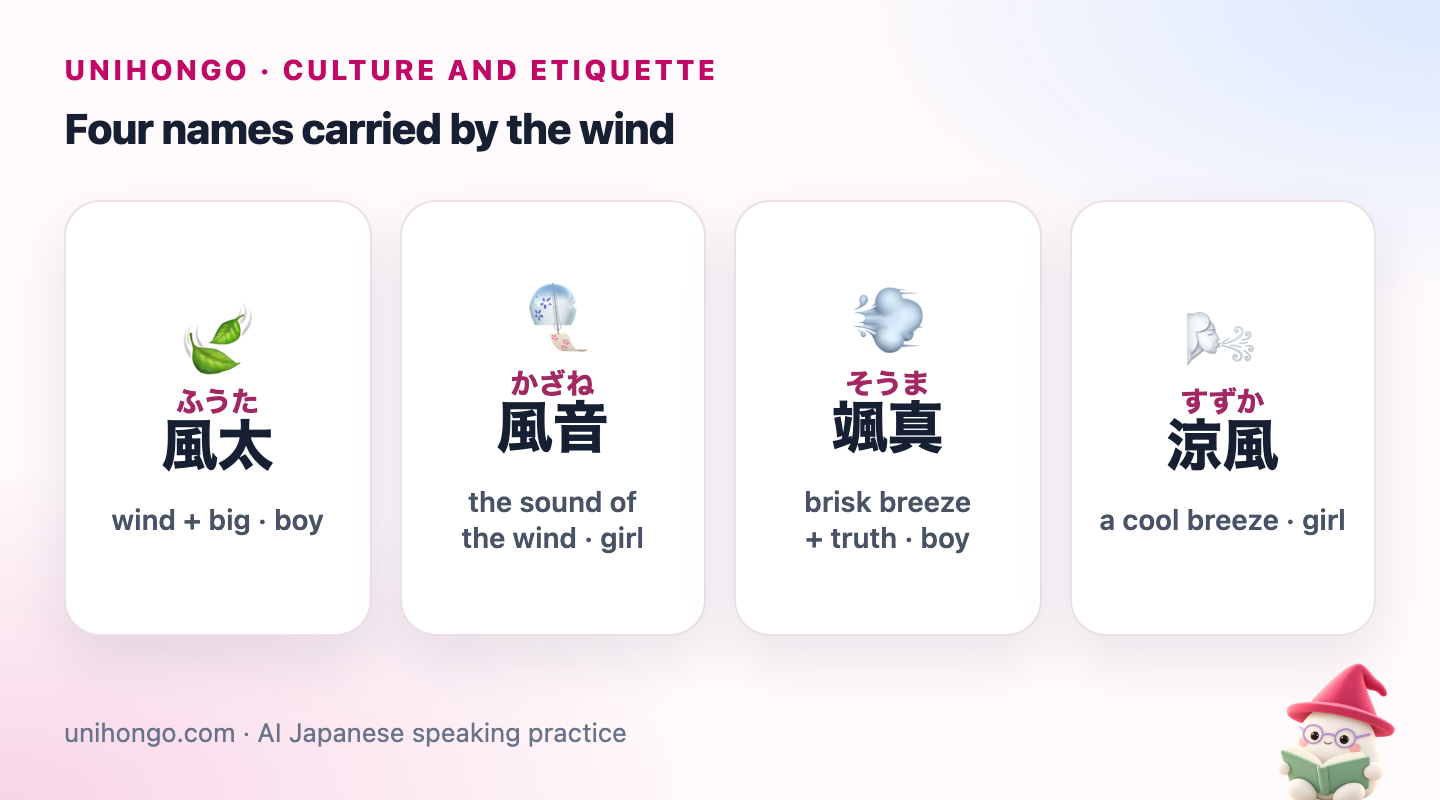
Each of these names catches the wind in a different way: plainly with 風, as a sound you can hear, as a brisk gust, and as a cool summer breeze.
| Japanese | Romaji | Meaning |
|---|---|---|
| 風太 | Fūta | wind + big · boy |
| 風音 | Kazane | the sound of the wind · girl |
| 颯真 | Sōma | brisk breeze + truth · boy |
| 涼風 | Suzuka | a cool breeze · girl |
風音 uses 音 (sound), read ne, so the name means something like the voice of the wind. 涼風 is also an everyday word, read suzukaze or ryōfū, for the cool breeze that brings relief on a hot summer day; as a name it is read Suzuka. 颯真 pairs a brisk wind with 真, truth or sincerity, a popular final kanji for boys.
How 風 is read in names
風 has an on'yomi, fū, and a kun'yomi, kaze. Both are used in names. The fū reading sounds light and modern, and kaze sounds more like the natural word. In compounds kaze can become kaza, the same change you hear in 風車 (kazaguruma, pinwheel).
| Japanese | Romaji | Meaning |
|---|---|---|
| 風雅 | Fūga | refined elegance · boy |
| 風人 | Kazato | wind + person · boy |
| 風真 | Fūma | wind + truth · boy |
| Reading | Where it appears | Name examples |
|---|---|---|
| fū | At the start of a name | 風太 Fūta, 風雅 Fūga, 風真 Fūma |
| kaze | At the start, before another kanji | 風人 Kazato (kaza), 風音 Kazane |
| kaze | At the end, after another kanji | 涼風 Suzukaze, as a word |
風雅 is an old word for refined, artistic taste, the elegance of poetry and tea, so the name has a cultured feel. Fūma also sounds like a name from ninja stories, which some families enjoy and others avoid. If you meet a Kazato, he may write his name with different kanji, so it is always worth asking.
颯 and 爽: brisk and refreshing breezes
Many parents who like the feeling of wind choose 颯 or 爽 instead of 風. 颯 contains 風 on its right side and describes wind that blows briskly; the word 颯爽 (sassō) means dashing, moving with confident ease. 爽 means refreshing, as in 爽やか (sawayaka), a word used for a clear morning, a mint taste or a pleasant, open person.
| Japanese | Romaji | Meaning |
|---|---|---|
| 颯太 | Sōta | brisk wind + big · boy |
| 颯斗 | Hayato | brisk wind + the Big Dipper · boy |
| 爽太 | Sōta | refreshing + big · boy |
| 爽香 | Sayaka | refreshing fragrance · girl |
Sōta is a good example of one name with many spellings: 颯太, 爽太, 蒼太 (blue) and 草太 (grass) all exist, and only the first two carry a breezy feeling. The calm opposite of wind, 凪 (nagi), is also used in names; it means the stillness when the sea wind drops.
Seasonal winds behind the names
Japanese has many poetic words for the winds of each season, used in haiku, letters and weather reports. Some of them inspire names, and all of them are lovely words to know.
| Japanese | Romaji | Meaning |
|---|---|---|
| 春一番 | haru ichiban | first strong south wind of spring |
| 薫風 | kunpū | fragrant breeze of early summer |
| そよ風 | soyokaze | a gentle breeze |
| 秋風 | akikaze | autumn wind |
| 木枯らし | kogarashi | cold wind of late autumn |
| 台風 | taifū | typhoon |
薫風 is behind the classic name 薫 (Kaoru), a fragrant breeze, used for any gender. 春一番 is announced on the news each year when the first strong, warm south wind of spring blows in some regions. Kogarashi means something like tree-withering wind and signals that winter is near. In everyday Japanese news, typhoons are usually called by number, such as 台風10号, typhoon number ten, rather than by name.
The kaze trap and other wind words
The word for a cold, the illness, is also kaze, written 風邪, literally wind plus evil. The idea is old: illness was once thought to be carried by bad winds. In speech the two kaze sound the same in standard Japanese, and context tells you which one is meant. 風 also hides in some everyday words where you might not expect it.
| Japanese | Romaji | Meaning |
|---|---|---|
| 風邪をひきました。 | Kaze o hikimashita. | I've caught a cold. |
| 今日は風が強いですね。 | Kyō wa kaze ga tsuyoi desu ne. | It's windy today, isn't it. |
| お風呂 | ofuro | bath |
| 風鈴 | fūrin | wind chime |
| 追い風 | oikaze | a tailwind, things going your way |
| 風の便り | kaze no tayori | news heard through the grapevine |
追い風 and its opposite 向かい風 (mukaikaze, a headwind) are also used about luck and circumstances, as in a tailwind for the economy. Kaze no tayori is a poetic way to say you heard something indirectly. If you name a character after the wind, you will never see 邪 in the name: it means wicked, and no parent would choose it.
Explaining a wind name politely
Wind names are easy to explain, because 風 is a kanji every Japanese speaker knows. The usual pattern is to name the first kanji, then describe the second with a common word. Parents also like to share the story behind the name, such as the weather on the day the baby was born or the kind of person they hope the child becomes.
| Japanese | Romaji | Meaning |
|---|---|---|
| 風という字に、音と書いて、かざねです。 | Kaze to iu ji ni, oto to kaite, Kazane desu. | I'm Kazane: the kanji for wind, then sound. |
| 生まれた日、風が強かったそうです。 | Umareta hi, kaze ga tsuyokatta sō desu. | Apparently it was windy the day I was born. |
| 自由に生きてほしいという意味です。 | Jiyū ni ikite hoshii to iu imi desu. | It means we hope he lives freely. |
| 爽やかな名前ですね。 | Sawayaka na namae desu ne. | What a fresh, pleasant name. |
Sawayaka is the natural compliment for a wind name: it means fresh and pleasant, and it is often used about people too, as in a sawayaka smile. Sō desu after a plain verb or adjective, as in tsuyokatta sō desu, means I heard that, which fits stories about your own birth that you only know from your parents.
Mini dialogue: Kazane at the wind chime stall
On a summer evening you visit a temple fair with your friend Kazane. Rows of glass wind chimes ring in the breeze. You are close friends, so you speak casually.

| Japanese | Romaji | Meaning |
|---|---|---|
| この風鈴、いい音だね。 | Kono fūrin, ii oto da ne. | You: This wind chime has a lovely sound. |
| うん。私の名前みたい。 | Un. Watashi no namae mitai. | Kazane: Yeah. Like my name. |
| かざねの「ね」って、音だっけ? | Kazane no ne tte, oto dakke? | You: The ne in Kazane is sound, right? |
| そう、風の音。 | Sō, kaze no oto. | Kazane: Yes, the sound of the wind. |
| ぴったりだね。一つ買おうかな。 | Pittari da ne. Hitotsu kaō ka na. | You: It suits you. Maybe I'll buy one. |
Dakke at the end of a question means I think so, but let me check, and it is very natural when you want to confirm something you half remember. Ka na after a verb, as in kaō ka na, turns a decision into a gentle thinking-aloud: maybe I'll buy one.
Let Mocchi blow the wind words your way
Ask Mocchi: /vocab wind words, the seasonal ones too. Mocchi gives you a short set with readings and examples, then asks you to use two of them in sentences and checks what you write. It notes the ones you confuse, such as kogarashi and kunpū, and works them back into later quizzes and your plan.
Then ask Mocchi to /create-flashcards from the set, choosing a photo for each card: a kite, a wind chime, bare autumn trees. Open Mocchi Flight and choose your own cards: you guide Mocchi through the gate with the right word, which suits a set of wind words rather well.
Before you choose a wind name
- Do not shorten the long vowel. Fūta and Fūga with a short u sound like different words.
- Do not write a wind name with 風邪 or call a character Kaze thinking it only means wind; in daily life kaze very often means a cold.
- Remember that 颯 and 爽 are both read sō, and so are 蒼 and 草. If someone is called Sōta, ask which kanji they use.
- 嵐 (arashi, storm) is legal in names but is rare for real children, because it suggests chaos. In fiction it can be perfect.
- Check the full name aloud with the surname. A light wind name usually suits any surname, but long combinations can be hard to say.