
What actually changes when you marry in
The vocabulary shift is bigger than the ceremony. You acquire a second set of relatives who have to be named correctly in three different situations: to their face, when you talk about them to outsiders, and when you write about them on a form. You also inherit a calendar of visits and gifts, and a register that sits somewhere between family and guest for the first few years.
The good news is that almost none of it demands advanced grammar. The formal lines are fixed, the family terms are a closed list, and the everyday register is polite -masu speech with a handful of humble verbs such as ukagau and itadaku. What it does demand is delivery: these are sentences said while everyone is looking at you, so they need to be rehearsed out loud rather than read.
Throughout this guide, treat the customs as what is commonly done rather than as rules. Families differ enormously, city and countryside differ, and a household that has already welcomed a foreign partner will run on very different expectations from one meeting its first.
The first visit: arriving, greeting, sitting down
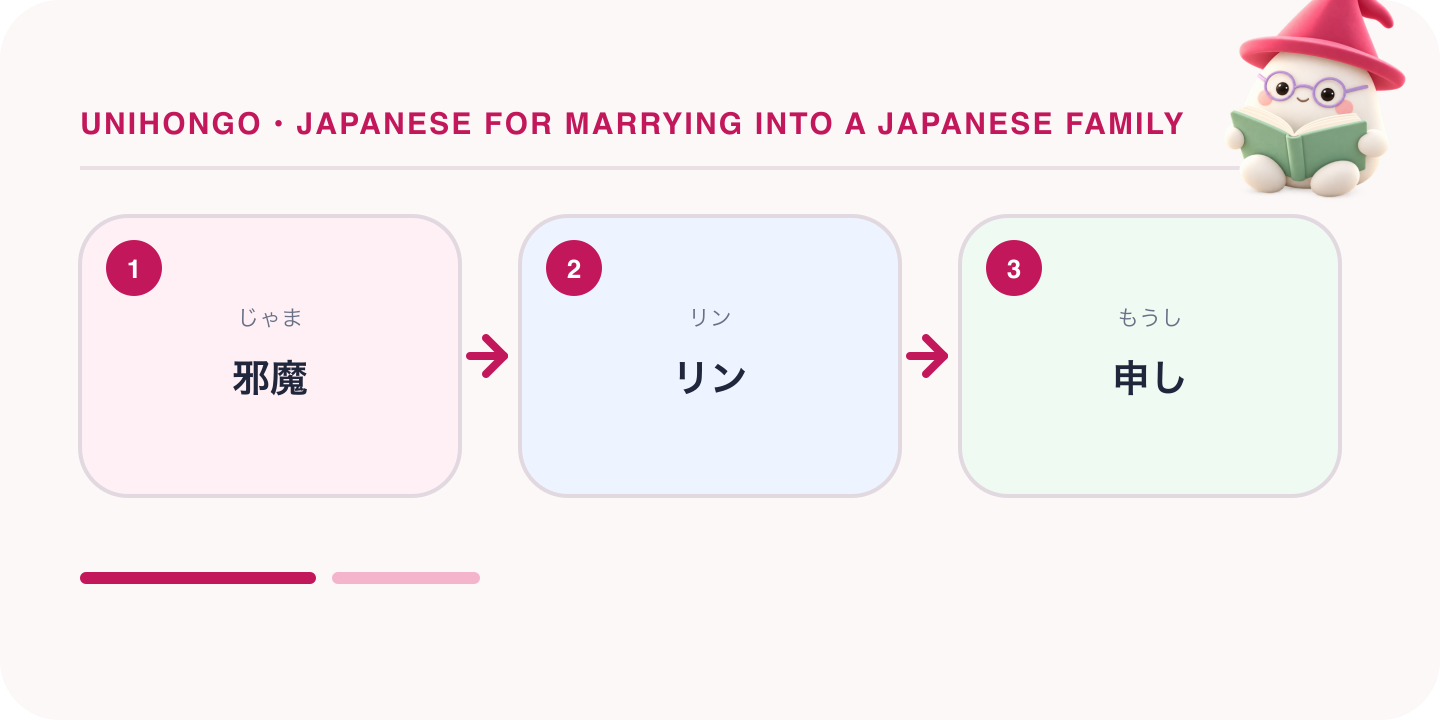
The opening minute is the most scripted part of the whole process. You greet at the door, hand over a small gift, give your name properly with to mōshimasu, and thank them for their time. Almost everyone is nervous, and saying so is acceptable and often disarming: kinchō shite imasu usually earns a laugh and lowers the temperature in the room.
The gift line is worth choosing in advance. Tsumaranai mono desu ga is the traditional self-deprecating formula and still perfectly normal, though some younger speakers find it stiff and prefer something warmer about hoping the recipient enjoys it. Either is safe. Handing the gift over after you have sat down, rather than in the doorway, is common practice in many households.
| Japanese | Romaji | Meaning |
|---|---|---|
| お邪魔します。 | Ojama shimasu. | Excuse me for intruding. (said on entering) |
| はじめまして、リンと申します。 | Hajimemashite, Rin to mōshimasu. | How do you do. My name is Rin. |
| 本日はお時間をいただき、ありがとうございます。 | Honjitsu wa ojikan o itadaki, arigatō gozaimasu. | Thank you for making time for me today. |
| 遠いところをよく来てくださいました。 | Tōi tokoro o yoku kite kudasaimashita. | Thank you for coming all this way. (you hear this) |
| どうぞお掛けください。 | Dōzo okake kudasai. | Please have a seat. (you hear this) |
| つまらないものですが、どうぞ。 | Tsumaranai mono desu ga, dōzo. | It is only a small thing, but please take it. |
| 気持ちばかりですが、お口に合えばうれしいです。 | Kimochi bakari desu ga, okuchi ni aeba ureshii desu. | It is just a token, but I hope you enjoy it. |
| 少し緊張しています。 | Sukoshi kinchō shite imasu. | I am a little nervous. |
| ご家族のお話をたくさん伺っています。 | Gokazoku no ohanashi o takusan ukagatte imasu. | I have heard a lot about your family. |
| 今日はごちそうさまでした。 | Kyō wa gochisōsama deshita. | Thank you for the meal today. |
| そろそろ失礼します。 | Sorosoro shitsurei shimasu. | I should be going now. |
The request line, traditional and modern
The famous version, ojōsan o boku ni kudasai, literally asks for the daughter to be given, and it is strongly associated with an older, male-spoken script. Plenty of parents would enjoy hearing it. Plenty of others, and plenty of partners, would find its framing uncomfortable. Do not choose it without asking your partner first.
The middle option is musume-san to kekkon sasete kudasai, which asks for permission to marry rather than for a person. The softest and increasingly common option skips permission entirely: the couple report a decision they have already made together and ask for the family's blessing and support. All three are shown below so you can pick the register your situation actually calls for.
Whichever you choose, expect the reply to be short. Musume o yoroshiku onegai shimasu is the standard response, and the correct answer to it is kochira koso, yoroshiku onegai itashimasu. Learn that exchange as a pair, because it arrives fast and it is the moment people remember.
| Japanese | Romaji | Meaning |
|---|---|---|
| お嬢さんを僕にください。 | Ojōsan o boku ni kudasai. | Please give me your daughter. (traditional, dated) |
| 娘さんと結婚させてください。 | Musume-san to kekkon sasete kudasai. | Please let me marry your daughter. |
| 娘さんとの結婚をお許しいただけないでしょうか。 | Musume-san to no kekkon o oyurushi itadakenai deshō ka? | Would you give us your permission to marry? |
| 息子さんと結婚させていただきたいと思っています。 | Musuko-san to kekkon sasete itadakitai to omotte imasu. | I would like your permission to marry your son. |
| 美咲さんと結婚を前提にお付き合いしています。 | Misaki-san to kekkon o zentei ni otsukiai shite imasu. | I am seeing Misaki with marriage in mind. |
| 二人で結婚を決めました。ご報告に伺いました。 | Futari de kekkon o kimemashita. Gohōkoku ni ukagaimashita. | We have decided to marry. We came to tell you. |
| 二人で幸せな家庭を築きたいと思っています。 | Futari de shiawase na katei o kizukitai to omotte imasu. | We want to build a happy home together. |
| 温かく見守っていただけたらうれしいです。 | Atatakaku mimamotte itadaketara ureshii desu. | We would be glad of your support. |
| 娘をよろしくお願いします。 | Musume o yoroshiku onegai shimasu. | Please take good care of my daughter. (you hear this) |
| こちらこそ、よろしくお願いいたします。 | Kochira koso, yoroshiku onegai itashimasu. | The pleasure is mine, and thank you. |
Family terms: to their face and about them
| Person | To their face | About them to others | Written or formal |
|---|---|---|---|
| Partner's father | お父さん Otōsan, or surname plus san early on | 義父 gifu, 主人の父 shujin no chichi | 義父 gifu, 舅 shūto |
| Partner's mother | お母さん Okāsan, or surname plus san early on | 義母 gibo, 妻の母 tsuma no haha | 義母 gibo, 姑 shūtome |
| Partner's parents together | お父さん、お母さん | 義理の両親 giri no ryōshin, 義両親 giryōshin | 義父母 gifubo |
| Partner's older brother | お兄さん Onīsan | 義理のお兄さん giri no onīsan | 義兄 gikei |
| Partner's older sister | お姉さん Onēsan | 義理のお姉さん giri no onēsan | 義姉 gishi |
| Partner's younger brother | Given name plus さん or くん | 夫の弟 otto no otōto | 義弟 gitei |
| Partner's younger sister | Given name plus さん or ちゃん | 妻の妹 tsuma no imōto | 義妹 gimai |
| Partner's grandparents | おじいさん Ojīsan, おばあさん Obāsan | 夫の祖父母 otto no sofubo | 義祖父母 gisofubo |
| Partner's family home | ご実家 gojikka when speaking to them | 実家 jikka | 実家 jikka |
| Your own husband | Given name, or あなた anata | 夫 otto, 主人 shujin | 夫 otto, 配偶者 haigūsha |
| Your own wife | Given name | 妻 tsuma, 家内 kanai | 妻 tsuma, 配偶者 haigūsha |
| A wife who married in | Given name | お嫁さん oyomesan, said by the husband's side | 嫁 yome |
| A husband who married in | Given name | お婿さん omukosan, said by the wife's side | 婿 muko, 娘婿 musume-muko |
| Relatives in general | みなさん minasan | 親戚 shinseki | 親族 shinzoku |
The pattern to notice is that the written words are almost never said out loud to the person. Nobody addresses their father-in-law as gifu. In speech people either use Otōsan directly or route around it with a phrase like shujin no chichi. The compound 義 words exist for forms, introductions and writing, and they are worth recognising for exactly that reason.
The polite spellings お義父さん and お義母さん are still read Otōsan and Okāsan. The extra character only tells a reader which parents you mean, so do not let it change your pronunciation.
Yome and shūtome carry historical weight about a woman joining her husband's household, and some speakers avoid them. Neither is an insult, but neither is a word to choose about yourself if you are unsure of the room.
Talking about siblings and the wider family
Once the first meeting is over, most of your conversation will be about people rather than to them, which is where the terms above start earning their keep. Asking about siblings is a reliable, low-risk topic, and using the honorific forms onīsan and imōtosan about the other family's members is expected even when you would use plain kyōdai about your own.
Age order matters more than in many languages, because it decides the word. If you do not know who is older, ask: onīsan desu ka, otōto-san desu ka is a perfectly ordinary question and much better than guessing wrong twice.
| Japanese | Romaji | Meaning |
|---|---|---|
| お兄さんはどんなお仕事をされていますか。 | Onīsan wa donna oshigoto o sarete imasu ka? | What sort of work does your older brother do? |
| 妹さんとは何歳違いですか。 | Imōto-san to wa nansai chigai desu ka? | How many years apart are you and your younger sister? |
| 義理のお姉さんがとても親切にしてくれます。 | Giri no onēsan ga totemo shinsetsu ni shite kuremasu. | My sister-in-law is very kind to me. |
| 妻の弟とは年が近いので、よく話します。 | Tsuma no otōto to wa toshi ga chikai node, yoku hanashimasu. | My wife's younger brother is close to me in age, so we talk a lot. |
| 夫の実家は九州にあります。 | Otto no jikka wa Kyūshū ni arimasu. | My husband's family home is in Kyushu. |
| 義父は野球が好きだそうです。 | Gifu wa yakyū ga suki da sō desu. | I hear my father-in-law likes baseball. |
| お父さんとお呼びしてもよろしいですか。 | Otōsan to oyobi shite mo yoroshii desu ka? | May I call you Otōsan? |
Kaoawase, yuinō and the engagement
Kaoawase is the meal where both families meet, and it is now the common choice. Yuinō is the older, more formal engagement ceremony with an exchange of gifts, and many couples skip it or fold a symbolic version into the meal. Which happens depends entirely on the two families, and it is normal for one side to care much more than the other.
The language of the meal is short and repeated. Somebody opens with a line about both families being present, everyone says yoroshiku onegai itashimasu, and the closing line usually contains suenagaku, meaning for many years to come. You are not expected to improvise. Learn the three or four fixed lines and you will sound entirely appropriate.
| Japanese | Romaji | Meaning |
|---|---|---|
| 顔合わせの日程はいつがよろしいでしょうか。 | Kaoawase no nittei wa itsu ga yoroshii deshō ka? | When would suit you for the family meeting? |
| 結納はしないで、食事会にする予定です。 | Yuinō wa shinaide, shokujikai ni suru yotei desu. | We plan to skip the formal ceremony and just have a meal. |
| 両家でお食事をしたいと思っています。 | Ryōke de oshokuji o shitai to omotte imasu. | We would like both families to share a meal. |
| 婚約指輪はもう渡しました。 | Kon'yaku yubiwa wa mō watashimashita. | I have already given her the engagement ring. |
| 本日はお集まりいただき、ありがとうございます。 | Honjitsu wa oatsumari itadaki, arigatō gozaimasu. | Thank you all for gathering here today. |
| 末永くよろしくお願いいたします。 | Suenagaku yoroshiku onegai itashimasu. | We look forward to a long relationship between our families. |
At the ward office, in general terms
The marriage itself is registered at a city, ward or town office with a form called the kon'in todoke. Beyond that sentence, be careful. Requirements for an international marriage depend on your nationality, your residence status and the office you visit, and they change. Many people need a document from their own embassy showing they are free to marry, and a translation, but the exact list is not something to take from a blog.
Say this plainly to yourself before you start: the ward office and your embassy are the authorities, and anything you read elsewhere including here is background. Residence status is a separate question again and belongs to the immigration authority, not to the ward office clerk. What this guide can give you is the Japanese for asking, which is the part that usually stops people at the counter.
Counter Japanese is slow and formulaic, and the staff are used to explaining procedures. Bring your partner if you can, ask for a kinyūrei, a filled-in example, and ask them to write down anything you are told verbally. Hitsuyō na shorui o oshiete itadakemasu ka is the single most useful sentence in the building.
| Japanese | Romaji | Meaning |
|---|---|---|
| 婚姻届はどこでもらえますか。 | Kon'in todoke wa doko de moraemasu ka? | Where can I get a marriage registration form? |
| 必要な書類を教えていただけますか。 | Hitsuyō na shorui o oshiete itadakemasu ka? | Could you tell me which documents are needed? |
| 外国籍の場合、何が必要でしょうか。 | Gaikokuseki no baai, nani ga hitsuyō deshō ka? | In the case of a foreign national, what is required? |
| 大使館で書類をもらう必要がありますか。 | Taishikan de shorui o morau hitsuyō ga arimasu ka? | Do I need to obtain a document from my embassy? |
| 記入例を見せていただけますか。 | Kinyūrei o misete itadakemasu ka? | Could you show me a filled-in example? |
| 証人の欄はどなたに書いてもらえばいいですか。 | Shōnin no ran wa donata ni kaite moraeba ii desu ka? | Who should fill in the witness section? |
| 翻訳も必要ですか。 | Honyaku mo hitsuyō desu ka? | Is a translation needed as well? |
| 在留資格については入管にご確認ください。 | Zairyū shikaku ni tsuite wa nyūkan ni gokakunin kudasai. | For residence status, please check with immigration. (you hear this) |
| もう一度ゆっくりお願いできますか。 | Mō ichido yukkuri onegai dekimasu ka? | Could you say that again slowly? |
The surname question, described neutrally
Surnames come up early and can be tense, so it helps to have neutral language ready. The words you need are myōji or sei for surname, kyūsei for the name you had before, and tetsuzuki for the paperwork that follows any change. Many people continue to use their former name at work, and there is ordinary vocabulary for saying so.
How surnames work legally differs between a marriage of two Japanese nationals and an international one, and the practical consequences reach your residence card, bank accounts, insurance and workplace records. This is another ward office question, not a blog question. What you can do in advance is agree a position with your partner and be able to state it calmly when a relative asks over dinner.
| Japanese | Romaji | Meaning |
|---|---|---|
| 名字はどうする予定ですか。 | Myōji wa dō suru yotei desu ka? | What are you planning to do about surnames? |
| まだ二人で話し合っているところです。 | Mada futari de hanashiatte iru tokoro desu. | We are still talking it over between ourselves. |
| 仕事では旧姓を使うつもりです。 | Shigoto de wa kyūsei o tsukau tsumori desu. | I intend to keep using my former name at work. |
| 名字が変わると手続きが多いですね。 | Myōji ga kawaru to tetsuzuki ga ōi desu ne. | There is a lot of paperwork when a surname changes. |
| 姓については役所で確認しました。 | Sei ni tsuite wa yakusho de kakunin shimashita. | We checked about surnames at the ward office. |
| 決まったら必ずご報告します。 | Kimattara kanarazu gohōkoku shimasu. | We will let you know as soon as we decide. |
Wedding conversations with relatives
Weddings generate a specific set of exchanges: inviting people, asking someone to speak, thanking guests, and negotiating the seating. Goshūgi, the money gift guests bring, comes up often, and the polite move is to play it down rather than to name an amount. Relatives you have never met will introduce themselves in a rush at the reception, so have a short self-introduction ready and expect to use it ten times.
| Japanese | Romaji | Meaning |
|---|---|---|
| 結婚式にはぜひお越しください。 | Kekkonshiki ni wa zehi okoshi kudasai. | Please do come to the wedding. |
| 披露宴で挨拶をお願いできますか。 | Hirōen de aisatsu o onegai dekimasu ka? | Could I ask you to give a speech at the reception? |
| 本日はご列席いただき、ありがとうございます。 | Honjitsu wa goresseki itadaki, arigatō gozaimasu. | Thank you for attending today. |
| ご祝儀はお気持ちだけで十分です。 | Goshūgi wa okimochi dake de jūbun desu. | A token is more than enough as a gift. |
| 席次はどうしましょうか。 | Sekiji wa dō shimashō ka? | What shall we do about the seating order? |
| 親族のご紹介をお願いします。 | Shinzoku no goshōkai o onegai shimasu. | Please introduce the relatives. |
| おめでとうございます。お幸せに。 | Omedetō gozaimasu. Oshiawase ni. | Congratulations. Be happy. (you hear this) |
Visits, gifts and the long register
After the wedding the language settles into a rhythm of visits, usually around New Year and Obon, and gift seasons that many families still observe: ochūgen in midsummer and oseibo at the end of the year. Whether a family keeps these customs varies widely, and the reliable move is to ask your partner what their family actually does rather than to follow a general description.
Register matters here more than vocabulary. Most people stay in polite -masu speech with their partner's parents for years, softening slowly, and use humble verbs for their own actions: ukagau for visiting, itadaku for receiving, sasete itadakimasu for anything you do in their house. Offering help in the kitchen with nanika otetsudai dekiru koto wa arimasu ka is one of the most reliably well-received sentences you can learn.
A short thank-you message after a visit is common and easy to write, and it is a good place to practise the humble forms without the pressure of speaking. The phrase you want is kinō wa arigatō gozaimashita plus one specific detail you enjoyed.
| Japanese | Romaji | Meaning |
|---|---|---|
| お盆にそちらへ伺ってもよろしいでしょうか。 | Obon ni sochira e ukagatte mo yoroshii deshō ka? | Would it be all right if we visited you at Obon? |
| お土産に地元のお菓子を持ってきました。 | Omiyage ni jimoto no okashi o motte kimashita. | I brought some local sweets as a gift. |
| 何かお手伝いできることはありますか。 | Nanika otetsudai dekiru koto wa arimasu ka? | Is there anything I can help with? |
| 今日は泊まらせていただきます。 | Kyō wa tomarasete itadakimasu. | We will stay the night, if that is all right. |
| お歳暮を送ろうと思っています。 | Oseibo o okurō to omotte imasu. | I am thinking of sending a year-end gift. |
| いつもお心遣いありがとうございます。 | Itsumo okokorozukai arigatō gozaimasu. | Thank you as always for your kindness. |
| 昨日はありがとうございました。お料理がとてもおいしかったです。 | Kinō wa arigatō gozaimashita. Oryōri ga totemo oishikatta desu. | Thank you for yesterday. The food was delicious. |
| また連絡します。 | Mata renraku shimasu. | I will be in touch again. |
| 気をつけて帰ってね。 | Ki o tsukete kaette ne. | Get home safely. (casual, you hear this) |
Mistakes worth avoiding
- Do not use gifu or gibo to your partner's parents' faces. They are words for forms and for talking about people, not to them.
- Do not switch to casual speech because you now count as family. Let the parents lower the register first, and follow their lead slowly.
- Do not decide the request line alone. Ask your partner which version, if any, their family expects, and whether a request is wanted at all.
- Do not treat any procedure described here as current. Confirm documents, surnames and residence status with the ward office and your embassy every time.
- Do not guess sibling age order. Asking which term to use is normal and takes one sentence.
- Do not rehearse only your own lines. Practise the replies you will hear, because those are what actually derail a first meeting.