
The short answer: small talk, not medicine
When someone in Japan asks your ketsuekigata (血液型), they are not thinking about transfusions. They are inviting a few minutes of friendly personality talk. The popular theory goes by names such as ketsuekigata uranai (血液型占い), blood type fortune-telling, and it sits in the same corner of life as horoscopes and personality quizzes.
It helps that everyone has something to say. Roughly four in ten people in Japan are type A, three in ten type O, two in ten type B and one in ten type AB, so any group contains a mix, and most people know their own type.
The four stereotypes
Each type has a standard sketch, repeated so often that people can recite it. Read every line below with the words is said to be in front. The cards show the single adjective most often attached to each type.
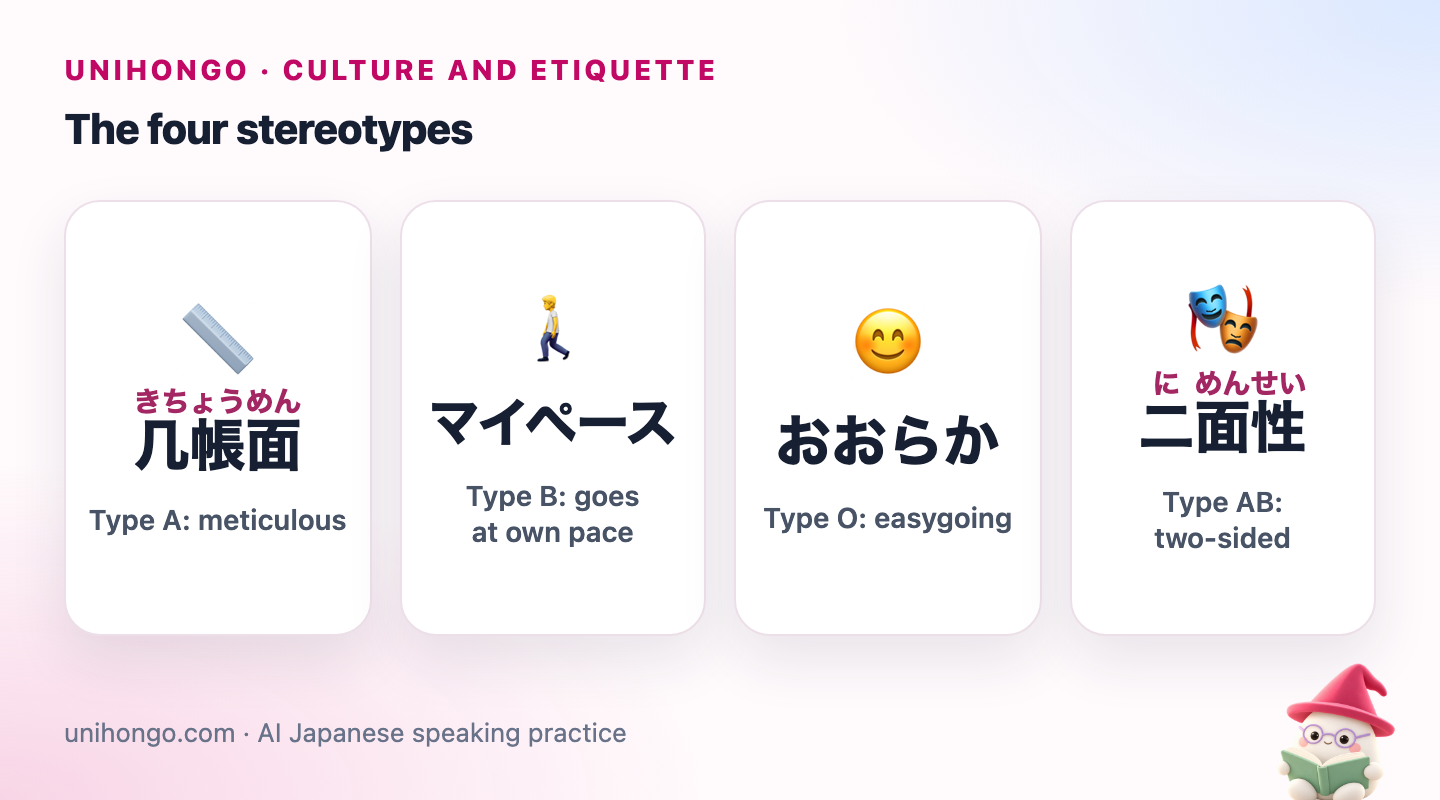
| Japanese | Romaji | Meaning |
|---|---|---|
| 几帳面 | kichōmen | Type A: meticulous |
| マイペース | maipēsu | Type B: goes at own pace |
| おおらか | ōraka | Type O: easygoing |
| 二面性 | nimensei | Type AB: two-sided |
| 真面目 | majime | serious, earnest |
| 大ざっぱ | ōzappa | rough, not fussy about detail |
| 天才肌 | tensaihada | the genius type |
Maipēsu comes from the English words my pace, but it is a Japanese coinage: it describes someone who does things in their own way and time, which can be a compliment or a complaint.
How the stereotypes are used
| Type | Said to be | The teasing version |
|---|---|---|
| A | Careful, tidy, considerate | Nervous, a perfectionist |
| B | Independent, curious, cheerful | Selfish, does not listen |
| O | Easygoing, generous, a natural leader | Careless about details |
| AB | Rational, creative, two-sided | Hard to read, an oddball |
Notice that every type has a flattering and an unflattering version, which is how such systems always seem to fit. Type B tends to get the roughest jokes, and people with that type sometimes announce it with a wry warning.
Asking and answering
The full question is polite and safe with anyone you are chatting with socially. Among friends it shrinks to two words. Blood types are named with the Latin letter plus gata (型), type.
| Japanese | Romaji | Meaning |
|---|---|---|
| 血液型は何型ですか。 | Ketsuekigata wa nanigata desu ka. | What is your blood type? |
| 何型? | Nanigata? | What type are you? (casual) |
| A型です。 | Ē-gata desu. | I'm type A. |
| O型です。 | Ō-gata desu. | I'm type O. |
| 何型に見えますか。 | Nanigata ni miemasu ka. | What type do I look like? |
| 当ててみてください。 | Atete mite kudasai. | Try to guess. |
Reacting: yappari, igai and ppoi
There are really only two reactions: the answer fits the stereotype, or it does not. Yappari (やっぱり) means just as I thought. Igai (意外) means unexpected. The ending ppoi (っぽい) means seems like, so Ē-gata ppoi is you seem like a type A.
| Japanese | Romaji | Meaning |
|---|---|---|
| やっぱり! | Yappari! | I knew it! |
| 意外です。 | Igai desu. | That's unexpected. |
| A型っぽいですね。 | Ē-gata ppoi desu ne. | You do seem like a type A. |
| よく言われます。 | Yoku iwaremasu. | I get that a lot. |
| 当たっていますね。 | Atatte imasu ne. | That fits, doesn't it? |
| 全然当たっていません。 | Zenzen atatte imasen. | That doesn't fit me at all. |
Keep it light. Yappari said about a compliment is friendly; yappari said after someone makes a mistake is a jab.
Where the idea came from
The idea is usually traced to the late 1920s, when the educator Takeji Furukawa published a paper proposing a link between blood type and temperament. Interest faded, then returned as a mass-market craze in the 1970s through bestselling books by the writer Masahiko Nomi.
Since then it has lived in magazines, television and conversation. Profiles of singers, athletes and fictional characters routinely list a blood type next to the birthday and height, which is why anime and game fans meet the idea long before they visit Japan.
Burahara: when the joke goes too far
Burahara (ブラハラ) is short for buraddo taipu harasumento, blood type harassment: treating someone differently, or explaining away their behaviour, because of their type. A guess over drinks is one thing. Telling a colleague that a mistake is typical of a B is another.
Asking about blood type in a job interview is widely regarded as inappropriate, since it has nothing to do with ability. As a visitor, follow the other person's lead: answer if asked, ask back if the mood is playful, and do not push the topic with someone who looks tired of it.
If you do not know your type, or do not believe it
You do not have to play along with the theory to enjoy the conversation. These polite lines let you answer honestly and keep things friendly.
| Japanese | Romaji | Meaning |
|---|---|---|
| 血液型は知りません。 | Ketsuekigata wa shirimasen. | I don't know my blood type. |
| 調べたことがありません。 | Shirabeta koto ga arimasen. | I've never had it checked. |
| 私の国ではあまり話しません。 | Watashi no kuni de wa amari hanashimasen. | We don't talk about it much in my country. |
| 信じていますか。 | Shinjite imasu ka. | Do you believe in it? |
| あまり信じていませんが、面白いですね。 | Amari shinjite imasen ga, omoshiroi desu ne. | I don't really believe it, but it's fun. |