
Safety first
A warehouse floor has moving equipment, and the phrases for warning and stopping are the ones with real consequences. They are short by design and are said loudly rather than politely.
Learn these before anything else. A safety phrase you have to assemble is one you will not say in time.
| Japanese | Romaji | Meaning |
|---|---|---|
| 危ない! | Abunai! | Danger! |
| 止まってください! | Tomatte kudasai! | Please stop! |
| 後ろ、通ります。 | Ushiro, tōrimasu. | Coming through behind you. |
| フォークリフトが来ます。 | Fōkurifuto ga kimasu. | A forklift is coming. |
| 下がってください。 | Sagatte kudasai. | Please stand back. |
| けが人がいます。 | Keganin ga imasu. | Someone is injured. |
Numbers and counters
Quantities are the substance of the job. Japanese counts different things with different counters, and a warehouse uses a small set of them constantly: pieces, boxes, pallets and cases.
The safer digit readings matter here more than in most places, because the floor is noisy and a misheard quantity means a wrong shipment.
| Counter | Used for | Example |
|---|---|---|
| 個 | Individual pieces | 十個 |
| 箱 | Boxes | 五箱 |
| ケース | Cases | 三ケース |
| パレット | Pallets | 二パレット |
| 本 | Long items | 六本 |
| 枚 | Flat items | 四枚 |
Use nana for seven and yon for four throughout. Both alternatives are confusable with one, and that is the error that ships the wrong quantity.
Receiving and confirming instructions
Instructions arrive quickly and often while the person is pointing at something. Confirming the number and the location back is expected practice and is the main defence against expensive errors.
Asking for a demonstration is usually faster than asking for a repetition, and it is the normal way to resolve a misunderstanding on a warehouse floor.
| Japanese | Romaji | Meaning |
|---|---|---|
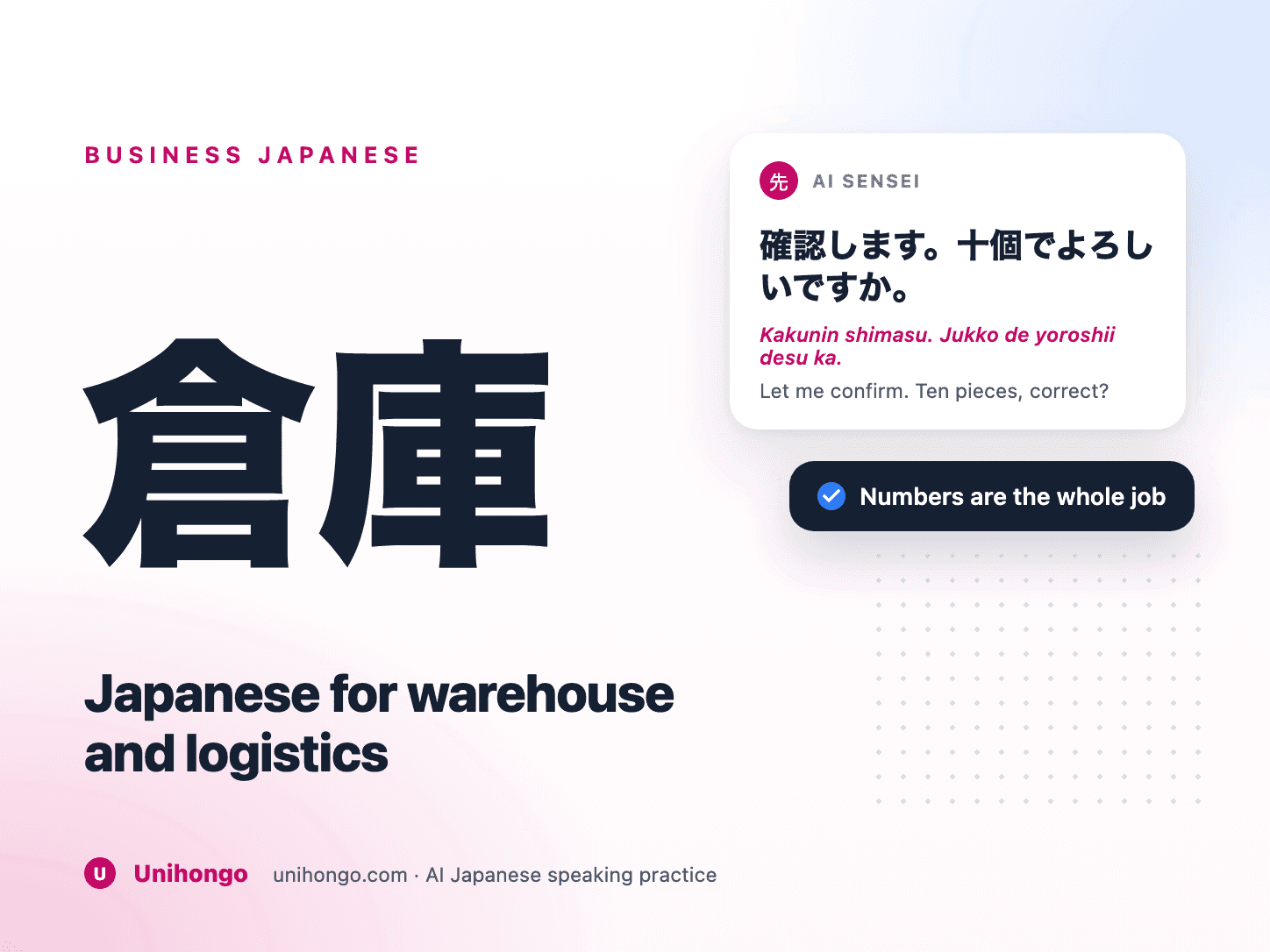
| 確認します。十個でよろしいですか。 | Kakunin shimasu. Jukko de yoroshii desu ka. | Let me confirm. Ten pieces, correct? |
| どの棚ですか。 | Dono tana desu ka. | Which shelf? |
| 場所をもう一度お願いします。 | Basho o mō ichido onegai shimasu. | The location once more, please. |
| やって見せていただけますか。 | Yatte misete itadakemasu ka. | Could you show me? |
| この商品で合っていますか。 | Kono shōhin de atte imasu ka. | Is this the right item? |
| 終わったら、次は何をしますか。 | Owattara, tsugi wa nani o shimasu ka. | When I finish, what is next? |
Reporting problems
Damage, shortages and mismatches are routine and are reported immediately rather than resolved quietly. Japanese workplaces strongly favour early reporting, and a problem raised at once is an ordinary event.
The report needs three things: what, where, and how many.
| Japanese | Romaji | Meaning |
|---|---|---|
| 数が合いません。 | Kazu ga aimasen. | The count does not match. |
| 商品が破損しています。 | Shōhin ga hason shite imasu. | The item is damaged. |
| ラベルが違います。 | Raberu ga chigaimasu. | The label is wrong. |
| 在庫が足りません。 | Zaiko ga tarimasen. | There is not enough stock. |
| 見つかりません。 | Mitsukarimasen. | I cannot find it. |
| 報告させていただきます。 | Hōkoku sasete itadakimasu. | I would like to report it. |
Report a count mismatch before continuing, not at the end of the shift. Later, nobody can tell where the discrepancy entered.
The shift handover
Handovers are short and structured: what was completed, what is outstanding, and anything unusual. Preparing the three points beforehand makes it a one-minute conversation.
Writing the numbers down before the handover removes any need to compose Japanese while people are waiting.
| Japanese | Romaji | Meaning |
|---|---|---|
| 本日、三百個完了しました。 | Honjitsu, sanbyakko kanryō shimashita. | Three hundred pieces completed today. |
| 残りは明日になります。 | Nokori wa ashita ni narimasu. | The rest will be tomorrow. |
| 異常はありませんでした。 | Ijō wa arimasen deshita. | Nothing unusual occurred. |
| 一件、破損がありました。 | Ikken, hason ga arimashita. | There was one damaged item. |
| 引き継ぎは以上です。 | Hikitsugi wa ijō desu. | That is the end of the handover. |
| お疲れさまでした。 | Otsukaresama deshita. | Thank you for your work. |
Drilling for a noisy floor
A warehouse degrades speech in exactly the way Japanese is most vulnerable to: noise smears the length distinctions that separate words, and quantities are the thing being said.
That makes the pronunciation lab unusually relevant. Drilling numbers and counters with clear length gives them the margin they need to land across a noisy floor, where a marginally produced number simply has to be repeated.
The confirmation phrases are the other thing to make automatic. Practising them with an AI Sensei in Unihongo's immersive 3D classroom means you can use them freely rather than saving them for when you are already lost.
If you learn only two things, learn the safety phrases and the numbers. Everything else in this job can be handled slowly.