
The two tricksters at a glance
Kitsune (狐) is the fox; tanuki (狸) is the raccoon dog. In stories both have a magical power: they can bakeru, take on another form, and bakasu, bewitch or trick a human. A fox might become a beautiful woman, a tanuki a monk or a tea kettle, and the unlucky traveller wakes up to find the feast was leaves and the money was grass.
Their personalities are different, though. The fox is usually the cool, clever one, admired and a little feared. The tanuki is the jolly, greedy, clumsy one, more likely to make you laugh than to frighten you. Japanese even has a phrase for two sly people trying to outwit each other: kitsune to tanuki no bakashiai, a fox and a tanuki tricking each other.
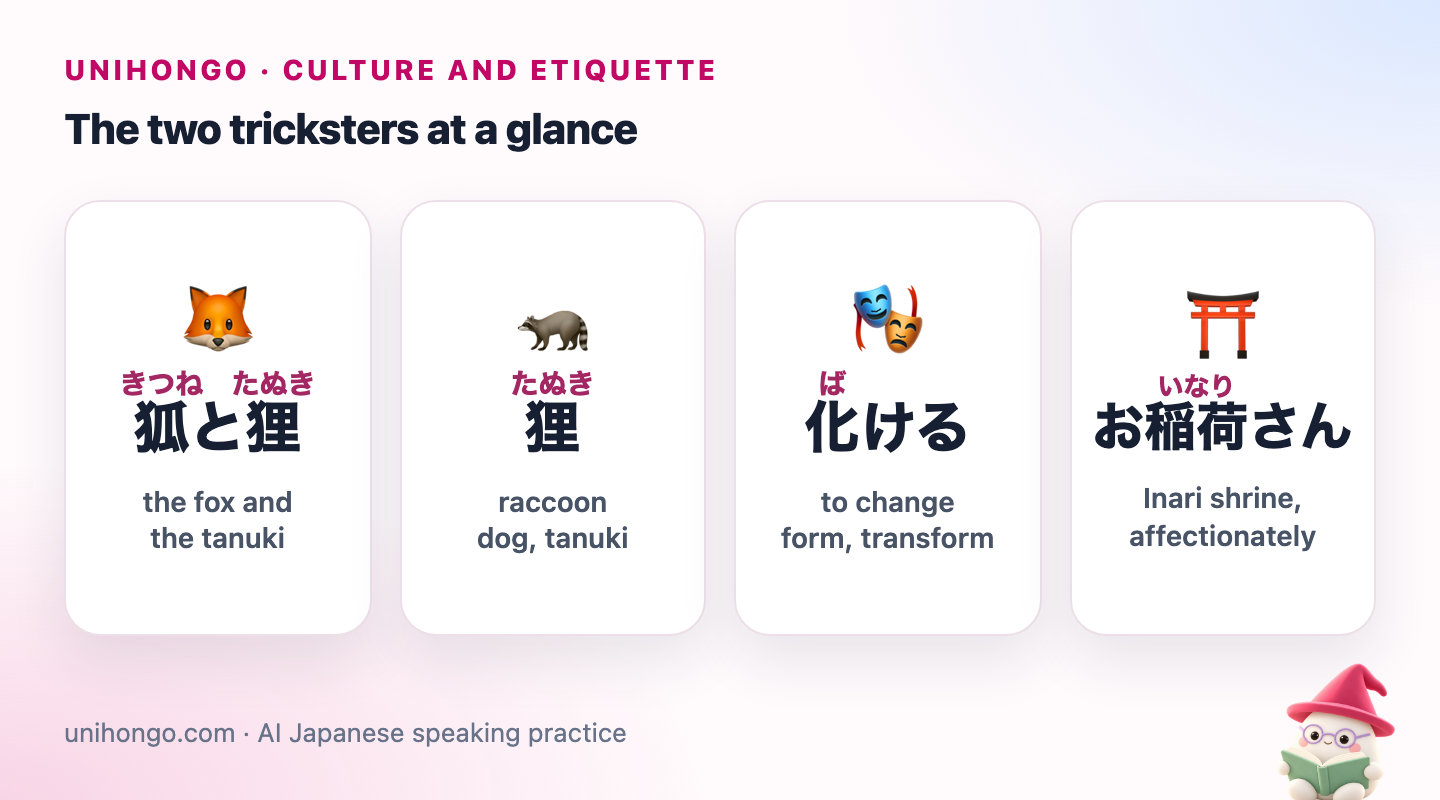
| Japanese | Romaji | Meaning |
|---|---|---|
| 狐と狸 | kitsune to tanuki | the fox and the tanuki |
| 狸 | tanuki | raccoon dog, tanuki |
| 化ける | bakeru | to change form, transform |
| お稲荷さん | oinari san | Inari shrine, affectionately |
| 化かす | bakasu | to bewitch, trick |
| 狐と狸の化かし合い | kitsune to tanuki no bakashiai | two sly people outwitting each other |
Kitsune: foxes of Inari and of legend
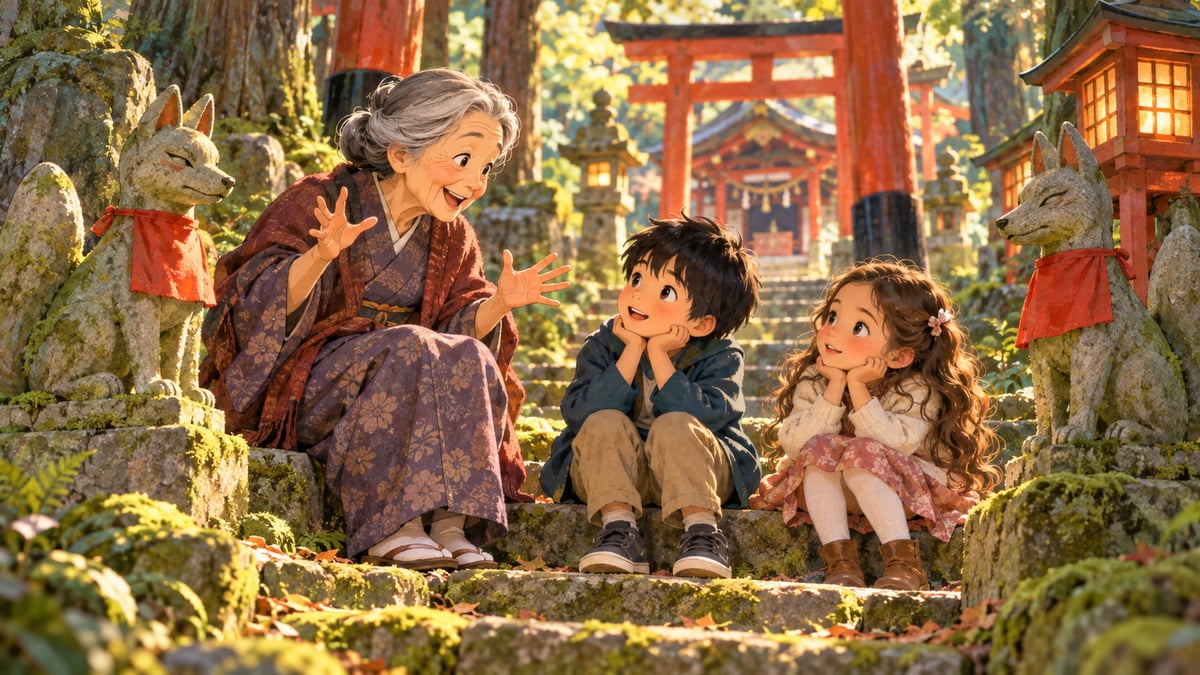
The fox has two faces in Japanese belief. The first is sacred: foxes are regarded as the messengers of Inari, the deity of rice and prosperity worshipped at many thousands of shrines across Japan. Pairs of stone foxes stand at the gates, often wearing red bibs and holding a key, a jewel or a scroll in their mouths. Offerings of aburaage, sweet fried tofu, are said to be the foxes' favourite, which is why inarizushi, rice in fried tofu pouches, and kitsune udon, udon topped with fried tofu, carry the fox's name.
The second face is wild. In folk tales, foxes trick travellers, possess people and transform into beautiful women who marry humans. In some stories, a fox grows more tails as it ages and gains power, up to the nine-tailed fox, kyūbi no kitsune, a famous figure of legend. Fox masks, kitsune no omen, are sold at festivals and appear often in anime.
| Japanese | Romaji | Meaning |
|---|---|---|
| お稲荷さんの狐 | oinari san no kitsune | the foxes of an Inari shrine |
| 油揚げ | aburaage | fried tofu |
| 九尾の狐 | kyūbi no kitsune | nine-tailed fox |
| 狐のお面 | kitsune no omen | fox mask |
| 狐火 | kitsunebi | fox fire, mysterious lights at night |
Tanuki: the jolly shape-shifter
The tanuki of folklore is a merry prankster. It is said to change shape by placing a leaf on its head, and to drum on its round belly on moonlit nights, a sound called tanuki no haratsuzumi. In many tales, its tricks go wrong because it cannot hide its tail or is too greedy, and it ends up the fool.
The tanuki you see most often is a ceramic one: a standing figure in a straw hat, with big round eyes, a broad smile, a huge belly, a sake flask in one hand and a ledger in the other. This style, strongly associated with Shigaraki ware from Shiga Prefecture, stands outside countless restaurants and shops as a good-luck charm for business. Shops often explain each part as a lucky symbol, for example the hat protecting from bad luck and the belly showing calm boldness, though the details differ from source to source.
| Japanese | Romaji | Meaning |
|---|---|---|
| 信楽焼の狸 | shigarakiyaki no tanuki | a Shigaraki ceramic tanuki |
| 腹鼓 | haratsuzumi | drumming on one's belly |
| 葉っぱを頭にのせる | happa o atama ni noseru | to put a leaf on one's head |
| しっぽが出ているよ。 | Shippo ga dete iru yo. | Your tail is showing. (your trick is exposed) |
Fox and tanuki compared
The food names are a fun reminder of regional variety: in much of eastern Japan, tanuki soba means soba with crunchy tempura bits, while in parts of western Japan, such as Kyoto and Osaka, the word refers to quite different dishes. If you are curious, ask the shop what their tanuki is.
| Japanese | Romaji | Meaning |
|---|---|---|
| きつねうどん | kitsune udon | udon with sweet fried tofu |
| たぬきそば | tanuki soba | soba with tempura bits (in many areas) |
| Point | Kitsune (fox) | Tanuki (raccoon dog) |
|---|---|---|
| Typical character | Clever, elegant, mysterious | Jolly, greedy, clumsy |
| Favourite disguise in tales | A beautiful woman | A monk, a kettle, a traveller |
| Sacred role | Messenger of Inari | Mostly a folk and good-luck figure |
| Where you see it | Inari shrines, festival masks | Shop and restaurant entrances |
| Food name | Kitsune udon: fried tofu | Tanuki udon or soba: tempura bits, varies by region |
Idioms the fox and tanuki left behind
Many everyday expressions come from these animals. Most are casual or neutral and are used with a smile. Use them about situations or about yourself; aiming them at a person you are talking to, especially an older one, can sound rude.
| Japanese | Romaji | Meaning |
|---|---|---|
| 狸寝入り | tanuki neiri | pretending to be asleep |
| 取らぬ狸の皮算用 | toranu tanuki no kawazan'yō | counting your chickens before they hatch |
| 狐につままれたよう | kitsune ni tsumamareta yō | utterly baffled, as if bewitched |
| 狐の嫁入り | kitsune no yomeiri | a sun shower; literally, the fox's wedding |
| 虎の威を借る狐 | tora no i o karu kitsune | acting tough on someone else's authority |
| 狸親父 | tanuki oyaji | a sly old man (rude) |
| また狸寝入りしてるでしょう。 | Mata tanuki neiri shiteru deshō. | You're pretending to sleep again, aren't you? (teasing) |
| まだ受かってないのに、取らぬ狸の皮算用だよ。 | Mada ukatte nai noni, toranu tanuki no kawazan'yō da yo. | You haven't passed yet; don't count your chickens. (casual) |
| 晴れているのに雨。狐の嫁入りだね。 | Harete iru noni ame. Kitsune no yomeiri da ne. | Rain while it's sunny. A fox's wedding, isn't it? |
Tanuki oyaji is genuinely insulting, used for a crafty older man, often a politician or a boss, behind his back. Toranu tanuki no kawazan'yō literally means calculating the price of the pelt of a tanuki you have not caught yet, a vivid old image.
Two famous tales
Bunbuku Chagama is a folk tale told in several versions. In a well-known one, a tanuki turns itself into a tea kettle; when the kettle is put on the fire, it grows a head, a tail and legs and runs about. The tanuki later performs tricks and brings good fortune to the man who looks after it. A temple in Gunma Prefecture, Morinji, is linked with the story and keeps a kettle associated with it.
Kuzunoha is a famous fox legend: a white fox, saved by a young man, takes the form of a woman named Kuzunoha, marries him and has a son, then must leave when her true form is discovered. In the legend, the son grows up to be a celebrated court diviner of the Heian period. The story has inspired plays and puppet theatre for centuries.
| Japanese | Romaji | Meaning |
|---|---|---|
| むかしむかし、あるところに… | Mukashi mukashi, aru tokoro ni... | Once upon a time, in a certain place... |
| 狸が茶釜に化けました。 | Tanuki ga chagama ni bakemashita. | The tanuki turned into a tea kettle. |
| 狐は美しい女の人に化けました。 | Kitsune wa utsukushii onna no hito ni bakemashita. | The fox turned into a beautiful woman. |
| 正体がばれてしまいました。 | Shōtai ga barete shimaimashita. | Its true form was discovered. |
Meeting the real animals
Both animals are real and live wild in Japan. Tanuki are shy, nocturnal and surprisingly common, even in wooded suburbs and parks near big cities. Foxes are seen in the countryside and are famous in Hokkaido, where the local fox, kita kitsune, often approaches tourists. Do not feed or touch wild foxes or tanuki: in Hokkaido in particular, foxes can carry a dangerous parasite, and local advice warns visitors not to touch them or drink untreated stream water.
| Japanese | Romaji | Meaning |
|---|---|---|
| 夜、タヌキを見かけました。 | Yoru, tanuki o mikakemashita. | I saw a tanuki at night. |
| キタキツネ | kita kitsune | Hokkaido red fox |
| 野生動物にえさをあげないでください。 | Yasei dōbutsu ni esa o agenaide kudasai. | Please don't feed wild animals. |
Make the idioms yours with Mocchi
Paste an idiom sentence into Mocchi with /explain, for example /explain 取らぬ狸の皮算用だよ, and Mocchi breaks it into parts, names the grammar and gives the meaning. Then ask it to quiz you on the six idioms in this guide; Mocchi keeps track of the ones you confuse and brings them back in a later /review.
Turn the idioms and animal words into flashcards and stack them up in Kotoba Stack, building a tower word by word, a light way to keep folklore vocabulary fresh.