
Sun and fire in four names
These four names show the range of the topic: two warm, everyday sun names that you will meet in classrooms and offices, one fire-related name that real parents do use, and one fire name that belongs mostly to stories.
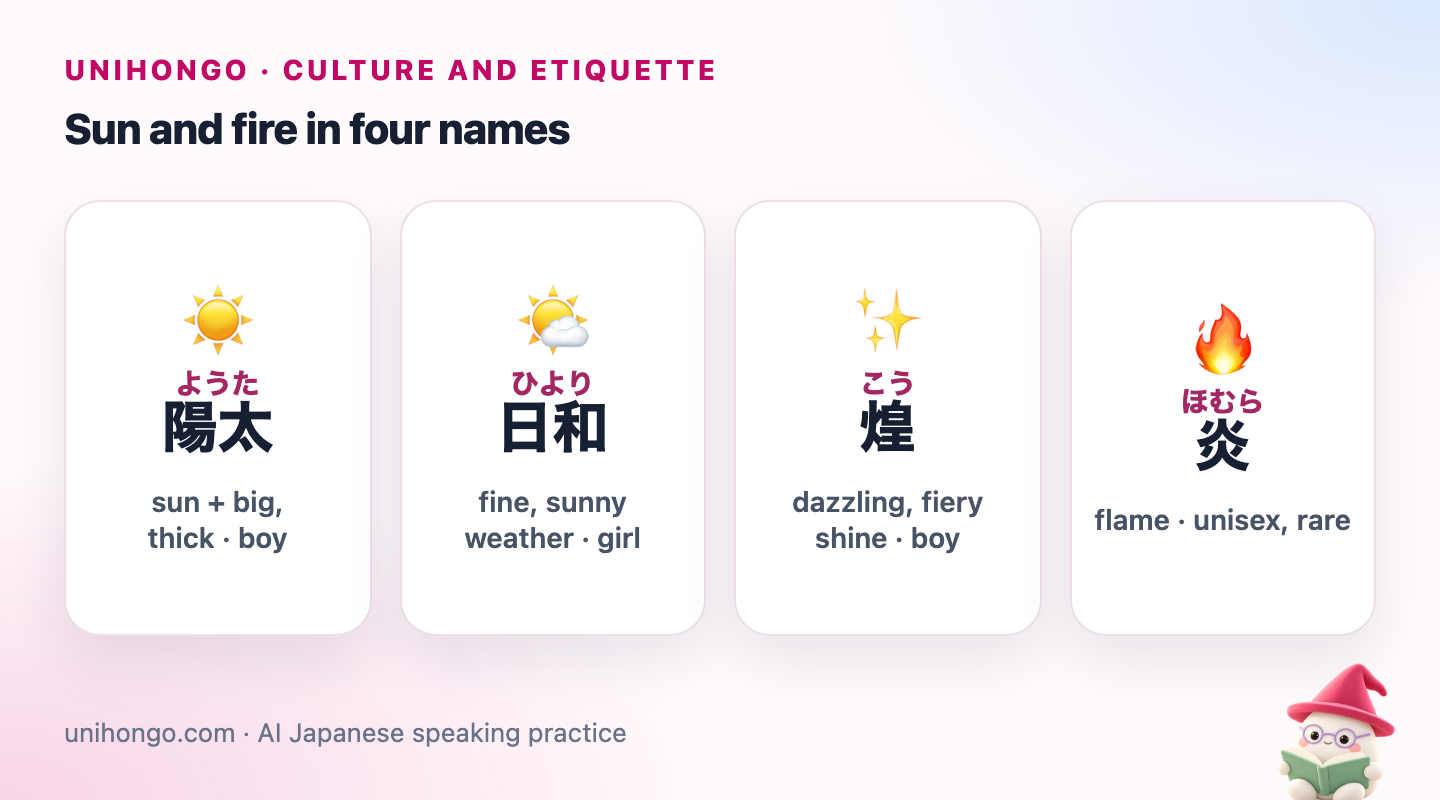
| Japanese | Romaji | Meaning |
|---|---|---|
| 陽太 | Yōta | sun + big, thick · boy |
| 日和 | Hiyori | fine, sunny weather · girl |
| 煌 | Kō | dazzling, fiery shine · boy |
| 炎 | Homura | flame · unisex, rare |
陽太 combines 陽, sunshine, with 太, big or thick, a kanji that appears in many boys' names ending in -ta. 日和 is an ordinary word for good weather, as in 小春日和, a warm spell in late autumn, and parents choose it for a calm, sunny feeling. 煌 is built from 火, fire, and 皇, and means to shine brilliantly; it can also be read Kira or Akira in names. 炎 is two fire kanji stacked on top of each other, and in names it is usually read Homura, an old word for flame.
陽 and 日: the two sun kanji
Both kanji are connected to the sun, but they feel different. 日 is the picture of the sun itself, and in everyday Japanese it means both sun and day: 日曜日 (Sunday), 毎日 (every day), 日本 (Japan). Because it is so ordinary, a name with 日 often feels simple and natural. 陽 means sunshine, the warm, sunny side of things, and it appears in words such as 太陽 (the sun) and 陽気 (cheerful). It sounds brighter and is the more common choice when parents want a sunny name.
In names both kanji can take several readings, so the same kanji gives very different names. The table shows the readings you are most likely to meet.
| Japanese | Romaji | Meaning |
|---|---|---|
| 陽介 | Yōsuke | sun + helper · boy |
| 陽子 | Yōko | sunshine child · girl, classic |
| 千陽 | Chiharu | a thousand suns · girl |
| 陽向 | Hinata | facing the sun · unisex |
| 日菜子 | Hinako | sun + greens + child · girl |
| Kanji | Readings in names | Example |
|---|---|---|
| 陽 | yō, haru, hi, hina, akira | 陽介 Yōsuke, 千陽 Chiharu, 陽向 Hinata |
| 日 | hi, hina, ka, haru | 日菜子 Hinako, 日和 Hiyori |
陽子 was a very common girl's name for an earlier generation, so today it sounds like the name of someone's mother or aunt. 日菜子 and 陽向 feel younger. 陽 read hina is a name reading rather than an everyday one, which is why Japanese people themselves sometimes ask how a name like this is read.
Why real fire names are rare
Japanese towns were built of wood for centuries, and large fires destroyed whole neighbourhoods many times. The everyday words for fire are mostly about danger or caution: 火事 (a fire in a building), 火傷 (a burn), 火の用心 (beware of fire, the call of old night patrols). Many parents feel that a direct fire kanji brings those images with it, or simply sounds too fierce for a baby. This is a feeling, not a rule, and families differ, but it explains why you rarely meet a real child whose name is written 火.
炎 is a common kanji and can legally be used in a name. In names it is usually read Homura, while the everyday word for flame is honō. You will find Homura, and the older-looking variant 焔, much more often in anime, manga and games, where a fiery name instantly tells you about a character's personality.
| Japanese | Romaji | Meaning |
|---|---|---|
| 火 | hi | fire |
| 炎 | honō | flame (the everyday word) |
| 火事 | kaji | a fire in a building |
| 花火 | hanabi | fireworks, literally fire flowers |
| 火の用心 | hi no yōjin | beware of fire |
Not every fire word is frightening. 花火, fireworks, is one of the happiest words of summer, and 灯 or 灯り, a lamp or a soft light, feels warm and safe. That is why parents who like the image of fire usually pick a lamp or a sparkle instead of a blaze.
Fire hiding inside other kanji
Look closely at some popular name kanji and you will find fire inside them. The radical 火 appears on the left of 灯 (lamp) and 煌 (dazzling), and in a squeezed form on the right of 秋 (autumn), where it sits next to 禾, the grain plant. A different form, four dots called 灬, appears at the bottom of 照 (to shine on) and 熙 (bright). Knowing these shapes helps you recognise the family resemblance, even though most people who carry these names do not think of them as fire names.
| Japanese | Romaji | Meaning |
|---|---|---|
| 千秋 | Chiaki | a thousand autumns · unisex |
| 秋人 | Akito | autumn + person · boy |
| 灯真 | Tōma | lamp + truth · boy |
| 燈子 | Tōko | lamp child · girl |
| 照 | Teru | to shine on · unisex, older |
| 煌大 | Kōdai | dazzling + great · boy |
千秋 is also an everyday expression in 一日千秋, a day that feels like a thousand autumns, used when you are waiting impatiently for something. 燈 is the older, more formal form of 灯, and some parents choose it because it looks more elegant. These names say warmth and light rather than burning, which is exactly why they are used.
Explaining a sunny name in Japanese
When Japanese people introduce their name, they usually explain the kanji with a well-known word, because spoken names do not show which kanji are used. For sun names, the easiest reference words are 太陽 (the sun), 天気 (weather) and the season you were born in. These lines work in polite conversation with colleagues, teachers or new acquaintances.
| Japanese | Romaji | Meaning |
|---|---|---|
| 陽太は、太陽を逆にした字です。 | Yōta wa, taiyō o gyaku ni shita ji desu. | Yōta is written like the word sun, reversed. |
| 日和は、お出かけ日和の日和です。 | Hiyori wa, odekake biyori no hiyori desu. | Hiyori is the hiyori in perfect day for an outing. |
| 夏生まれなので、陽の字を入れました。 | Natsu umare na node, yō no ji o iremashita. | She was born in summer, so we used the sun kanji. |
| 明るい子に育ってほしくて。 | Akarui ko ni sodatte hoshikute. | We wanted him to grow up cheerful. |
| 温かい名前ですね。 | Atatakai namae desu ne. | What a warm name. (polite compliment) |
Notice that 日和 becomes biyori after another word, as in odekake biyori. This sound change, called rendaku, happens in many compounds, but the name itself stays Hiyori. If you compliment the name, warm adjectives such as 温かい (warm) and 明るい (bright, cheerful) fit sun names perfectly.
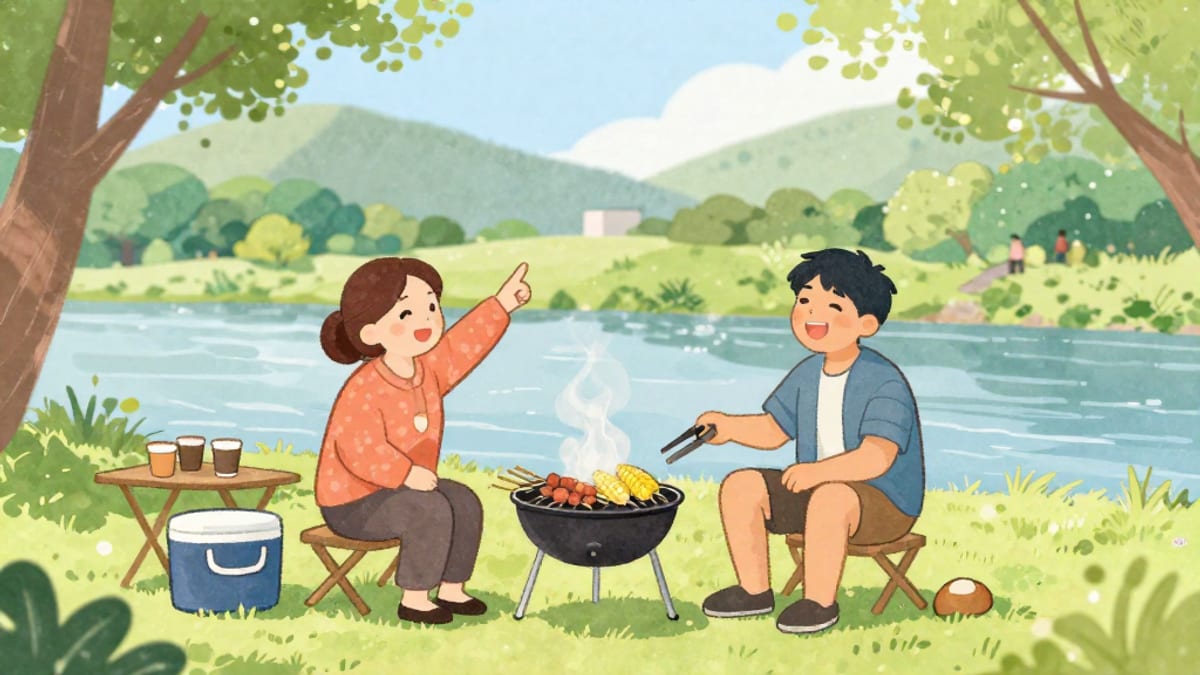
Mini dialogue: Hiyori at a riverside barbecue
A friend has invited you to a barbecue by the river, and you meet a woman who has just arrived. The weather is perfect, which gives you an easy start. The conversation is polite, because you have just met, but relaxed.
| Japanese | Romaji | Meaning |
|---|---|---|
| 今日は本当にいい天気ですね。 | Kyō wa hontō ni ii tenki desu ne. | You: The weather is really lovely today. |
| ええ、名前のとおりです。 | Ee, namae no tōri desu. | Hiyori: Yes, just like my name. |
| え、お名前は何ですか。 | E, onamae wa nan desu ka. | You: Oh? What's your name? |
| 日和です。いい天気の日和です。 | Hiyori desu. Ii tenki no hiyori desu. | Hiyori: I'm Hiyori. Hiyori as in nice weather. |
| 素敵ですね。晴れ女なんですか。 | Suteki desu ne. Hareonna na n desu ka. | You: Lovely. Do you bring the sunshine? |
| よく言われます。 | Yoku iwaremasu. | Hiyori: People often say so. |
晴れ女 (hareonna) is a playful word for a woman who seems to bring good weather wherever she goes; the male version is 晴れ男 (hareotoko), and the opposite is 雨女 or 雨男, someone who always brings rain. It is light-hearted and fine among friends, and it is a natural joke to make with someone called Hiyori or Hinata.
Make 陽 and 日 stick with Mocchi
Open Mocchi and type /kanji 陽. Mocchi gives you the meaning, the readings and a handful of everyday words, and you can follow up with a question such as Which readings of 陽 are used only in names? Then ask Mocchi to quiz you on the names in this post. It keeps track of the ones you misread, for example Hinata versus Hinako, and brings them back in a later review instead of starting from zero.
For the visual side, ask Mocchi to /create-flashcards for 陽太, 日和, 千秋 and 灯真. You pick a photo for each card, perhaps a sunrise, a picnic, red maple leaves and a paper lantern, and the spaced-repetition review shows the cards you find hard more often until the kanji and the picture are linked in your head.
Pitfalls with sun and fire names
- Reading every 陽 as yō. In names it is often haru or hina, so 千陽 is Chiharu and 陽向 is Hinata. When in doubt, ask how the name is read rather than guessing aloud.
- Choosing 火 or 炎 for a real child because it looks cool in English. Many Japanese speakers find a direct fire name harsh, and it may sound like a game character. For a novel or a game, of course, that is exactly the effect you might want.
- Mixing up the words honō and Homura. The everyday word for flame is honō; Homura is the poetic, name-like reading.
- Dropping the long vowels. Yōta, Yōsuke, Yōko and Tōma all have a long ō, and Yota or Toma sound like different names to a Japanese ear.
- Assuming a sun name is always for a girl. 陽太, 陽介 and 煌大 are boys' names, 陽向 is used for any gender, and only some, such as 陽子, are clearly girls' names.