

Chotto kangaesasete: the direct phrase
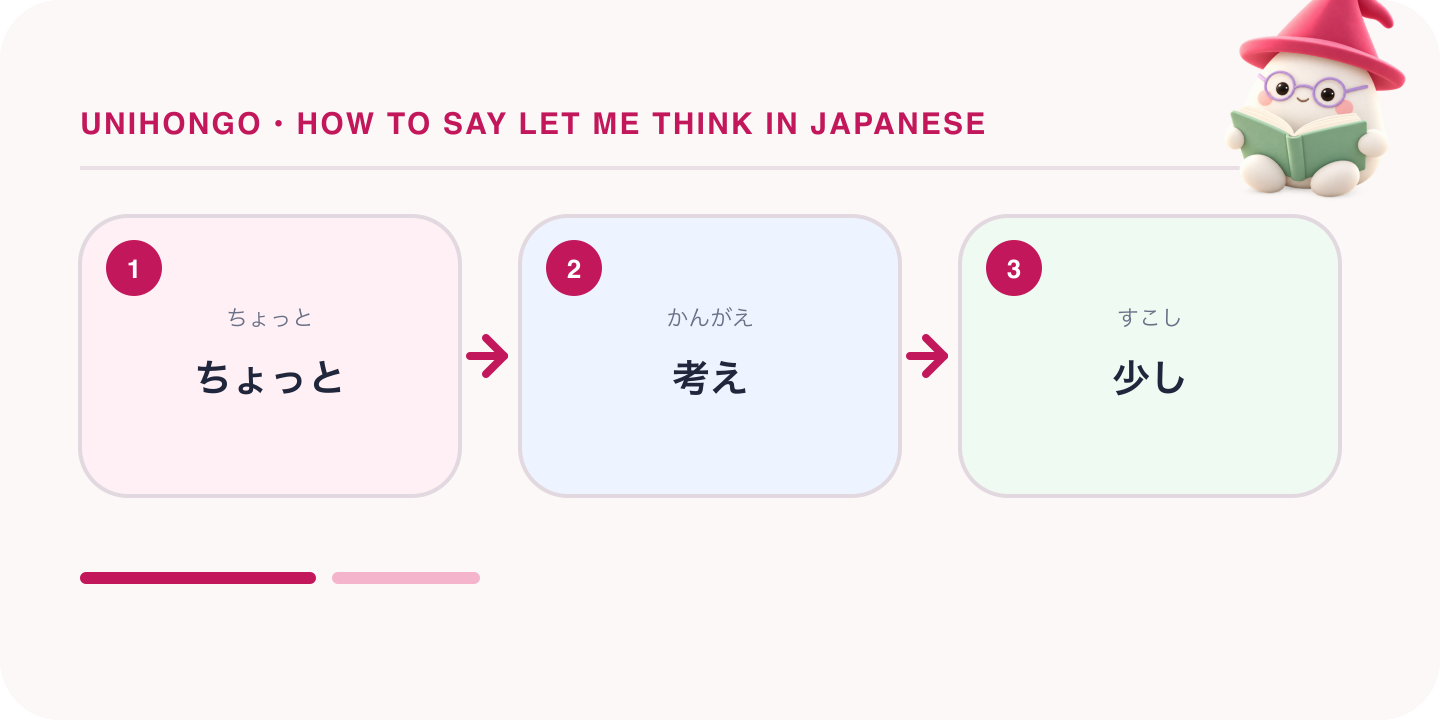
考える (kangaeru) means to think or consider. Its causative form, 考えさせる (kangaesaseru), means to let someone think, and the te-form 考えさせて (kangaesasete) turns it into a request: let me think. Add ちょっと (chotto), a little, and you have the everyday casual phrase ちょっと考えさせて (chotto kangaesasete).
In polite speech, add kudasai: chotto kangaesasete kudasai. To soften it further, turn it into a question: sukoshi kangaesasete moraemasu ka, could you give me a little time to think? The phrase works for everything from choosing a restaurant to deciding on a job offer.
The causative pattern is the same one used in yasumasete kudasai, please let me rest, and kaerasete kudasai, please let me go home. It asks for permission, which is why it sounds considerate.
| Japanese | Romaji | Meaning |
|---|---|---|
| ちょっと考えさせて。 | Chotto kangaesasete. | Let me think a bit. (casual) |
| ちょっと考えさせてください。 | Chotto kangaesasete kudasai. | Please let me think about it. (polite) |
| 少し考えさせてもらえますか。 | Sukoshi kangaesasete moraemasu ka. | Could you give me a little time to think? |
| 一晩考えさせてください。 | Hitoban kangaesasete kudasai. | Let me sleep on it. |
| ちょっと待って、考えてる。 | Chotto matte, kangaeteru. | Hang on, I'm thinking. |
Fillers while you think: sō desu ne, ētto, un
Often you only need a few seconds, and a full request would be too much. Japanese uses short fillers to show you are thinking. そうですね (sō desu ne), said slowly and with a falling tone, is the polite all-rounder: let me see. In casual speech it becomes sō da ne or just sō nē.
えーっと (ētto) and えー (ē) are the everyday ums. あのー (anō) is more for getting attention or hesitating before saying something awkward. うーん (ūn) signals that you are genuinely unsure. Nan te iu ka na, how should I put it, and nan da kke, what was it again, are useful when you are searching for a word.
Japanese listeners expect these sounds, and a silent pause without them can feel like you did not hear. A filler keeps the conversation alive while you think.
| Japanese | Romaji | Meaning |
|---|---|---|
| そうですね… | Sō desu ne... | Let me see... (polite) |
| えーっと… | Ētto... | Um... |
| うーん、どうかな。 | Ūn, dō ka na. | Hmm, I'm not sure. |
| 何て言うかな。 | Nan te iu ka na. | How should I put it? |
| 何だっけ。 | Nan da kke. | What was it again? |
| そうですねえ、難しいですね。 | Sō desu nē, muzukashii desu ne. | Hmm, that's a tricky one. |
Kangaete mimasu: I'll think about it
考えてみます (kangaete mimasu) means I'll try thinking about it, or I'll think it over. The te-miru pattern, try doing, makes it gentle and open. Casually it is kangaete miru, and friends often say kangaete oku, I'll think about it, which can sound a little noncommittal.
In shops, this is the standard way to leave without buying: mō sukoshi kangaete mimasu, I'll think about it a bit more. Staff will not push, because they understand it as a polite way to leave. Among friends, kangaete oku ne in response to an invitation is often a soft no, while a sincere maybe usually comes with more detail, such as a date you will confirm.
| Japanese | Romaji | Meaning |
|---|---|---|
| 考えてみます。 | Kangaete mimasu. | I'll think about it. |
| もう少し考えてみます。 | Mō sukoshi kangaete mimasu. | I'll think about it a bit more. |
| 考えとくね。 | Kangaetoku ne. | I'll think about it. (casual) |
| 家族と相談してみます。 | Kazoku to sōdan shite mimasu. | I'll talk it over with my family. |
| 明日までにお返事します。 | Ashita made ni o-henji shimasu. | I'll give you an answer by tomorrow. |
Kentō shimasu: the business phrase and its soft no
検討 (kentō) means examination or consideration, and in business it is the standard word for taking something under review. 検討します (kentō shimasu) is we will consider it, and the more humble 検討させていただきます (kentō sasete itadakimasu) is we would like to consider it. You will hear these after proposals, quotes and requests.
Kentō is often sincere: a company may need approval from several people before anything is decided. But it is also a widely recognised way to say no without saying it. Signs that it is a real consideration include a time frame, questions about details, or a named person who will get back to you. Signs of a polite no include a quick zensho shimasu, we'll do our best, with no follow-up, or silence after the meeting.
When it matters, ask politely for a time frame: itsu-goro o-henji o itadakemasu deshō ka, around when might we hear back? That is normal in Japanese business and will clarify things without pressuring anyone.
| Japanese | Romaji | Meaning |
|---|---|---|
| 検討します。 | Kentō shimasu. | We'll consider it. |
| 検討させていただきます。 | Kentō sasete itadakimasu. | Allow us to consider it. (humble) |
| 社内で検討いたします。 | Shanai de kentō itashimasu. | We'll discuss it internally. |
| 前向きに検討します。 | Maemuki ni kentō shimasu. | We'll consider it positively. |
| いつ頃お返事をいただけますでしょうか。 | Itsu-goro o-henji o itadakemasu deshō ka. | Around when might we hear back? |
| 来週中にご連絡いたします。 | Raishū-chū ni go-renraku itashimasu. | We'll contact you within next week. |
Choosing the right level
The right phrase depends on how long you need and who you are talking to. This table sums up the main options.
| Situation | Phrase | Level |
|---|---|---|
| A few seconds, any listener | そうですね… (sō desu ne) | Neutral |
| A few seconds, friends | えーっと / うーん (ētto / ūn) | Casual |
| A minute or more, friends | ちょっと考えさせて (chotto kangaesasete) | Casual |
| Time to decide, polite | 考えさせてください (kangaesasete kudasai) | Polite |
| Leaving a shop without buying | もう少し考えてみます (mō sukoshi kangaete mimasu) | Polite |
| Business proposal | 検討させていただきます (kentō sasete itadakimasu) | Formal |
What people say back
When you ask for time, the usual reply is permission and patience. Friends say ii yo, yukkuri de, sure, take your time. Polite speakers say dōzo, go-yukkuri, please take your time, and in business, sales staff often reply with an offer of more information and a question about when they may follow up.
If the other person needs an answer soon, they may give a deadline: kinyōbi made ni o-henji itadakemasu ka, could you let us know by Friday? That is not pushy; it is a normal way to keep things moving.
| Japanese | Romaji | Meaning |
|---|---|---|
| いいよ、ゆっくりで。 | Ii yo, yukkuri de. | Sure, take your time. |
| どうぞ、ごゆっくりお考えください。 | Dōzo, go-yukkuri o-kangae kudasai. | Please take your time to think it over. |
| 決まったら教えてね。 | Kimattara oshiete ne. | Let me know when you decide. |
| 金曜日までにお返事いただけますか。 | Kin'yōbi made ni o-henji itadakemasu ka. | Could you let us know by Friday? |
| 何かご不明な点があれば、お気軽にどうぞ。 | Nanika go-fumei na ten ga areba, o-kigaru ni dōzo. | If anything is unclear, feel free to ask. |
Common learner mistakes
These are the most frequent problems learners have with thinking phrases.
- Saying watashi wa kangaemasu, I think. It is not a request and does not ask for time; use kangaesasete.
- Using kangaesasete without chotto or kudasai to a teacher or boss. It sounds like a demand.
- Staying silent while thinking. Use a filler such as sō desu ne so the listener knows you heard.
- Saying kentō shimasu in a casual chat. It is business language and sounds stiff with friends.
- Taking every kentō shimasu as a yes, or every one as a no. Look for a time frame and follow-up.
- Overusing ētto in an interview. One or two are fine; after that, pause calmly instead.
The phrase you will use most is probably the simplest: sō desu ne, said slowly, while you find your words.