
Three arts, one shape of lesson
A traditional arts lesson is usually small, quiet, and organised around turns. Students arrive, greet the teacher and each other, prepare their materials, and then work one at a time or side by side while the teacher moves between them. Nobody talks much. What conversation there is tends to be brief and formal at the edges of the lesson and almost wordless in the middle of it.
That shape means the Japanese you need is front-loaded and back-loaded. The greeting, the request, the acknowledgement and the thanks carry the whole social side of the class, and they barely change between tea, brush and flowers. Learn those twelve or so phrases and you can attend any of the three without feeling lost, then add the specific vocabulary of your art at your own pace.
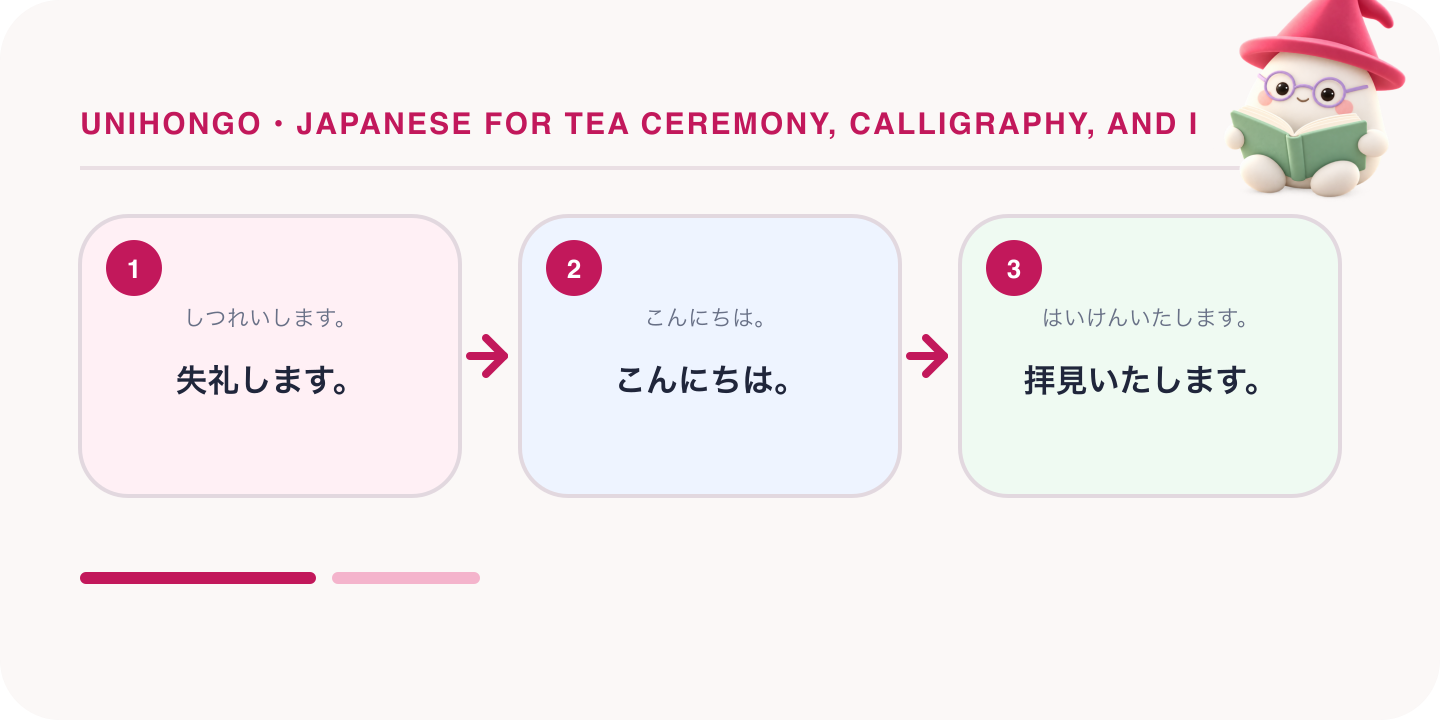
Lesson moments and the phrase that fits
| Moment | What you say | Reading |
|---|---|---|
| Arriving at the door | 失礼します。 | Shitsurei shimasu. |
| Greeting the teacher | 本日もよろしくお願いいたします。 | Honjitsu mo yoroshiku onegai itashimasu. |
| Greeting other students | こんにちは。 | Konnichiwa. |
| Starting your turn | お願いいたします。 | Onegai itashimasu. |
| Asking to watch someone | 見学させていただけますか。 | Kengaku sasete itadakemasu ka? |
| Looking closely at an object | 拝見いたします。 | Haiken itashimasu. |
| Missing what was said | すみません、もう一度お願いします。 | Sumimasen, mō ichido onegaishimasu. |
| Receiving a correction | はい、ありがとうございます。 | Hai, arigatō gozaimasu. |
| Finishing your turn | ありがとうございました。 | Arigatō gozaimashita. |
| Leaving before others | お先に失礼いたします。 | Osaki ni shitsurei itashimasu. |
| Saying goodbye | 来週もよろしくお願いいたします。 | Raishū mo yoroshiku onegai itashimasu. |
Notice how many of these use itashimasu rather than shimasu. It is the humble form, and it is the normal register in a lesson where the teacher is clearly senior to you. If it feels like too much to remember at first, the plain polite versions, onegaishimasu and shitsurei shimasu, are perfectly acceptable and nobody will correct you for using them.
Arriving and greeting the room
Most lessons happen in a room you take your shoes off to enter. The usual sequence is a greeting at the door, a greeting to the teacher, then a quieter one to whoever is already working. If a lesson is under way when you arrive, greet with your voice low and settle before you say anything else. Being early enough to help set out the materials is generally appreciated more than any phrase.
| Japanese | Romaji | Meaning |
|---|---|---|
| 失礼します。 | Shitsurei shimasu. | Excuse me. (on entering) |
| おはようございます。 | Ohayō gozaimasu. | Good morning. |
| こんにちは。 | Konnichiwa. | Hello. (daytime) |
| 先生、本日もよろしくお願いいたします。 | Sensei, honjitsu mo yoroshiku onegai itashimasu. | Sensei, I look forward to today's lesson. |
| 遅れて申し訳ありません。 | Okurete mōshiwake arimasen. | I am very sorry I am late. |
| お手伝いしましょうか。 | Otetsudai shimashō ka? | Shall I help you set up? |
| 今日は初めてです。 | Kyō wa hajimete desu. | This is my first time today. |
| どうぞよろしくお願いいたします。 | Dōzo yoroshiku onegai itashimasu. | Pleased to meet you. |
Honjitsu is a formal word for today and belongs to this kind of setting; kyō is the everyday word and is also fine. Teachers are addressed as sensei, either alone or after a surname, and never with san added. Some schools use shishō for a master teacher; use whichever word the other students use.
Beginning and ending your turn
Inside the lesson, work is bracketed by two short phrases in the same way a martial arts drill is. Onegai itashimasu when you begin, arigatō gozaimashita when you finish. They are said with a small bow from wherever you are sitting, and they are said even if the turn went badly, which is part of the point: the phrase marks the boundary rather than judging the result.
| Japanese | Romaji | Meaning |
|---|---|---|
| お願いいたします。 | Onegai itashimasu. | Please, I am ready to begin. |
| 始めさせていただきます。 | Hajimesasete itadakimasu. | I will make a start. |
| ありがとうございました。 | Arigatō gozaimashita. | Thank you. (at the end of a turn) |
| 勉強になりました。 | Benkyō ni narimashita. | I learned a lot from that. |
| 難しいです。 | Muzukashii desu. | This is difficult. |
| もう少し練習します。 | Mō sukoshi renshū shimasu. | I will practise it a bit more. |
| 家でも練習します。 | Ie de mo renshū shimasu. | I will practise at home too. |
Asking to watch, and watching well
In these arts the demonstration is the lesson. A teacher will often perform a sequence once at normal speed, and expect you to take from it what you can rather than narrate it. Asking to watch again is a completely normal request, and it is generally better received than asking why, because it shows you intend to copy rather than debate. Kengaku means observing rather than participating and covers a whole lesson; misete itadaku is for a single demonstration.
| Japanese | Romaji | Meaning |
|---|---|---|
| 見学させていただけますか。 | Kengaku sasete itadakemasu ka? | May I sit in and watch? |
| もう一度見せていただけますか。 | Mō ichido misete itadakemasu ka? | Could you show me once more? |
| ゆっくり見せていただけますか。 | Yukkuri misete itadakemasu ka? | Could you show me slowly? |
| 手元を拝見してもよろしいですか。 | Temoto o haiken shite mo yoroshii desu ka? | May I watch your hands closely? |
| 先輩のを見せていただきます。 | Senpai no o misete itadakimasu. | I will watch my senior's turn. |
| 写真を撮ってもいいですか。 | Shashin o totte mo ii desu ka? | May I take a photograph? |
| メモを取ってもいいですか。 | Memo o totte mo ii desu ka? | May I take notes? |
Ask about photographs and notes rather than assuming. Some teachers welcome both, some prefer that beginners watch with their hands still, and in a tea room a camera can break the atmosphere the lesson is trying to build. One question at the start of the term settles it for good.
Asking for a correction, and taking one
Corrections in these classes are often physical and very short: a hand moves your wrist, or the teacher says just chigaimasu, meaning that is not it. The expected response is not an explanation of what you were trying to do. It is a short acknowledgement and an immediate second attempt. Learners who apologise at length or argue their intention slow the lesson down, while a simple hai and another try keeps it moving.
| Japanese | Romaji | Meaning |
|---|---|---|
| これでよろしいでしょうか。 | Kore de yoroshii deshō ka? | Is this all right? |
| ここを直していただけますか。 | Koko o naoshite itadakemasu ka? | Could you correct this part for me? |
| どこが違いますか。 | Doko ga chigaimasu ka? | Which part is wrong? |
| 違います。 | Chigaimasu. | That is not right. (teacher) |
| もう一度。 | Mō ichido. | Again. (teacher) |
| そうです。 | Sō desu. | That's it. (teacher) |
| 上手になりましたね。 | Jōzu ni narimashita ne. | You have improved. (teacher) |
| はい、気をつけます。 | Hai, ki o tsukemasu. | Yes, I will watch for that. |
| ご指導ありがとうございます。 | Goshidō arigatō gozaimasu. | Thank you for the instruction. |
| 失礼いたしました。 | Shitsurei itashimashita. | I apologise for that. (formal) |
The tea room: utensils and guest phrases
A tea lesson divides into making tea and receiving it, and beginners usually spend a long time as the guest before they touch a whisk. The room is the chashitsu, the alcove holding a scroll and often a flower is the tokonoma, and the sequence of preparing tea is the otemae. As a guest your job is to receive the sweet, receive the bowl, drink, and say the right short thing at each step. The details vary a great deal between schools, so learn your teacher's sequence rather than a general one.
| Japanese | Romaji | Meaning |
|---|---|---|
| お菓子をどうぞ。 | Okashi o dōzo. | Please take a sweet. (host) |
| 頂戴いたします。 | Chōdai itashimasu. | I will gratefully receive it. |
| お先に。 | Osaki ni. | Excuse me for going before you. (to the next guest) |
| お点前頂戴いたします。 | Otemae chōdai itashimasu. | I will receive the tea you have made. |
| 結構なお点前でした。 | Kekkō na otemae deshita. | That was a fine bowl of tea. |
| お茶碗を拝見いたします。 | Ochawan o haiken itashimasu. | May I look at the bowl. |
| もう一服いかがですか。 | Mō ippuku ikaga desu ka? | Would you like another bowl? (host) |
| もう結構でございます。 | Mō kekkō de gozaimasu. | No more for me, thank you. |
| 足がしびれました。 | Ashi ga shibiremashita. | My legs have gone numb. |
| 足を崩してもよろしいですか。 | Ashi o kuzushite mo yoroshii desu ka? | May I sit less formally? |
| Word | Reading | What it is |
|---|---|---|
| 茶室 | Chashitsu | The tea room |
| 床の間 | Tokonoma | The alcove for the scroll and flower |
| お点前 | Otemae | The procedure for preparing tea |
| 亭主 | Teishu | The host |
| 正客 | Shōkyaku | The main guest |
| 茶碗 | Chawan | Tea bowl |
| 茶筅 | Chasen | Bamboo whisk |
| 茶杓 | Chashaku | Tea scoop |
| 袱紗 | Fukusa | Silk cloth used to clean utensils |
| 柄杓 | Hishaku | Ladle |
| 水指 | Mizusashi | Fresh water jar |
| 建水 | Kensui | Waste water container |
| 抹茶 | Matcha | Powdered green tea |
| 薄茶 | Usucha | Thin tea |
| 濃茶 | Koicha | Thick tea |
| 和菓子 | Wagashi | The sweet served with tea |
Kneeling in seiza for a long time is genuinely hard for beginners, and asking to shift position is a normal request rather than a failure. Most teachers would far rather you ask than faint quietly. The art is called sadō or chadō depending on the school, and both readings of the same two characters are correct.
The brush: ink, paper, and the shape of a stroke
A calligraphy lesson usually starts with laying out the materials in a fixed order, grinding or pouring ink, and copying a model the teacher has written. The vocabulary you need is mostly nouns for the tools plus a handful of words for what a stroke does: tome is a stop, hane is a flick upward, harai is a sweep that thins as it leaves the paper. Corrections tend to be about balance and spacing rather than beauty, so learn the words for centre, spacing and white space early.
| Japanese | Romaji | Meaning |
|---|---|---|
| お手本を見せていただけますか。 | Otehon o misete itadakemasu ka? | Could you show me the model? |
| 筆の持ち方を教えてください。 | Fude no mochikata o oshiete kudasai. | Please teach me how to hold the brush. |
| 墨をすります。 | Sumi o surimasu. | I will grind the ink. |
| 墨が濃すぎますか。 | Sumi ga kosugimasu ka? | Is the ink too dark? |
| もう一枚書きます。 | Mō ichimai kakimasu. | I will write one more sheet. |
| 筆順が分かりません。 | Hitsujun ga wakarimasen. | I do not know the stroke order. |
| バランスが難しいです。 | Baransu ga muzukashii desu. | The balance is difficult. |
| 中心がずれています。 | Chūshin ga zurete imasu. | Your centre line has drifted. (teacher) |
| 半紙をもう一枚いただけますか。 | Hanshi o mō ichimai itadakemasu ka? | Could I have one more sheet of paper? |
| Word | Reading | What it is |
|---|---|---|
| 書道 | Shodō | Calligraphy |
| 筆 | Fude | Brush |
| 穂先 | Hosaki | The tip of the brush |
| 墨 | Sumi | Ink |
| 硯 | Suzuri | Inkstone |
| 半紙 | Hanshi | Practice paper |
| 下敷き | Shitajiki | Felt mat under the paper |
| 文鎮 | Bunchin | Paperweight |
| お手本 | Otehon | The model to copy |
| 筆順 | Hitsujun | Stroke order |
| とめ | Tome | A stopped stroke ending |
| はね | Hane | A flicked hook |
| はらい | Harai | A sweeping, thinning stroke |
| 余白 | Yohaku | The empty space around the writing |
| 中心 | Chūshin | The centre line |
| 楷書 | Kaisho | The block, fully separated style |
Flowers: material, line, and space
In a flower lesson the teacher usually gives out the material for the day, and part of the exercise is working with what you were handed rather than what you would have chosen. The vocabulary splits into the material itself, branch, leaf, stem and bud, the equipment that holds it, and the words for the decisions you are making: length, angle, direction and the space between things. Yohaku, the empty space, matters here as much as it does on a sheet of calligraphy paper.
| Japanese | Romaji | Meaning |
|---|---|---|
| 花を生けます。 | Hana o ikemasu. | I will arrange the flowers. |
| 花材は何ですか。 | Kazai wa nan desu ka? | What is today's material? |
| この枝を切ってもいいですか。 | Kono eda o kitte mo ii desu ka? | May I cut this branch? |
| どのくらいの長さがいいですか。 | Dono kurai no nagasa ga ii desu ka? | About how long should it be? |
| この角度でよろしいですか。 | Kono kakudo de yoroshii desu ka? | Is this angle all right? |
| 剣山に挿します。 | Kenzan ni sashimasu. | I will set it into the pin holder. |
| 花器を選んでもいいですか。 | Kaki o erande mo ii desu ka? | May I choose the vessel? |
| 水切りをします。 | Mizukiri o shimasu. | I will cut the stems under water. |
| 葉を少し取ります。 | Ha o sukoshi torimasu. | I will remove a few leaves. |
| 線がきれいですね。 | Sen ga kirei desu ne. | The line is beautiful. (teacher) |
| 空間が足りません。 | Kūkan ga tarimasen. | There is not enough space. (teacher) |
| 持って帰ってもいいですか。 | Motte kaette mo ii desu ka? | May I take it home? |
The art is called ikebana or kadō, and schools differ in style names, in the shapes a beginner learns first, and in how much freedom you are given early on. Some lessons finish with everyone looking at each other's work, which is a good moment to use kirei desu ne and to ask a short question about a choice someone made.
Leaving well, and what happens between lessons
The end of a lesson is tidying, thanks and a short goodbye. Cleaning your own tools and putting the room back is part of the practice in all three arts, and doing it without being asked is noticed. If you have to go before the others, say so rather than slipping out. Between lessons, the expectation in most classes is quiet repetition at home rather than reading, and teachers usually respond better to a student who has practised than to one who has questions.
| Japanese | Romaji | Meaning |
|---|---|---|
| 片付けます。 | Katazukemasu. | I will tidy up. |
| お手伝いいたします。 | Otetsudai itashimasu. | Let me help. |
| 本日はありがとうございました。 | Honjitsu wa arigatō gozaimashita. | Thank you for today. |
| ご指導いただきありがとうございました。 | Goshidō itadaki arigatō gozaimashita. | Thank you for teaching me. |
| お先に失礼いたします。 | Osaki ni shitsurei itashimasu. | Excuse me for leaving first. |
| 来週もよろしくお願いいたします。 | Raishū mo yoroshiku onegai itashimasu. | See you next week. |
| 次回はいつですか。 | Jikai wa itsu desu ka? | When is the next lesson? |
| 来週は休ませていただきます。 | Raishū wa yasumasete itadakimasu. | I will have to miss next week. |
| 何を練習すればいいですか。 | Nani o renshū sureba ii desu ka? | What should I practise? |
Where schools differ, and how to follow yours
- Sequence: the order of steps in a tea procedure, a stroke exercise or a first arrangement is set by the school.
- Vocabulary: two schools may use different words for the same object, or the same word slightly differently.
- Formality: some classes use humble forms throughout, others are relaxed and use plain polite Japanese.
- Certificates: many schools issue their own qualifications with their own requirements; ask your teacher rather than assuming.
- Materials: what you are expected to buy, and when, varies by teacher and by how far along you are.
- Photography, notes and questions: settle the house rules early with one polite question.
Nothing in this guide overrides your teacher. Treat it as a way to arrive already knowing what the greetings mean and what the tools are called, so that your attention in the room can go to the demonstration instead of to the language. The tone that works everywhere is simple: arrive early, speak little, thank people twice, and practise between lessons.