
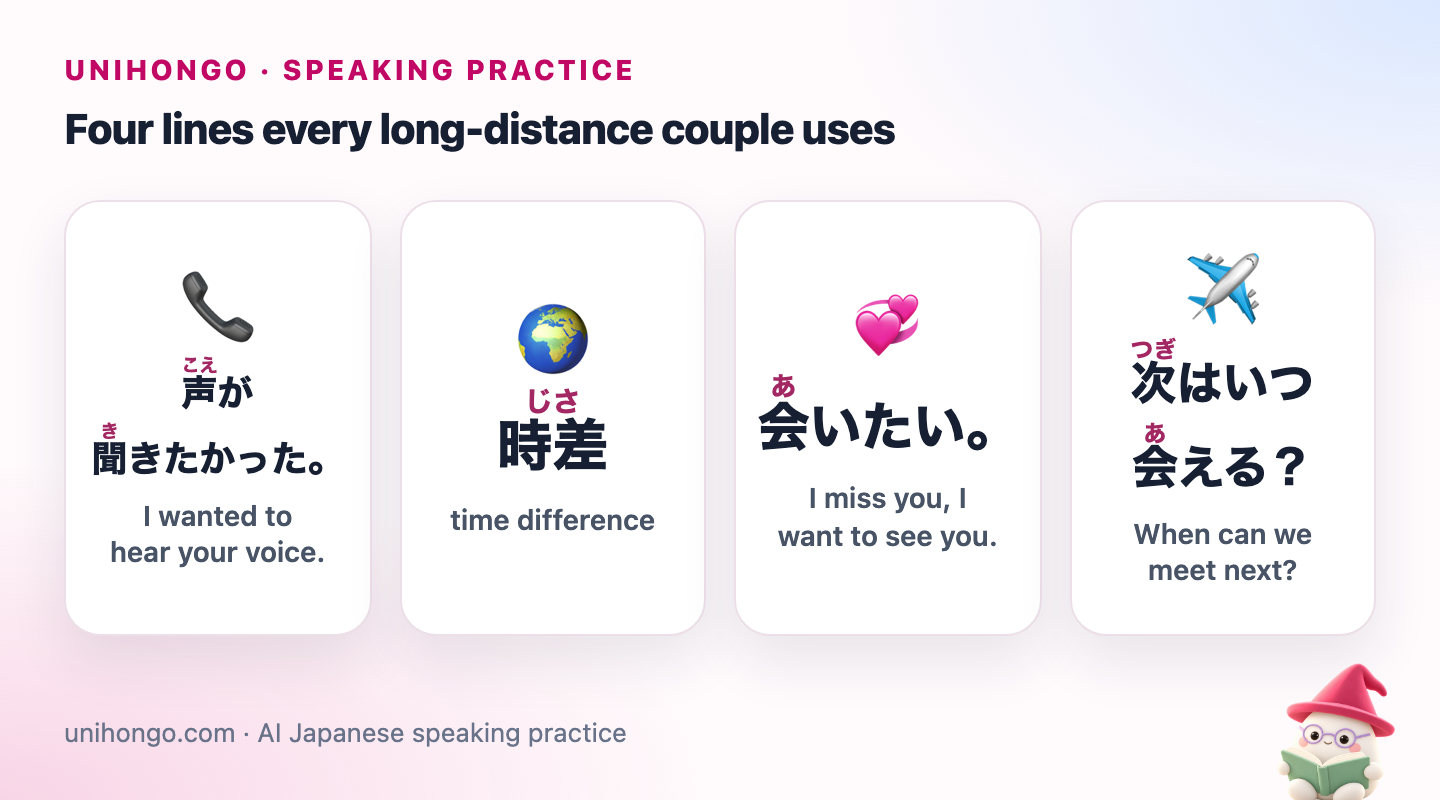
Four lines every long-distance couple uses
Koe ga kikitakatta, I wanted to hear your voice, is the reason for most calls and a sweet way to open one. Jisa (時差) is the time difference you plan around. Aitai, I want to see you, is the Japanese for missing someone. Tsugi wa itsu aeru, when can we meet next, is the question that keeps the relationship pointed at a date. All four are casual, plain-form Japanese, the register partners use with each other; the polite forms appear only in the family section at the end.
| Japanese | Romaji | Meaning |
|---|---|---|
| 声が聞きたかった。 | Koe ga kikitakatta. | I wanted to hear your voice. |
| 時差 | jisa | time difference |
| 会いたい。 | Aitai. | I miss you, I want to see you. |
| 次はいつ会える? | Tsugi wa itsu aeru? | When can we meet next? |
Starting and fixing a video call
Calls start with a check that the other person is free and the sound works, and half of them involve a frozen screen. The verbs are in casual plain form with the question marked by rising intonation, not ka. Kakenaosu is to call back, and the final ne tells your partner you are not hanging up on them. Kyō wa dō datta, how was your day, is the sentence you will say more than any other.
| Japanese | Romaji | Meaning |
|---|---|---|
| 今、話せる? | Ima, hanaseru? | Can you talk now? |
| 声、聞こえる? | Koe, kikoeru? | Can you hear me? |
| 画面が止まってる。 | Gamen ga tomatteru. | The picture has frozen. |
| 電波が悪いみたい。 | Denpa ga warui mitai. | The connection seems bad. |
| もう一回かけ直すね。 | Mō ikkai kakenaosu ne. | I'll call you back. |
| 今日はどうだった? | Kyō wa dō datta? | How was your day? |
Time zones and finding a time
Sotchi (そっち) is your partner's side and kotchi (こっち) is yours, and the pair carries most time-zone talk. Fix times in one zone to avoid confusion: Nihon jikan de, in Japan time. Japan does not use daylight saving, so if you live in a country that does, the gap changes twice a year and someone has to say zureru, it shifts. Sleepiness is a kind compliment here: noticing that your partner is tired and sending them to bed is affection in Japanese.
| Japanese | Romaji | Meaning |
|---|---|---|
| そっちは今、何時? | Sotchi wa ima, nanji? | What time is it there now? |
| こっちは夜の10時。 | Kotchi wa yoru no jūji. | It's 10 at night here. |
| 日本時間の朝8時にしよう。 | Nihon jikan no asa hachiji ni shiyō. | Let's make it 8 am Japan time. |
| 週末は空いてる? | Shūmatsu wa aiteru? | Are you free at the weekend? |
| 夏時間が終わったから、1時間ずれるよ。 | Natsu jikan ga owatta kara, ichijikan zureru yo. | Summer time ended, so it shifts by an hour. |
| 眠そうだね。もう寝る? | Nemusō da ne. Mō neru? | You look sleepy. Going to bed? |
| Time of day | Reading | Rough hours |
|---|---|---|
| 朝 | asa | Morning, from waking until about 10 |
| 昼 | hiru | Midday to afternoon |
| 夕方 | yūgata | Early evening, around sunset |
| 夜 | yoru | Evening and night |
| 深夜 | shin'ya | Late night, after about midnight |
Saying how you feel without sounding like a textbook
Japanese couples often express feeling through small, specific sentences rather than declarations. Aitai na, with the soft na, is a wish spoken half to yourself. Sabishiku natchatta, I've gone and got lonely, uses the chatta ending that makes a feeling sound unplanned and therefore honest. Caring is shown with muri shinaide ne, don't overdo it, and gratitude with itsumo arigatō. Daisuki da yo is the everyday I love you; aishiteru is rarer and heavier, and some couples never say it at all. None of this is a rule, and your partner's habits are the best guide.
| Japanese | Romaji | Meaning |
|---|---|---|
| 会いたいな。 | Aitai na. | I wish I could see you. |
| 寂しくなっちゃった。 | Sabishiku natchatta. | I've started to feel lonely. |
| 声を聞いたら元気になった。 | Koe o kiitara genki ni natta. | Hearing your voice cheered me up. |
| いつもありがとう。 | Itsumo arigatō. | Thank you, always. |
| 無理しないでね。 | Muri shinaide ne. | Don't push yourself too hard. |
| おやすみ。また明日ね。 | Oyasumi. Mata ashita ne. | Good night. Talk tomorrow. |
| 大好きだよ。 | Daisuki da yo. | I love you (everyday way). |
The small daily things that keep a call alive
Long-distance couples live on details: what you ate, how work went, what is coming next week. Photos of meals are a love language in Japan, and the question about dinner is sincere. The dialogue below is a typical two-minute exchange in casual form; notice aru nda, the explanatory nda ending that shares news, and ōen shiteru, I'm cheering for you, which is how Japanese says I'm behind you.
Between calls, Japanese couples lean heavily on messaging: a short ohayō in the morning, a photo at lunch, a sticker instead of a sentence at night. Stickers and one-word replies are not laziness in Japanese messaging culture; they are a way of staying present without demanding a conversation. Voice messages are a good middle ground for learners, because you can record one three times before sending it, and your partner hears your voice rather than reading your grammar.
| Japanese | Romaji | Meaning |
|---|---|---|
| 今日のご飯、何食べた? | Kyō no gohan, nani tabeta? | A: What did you eat today? |
| カレー。写真送るね。 | Karē. Shashin okuru ne. | B: Curry. I'll send a photo. |
| 仕事、忙しかった? | Shigoto, isogashikatta? | A: Was work busy? |
| ちょっとね。来週、面接があるんだ。 | Chotto ne. Raishū, mensetsu ga aru nda. | B: A bit. I have an interview next week. |
| 応援してるよ。 | Ōen shiteru yo. | A: I'm rooting for you. |
| ありがとう。頑張る。 | Arigatō. Ganbaru. | B: Thanks. I'll do my best. |
Planning the visit
Visits are the milestones, and planning them is happy talk. Ai ni iku, to go to see someone, is the verb for visiting a person, not hōmon suru, which is for formal visits. Kōkūken is the air ticket, and mukae ni iku is to go and meet someone at the airport or station. Counting down the days with ato, remaining, is a small ritual many couples share.

| Japanese | Romaji | Meaning |
|---|---|---|
| 来月、会いに行くよ。 | Raigetsu, ai ni iku yo. | I'm coming to see you next month. |
| 航空券、取ったよ。 | Kōkūken, totta yo. | I've booked the flight. |
| 何日から何日まで? | Nannichi kara nannichi made? | From which day to which day? |
| 空港まで迎えに行くね。 | Kūkō made mukae ni iku ne. | I'll come and meet you at the airport. |
| 一緒に行きたいところ、ある? | Issho ni ikitai tokoro, aru? | Anywhere you want to go together? |
| あと10日だね。 | Ato tōka da ne. | Only ten days left. |
Meeting the family: switching to polite
Sooner or later a visit includes dinner with the parents, and the register flips. Everything to them is polite masu and desu, with humble mōshimasu for your name. Osewa ni natte imasu, literally I am being looked after, thanks them for their child's kindness to you and is exactly what Japanese partners say. A small gift from home, presented with sasayaka desu ga, it is only a small thing, is customary in most families. Keep casual speech for your partner, and if the parents speak to you casually, you can relax a little, but staying polite is never wrong.
| Japanese | Romaji | Meaning |
|---|---|---|
| はじめまして。マリアと申します。 | Hajimemashite. Maria to mōshimasu. | Nice to meet you. My name is Maria. |
| いつも健太さんにお世話になっています。 | Itsumo Kenta-san ni osewa ni natte imasu. | Kenta is always so good to me. |
| お会いできてうれしいです。 | Oai dekite ureshii desu. | I'm happy to meet you. |
| これ、ささやかですが、お土産です。 | Kore, sasayaka desu ga, omiyage desu. | This is a small gift for you. |
| ごちそうさまでした。とてもおいしかったです。 | Gochisōsama deshita. Totemo oishikatta desu. | Thank you for the meal. It was delicious. |
| これからもよろしくお願いします。 | Korekara mo yoroshiku onegai shimasu. | I hope we'll get on well from now on. |
Common mistakes
- Translating I miss you literally. There is no everyday verb; aitai or sabishii is what a partner says.
- Using aishiteru constantly. It can sound theatrical; daisuki is the everyday word, and many couples say it rarely too.
- Speaking to a partner in masu form. It sounds distant after the first weeks; plain form with ne and yo is the register of closeness.
- Forgetting to switch back. With the parents, masu and desu return in full, and your partner's name gets san.
- Fixing call times in two zones. Pick one, say Nihon jikan de, and both of you convert from there.