
Four words of daycare life
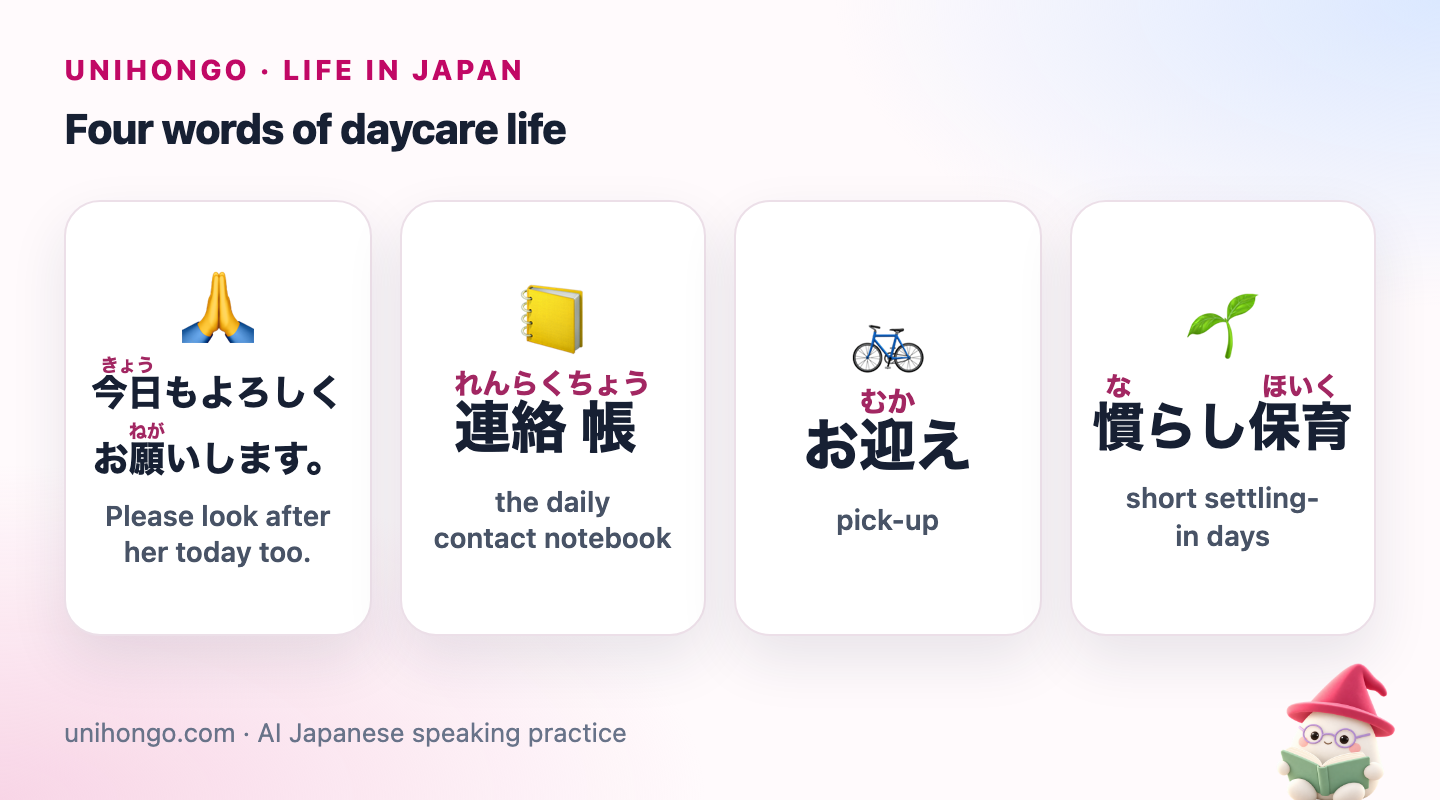
Kyō mo yoroshiku onegai shimasu is what parents say as they hand their child over in the morning: please look after her today too. The renrakuchō is the notebook in the bag. Omukae (お迎え) is pick-up, and the teacher will ask what time omukae is. Narashi hoiku (慣らし保育) is the settling-in period in the first weeks, when children stay for an hour or two and the hours grow gradually. Tōen (登園) is going in to daycare, and hogosha (保護者) is the formal word for a parent or guardian that you will see on every notice.
| Japanese | Romaji | Meaning |
|---|---|---|
| 今日もよろしくお願いします。 | Kyō mo yoroshiku onegai shimasu. | Please look after her today too. |
| 連絡帳 | renrakuchō | the daily contact notebook |
| お迎え | omukae | pick-up |
| 慣らし保育 | narashi hoiku | short settling-in days |
| 登園 | tōen | going in to daycare |
| 保護者 | hogosha | parent or guardian |
Applying for a place: hokatsu at the city office
Hokatsu (保活) is the word for the hunt for a daycare place, and in big cities it can take months. Licensed daycares, ninka hoikuen (認可保育園), are applied for through the city office, which ranks families by need, usually by how many hours each parent works. Unlicensed ones, ninkagai (認可外), are applied to directly. The main intake is April, and application deadlines are often in the autumn before, so ask early. Expect to be asked for a shūrō shōmeisho (就労証明書), a certificate of employment, for each parent.
Most daycares welcome a visit, a kengaku (見学), before you apply. It is also the moment to ask whether anyone speaks English and whether notices come in any other language, without expecting that they do.
| Japanese | Romaji | Meaning |
|---|---|---|
| 保育園の申し込みについて聞きたいです。 | Hoikuen no mōshikomi ni tsuite kikitai desu. | I'd like to ask about daycare applications. |
| 4月入園を希望しています。 | Shigatsu nyūen o kibō shite imasu. | We're hoping for an April start. |
| 必要な書類は何ですか。 | Hitsuyō na shorui wa nan desu ka. | What documents do I need? |
| 夫婦ともフルタイムで働いています。 | Fūfu tomo furutaimu de hataraite imasu. | We both work full-time. |
| 見学はできますか。 | Kengaku wa dekimasu ka. | Can we visit the daycare? |
| 英語の資料はありますか。 | Eigo no shiryō wa arimasu ka. | Do you have materials in English? |
| Type | Reading | In short |
|---|---|---|
| 認可保育園 | ninka hoikuen | Licensed daycare; apply through the city, fees set by income |
| 認可外保育園 | ninkagai hoikuen | Unlicensed daycare; apply directly, fees set by the daycare |
| 認定こども園 | nintei kodomoen | Combined daycare and kindergarten |
| 一時保育 | ichiji hoiku | Occasional, hourly or daily care |
The morning handover
Drop-off is quick, and the teacher wants three things: how the child slept, how they ate, and anything unusual, such as a runny nose or a bad mood. Then confirm who is collecting and when. Everything is in polite masu form, and you can talk about your child in plain words without honorifics. The teacher sends the child off with itterasshai, the same farewell used at home.
| Japanese | Romaji | Meaning |
|---|---|---|
| おはようございます。 | Ohayō gozaimasu. | You: Good morning. |
| 昨夜はよく寝ました。 | Sakuya wa yoku nemashita. | You: She slept well last night. |
| 朝ごはんは全部食べました。 | Asagohan wa zenbu tabemashita. | You: He ate all his breakfast. |
| 少し鼻水が出ています。 | Sukoshi hanamizu ga dete imasu. | You: She has a bit of a runny nose. |
| 今日のお迎えは6時ごろです。 | Kyō no omukae wa rokuji goro desu. | You: Pick-up today is around six. |
| 今日はおばあちゃんが迎えに来ます。 | Kyō wa obāchan ga mukae ni kimasu. | You: Grandma is picking up today. |
| 行ってらっしゃい。 | Itterasshai. | Teacher: Off you go, have a good day. |
Writing the renrakuchō
For babies and toddlers the notebook has boxes: taion (体温), temperature; suimin (睡眠), sleep; shokuji (食事), meals; haiben (排便), bowel movements; and kigen (機嫌), mood. Fill them with short noun phrases or plain past-tense sentences. Then there is a free space where parents write a line about the evening, and this is where your Japanese grows: one true sentence a day about a walk, a new word or a tantrum. Teachers reply in the same space, and reading their entries aloud is excellent practice.
Many daycares have moved the notebook into an app. The vocabulary is identical.
| Japanese | Romaji | Meaning |
|---|---|---|
| 体温は平熱でした。 | Taion wa heinetsu deshita. | Temperature was normal. |
| 夜9時に寝て、朝6時半に起きました。 | Yoru kuji ni nete, asa rokuji han ni okimashita. | Slept at 9 pm, woke at 6:30. |
| 機嫌はいいです。 | Kigen wa ii desu. | In a good mood. |
| 便は普通でした。 | Ben wa futsū deshita. | Bowel movement was normal. |
| 昨日は公園で遊びました。 | Kinō wa kōen de asobimashita. | Yesterday we played in the park. |
| いつもありがとうございます。 | Itsumo arigatō gozaimasu. | Thank you as always. |
Pick-up: hearing how the day went
At omukae the teacher gives you a short report: nap, lunch, play, and any bumps. Kyūshoku (給食) is the lunch provided by the daycare, ohirune (お昼寝) is the nap, and sunaba (砂場) is the sandpit, where most knees are scraped. Listen for koronde, fell over, and the body part that follows. If you did not catch something, ask the teacher to repeat it; they are used to tired parents.
| Japanese | Romaji | Meaning |
|---|---|---|
| 今日はお昼寝をよくしました。 | Kyō wa ohirune o yoku shimashita. | Teacher: She napped well today. |
| 給食を全部食べました。 | Kyūshoku o zenbu tabemashita. | Teacher: He ate all his lunch. |
| お友達と砂場で遊びました。 | Otomodachi to sunaba de asobimashita. | Teacher: She played in the sandpit with friends. |
| 転んで膝を少しすりむきました。 | Koronde hiza o sukoshi surimukimashita. | Teacher: He fell and scraped his knee a little. |
| ありがとうございました。 | Arigatō gozaimashita. | You: Thank you very much. |
| また明日お願いします。 | Mata ashita onegai shimasu. | You: See you tomorrow. |
Illness: the call from the daycare and the call to it
Two phone calls define a daycare winter. In the first, you call in the morning to say your child is staying home, and the daycare will want to know the symptom. In the second, the daycare calls you: the child's temperature has gone up, commonly at around 37.5 degrees, and someone must collect them. Say when you can arrive, in minutes. Teachers say onetsu, with the polite o, when talking about your child.
Some illnesses, such as flu or chickenpox, require a tōen kyokashō (登園許可証), a doctor's note allowing the child to return. Byōji hoiku (病児保育) is sick-child care, offered by some clinics and facilities for children who are ill but stable; availability varies a great deal between cities.
| Japanese | Romaji | Meaning |
|---|---|---|
| 熱が出たので今日はお休みします。 | Netsu ga deta node kyō wa oyasumi shimasu. | He has a fever, so he'll stay home today. |
| 病院に行ってから連絡します。 | Byōin ni itte kara renraku shimasu. | I'll call after we've seen the doctor. |
| お熱が38度あります。 | Onetsu ga sanjūhachido arimasu. | Teacher: Her temperature is 38 degrees. |
| お迎えをお願いできますか。 | Omukae o onegai dekimasu ka. | Teacher: Could you come and collect her? |
| 今から向かいます。30分くらいかかります。 | Ima kara mukaimasu. Sanjuppun kurai kakarimasu. | You: I'm leaving now. It'll take about 30 minutes. |
| 登園許可証は必要ですか。 | Tōen kyokashō wa hitsuyō desu ka. | Do we need a doctor's note to return? |
| 病児保育を使えますか。 | Byōji hoiku o tsukaemasu ka. | Can we use sick-child care? |
Symptom words worth knowing: seki (咳) cough, hanamizu (鼻水) runny nose, ōto (嘔吐) vomiting, geri (下痢) diarrhoea, and hosshin (発疹) a rash. Unihongo's Describe Symptoms at a Clinic mission uses the same words from the parent's side of the desk.
Events: sports day, performances and parents' meetings
The daycare year has fixed events. Undōkai (運動会) is sports day, usually in autumn or early summer; happyōkai (発表会) is the performance where the children sing and act; ensoku (遠足) is an outing; and hogoshakai (保護者会) is the parents' meeting, with a kondankai (懇談会), an informal talk with the teacher, once or twice a year. Notices list the mochimono (持ち物), the things to bring, and every item must have your child's name written on it.
| Japanese | Romaji | Meaning |
|---|---|---|
| 運動会は何時からですか。 | Undōkai wa nanji kara desu ka. | What time does sports day start? |
| 持ち物は何ですか。 | Mochimono wa nan desu ka. | What should we bring? |
| 写真を撮ってもいいですか。 | Shashin o totte mo ii desu ka. | May we take photos? |
| 保護者会に参加します。 | Hogoshakai ni sanka shimasu. | I'll attend the parents' meeting. |
| 名前はすべて書きました。 | Namae wa subete kakimashita. | I've labelled everything with his name. |
Photo rules differ: some daycares allow photos of your own child only, others sell official photos instead. Ask before you raise the phone.
Common mistakes
- Over-polite language about your own child. Say nemashita, slept, not onemuri ni narimashita; honorifics are for the other person, and the teacher uses them about your child, not you about yours.
- Confusing omukae (pick-up) with oyasumi (a day off or good night). A morning call to say your child is staying home uses oyasumi shimasu.
- Forgetting the temperature. In the illness call, the number is the first thing the daycare asks for, so have it ready: netsu wa sanjūnana do go bu, 37.5 degrees.
- Writing too little in the notebook. A single sentence about home each day helps the teacher and is the easiest daily writing practice you will ever get.