

Nodo ga kawaita: the standard phrase
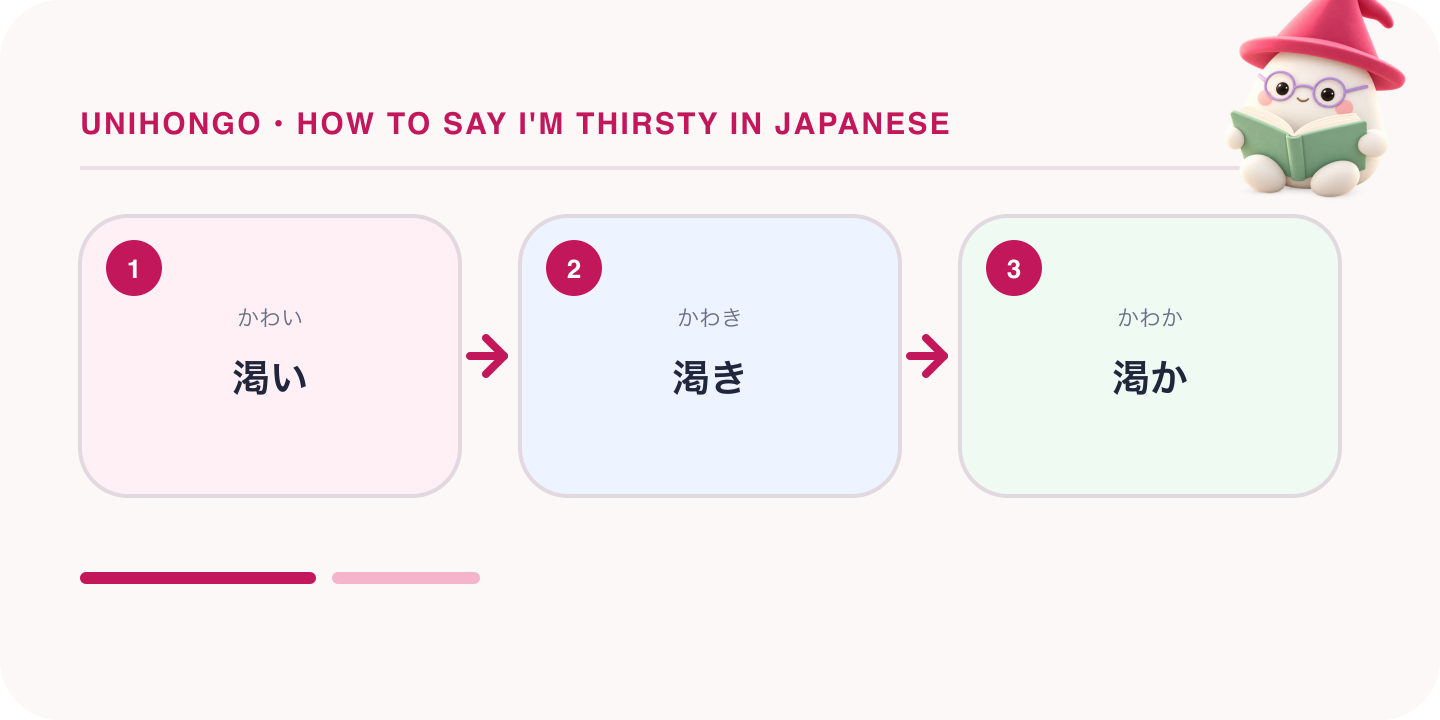
喉 (nodo) is the throat, and 渇く (kawaku) means to become dry or parched. Put together, 喉が渇いた (nodo ga kawaita) means my throat has dried, which is how Japanese says I'm thirsty. There is no adjective like thirsty that you attach to yourself; you describe your throat instead.
Note the kanji. The thirst verb is written 渇く, with the water radical on the left, while the everyday verb for laundry or paint drying is 乾く. Both are read kawaku, and in speech you will never notice, but if you type the phrase, 喉が渇いた is the correct spelling.
In casual conversation the particle ga often drops: nodo kawaita. Among friends you will also hear it as a question: nodo kawakanai? aren't you thirsty? That is a common way of suggesting a drink break.
| Japanese | Romaji | Meaning |
|---|---|---|
| 喉が渇いた。 | Nodo ga kawaita. | I'm thirsty. |
| 喉渇いた。 | Nodo kawaita. | I'm thirsty. (casual) |
| 喉が渇きました。 | Nodo ga kawakimashita. | I'm thirsty. (polite) |
| 喉渇かない? | Nodo kawakanai? | Aren't you thirsty? |
| すごく喉が渇いた。 | Sugoku nodo ga kawaita. | I'm really thirsty. |
| ちょっと喉が渇いたね。 | Chotto nodo ga kawaita ne. | I'm getting a bit thirsty, aren't you? |
Why the past tense means right now
Learners often say nodo ga kawaku, expecting the present tense to mean I am thirsty. It does not. Kawaku describes the process of becoming dry, so the present form sounds like a general statement or a prediction: this curry makes you thirsty, or you will get thirsty on the walk.
The past form kawaita tells the listener the change has happened and you are in that state now. The same logic applies to onaka ga suita, I'm hungry, and tsukareta, I'm tired. Once you see the pattern, all three feel natural.
If you want to describe an ongoing state, you can also use the te-iru form: nodo ga kawaite iru, my throat is dry. It is correct, but in everyday speech the short past form is far more common.
| Japanese | Romaji | Meaning |
|---|---|---|
| 喉が渇いた | nodo ga kawaita | I'm thirsty (now) |
| 喉が渇く | nodo ga kawaku | It makes you thirsty; you get thirsty |
| 喉が渇いている | nodo ga kawaite iru | My throat is dry (ongoing) |
| 喉が渇きそう | nodo ga kawakisō | It looks like I'll get thirsty |
| 喉が渇かない | nodo ga kawakanai | I'm not thirsty |
Nodo kara kara and other casual ways
Japanese has a rich set of sound-symbolic words, and カラカラ (kara kara) describes something completely dry. Nodo ga kara kara, or just nodo kara kara, is what you might say after football practice or a long walk in the summer heat. It is expressive and casual, so keep it for friends and family.
Other casual lines describe the craving rather than the throat. Nanka nomitai means I want to drink something, and tsumetai no nomitai means I want something cold. On a hot evening, adults often say bīru ga nomitai, I want a beer, which is less about thirst than about the end of the working day.
| Japanese | Romaji | Meaning |
|---|---|---|
| 喉カラカラ。 | Nodo kara kara. | My throat is parched. |
| 喉がカラカラだ。 | Nodo ga kara kara da. | I'm bone-dry. |
| 何か飲みたい。 | Nanika nomitai. | I want something to drink. |
| 冷たいの飲みたい。 | Tsumetai no nomitai. | I want something cold. |
| 水、ちょうだい。 | Mizu, chōdai. | Give me some water. (very casual) |
| ちょっとコンビニ寄ろう。 | Chotto konbini yorō. | Let's stop at the convenience store. |
Polite and formal: when to say it and when not to
Nodo ga kawakimashita is the polite version, and it is fine with teachers, acquaintances or a host family. It is still a statement about your needs, though, so in more formal settings Japanese speakers usually avoid announcing it at all.
At a client's office, for example, you will usually be offered tea or water, and it is polite to wait for that offer. If you really need water, perhaps because you have a cough, ask for it as a small favour and give the reason: sumimasen, o-mizu o itadaite mo yoroshii deshō ka, would it be all right if I had some water? Adding the reason makes the request sound considerate rather than demanding.
In a speech or a presentation, a short sumimasen, shitsurei shimasu before you drink from your glass or bottle is a polite touch.
| Japanese | Romaji | Meaning |
|---|---|---|
| 喉が渇きました。 | Nodo ga kawakimashita. | I'm thirsty. (polite) |
| お水をいただいてもよろしいでしょうか。 | O-mizu o itadaite mo yoroshii deshō ka. | Would it be all right if I had some water? (formal) |
| 少し喉の調子が悪くて。 | Sukoshi nodo no chōshi ga warukute. | My throat is a little rough. |
| 失礼して、お水をいただきます。 | Shitsurei shite, o-mizu o itadakimasu. | Excuse me, I'll have some water. |
| お気遣いありがとうございます。 | O-kizukai arigatō gozaimasu. | Thank you for your thoughtfulness. |
Asking for water: o-mizu and refills
Water is 水 (mizu), and in polite speech it becomes お水 (o-mizu). Restaurant staff, hosts and most adults say o-mizu, so use it when asking. Hot water is not mizu but お湯 (o-yu), which matters if you want hot water for tea or medicine.
In most Japanese restaurants a glass of water or tea arrives automatically, often with ice. If your glass is empty, catch a staff member's attention with sumimasen and ask for a refill with o-mizu o onegai shimasu or o-mizu no okawari o onegai shimasu. Some restaurants, especially ramen shops and chains, have a self-service water jug or dispenser; look for a sign reading o-mizu wa serufu sābisu desu.
| Japanese | Romaji | Meaning |
|---|---|---|
| すみません、お水をください。 | Sumimasen, o-mizu o kudasai. | Excuse me, water please. |
| お水のおかわりをお願いします。 | O-mizu no okawari o onegai shimasu. | Could I have more water, please? |
| お水をいただけますか。 | O-mizu o itadakemasu ka. | Could I have some water? |
| 氷なしでお願いします。 | Kōri nashi de onegai shimasu. | No ice, please. |
| お湯をいただけますか。 | O-yu o itadakemasu ka. | Could I have some hot water? |
| お水はセルフサービスです。 | O-mizu wa serufu sābisu desu. | Water is self-service. |
Ordering drinks at a café, restaurant or izakaya
Once you are thirsty, the next step is usually ordering. The simplest pattern is the drink name plus o kudasai or o onegai shimasu. Add a size, a temperature or a count if needed: aisu kōhī o hitotsu, one iced coffee, or hotto de, hot please.
At an izakaya, the first order is often a round of drinks for the table, and staff may ask o-nomimono wa? what would you like to drink? before anything else. Toriaezu bīru, a beer for now, is a well-known first order. If you do not drink alcohol, oolong tea, ūron-cha, is a common choice, and asking for a non-alcoholic option is completely normal.
| Japanese | Romaji | Meaning |
|---|---|---|
| アイスコーヒーを一つください。 | Aisu kōhī o hitotsu kudasai. | One iced coffee, please. |
| ホットでお願いします。 | Hotto de onegai shimasu. | Hot, please. |
| お飲み物はいかがなさいますか。 | O-nomimono wa ikaga nasaimasu ka. | What would you like to drink? (staff) |
| とりあえずビールで。 | Toriaezu bīru de. | A beer to start with. |
| 烏龍茶をお願いします。 | Ūron-cha o onegai shimasu. | Oolong tea, please. |
| ノンアルコールの飲み物はありますか。 | Non-arukōru no nomimono wa arimasu ka. | Do you have non-alcoholic drinks? |
What people say back
When you say you are thirsty, friends usually respond with a suggestion: jā, nanka nomō ka, shall we get something to drink? or asoko ni jihanki aru yo, there is a vending machine over there. Japan has vending machines almost everywhere, so a friend may simply point to one.
A host or teacher may offer something: nanika o-nomi ni narimasu ka, would you like something to drink? or o-cha demo ikaga desu ka, how about some tea? Accept with a thank you, or name what you would like. If you want water rather than tea, it is fine to say o-mizu de daijōbu desu, water is fine.
| Japanese | Romaji | Meaning |
|---|---|---|
| じゃあ、何か飲もうか。 | Jā, nanika nomō ka. | Shall we get something to drink? |
| あそこに自販機あるよ。 | Asoko ni jihanki aru yo. | There's a vending machine over there. |
| 何かお飲みになりますか。 | Nanika o-nomi ni narimasu ka. | Would you like something to drink? |
| お茶でもいかがですか。 | O-cha demo ikaga desu ka. | How about some tea? |
| ありがとうございます。いただきます。 | Arigatō gozaimasu. Itadakimasu. | Thank you, I'll have some. |
| お水で大丈夫です。 | O-mizu de daijōbu desu. | Water is fine. |
Common learner mistakes
Most mistakes with this phrase come from translating English directly. Watch for these.
- Saying nodo ga kawaku for I'm thirsty now. Use the past form, nodo ga kawaita.
- Inventing an adjective such as watashi wa kawaita. Without nodo, it sounds like you yourself have dried out, or it is unclear.
- Using mizu with staff and hosts. O-mizu is the normal polite word; plain mizu is fine among friends.
- Asking for mizu when you want hot water. Hot water is o-yu.
- Announcing nodo ga kawakimashita to a client. In formal settings, wait for an offer or ask for water as a favour with a reason.
- Saying daijōbu desu when you mean yes. It usually works as no thank you, so accept clearly.
If you remember one line, make it nodo ga kawaita: short, correct and understood everywhere in Japan.