

The three ways to ask
Japanese has three common questions for where someone is from, and they are not interchangeable. Doko kara kimashita ka, where did you come from, is the one most textbooks teach first. It is friendly and clear, but it is about movement, so it fits a tourist or someone who has recently arrived better than a colleague who has lived in Japan for a decade.
O-kuni wa dochira desu ka, which country are you from, is polite and specific. The o- prefix and dochira make it soft, and Japanese people use it almost exclusively with foreigners, since asking another Japanese person their country would be odd. You will hear it from hotel staff, taxi drivers and older people making conversation.
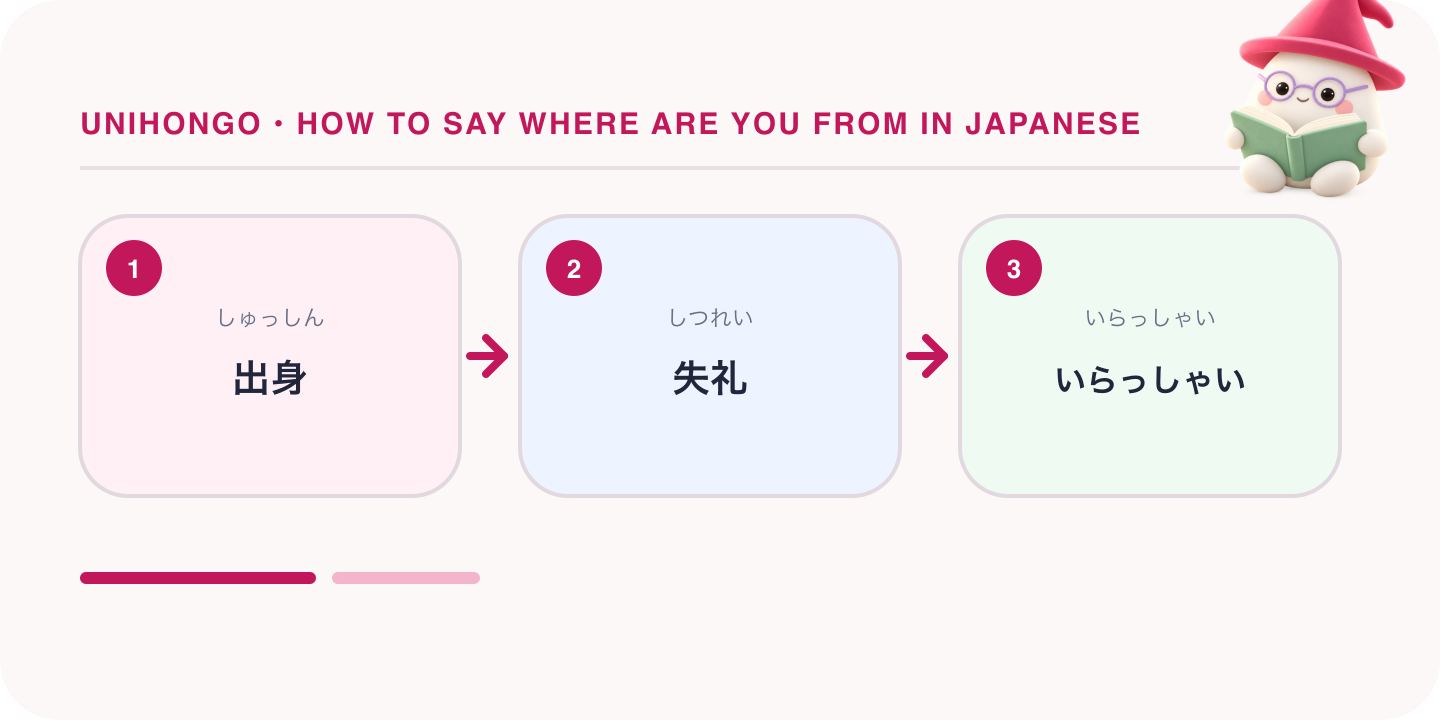
Go-shusshin wa dochira desu ka is the question to learn if you learn only one. Shusshin means origin or hometown, go- makes it respectful, and it works equally well for a foreigner and for a Japanese person, where it asks which part of Japan they come from. It is the version you hear in job interviews, at welcome parties and in polite small talk.
| Japanese | Romaji | Meaning |
|---|---|---|
| どこから来ましたか。 | Doko kara kimashita ka. | Where did you come from? |
| お国はどちらですか。 | O-kuni wa dochira desu ka. | Which country are you from? |
| ご出身はどちらですか。 | Go-shusshin wa dochira desu ka. | Where are you from originally? |
| 失礼ですが、ご出身は。 | Shitsurei desu ga, go-shusshin wa. | Sorry to ask, but where are you from? |
| どちらからいらっしゃいましたか。 | Dochira kara irasshaimashita ka. | Where have you come from? (very polite) |
| 出身はどこですか。 | Shusshin wa doko desu ka. | Where are you from? (plain polite) |
Answering with kara kimashita and shusshin desu
Two answer shapes cover nearly every situation. Place kara kimashita, I came from place, matches the doko kara kimashita ka question and suits anyone visiting or recently arrived. Place shusshin desu, I am from place originally, matches go-shusshin wa and suits everyone, including long-term residents. If you are unsure, shusshin desu is never wrong.
Add the country name in katakana form: Amerika, Igirisu, Furansu, Doitsu, Ōsutoraria, Kanada, Indo, Betonamu, Burajiru. If your country has an unfamiliar Japanese name, say it slowly and be ready to add a hint, for example Yōroppa no, in Europe. You can also combine the two sentence shapes to say where you are from and where you live now: Igirisu shusshin de, ima wa Ōsaka ni sunde imasu.
Casual answers drop the desu. Among friends, Kanada, with a nod, or Kanada da yo, is fine. Between kara kimashita and shusshin desu, only the polite versions need practising, because the casual ones are just the same words shortened.
| Japanese | Romaji | Meaning |
|---|---|---|
| カナダから来ました。 | Kanada kara kimashita. | I came from Canada. |
| イギリス出身です。 | Igirisu shusshin desu. | I'm from the UK. |
| アメリカのシアトルから来ました。 | Amerika no Shiatoru kara kimashita. | I came from Seattle, in the United States. |
| 出身はフランスですが、今は大阪に住んでいます。 | Shusshin wa Furansu desu ga, ima wa Ōsaka ni sunde imasu. | I'm from France, but I live in Osaka now. |
| 生まれはインドで、育ちはロンドンです。 | Umare wa Indo de, sodachi wa Rondon desu. | I was born in India and grew up in London. |
| ベトナムです。ハノイの近くです。 | Betonamu desu. Hanoi no chikaku desu. | Vietnam. Near Hanoi. |
City or country: which to say first
Choose the answer the listener can picture. For a world-famous city, the city alone works: Nyūyōku desu, Pari desu, Rondon desu. Naming the country as well would sound slightly stiff. For a mid-sized or small place, lead with the country and then add the city with no: Doitsu no Hanbā desu, Hamburg in Germany. That order matters, because Japanese puts the bigger place first and the smaller one after it, exactly as in an address.
If the city is unknown, a short description helps far more than repeating the name. Say how far it is from a known city, or what it is known for: Shidonī kara kuruma de ni-jikan gurai no machi desu, a town about two hours by car from Sydney. This is also a good moment to keep the conversation moving rather than watching the listener nod politely.
| Japanese | Romaji | Meaning |
|---|---|---|
| ロンドンです。 | Rondon desu. | London. |
| ドイツのハンブルクです。 | Doitsu no Hanburuku desu. | Hamburg, in Germany. |
| オーストラリアの、シドニーから車で二時間くらいの町です。 | Ōsutoraria no, Shidonī kara kuruma de ni-jikan kurai no machi desu. | A town in Australia, about two hours by car from Sydney. |
| あまり知られていない小さい町です。 | Amari shirarete inai chiisai machi desu. | It's a small town that isn't very well known. |
| 海が近くて、魚がおいしいところです。 | Umi ga chikakute, sakana ga oishii tokoro desu. | It's near the sea, and the fish is good. |
Asking a Japanese person where in Japan they are from
Turning the question round is the easiest way to make the exchange feel like a conversation rather than an interview. Since your conversation partner is presumably Japanese, ask nihon no doko desu ka, where in Japan, or the polite go-shusshin wa dochira desu ka. Do not use o-kuni wa with a Japanese person, because it asks about their country.
Answers come as a prefecture, ken, or a city. Someone from Tokyo may say Tōkyō desu, or name a ward or a part of the city. People from elsewhere often give the prefecture first, such as Fukuoka-ken desu, and then the city if you ask. Knowing a handful of prefecture names and one thing each is famous for gives you a ready reaction: Hokkaidō and snow, Nagano and mountains, Hiroshima and okonomiyaki, Fukuoka and ramen.
If you do not recognise the place, say so honestly and ask about it. Dō iu tokoro desu ka, what sort of place is it, and nani ga yūmei desu ka, what is it famous for, are questions Japanese people enjoy answering about their hometowns.
| Japanese | Romaji | Meaning |
|---|---|---|
| 日本のどこですか。 | Nihon no doko desu ka. | Where in Japan? |
| ご出身は東京ですか。 | Go-shusshin wa Tōkyō desu ka. | Are you from Tokyo? |
| 福岡県です。 | Fukuoka-ken desu. | Fukuoka prefecture. |
| 東京生まれ、東京育ちです。 | Tōkyō umare, Tōkyō sodachi desu. | Born and raised in Tokyo. |
| どういうところですか。 | Dō iu tokoro desu ka. | What sort of place is it? |
| 何が有名ですか。 | Nani ga yūmei desu ka. | What is it famous for? |
| 行ったことがあります。いいところですね。 | Itta koto ga arimasu. Ii tokoro desu ne. | I've been there. It's a lovely place. |
Follow-up questions that keep it going
A one-word answer often stops the conversation dead, so it helps to have the next three questions ready. When the other person is a foreigner or a visitor, the natural sequence is how long they have been in Japan, why they came, and what they think of the place. When the other person is Japanese, ask how long they have lived where they live now and whether they go back often.
These questions work in both directions, so prepare a two-sentence answer for each one about yourself: how long, why, and one thing you like.
- Nihon wa nagai desu ka: have you been in Japan long?
- Dō shite nihon ni kita n desu ka: why did you come to Japan?
- Ima wa doko ni sunde imasu ka: where do you live now?
- Nihon no seikatsu wa dō desu ka: how is life in Japan?
- Tōkyō ni kite dono kurai desu ka: how long have you been in Tokyo?
- Jimoto ni wa yoku kaerimasu ka: do you go back home often?
- Jimoto no oishii mono wa nan desu ka: what is the local food where you are from?
Answer length matters as much as the question. Ni-nen desu, two years, is fine, but ni-nen desu, shigoto de kimashita, two years, I came for work, gives the listener something to follow up on. Japanese conversation runs on small offerings like that.
Country names in Japanese
Most country names are katakana approximations of the English or local name, though a few use kanji abbreviations in writing. The table gives the spoken form you need for shusshin desu and kara kimashita. Nationality is the country name plus -jin, so Kanada-jin is a Canadian, and language is the country plus -go, so Doitsu-go is German.
| Country | Reading | Meaning |
|---|---|---|
| アメリカ | Amerika | United States |
| イギリス | Igirisu | United Kingdom |
| カナダ | Kanada | Canada |
| オーストラリア | Ōsutoraria | Australia |
| フランス | Furansu | France |
| ドイツ | Doitsu | Germany |
| スペイン | Supein | Spain |
| ブラジル | Burajiru | Brazil |
| インド | Indo | India |
| ベトナム | Betonamu | Vietnam |
| フィリピン | Firipin | Philippines |
| 韓国 | Kankoku | South Korea |
If you want the full list of nationalities and how to talk about your home country in more depth, the separate guides on countries and nationalities and on describing your country cover that. This post stays with the exchange itself.
Common mistakes and awkward moments
The most common mistake is answering go-shusshin wa with the name of the city where you live now. Shusshin is where you are from, not where you are based, so a Canadian living in Nagoya answers Kanada, and then adds ima wa Nagoya ni sunde imasu if it helps. The reverse mistake is also common: answering doko ni sunde imasu ka, where do you live, with your home country.
Learners sometimes use o-kuni wa on a Japanese person, which sounds as if you assumed they were foreign. Stick to go-shusshin wa or nihon no doko desu ka. Register matters too: answer a casual doko shusshin with a bare place name, and a polite go-shusshin wa dochira desu ka with desu.
If you did not catch the place name, ask for it again rather than nodding. Mō ichido onegai shimasu, once more please, or nan-ken desu ka, which prefecture, are normal questions. Japanese people are used to their hometowns being unknown abroad and will usually add a landmark or a nearby big city without being asked.
| Japanese | Romaji | Meaning |
|---|---|---|
| 出身はカナダで、今は名古屋に住んでいます。 | Shusshin wa Kanada de, ima wa Nagoya ni sunde imasu. | I'm from Canada, and I live in Nagoya now. |
| すみません、もう一度お願いします。 | Sumimasen, mō ichido onegai shimasu. | Sorry, once more please. |
| 何県ですか。 | Nan-ken desu ka. | Which prefecture? |
| それはどのへんですか。 | Sore wa dono hen desu ka. | Whereabouts is that? |
| 名前は聞いたことがあります。 | Namae wa kiita koto ga arimasu. | I've heard the name. |