

Before midnight: yoi o-toshi o
From about the middle of December, Japanese people start ending conversations with yoi o-toshi o. The full sentence is yoi o-toshi o o-mukae kudasai, please greet a good new year, and the short form drops everything after the particle o. It is said to anyone you probably will not see again before 1 January: colleagues on the last working day, the staff at your usual café, neighbours, a friend leaving a party. It replaces goodbye rather than being added to it.
The polite form is fine for everyone. With close friends it becomes yoi o-toshi o ne, and some people add mata rainen, see you next year. If you are the one being wished, reply with the same phrase, or with the slightly more formal kochira koso, yoi o-toshi o. Notice that yoi o-toshi o is never used after the year has turned; on 1 January it would sound as though you had missed the change.
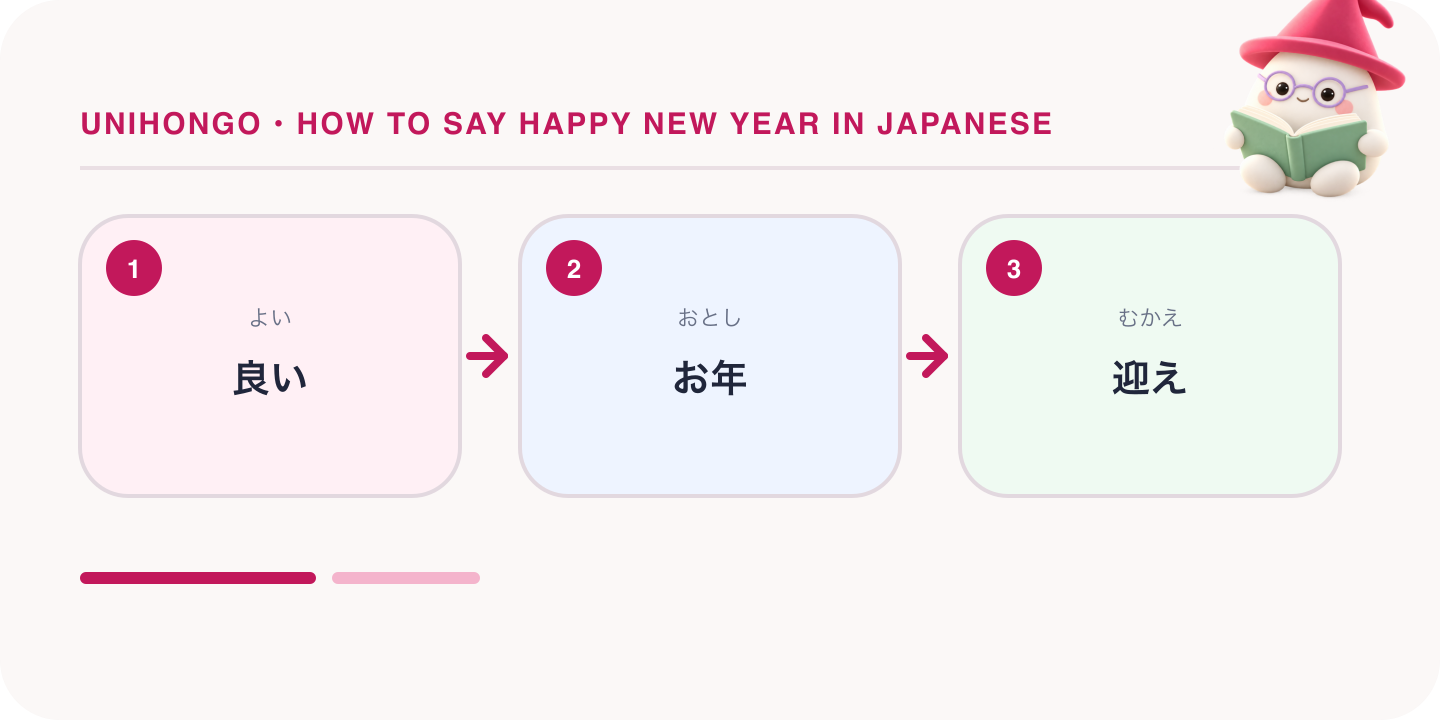
| Japanese | Romaji | Meaning |
|---|---|---|
| 良いお年をお迎えください。 | Yoi o-toshi o o-mukae kudasai. | Have a good new year. (full, polite) |
| 良いお年を。 | Yoi o-toshi o. | Have a good new year. |
| 今年もお世話になりました。良いお年を。 | Kotoshi mo o-sewa ni narimashita. Yoi o-toshi o. | Thank you for everything this year. Have a good new year. |
| じゃあ、また来年。良いお年をね。 | Jā, mata rainen. Yoi o-toshi o ne. | See you next year, then. Have a good one. |
| こちらこそ、良いお年を。 | Kochira koso, yoi o-toshi o. | You too, have a good new year. |
After midnight: akemashite omedetō gozaimasu
Akemashite comes from akeru, to open or to dawn, and the greeting congratulates the person on the new year having opened. It is said the first time you meet or contact someone in the new year, whether that is at midnight, at a shrine on 1 January or in the office on the first working day. It is almost always followed by kotoshi mo yoroshiku onegaishimasu, please treat me well this year too, which does the same job that yoroshiku onegaishimasu does after a first meeting: it closes the greeting and looks forward.
The reply is the same greeting back, and the two halves often overlap, with both people saying omedetō gozaimasu at the same time and then bowing. Among family and friends the polite ending drops: akemashite omedetō, kotoshi mo yoroshiku. Between very close friends it shrinks further to omedetō alone, since the context is obvious. There is no need to say shinnen, new year, in speech; the phrase already means that.
| Japanese | Romaji | Meaning |
|---|---|---|
| 明けましておめでとうございます。今年もよろしくお願いします。 | Akemashite omedetō gozaimasu. Kotoshi mo yoroshiku onegaishimasu. | Happy New Year. I look forward to another good year with you. |
| 明けましておめでとう。今年もよろしくね。 | Akemashite omedetō. Kotoshi mo yoroshiku ne. | Happy New Year. Here's to another good year. (casual) |
| こちらこそ、今年もよろしくお願いします。 | Kochira koso, kotoshi mo yoroshiku onegaishimasu. | Likewise, I look forward to this year. |
| 新年おめでとうございます。 | Shinnen omedetō gozaimasu. | Happy New Year. (a slightly formal variant) |
| おめでとう!今年も楽しもうね。 | Omedetō! Kotoshi mo tanoshimō ne. | Happy New Year! Let's have fun this year too. |
| 初詣、もう行った? | Hatsumōde, mō itta? | Have you done the first shrine visit yet? |
How long the greeting lasts
Akemashite omedetō gozaimasu is not said all January. The customary window is matsu no uchi, the period while pine decorations stand at the door, which ends on 7 January in most of Japan and around 15 January in parts of Kansai. Within that window you say the full greeting to everyone you meet for the first time that year. After it, the greeting starts to feel late, so people soften it. Osoku narimashita ga, akemashite omedetō gozaimasu, belated happy new year, is fine into mid-January, and beyond that most people simply say kotoshi mo yoroshiku onegaishimasu on its own.
The important point is that the greeting is triggered by the first meeting of the year, not by the date. If you see a colleague every day from 4 January, you say it once, on that day, and not again. If you first see a client in late January, you skip the greeting and go to the yoroshiku line, perhaps with a reference to the year having started.
| Japanese | Romaji | Meaning |
|---|---|---|
| 遅くなりましたが、明けましておめでとうございます。 | Osoku narimashita ga, akemashite omedetō gozaimasu. | Belatedly, happy new year. |
| 今年もどうぞよろしくお願いいたします。 | Kotoshi mo dōzo yoroshiku onegai itashimasu. | I look forward to working with you this year. (formal) |
| もう松の内は過ぎましたね。 | Mō matsu no uchi wa sugimashita ne. | The New Year period is already over, isn't it. |
| 今年初めてお会いしますね。 | Kotoshi hajimete o-ai shimasu ne. | This is our first meeting this year, isn't it. |
| 本年もよろしくお願いいたします。 | Honnen mo yoroshiku onegai itashimasu. | I look forward to this year too. (written or very formal) |
Casual shortcuts: akeome and kotoyoro
Young people and close friends compress the long greeting into akeome, from akemashite omedetō, and kotoyoro, from kotoshi mo yoroshiku. Together, akeome kotoyoro is the standard New Year text between friends, often sent just after midnight with a sticker. It is playful rather than lazy, and it marks the sender as someone inside your casual circle. Some people write it in katakana, アケオメ, for an even lighter feel.
The shortcut is for friends and peers only. Sending akeome to a teacher, a manager or a client reads as careless, and even to older relatives it can look flippant. In a group chat that mixes friends and seniors, the full akemashite omedetō gozaimasu is the safe choice. Replies match the register: akeome gets akeome back, and kotoyoro gets kochira koso or a sticker.
| Japanese | Romaji | Meaning |
|---|---|---|
| あけおめ!ことよろ! | Akeome! Kotoyoro! | Happy New Year! Here's to this year! (text slang) |
| あけおめー。今年もよろしく。 | Akeomē. Kotoshi mo yoroshiku. | Happy New Year. Looking forward to this year. (casual) |
| あけおめ。初詣行く? | Akeome. Hatsumōde iku? | Happy New Year. Going to the shrine? |
| こちらこそ、ことよろ。 | Kochira koso, kotoyoro. | Same to you, here's to this year. |
The first day back at work
The first working day of the year, shigoto hajime, often begins with a round of greetings. You say akemashite omedetō gozaimasu and kotoshi mo yoroshiku onegaishimasu to each colleague the first time you see them, senior people first if you have the choice, and sometimes the whole office does it together at a short morning gathering. Some companies hold a formal New Year assembly where the president speaks; you listen, bow at the end, and greet the people around you afterwards.
A common addition for colleagues is kyūnen-chū wa o-sewa ni narimashita, thank you for your help last year, which fits between the two halves of the greeting. To clients, whether by phone, email or visit, the same three-part structure works, with honnen replacing kotoshi for a more formal ring. If your workplace prefers otsukaresama desu after the New Year gathering, follow the local habit.
| Japanese | Romaji | Meaning |
|---|---|---|
| 明けましておめでとうございます。旧年中はお世話になりました。本年もよろしくお願いいたします。 | Akemashite omedetō gozaimasu. Kyūnen-chū wa o-sewa ni narimashita. Honnen mo yoroshiku onegai itashimasu. | Happy New Year. Thank you for your support last year. I look forward to this year. |
| お休み中はゆっくりできましたか。 | O-yasumi-chū wa yukkuri dekimashita ka. | Did you manage to relax over the holiday? |
| はい、実家に帰っていました。 | Hai, jikka ni kaette imashita. | Yes, I went back to my parents' place. |
| 今年もチームで頑張りましょう。 | Kotoshi mo chīmu de ganbarimashō. | Let's do our best as a team this year too. |
| 新年会はいつですか。 | Shinnenkai wa itsu desu ka. | When is the New Year party? |
Messages and nengajō lines
New Year cards, nengajō, follow a fixed structure, and the same lines work in a New Year email or message. The header is a greeting, either the full sentence or a short set phrase in kanji. Then comes thanks for the past year, then a request for goodwill in the new one, then a wish for the reader's health or happiness, and finally the date, often written as gantan, New Year's Day, with the year. The table gives the pieces so you can assemble a card or a message at the right formality.
| Line | Reading | Meaning and use |
|---|---|---|
| 謹賀新年 | kinga shinnen | Respectful happy new year; formal card header |
| 賀正 | gashō | Celebrating the new year; short header, casual or to juniors |
| 明けましておめでとうございます | akemashite omedetō gozaimasu | Full greeting; safe header for anyone |
| 旧年中はお世話になりました | kyūnen-chū wa o-sewa ni narimashita | Thank you for your support last year |
| 本年もよろしくお願い申し上げます | honnen mo yoroshiku onegai mōshiagemasu | Goodwill request; very formal |
| 今年もよろしくお願いします | kotoshi mo yoroshiku onegaishimasu | Goodwill request; standard |
| 皆様のご健康をお祈り申し上げます | minasama no go-kenkō o o-inori mōshiagemasu | Wishing everyone good health |
| 素敵な一年になりますように | suteki na ichinen ni narimasu yō ni | May it be a lovely year; friendly |
| 元旦 | gantan | New Year's Day; the date line on a card |
| あけおめ | akeome | Text slang; friends only |
One rule of card etiquette: do not put the full akemashite omedetō gozaimasu next to kinga shinnen, because both are complete greetings and the pair reads as a repetition. Choose one header, then the thanks and the goodwill line.
Choosing the right form at a glance
When you are not sure which phrase fits, run through this list. It is organised by the moment and the person, which are the two things that decide the greeting.
- Late December, anyone: yoi o-toshi o, with o-mukae kudasai for politeness
- Midnight to 7 January, colleagues and seniors: akemashite omedetō gozaimasu, kotoshi mo yoroshiku onegaishimasu
- Same period, friends and family: akemashite omedetō, kotoshi mo yoroshiku
- Text to a friend: akeome kotoyoro, with a sticker if you like
- First day back at work: the full greeting plus kyūnen-chū wa o-sewa ni narimashita
- Clients and formal email: honnen mo yoroshiku onegai itashimasu
- Mid-January onwards: osoku narimashita ga before the greeting, or just the yoroshiku line
- Someone in mourning: skip omedetō and say kotoshi mo yoroshiku onegaishimasu only
The last item matters. A household that has lost a family member during the year sends a mochū hagaki in advance to say it will not exchange New Year greetings, and people avoid omedetō with them. If you receive one, reply after the New Year period with a quiet card or simply the yoroshiku line in person.
Mistakes to avoid at New Year
The classic mistake is saying akemashite omedetō gozaimasu on 31 December. Japanese people will understand, but it sounds like congratulating someone on a race they have not yet run. The mirror mistake is saying yoi o-toshi o on 2 January. A second common slip is dropping kotoshi mo yoroshiku onegaishimasu; without it the greeting feels cut short, because the second half is what makes it a wish rather than an announcement.
Third, sending akeome to the wrong person. It is a friend-to-friend shortcut, and it does not become polite by adding gozaimasu. Fourth, repeating the greeting to the same person every day of the first week; once is the rule. Finally, using omedetō with someone in mourning. If you are unsure whether a colleague has had a bereavement, the neutral kotoshi mo yoroshiku onegaishimasu is always safe, and it is also the phrase to use once the window has closed.
| Japanese | Romaji | Meaning |
|---|---|---|
| あ、まだ今年でしたね。良いお年を。 | A, mada kotoshi deshita ne. Yoi o-toshi o. | Oh, it's still this year, isn't it. Have a good new year. |
| すみません、もうお伝えしましたね。 | Sumimasen, mō o-tsutae shimashita ne. | Sorry, I already said that to you, didn't I. |
| 今年もよろしくお願いします。 | Kotoshi mo yoroshiku onegaishimasu. | I look forward to this year. (safe in any case) |
| 喪中と伺いましたので、ご挨拶は控えさせていただきます。 | Mochū to ukagaimashita node, go-aisatsu wa hikaesasete itadakimasu. | I heard you are in mourning, so I will refrain from the New Year greeting. |