
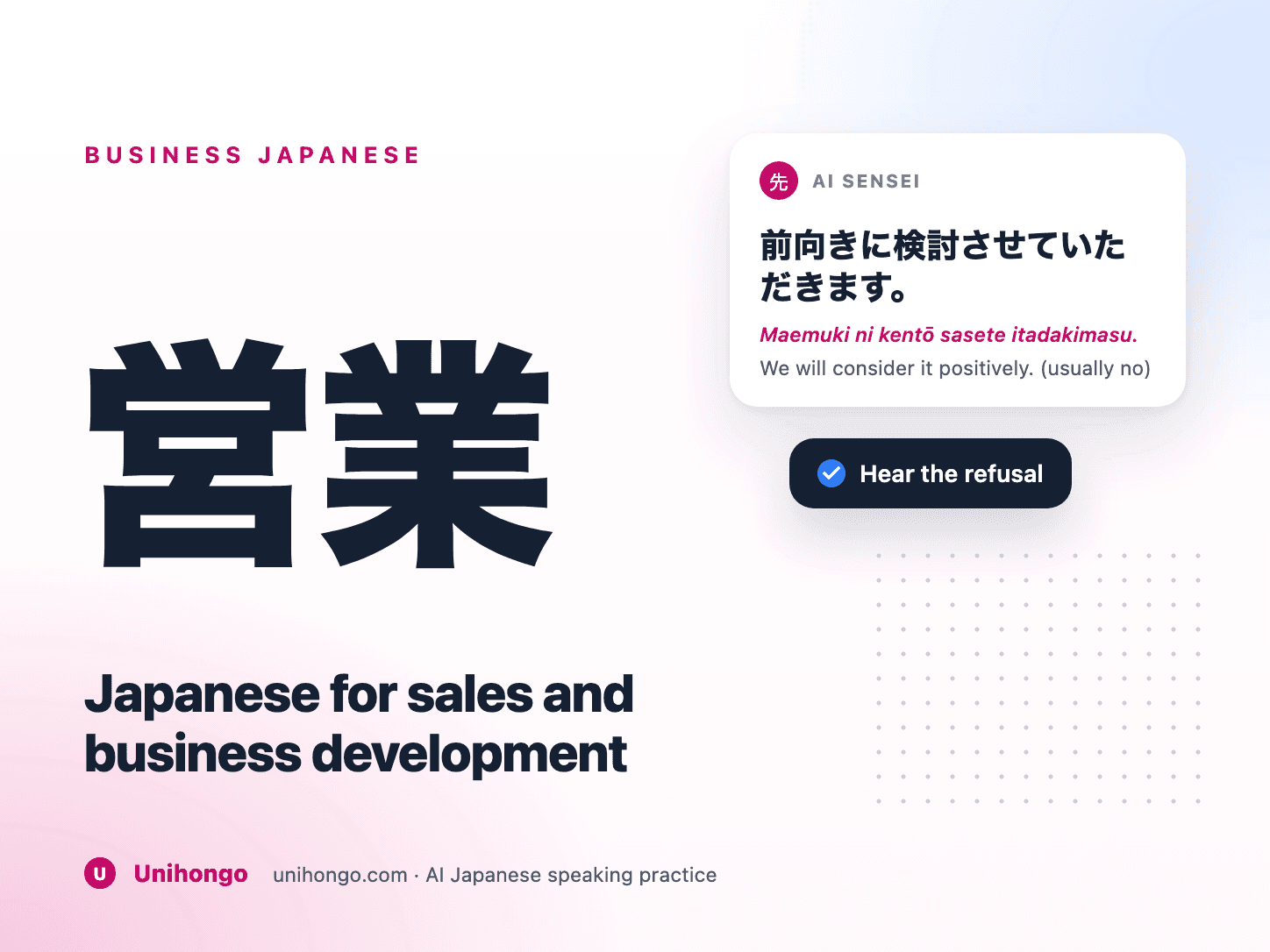
Hearing the refusal
This is the skill that matters most and the one that costs foreign salespeople the most time. Japanese business refusals are delivered as expressions of difficulty, often trailing off before the refusal itself is spoken, and a salesperson who takes them literally spends weeks chasing a deal that ended in the first meeting.
The reliable test is whether an alternative or a next step is offered. A genuine maybe comes with a date, a condition or a request for more information; a refusal trails off and stops.
| Japanese | Romaji | Meaning |
|---|---|---|
| 前向きに検討させていただきます。 | Maemuki ni kentō sasete itadakimasu. | We will consider it positively. (usually no) |
| 社内で相談してみます。 | Shanai de sōdan shite mimasu. | We will discuss it internally. (genuine maybe) |
| ちょっと難しいかもしれません。 | Chotto muzukashii kamo shiremasen. | It might be a little difficult. (no) |
| 予算の都合がありまして。 | Yosan no tsugō ga arimashite. | There are budget considerations. (usually no) |
| 時期を見て、また。 | Jiki o mite, mata. | We will revisit it in time. (no) |
| 資料をお送りいただけますか。 | Shiryō o okutte itadakemasu ka. | Could you send us materials? (genuine interest) |
The first contact
Cold approaches are harder in Japan than in many markets, and an introduction from an existing contact is worth a great deal more than a good call. Where a call is the only route, the opening is formal and short.
The goal of a first call is a meeting, not a sale, and framing it that way makes the call much easier.
| Japanese | Romaji | Meaning |
|---|---|---|
| お忙しいところ恐れ入ります。 | Oisogashii tokoro osoreirimasu. | I am sorry to trouble you when you are busy. |
| 株式会社サンプルの田中と申します。 | Kabushiki-gaisha Sanpuru no Tanaka to mōshimasu. | This is Tanaka from Sample Ltd. |
| ご担当者様はいらっしゃいますでしょうか。 | Gotantōsha-sama wa irasshaimasu deshō ka. | Is the person in charge available? |
| 一度ご挨拶に伺えればと存じます。 | Ichido goaisatsu ni ukagaereba to zonjimasu. | I would like to visit to introduce ourselves. |
| まずは資料をお送りいたします。 | Mazu wa shiryō o okuri itashimasu. | First, I will send you some materials. |
| ご紹介いただきまして、ご連絡しました。 | Goshōkai itadakimashite, gorenraku shimashita. | I am contacting you following an introduction. |
The last phrase changes a cold call into a warm one. If you have any introduction at all, lead with it.
The first meeting
A first meeting is usually about establishing who you are rather than about closing anything. Card exchange, company introduction, an understanding of their situation, and a clear next step is a successful first meeting.
Pushing towards a decision here is counterproductive, because the person across the table is rarely the one who decides.
| Japanese | Romaji | Meaning |
|---|---|---|
| 本日はお時間をいただき、ありがとうございます。 | Honjitsu wa ojikan o itadaki, arigatō gozaimasu. | Thank you for your time today. |
| 弊社のご紹介をさせていただきます。 | Heisha no goshōkai o sasete itadakimasu. | Allow me to introduce our company. |
| 現在の課題を伺えますでしょうか。 | Genzai no kadai o ukagaemasu deshō ka. | May I ask what challenges you currently face? |
| どのような形でしたらお役に立てますか。 | Dono yō na katachi deshitara oyaku ni tatemasu ka. | In what form could we be useful? |
| 次回、ご提案をお持ちいたします。 | Jikai, goteian o omochi itashimasu. | Next time I will bring a proposal. |
| いつ頃、お伺いできますでしょうか。 | Itsu goro, oukagai dekimasu deshō ka. | Around when might I visit again? |
Who actually decides
Decisions in Japanese companies are frequently made by consensus across several people rather than by the individual you are meeting, and often circulated internally in writing before anything is agreed.
This has a practical consequence for how you sell: your materials have to work when you are not in the room, because they will be shown to people you have never met.
| Signal | What it means | What to do |
|---|---|---|
| Asked for materials | It will be circulated | Make them self-explanatory |
| More people at meeting two | Serious interest | Prepare for detail |
| Asked about after-sales | Real evaluation | Answer thoroughly |
| Questions about references | Risk checking | Offer examples |
| No next date offered | Probably over | One polite follow-up |
The first row is why written materials matter so much. They are your representative in a meeting you are not attending.
Following up
A written follow-up after every meeting is standard, useful and expected. It summarises what was discussed, confirms the next step, and gives the internal decision-makers something concrete.
Persistence is normal in moderation and counterproductive beyond it. One follow-up after a soft refusal is fine; three is not.
| Japanese | Romaji | Meaning |
|---|---|---|
| 本日はありがとうございました。 | Honjitsu wa arigatō gozaimashita. | Thank you for today. |
| お打ち合わせの内容をまとめました。 | Ouchiawase no naiyō o matomemashita. | I have summarised what we discussed. |
| ご不明な点がございましたら、お知らせください。 | Gofumei na ten ga gozaimashitara, oshirase kudasai. | Please let me know if anything is unclear. |
| その後、いかがでしょうか。 | Sono go, ikaga deshō ka. | How are things since then? |
| ご検討状況を伺えればと存じます。 | Gokentō jōkyō o ukagaereba to zonjimasu. | I would like to ask how your consideration is going. |
| またご縁がありましたら、よろしくお願いいたします。 | Mata goen ga arimashitara, yoroshiku onegai itashimasu. | If the opportunity arises again, I hope we can work together. |
The last phrase is how to close a lost deal well. It keeps the relationship available, and in a small market that matters.
Practising the part that costs money
The pitch is preparable and most salespeople over-prepare it. The refusal signals are not preparable by study, because recognising one in real time is different from knowing the phrase.
That is what roleplay supplies. Running a first meeting with an AI Sensei in Unihongo's immersive 3D classroom, where the response is a soft refusal delivered aloud with its hesitation and trailing intonation, trains the recognition that a list of phrases cannot.
The register is worth checking too. The session report will flag your own company's staff being given honorifics in front of a client, which is the error most likely to be noticed and least likely to be mentioned to you.
Track how many deals you thought were alive and were not. If that number is high, the problem is listening rather than selling.