
Why the calendar is a phrasebook
In Japan the seasons are not just weather; they are a shared script. A colleague arriving in the office on the first day after the New Year holiday will say the same line to everyone, and everyone will reply with the same line back. In June people greet each other with a remark about the rain, and in August with a remark about the heat, and the point is not information but connection. For a learner this is good news. If you know the month, you know how the conversation will start and what the other person will say.
The lines below are grouped by event rather than strictly by date, because the same conversation about heat runs from July into September, and the same homecoming small talk appears at New Year, Golden Week and Obon. Each event gets a sentence of description, then the spoken lines, then the reply you can expect. Regional dates vary, especially for Obon, and families and companies observe events with different levels of formality, so treat every line here as common rather than compulsory.
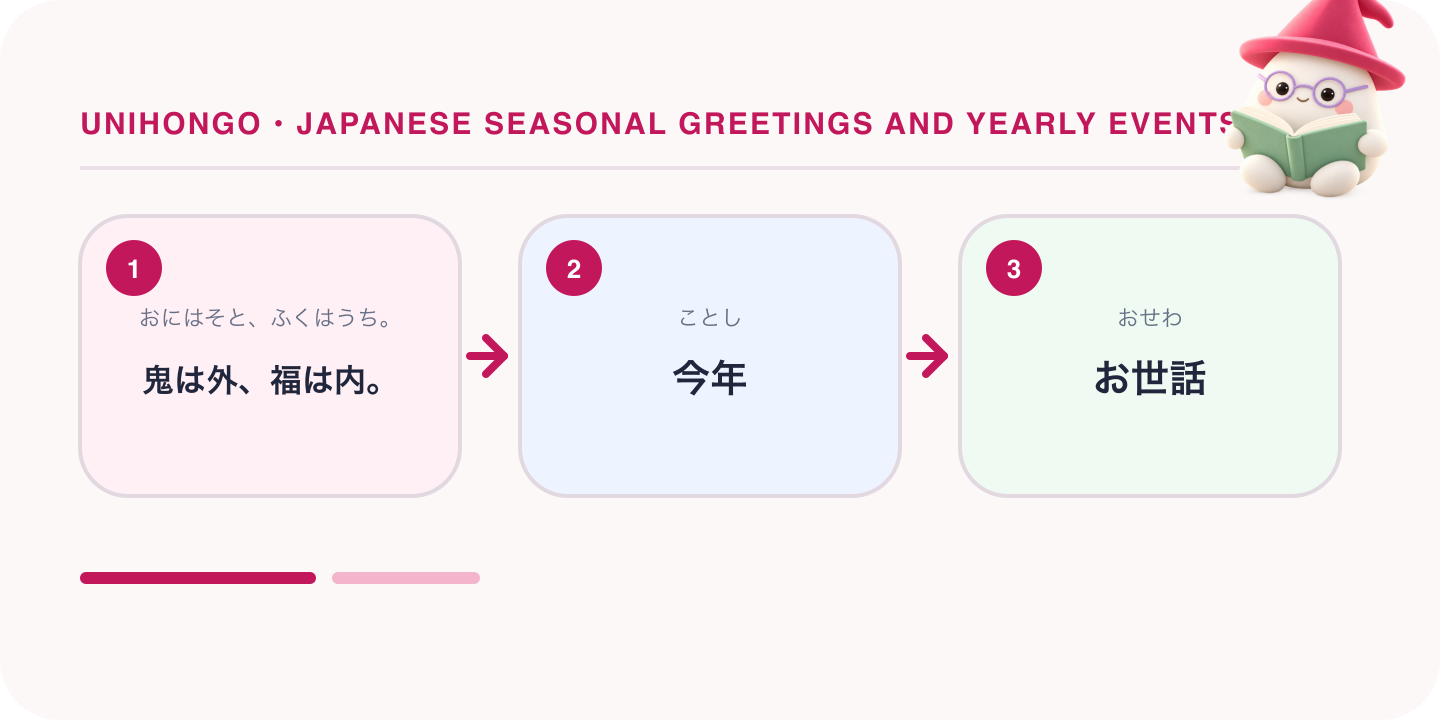
The year in greetings, month by month
| Month | Event | Greeting you will hear |
|---|---|---|
| January | Shōgatsu, the New Year holiday, and hatsumōde shrine visits | あけましておめでとうございます。今年もよろしくお願いします。 |
| February | Setsubun bean throwing, then Valentine's Day chocolate | 鬼は外、福は内。 |
| March | Graduation ceremonies and Hinamatsuri, the doll festival | ご卒業おめでとうございます。 |
| April | School and company entrance ceremonies, cherry blossom viewing | ご入学おめでとうございます。お花見に行きませんか? |
| May | Golden Week holidays and Mother's Day | 連休はどこか行きましたか? |
| June | Tsuyu, the rainy season | 梅雨入りしましたね。 |
| July | Tanabata star festival, summer heat, shochū mimai cards | 暑中お見舞い申し上げます。 |
| August | Obon homecomings, fireworks, zansho mimai cards | お盆は帰省しますか? |
| September | Respect for the Aged Day and moon viewing | 涼しくなりましたね。 |
| October | Sports days and the start of autumn colours | 紅葉がきれいですね。 |
| November | Shichi-go-san for children and peak autumn colours | 寒くなってきましたね。 |
| December | Bōnenkai parties, Christmas, and the year end | 今年もお世話になりました。良いお年を。 |
The year-end thank-you and see you next year
From the middle of December, the last conversation you have with anyone before the holiday ends with a thank-you for the year and a wish for a good New Year. Kotoshi mo osewa ni narimashita thanks the person for everything they did for you this year, and yoi otoshi o omukae kudasai wishes them a good year to come. Between colleagues and friends the second line shortens to yoi otoshi o. The reply mirrors it: kochira koso, and the same wish back.
The mistake almost every learner makes is saying akemashite omedetō gozaimasu on the last working day of December. That line belongs only after midnight on the first. Before then, the year has not opened, so the greeting is a wish, not a congratulation. If you remember only one rule from this post, remember that the year-end line is yoi otoshi o and the New Year line comes later.
| Japanese | Romaji | Meaning |
|---|---|---|
| 今年もお世話になりました。 | Kotoshi mo osewa ni narimashita. | Thank you for everything this year. |
| 良いお年をお迎えください。 | Yoi otoshi o omukae kudasai. | Have a good New Year. (polite) |
| 良いお年を。 | Yoi otoshi o. | Have a good New Year. |
| こちらこそ、来年もよろしくお願いします。 | Kochira koso, rainen mo yoroshiku onegai shimasu. | Likewise, and I look forward to next year. |
| 一年間お疲れ様でした。 | Ichinenkan otsukaresama deshita. | Thank you for your hard work this year. |
| 年末はどう過ごしますか? | Nenmatsu wa dō sugoshimasu ka? | How will you spend the end of the year? |
New Year greetings after the year has changed
Shōgatsu, the New Year holiday, is the biggest family event of the year; many people return to their hometown, eat special food, receive nengajō cards, and make hatsumōde, the first shrine or temple visit of the year. From the first of January the greeting becomes akemashite omedetō gozaimasu, followed almost always by kotoshi mo yoroshiku onegai shimasu, which asks for the other person's goodwill in the coming year. You say the pair once to each person the first time you see them, and they say the same pair back.
Among friends the pair collapses to akeome, kotoyoro, which is very casual and best kept for text messages and people your own age. The first days back at work also bring small talk about the holiday: how was your New Year, did you go home, did you visit a shrine. The natural answers are short and unremarkable, which is exactly the point. The greeting is usually dropped by around the end of the first week of January, though many people keep it until they have met each colleague once.
| Japanese | Romaji | Meaning |
|---|---|---|
| あけましておめでとうございます。 | Akemashite omedetō gozaimasu. | Happy New Year. |
| 今年もよろしくお願いします。 | Kotoshi mo yoroshiku onegai shimasu. | I look forward to your continued support this year. |
| こちらこそ、よろしくお願いします。 | Kochira koso, yoroshiku onegai shimasu. | Likewise, thank you. |
| あけおめ、ことよろ。 | Akeome, kotoyoro. | Happy New Year. (very casual) |
| お正月はどうでしたか? | Oshōgatsu wa dō deshita ka? | How was your New Year? |
| 実家でのんびりしました。 | Jikka de nonbiri shimashita. | I relaxed at my parents' place. |
| 初詣に行きましたか? | Hatsumōde ni ikimashita ka? | Did you make the first shrine visit? |
Setsubun and early spring
Setsubun, in early February, marks the traditional turn toward spring, and in many homes and at many shrines people throw roasted soybeans while calling out oni wa soto, fuku wa uchi, sending bad luck out and good fortune in. Many people also eat an ehōmaki, a thick sushi roll, facing that year's lucky direction, and in most versions of the custom the roll is eaten in silence. It is a light, family event rather than a solemn one, and children do most of the shouting.
As a speaker you will use the chant itself, questions about whether someone did it, and the follow-up about the lucky direction, which changes yearly and is printed on every ehōmaki packet. Late February and March then bring Valentine's Day, where women traditionally give chocolate, and graduation season, where the line is gosotsugyō omedetō gozaimasu to the student and their parents alike.
| Japanese | Romaji | Meaning |
|---|---|---|
| 鬼は外、福は内。 | Oni wa soto, fuku wa uchi. | Demons out, good fortune in. |
| 豆まきをしましたか? | Mamemaki o shimashita ka? | Did you do the bean throwing? |
| 今年の恵方はどっちですか? | Kotoshi no ehō wa dotchi desu ka? | Which is this year's lucky direction? |
| 恵方巻を食べました。 | Ehōmaki o tabemashita. | I ate an ehōmaki roll. |
| ご卒業おめでとうございます。 | Gosotsugyō omedetō gozaimasu. | Congratulations on your graduation. |
Cherry blossom and Golden Week small talk
April opens the school and business year, so the greetings are congratulations on entering: gonyūgaku omedetō gozaimasu for a child starting school and, in offices, a welcome to new employees. The cherry blossom usually peaks in the same weeks, and hanami, sitting under the trees with food and drink, is the invitation you are most likely to receive. Sakura mō sakimashita ne is the small-talk line, and the invitation is ohanami ni ikimasen ka.
Golden Week is the cluster of public holidays that runs from late April into early May, and it is the busiest travel period of spring. The small talk is entirely predictable: before it, where are you going; after it, how was it and how bad was the traffic. The honest answer that nothing was planned, toku ni yotei wa nai desu, is completely normal and often met with relief. The post on Japanese small talk covers the general technique; these are the lines for this particular week.
| Japanese | Romaji | Meaning |
|---|---|---|
| ご入学おめでとうございます。 | Gonyūgaku omedetō gozaimasu. | Congratulations on starting school. |
| 桜、もう咲きましたね。 | Sakura, mō sakimashita ne. | The cherry blossoms are out already. |
| お花見に行きませんか? | Ohanami ni ikimasen ka? | Shall we go blossom viewing? |
| ゴールデンウィークはどこか行きますか? | Gōruden wīku wa dokoka ikimasu ka? | Are you going anywhere for Golden Week? |
| 特に予定はないです。家でゆっくりします。 | Toku ni yotei wa nai desu. Ie de yukkuri shimasu. | No particular plans. I will relax at home. |
| どこも混んでいますよね。 | Doko mo konde imasu yo ne. | Everywhere is crowded, isn't it. |
| 連休はどうでしたか? | Renkyū wa dō deshita ka? | How was the long weekend? |
Rainy season and summer heat greetings
Tsuyu, the rainy season, arrives in most of the country in June and brings weeks of grey, humid weather. The greeting is a remark about it: tsuyuiri shimashita ne when it begins, jimejime shimasu ne about the humidity, and tsuyuake shimashita ne when it lifts. From then until September the heat takes over, and atsui desu ne becomes the opening line of nearly every conversation, answered by sō desu ne and often a sympathetic comment about sleeping badly.
Formal summer greetings have their own wording. Shochū omimai mōshiagemasu appears on cards and in emails during the hottest part of summer, and from around early August, when the traditional calendar says autumn has begun, it changes to zansho omimai mōshiagemasu, the greeting for lingering heat. Both are usually followed by a wish for the reader's health. In speech, the everyday version is a warning about heatstroke: netchūshō ni ki o tsukete kudasai.
| Japanese | Romaji | Meaning |
|---|---|---|
| 梅雨入りしましたね。 | Tsuyuiri shimashita ne. | The rainy season has started, hasn't it. |
| じめじめしますね。 | Jimejime shimasu ne. | It is so humid. |
| 梅雨明けしましたね。 | Tsuyuake shimashita ne. | The rainy season is over, isn't it. |
| 暑いですね。 | Atsui desu ne. | Hot, isn't it. |
| 暑中お見舞い申し上げます。 | Shochū omimai mōshiagemasu. | Greetings in the summer heat. (formal) |
| 残暑お見舞い申し上げます。 | Zansho omimai mōshiagemasu. | Greetings in the lingering heat. (formal) |
| 熱中症に気をつけてください。 | Netchūshō ni ki o tsukete kudasai. | Be careful of heatstroke. |
| 暑さに負けないでくださいね。 | Atsusa ni makenaide kudasai ne. | Do not let the heat get to you. |
Obon and going back to a hometown
Obon, in mid-August in most regions and in July in some, is the period when families welcome the spirits of ancestors home, visit and clean family graves, and gather in the hometown. Many companies close for several days, trains and motorways fill with the kisei rush of people heading back, and the conversations before and after follow the same shape as at New Year and Golden Week: are you going home, when is your holiday, how was the journey.
Two words carry most of the conversation. Kisei means returning to your hometown, and jikka means your parents' home, so jikka ni kaerimasu is the standard answer. Ohakamairi, visiting the family grave, is mentioned plainly and without ceremony; it is simply what many people do. If you are welcomed into a family home during Obon, okaerinasai may be said to a returning family member, and you as a guest will hear yoku kite kuremashita or a simple dōzo.
| Japanese | Romaji | Meaning |
|---|---|---|
| お盆はどうしますか? | Obon wa dō shimasu ka? | What are you doing for Obon? |
| 実家に帰ります。 | Jikka ni kaerimasu. | I am going back to my parents' home. |
| お墓参りに行きます。 | Ohakamairi ni ikimasu. | I am going to visit the family grave. |
| お盆休みはいつからですか? | Obon-yasumi wa itsu kara desu ka? | When does your Obon holiday start? |
| 帰省ラッシュがすごいですね。 | Kisei rasshu ga sugoi desu ne. | The homecoming rush is intense. |
| おかえりなさい。 | Okaerinasai. | Welcome home. |
Autumn and the end-of-year gatherings
Autumn conversation is about relief. Suzushiku narimashita ne, it has got cooler, replaces the summer heat line in September, and from October the talk moves to kōyō, the autumn leaves, and to food, since aki is described as the season of appetite. Respect for the Aged Day, moon viewing, and school sports days pass through the calendar, and by November the line has turned to samuku natte kimashita ne, it is getting cold, which then runs all the way to spring.
December belongs to the bōnenkai, the year-end party held by companies, teams and friend groups to leave the year's troubles behind. It is usually the most relaxed event in the workplace calendar, and the lines are simple: a toast thanking everyone for the year's work, kanpai, and at the end the year-end greetings from the earlier section. Christmas is mostly a commercial and romantic occasion, and merī kurisumasu is said lightly, if at all. A shinnenkai, the matching new-year party, often follows in January.
| Japanese | Romaji | Meaning |
|---|---|---|
| 涼しくなりましたね。 | Suzushiku narimashita ne. | It has got cooler, hasn't it. |
| 紅葉がきれいですね。 | Kōyō ga kirei desu ne. | The autumn leaves are beautiful. |
| 食欲の秋ですね。 | Shokuyoku no aki desu ne. | Autumn, the season of appetite. |
| 寒くなってきましたね。 | Samuku natte kimashita ne. | It is getting cold, isn't it. |
| 忘年会はいつですか? | Bōnenkai wa itsu desu ka? | When is the year-end party? |
| 今年一年、お疲れ様でした。乾杯。 | Kotoshi ichinen, otsukaresama deshita. Kanpai. | Thank you for a year of hard work. Cheers. |
| メリークリスマス。 | Merī kurisumasu. | Merry Christmas. |
Seasonal openers for letters and emails
Written Japanese opens with the season before it gets to the point, and a learner who starts an email with the request itself can sound brusque. The plain version is one sentence about the weather plus a question about the reader's health: samui hi ga tsuzukimasu ga, ikaga osugoshi desu ka in winter, atsui hi ga tsuzukimasu ga, ogenki desu ka in summer. Formal business letters use a fixed opener such as jika masumasu goseiei no koto to oyorokobi mōshiagemasu, which is best copied whole rather than built from parts.
The closing does the same job in reverse: a wish for the reader's health tied to the season, such as a warning about chilly mornings and evenings in autumn. In routine work email between colleagues the season line is usually dropped and replaced with otsukaresama desu, but to a customer, a teacher, or someone you have not written to in a while, one seasonal sentence at the top is expected and appreciated.
| Japanese | Romaji | Meaning |
|---|---|---|
| 寒い日が続きますが、いかがお過ごしですか。 | Samui hi ga tsuzukimasu ga, ikaga osugoshi desu ka. | The cold days continue; how are you keeping? |
| 暑い日が続きますが、お元気ですか。 | Atsui hi ga tsuzukimasu ga, ogenki desu ka. | It has been hot day after day; are you well? |
| 桜の季節になりましたね。 | Sakura no kisetsu ni narimashita ne. | Cherry blossom season is here. |
| 朝晩は冷え込みますので、お体に気をつけてください。 | Asaban wa hiekomimasu node, okarada ni ki o tsukete kudasai. | Mornings and evenings are chilly, so please take care of yourself. |
| 時下ますますご清栄のこととお慶び申し上げます。 | Jika masumasu goseiei no koto to oyorokobi mōshiagemasu. | I trust this finds you in continued prosperity. (formal letter) |
How to learn the calendar by speaking it
- Put the current month's line on a card by the door and say it to the first person you meet each day, real or imagined.
- Pair every greeting with its reply and practise both sides, since you will be the listener half the time.
- Practise the year-end and New Year pair together until yoi otoshi o and akemashite omedetō never swap places.
- Rehearse the three homecoming conversations at New Year, Golden Week and Obon as one script with different dates.
- Draft one seasonal email opener a month and read it aloud before sending, checking that the honorific forms sound smooth.