
Two kinds of jealous, two sets of words
Start by asking which jealous you mean. If you would like what someone has, such as a trip, a job or a new phone, that is envy, and Japanese uses urayamashii (うらやましい) or the short exclamation ii nā (いいなあ). If you feel uneasy because someone you love is paying attention to another person, that is romantic jealousy, and Japanese uses yakimochi (やきもち) or, more seriously, shitto (嫉妬).
In everyday conversation the first group appears far more often. Most of the time an English speaker says I'm so jealous, a Japanese speaker says ii nā.
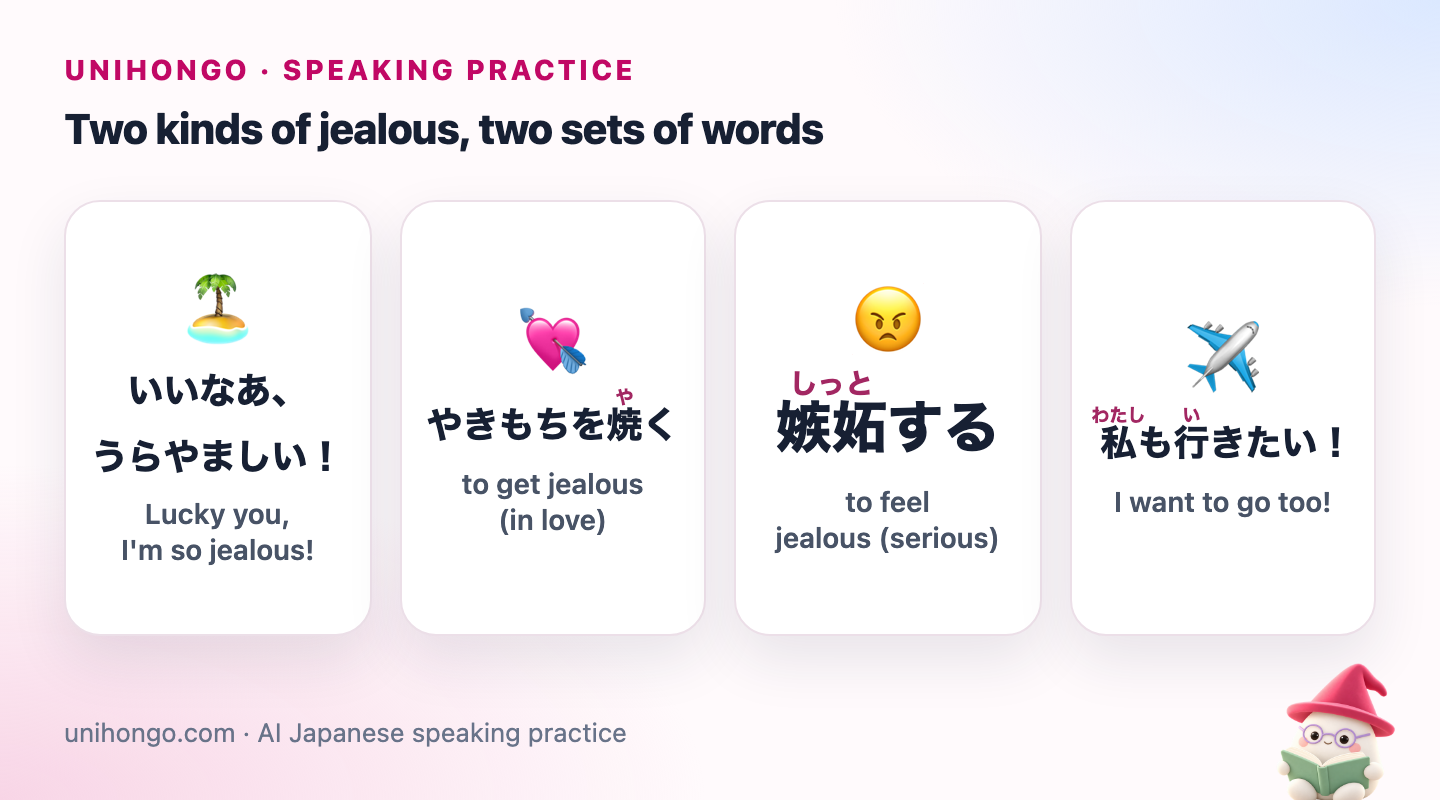
| Japanese | Romaji | Meaning |
|---|---|---|
| いいなあ、うらやましい! | Ii nā, urayamashii! | Lucky you, I'm so jealous! |
| やきもちを焼く | yakimochi o yaku | to get jealous (in love) |
| 嫉妬する | shitto suru | to feel jealous (serious) |
| 私も行きたい! | Watashi mo ikitai! | I want to go too! |
A quick test: if you could happily say good for you! in English, use ii nā or urayamashii. If the feeling involves a partner or a rival and a little pain, you are in yakimochi or shitto territory.
Ii nā and urayamashii: friendly envy
Ii nā is ii (good) plus nā, a sigh of feeling. Said brightly, it means lucky you; stretched out, ii nāā, it sounds dreamy and wistful. It is casual, and it is the most natural first reaction to a friend's good news. The polite version is ii desu ne, which works with coworkers and people you have just met.
Urayamashii is an adjective meaning envious, or enviable. In conversation it is usually said as a one-word reaction, often stretched: urayamashii! When you name the person you envy, the particle is ga: Tanaka-san ga urayamashii, I envy Tanaka-san. Learners often use o, which sounds wrong.
| Japanese | Romaji | Meaning |
|---|---|---|
| いいなあ! | Ii nā! | Lucky you! (casual) |
| いいですね。 | Ii desu ne. | That sounds nice. (polite) |
| うらやましい! | Urayamashii! | I'm so jealous! (friendly envy) |
| 田中さんがうらやましいです。 | Tanaka-san ga urayamashii desu. | I envy Tanaka-san. |
| 京都に住んでるなんて、うらやましい。 | Kyōto ni sunderu nante, urayamashii. | You live in Kyoto? I'm so envious. |
| ずるい!私も行きたかった。 | Zurui! Watashi mo ikitakatta. | No fair! I wanted to go too. (playful) |
Zurui literally means unfair or sly. Between close friends, said with a laugh, it is a playful way to show envy. With anyone you are not close to, it can sound like a real complaint, so keep it for friends.
Talking about other people's envy
Japanese adjectives of feeling describe your own feelings. To say that someone else is envious, add -garu: urayamashigaru, to show envy, or say that they seem envious with -sō. This is a common slip in the other direction: Mari wa urayamashii means Mari is enviable, not Mari is envious.
| Japanese | Romaji | Meaning |
|---|---|---|
| 妹がうらやましがっています。 | Imōto ga urayamashigatte imasu. | My younger sister is envious. |
| みんな、うらやましそうだった。 | Minna, urayamashisō datta. | Everyone looked envious. |
| うらやましがられるかも。 | Urayamashigarareru kamo. | People might envy you. |
This rule applies to most feeling words: ureshii, sabishii and kowai describe the speaker. For someone else, Japanese adds -sō (seems), -garu (shows signs of) or rashii (apparently), because you cannot see inside another person's head.
Yakimochi: jealousy in love
Yakimochi is literally a grilled rice cake, which puffs up as it toasts, and the image of swelling up suits the feeling. Yakimochi o yaku, to grill a rice cake, means to get jealous, usually in a relationship. It is often said with affection or teasing, and it also covers children who are jealous of a new baby brother or sister. A person who gets jealous easily is a yakimochi-yaki.
Shitto (嫉妬) is the same emotion named directly. It sounds stronger and more serious, and it is common in songs, dramas and articles. Shitto-bukai, deeply jealous, describes a possessive partner, and it is not a compliment. The English loanword jerashī (ジェラシー) also exists, with a slightly dramatic, playful feel.
| Japanese | Romaji | Meaning |
|---|---|---|
| やきもち焼いてるの? | Yakimochi yaiteru no? | Are you jealous? (teasing) |
| ちょっとやきもちを焼いちゃった。 | Chotto yakimochi o yaichatta. | I got a little jealous. |
| 彼女はやきもち焼きです。 | Kanojo wa yakimochi-yaki desu. | She gets jealous easily. |
| 上の子が赤ちゃんにやきもちを焼いています。 | Ue no ko ga akachan ni yakimochi o yaite imasu. | Our older child is jealous of the baby. |
| 彼は嫉妬深い人です。 | Kare wa shitto-bukai hito desu. | He is a very jealous person. |
In a relationship, admitting jealousy lightly is often taken as affection, and chotto yakimochi yaichatta said with a smile can be sweet. Calling a partner a yakimochi-yaki can be teasing or a real complaint depending on the tone, so read the mood before you say it.
Words to keep out of small talk
Some jealousy words carry resentment, and using them about a friend's good news would shock people. Netamashii (妬ましい) means bitterly envious, wishing the other person did not have what they have. Netamu is the verb. You will meet these words in novels and in discussions of envy, but not in a cheerful chat about holiday photos.
| Word | Feeling | Use it for |
|---|---|---|
| Ii nā | Light, warm envy | Friends' news and photos |
| Urayamashii | Friendly envy | Friends, and coworkers in relaxed moments |
| Yakimochi | Jealousy in love, often teasing | Partners, children, pets |
| Shitto | Serious jealousy or rivalry | Talking about the emotion itself |
| Netamashii | Bitter, resentful envy | Almost never about a friend |
If you want to admit a real twinge of envy without sounding bitter, add a laugh and a little honesty: chotto urayamashii kamo, I might be a tiny bit jealous. The softeners chotto and kamo keep it light and human.
A spoken exchange: holiday photos
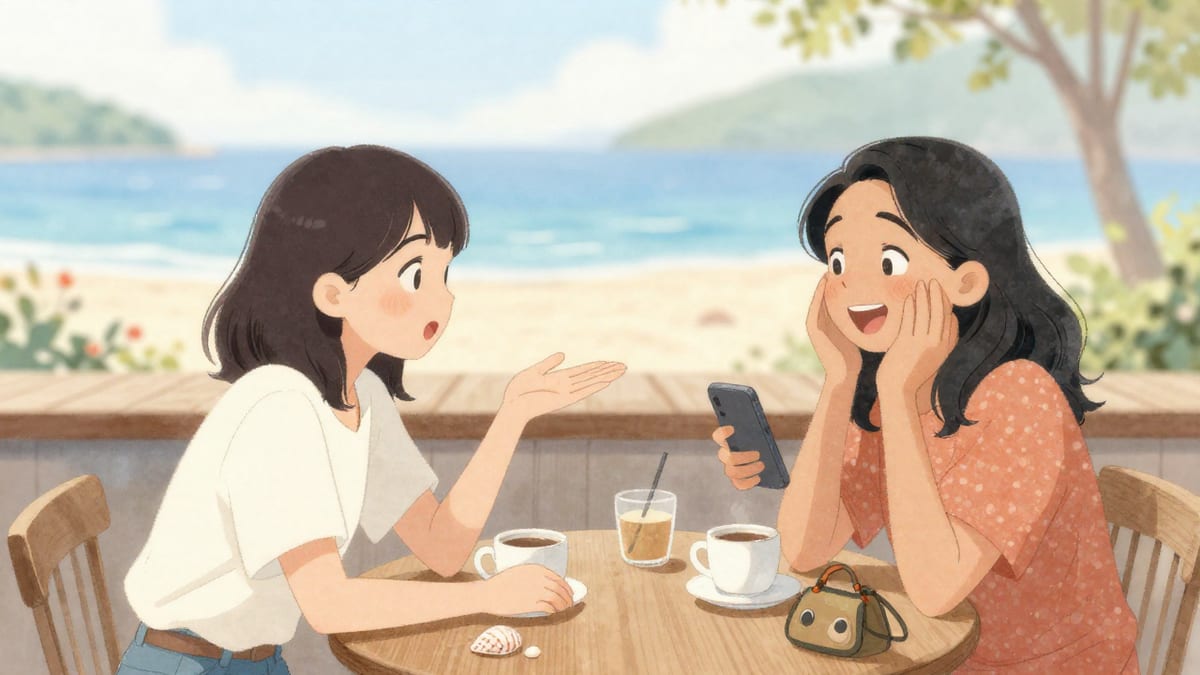
A friend has just come back from Okinawa and pulls out a phone. Notice how the envy comes first and then turns straight into questions. In Japanese conversation, a reaction followed by interest feels warm; envy on its own can make the other person feel they must play down their trip.
| Japanese | Romaji | Meaning |
|---|---|---|
| 見て、沖縄の写真! | Mite, Okinawa no shashin! | Friend: Look, my Okinawa photos! |
| わあ、いいなあ!海がきれい! | Wā, ii nā! Umi ga kirei! | You: Wow, lucky you! The sea is beautiful! |
| 三日間行ってきたんだ。 | Mikkakan itte kita n da. | Friend: I went for three days. |
| うらやましい!何が一番楽しかった? | Urayamashii! Nani ga ichiban tanoshikatta? | You: So jealous! What was the most fun? |
| シュノーケリングかな。 | Shunōkeringu ka na. | Friend: Snorkelling, I think. |
| 私もそこ行きたい!どこに泊まったの? | Watashi mo soko ikitai! Doko ni tomatta no? | You: I want to go there too! Where did you stay? |
Polite envy with coworkers and seniors
At work, envy is usually expressed as admiration of the situation rather than as a feeling of your own. Ii desu ne and urayamashii desu are both fine with colleagues in a relaxed moment, for example when someone mentions a long weekend. With a manager or a client, praising the plan works better: tanoshisō desu ne, that sounds fun, or suteki desu ne, that's lovely. These keep the focus on the other person's good news.
When someone envies you, a modest answer is expected in many situations. Sonna koto nai yo, oh, not really, playfully plays it down among friends, and okagesama de, thanks to you, is the polite reply when a senior congratulates you.
| Japanese | Romaji | Meaning |
|---|---|---|
| 楽しそうですね。 | Tanoshisō desu ne. | That sounds like fun. |
| 素敵ですね。 | Suteki desu ne. | How lovely. |
| そんなことないよ。 | Sonna koto nai yo. | Oh, not really. (modest) |
| ぜひ、話を聞かせてください。 | Zehi, hanashi o kikasete kudasai. | I'd love to hear all about it. |
Common mistakes
- Saying shitto shite iru about a friend's trip. It sounds like real resentment; use urayamashii.
- Using o with urayamashii. The person or thing you envy takes ga: kare ga urayamashii.
- Saying anata ga urayamashii. Anata sounds distant; use the person's name or just urayamashii.
- Stopping at envy. Add a question, or a compliment such as tanoshisō, it looks fun, so your friend can keep sharing.
- Using zurui with seniors. It is playful between friends but can sound like a complaint upward.