

Onaka ippai: the basic way to say I'm full
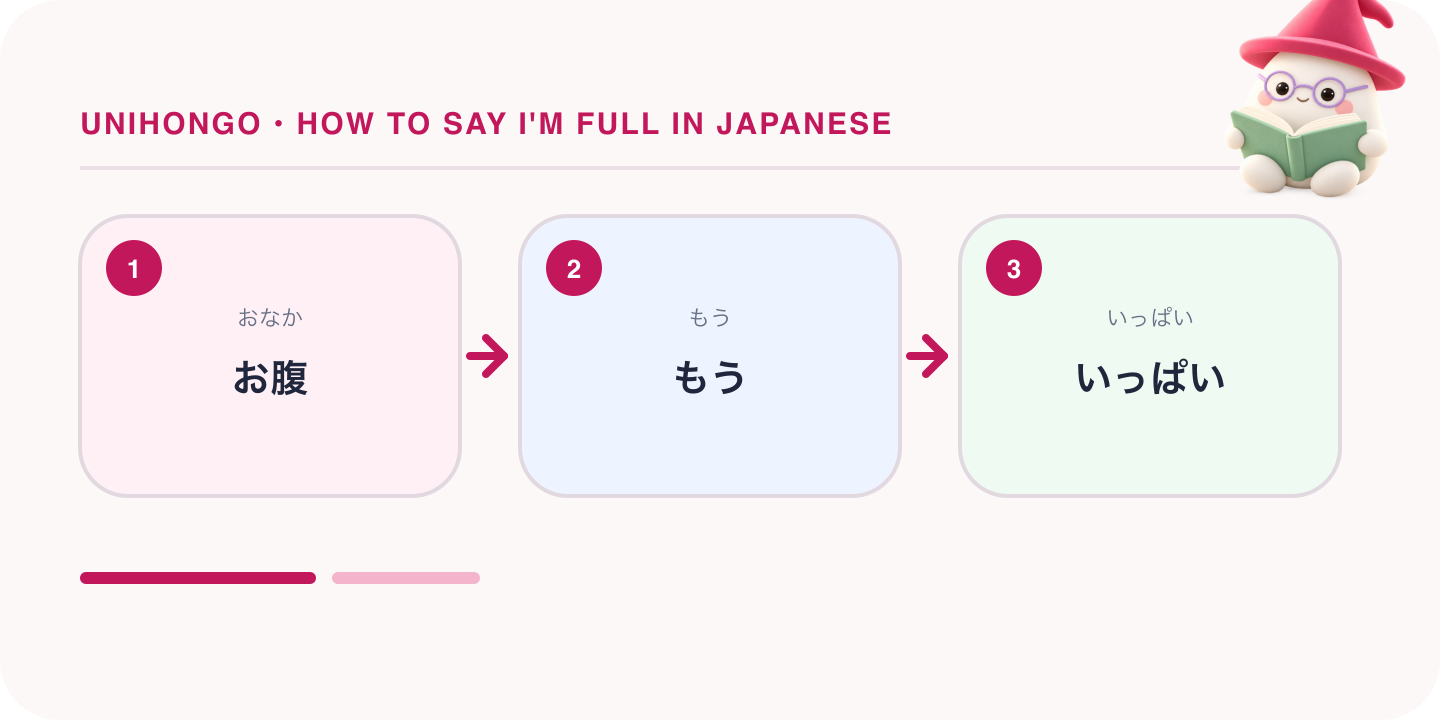
お腹 (onaka) is stomach and いっぱい (ippai) is full, so onaka ippai is literally "stomach full". It is the phrase children learn first and adults use every day. In casual speech the particle ga is usually dropped; in polite speech it often comes back: onaka ga ippai desu.
Put mō in front and it becomes "I'm already full" or "I'm full now", which is the most natural reply when someone offers more. Kekkō, a lot, or kanari, quite, add emphasis. Among men, especially older speakers, you may also hear the rougher hara ippai, which uses hara, belly.
| Japanese | Romaji | Meaning |
|---|---|---|
| あー、お腹いっぱい。 | Ā, onaka ippai. | Ah, I'm full. |
| もうお腹いっぱいです。 | Mō onaka ippai desu. | I'm already full. (polite) |
| お腹がいっぱいになりました。 | Onaka ga ippai ni narimashita. | I've become full. (polite) |
| かなりお腹いっぱい。 | Kanari onaka ippai. | I'm pretty full. |
| 腹いっぱいだ。 | Hara ippai da. | I'm stuffed. (rough, casual) |
| お腹いっぱい? | Onaka ippai? | Are you full? |
Mō taberarenai and other ways to say I'm stuffed
もう食べられない (mō taberarenai) means "I can't eat any more". It is the potential form of taberu in the negative, and it sounds stronger and more physical than onaka ippai. With friends it is completely natural, often said while leaning back from the table. The polite version is mō taberaremasen.
Other casual options describe how stuffed you feel. Tabesugita means "I ate too much", and pan-pan describes a stomach that is tight as a drum. Manpuku, full stomach, is a slightly more written word, but manpuku desu is also heard in speech and on food shows.
| Japanese | Romaji | Meaning |
|---|---|---|
| もう食べられない。 | Mō taberarenai. | I can't eat any more. |
| もう食べられません。 | Mō taberaremasen. | I can't eat any more. (polite) |
| 食べすぎた。 | Tabesugita. | I ate too much. |
| お腹がパンパン。 | Onaka ga panpan. | My stomach is about to burst. |
| 満腹です。 | Manpuku desu. | I'm full. |
| もう無理。 | Mō muri. | I can't manage any more. (very casual) |
Polite and formal ways to say you have eaten enough
In polite and formal situations, Japanese speakers often avoid talking about their stomach at all. Instead they say they have received enough, using itadaku, the humble verb for eating and receiving. Jūbun itadakimashita, "I have had plenty", is the standard phrase at a business dinner or with someone older.
Another polite pattern is to explain gently with node or de, and leave the sentence soft rather than finishing with a clear refusal. Mō onaka ga ippai de... trailing off with a smile is heard as a complete, polite answer.
| Japanese | Romaji | Meaning |
|---|---|---|
| もう十分いただきました。 | Mō jūbun itadakimashita. | I have had plenty, thank you. |
| たくさんいただきました。 | Takusan itadakimashita. | I've eaten a lot, thank you. |
| もうお腹がいっぱいで… | Mō onaka ga ippai de... | I'm quite full, so... |
| 十分です、ありがとうございます。 | Jūbun desu, arigatō gozaimasu. | That's plenty, thank you. |
| すっかりごちそうになりました。 | Sukkari gochisō ni narimashita. | You've treated me to a wonderful meal. |
Refusing seconds at a host's home
Japanese hosts often offer more food, sometimes several times, as a sign of hospitality: okawari wa?, another helping?, or mō sukoshi dō?, how about a little more? A plain no can feel cold. The pattern that works is thanks, praise, then a reason: the food was delicious, but you are full.
けっこうです (kekkō desu) is the classic polite refusal, meaning "I'm fine, thank you". Say it with a small wave of the hand or a slight bow, and ideally with iie or mō in front so it cannot be mistaken for "that's fine, go ahead". If the host insists, one more gentle refusal is normal. If you do want a little, sukoshi dake, just a little, lets you accept without overeating.
| Japanese | Romaji | Meaning |
|---|---|---|
| おかわりはいかがですか。 | Okawari wa ikaga desu ka. | Would you like another helping? |
| とてもおいしかったです。でも、もうお腹いっぱいです。 | Totemo oishikatta desu. Demo, mō onaka ippai desu. | It was delicious, but I'm already full. |
| いえ、もうけっこうです。ありがとうございます。 | Ie, mō kekkō desu. Arigatō gozaimasu. | No, I'm fine now, thank you. |
| じゃあ、少しだけお願いします。 | Jā, sukoshi dake onegai shimasu. | Well then, just a little, please. |
| お気持ちだけいただきます。 | O-kimochi dake itadakimasu. | I'll accept just the kind thought. |
| 本当に十分です。 | Hontō ni jūbun desu. | I really have had enough. |
Gochisōsama deshita: ending the meal
Saying you are full is not the same as ending the meal. When you finish eating, the set phrase is ごちそうさまでした (gochisōsama deshita), a thank-you for the food and the effort behind it. Among family and friends the short gochisōsama is common. It pairs with itadakimasu, said before eating.
Gochisōsama is also said to whoever paid, and to restaurant staff as you leave. After a meal at someone's home, it is natural to combine it with praise: gochisōsama deshita, hontō ni oishikatta desu. Our guide to itadakimasu and gochisōsama covers the etiquette in more detail.
| Japanese | Romaji | Meaning |
|---|---|---|
| ごちそうさまでした。 | Gochisōsama deshita. | Thank you for the meal. |
| ごちそうさま。 | Gochisōsama. | Thanks for the meal. (casual) |
| ごちそうさまでした。本当においしかったです。 | Gochisōsama deshita. Hontō ni oishikatta desu. | Thank you for the meal. It was really delicious. |
| お粗末さまでした。 | O-somatsusama deshita. | It was nothing special. (host's modest reply) |
| ごちそうになりました。 | Gochisō ni narimashita. | Thank you for treating me. |
Hara hachibu and other food words
腹八分 (hara hachibu), sometimes hara hachibunme, means eating until you are about eighty per cent full. It is a traditional piece of advice about moderation, often linked to Okinawa and long life. People use it as a rule or a reminder, for example hara hachibu ni shite oku, "I'll stop at eighty per cent", rather than to describe how full they are.
The table below collects the words you will hear around the idea of being full, from the everyday to the idiomatic.
| Word | Reading | Meaning |
|---|---|---|
| お腹いっぱい | onaka ippai | Full (everyday) |
| 満腹 | manpuku | Full stomach (slightly formal) |
| 腹八分 | hara hachibu | Eating to 80 per cent full |
| 食べすぎ | tabesugi | Overeating |
| おかわり | okawari | Second helping, refill |
| 別腹 | betsubara | A separate stomach for dessert |
| 腹ごなし | haragonashi | Moving about to help digestion |
Betsubara is a favourite: even when you say onaka ippai, dessert goes into your "other stomach". Dezāto wa betsubara, dessert has its own stomach, is a light, friendly line that usually gets a laugh.
What people say back
When you say you are full, people usually respond by checking you enjoyed the meal, teasing gently, or respecting your answer. A host may ask once more, and that second offer is part of the ritual rather than pressure. If someone else says they are full, the natural reply is to ask if they enjoyed it or to suggest a break.
| Japanese | Romaji | Meaning |
|---|---|---|
| 本当に?遠慮しないでね。 | Hontō ni? Enryo shinaide ne. | Really? Don't hold back. |
| たくさん食べてくれてうれしい。 | Takusan tabete kurete ureshii. | I'm glad you ate so much. |
| 口に合ってよかったです。 | Kuchi ni atte yokatta desu. | I'm glad it suited your taste. |
| デザートは別腹でしょう? | Dezāto wa betsubara deshō? | There's always room for dessert, right? |
| じゃあ、少し休もうか。 | Jā, sukoshi yasumō ka. | Shall we take a little break then? |
Common mistakes when saying you're full
- Saying ippai desu on its own: without onaka it can sound like "it's crowded" or "that's a lot". Keep onaka in the sentence.
- Using iranai to a host: it means "I don't need it" and sounds blunt. Say kekkō desu or mō onaka ippai desu instead.
- Saying kekkō desu with a flat tone and no gesture: it can be heard as "that's fine", which may mean yes. Add iie or mō, and a small wave.
- Using onaka ippai to end the meal: it describes your stomach, but the closing ritual is gochisōsama deshita.
- Saying mō muri to a senior person: it is casual slang for "can't". Use mō jūbun itadakimashita instead.
- Leaving a large amount on your plate: if you know you will be full, ask for a smaller portion from the start with sukoshi dake.