
Oshibori in one minute
The word comes from shiboru (絞る), to wring out, with the polite prefix o: an oshibori is a towel that has been dampened and wrung out. In restaurants it is usually rolled or folded, and either placed on a small tray in front of you or handed over by the server as you sit down. You may also hear otefuki, a hand wipe, which is often used for paper wet wipes.
Hot oshibori, atsui oshibori, are typical in winter and in many izakaya all year. Cold ones, tsumetai oshibori, are a summer treat. Either way, the gesture is about welcoming you and letting you start the meal with clean hands.
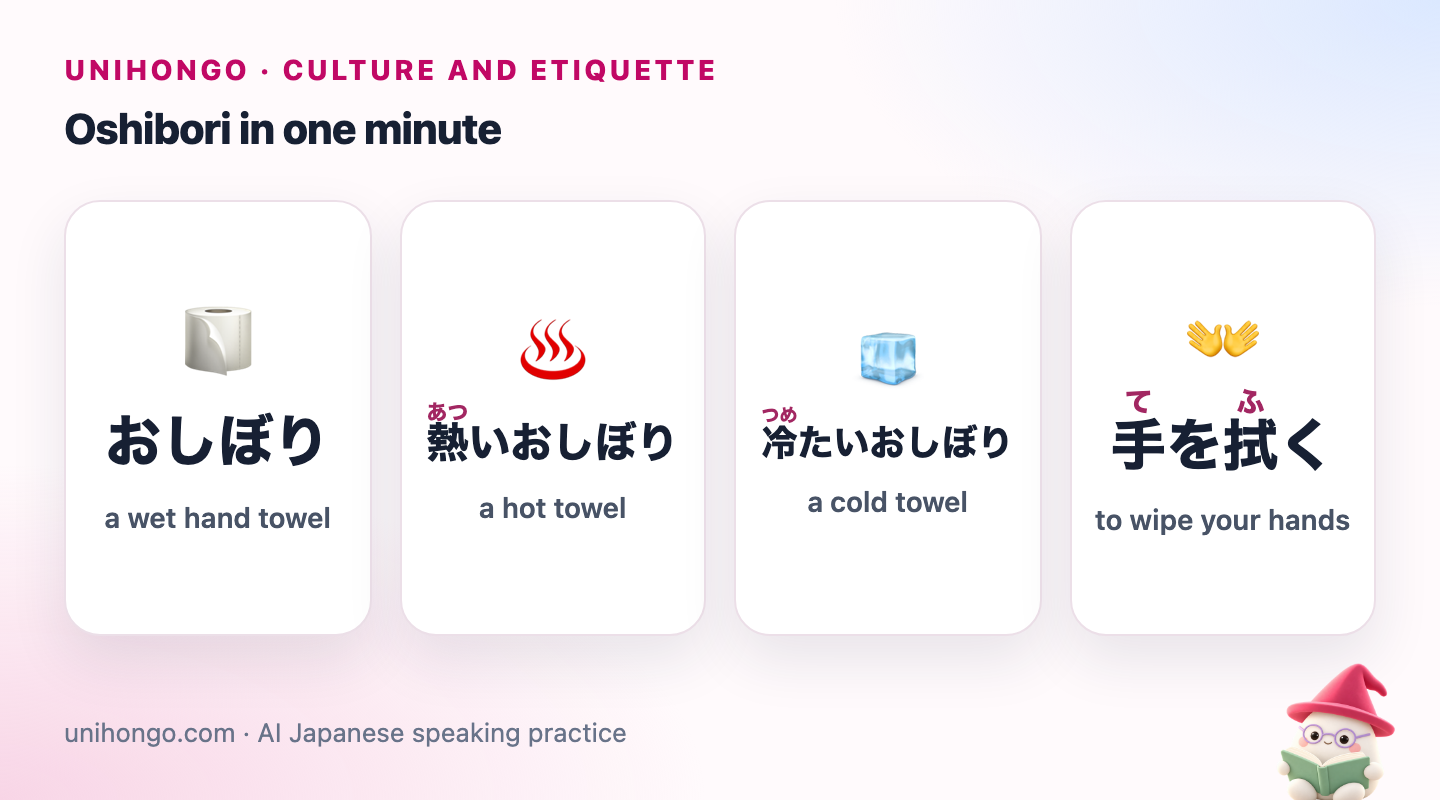
| Japanese | Romaji | Meaning |
|---|---|---|
| おしぼり | oshibori | a wet hand towel |
| 熱いおしぼり | atsui oshibori | a hot towel |
| 冷たいおしぼり | tsumetai oshibori | a cold towel |
| 手を拭く | te o fuku | to wipe your hands |
| お手拭き | otefuki | a hand wipe, often paper |
Why restaurants hand you a towel
Offering a damp towel to a guest is often explained as an old gesture of hospitality, from the days when travellers arrived at inns and tea houses tired and dusty and were given water or a cloth to refresh themselves. How exactly the modern restaurant towel grew out of that is not certain, and there are various theories, but the feeling behind it is easy to understand: it is a small piece of omotenashi, care for the guest, that happens before you have even ordered.
It is also practical. Japanese meals often involve food you touch, such as sushi at the counter, edamame, yakitori skewers and crab, and many people like to clean their hands before eating rather than walk to a washroom. A towel at the table saves a trip and starts the meal on a clean note. In summer, a chilled towel on the wrists is a genuine relief after a hot walk; in winter, a hot one on cold hands is part of the pleasure of coming in from the street.
| Japanese | Romaji | Meaning |
|---|---|---|
| おもてなし | omotenashi | wholehearted hospitality |
| 生き返る! | Ikikaeru! | That brings me back to life! (casual) |
| 冷たくて気持ちいい。 | Tsumetakute kimochi ii. | It's cold and feels great. (casual) |
Cloth or paper: the two kinds
There are two main types. Cloth oshibori are thick cotton towels, rolled and often kept in a warmer or a fridge. Many restaurants do not wash them themselves: they rent them from specialist laundry businesses that collect the used towels and deliver clean ones, which is why you sometimes see vans with stacks of towels outside restaurants in the morning. Paper oshibori come sealed in a plastic packet, sometimes with a faint fragrance, and are common at family restaurants, fast-food places and convenience stores.
| Japanese | Romaji | Meaning |
|---|---|---|
| 布のおしぼり | nuno no oshibori | a cloth towel |
| 紙おしぼり | kami oshibori | a paper wet towel |
| 使い捨て | tsukaisute | disposable |
| おしぼりはセルフサービスです。 | Oshibori wa serufu sābisu desu. | Towels are self-service. |
| Type | Where you meet it | How to finish |
|---|---|---|
| Cloth, rolled | Izakaya, sushi bars, cafés, traditional restaurants | Fold it and leave it on its tray |
| Paper, sealed packet | Family restaurants, chains, takeaway counters | Keep the towel and wrapper together at the side |
| Wet wipes from a box | Self-service places, food courts | Take one, throw it away in the bin provided |
How to use an oshibori, step by step
| Japanese | Romaji | Meaning |
|---|---|---|
| おしぼりをどうぞ。 | Oshibori o dōzo. | Staff: Here's a towel for you. |
| 熱いので、お気をつけください。 | Atsui no de, oki o tsuke kudasai. | Staff: It's hot, so please be careful. |
| ありがとうございます。あったかい! | Arigatō gozaimasu. Attakai! | Thank you. It's lovely and warm! |
- When it arrives, say a quick thank you. A nod or arigatō gozaimasu is enough.
- If it is rolled, open it out. If it is very hot, wait a few seconds or shake it gently.
- Wipe your hands, front and back, and between your fingers.
- Fold it neatly and place it to the side of your plate or on its tray.
- During the meal you can use it again lightly for your fingertips, for example after peeling edamame or eating with your hands at a sushi bar.
- Leave it at the table when you go. Do not take a cloth one home.
What not to wipe with it
The oshibori is for your hands. Wiping your face and neck with it is a famous stereotype of the tired office worker at an izakaya, and while some people do it among friends, many others find it unrefined, especially in a smart restaurant or with people you do not know well. Wiping your mouth with it during the meal is also better avoided; use a napkin or a tissue.
Using it to wipe the table is a grey area. After a small spill, many people dab with their oshibori, but in a restaurant it is better to ask the staff for a cloth, which they will happily bring. Do not use it to blow your nose, and do not use it to clean shoes or bags.
| Japanese | Romaji | Meaning |
|---|---|---|
| 顔は拭かないほうがいいよ。 | Kao wa fukanai hō ga ii yo. | Better not wipe your face. (casual advice) |
| 台拭きをお願いできますか。 | Daifuki o onegai dekimasu ka. | Could I have a cloth for the table? |
| Use | How it comes across |
|---|---|
| Wiping your hands | Exactly what it is for |
| Wiping fingertips during the meal | Fine and common |
| Wiping your face or neck | Unrefined to many, though some do it with friends |
| Wiping your mouth | Better to use a napkin or tissue |
| Wiping up a small spill | Common, but asking staff for a cloth is better |
| Blowing your nose | Avoid |
When something spills
Spills happen, especially with the small glasses and dipping bowls of a Japanese meal. The polite response is quick: say sorry, call the staff, and ask for a towel or a cloth. Servers deal with this all the time and will usually bring several oshibori or a cloth and ask if you are all right, especially if the drink was hot.

| Japanese | Romaji | Meaning |
|---|---|---|
| すみません、こぼしてしまいました。 | Sumimasen, koboshite shimaimashita. | Sorry, I've spilled something. |
| おしぼりをもう一つお願いします。 | Oshibori o mō hitotsu onegai shimasu. | One more towel, please. |
| おしぼり、いただけますか。 | Oshibori, itadakemasu ka. | Could I have a towel? (very polite) |
| 大丈夫ですか。お洋服にかかりませんでしたか。 | Daijōbu desu ka. Oyōfuku ni kakarimasen deshita ka. | Staff: Are you all right? Did it get on your clothes? |
| 大丈夫です。ありがとうございます。 | Daijōbu desu. Arigatō gozaimasu. | I'm fine. Thank you. |
Mini dialogue: the first minute at an izakaya
| Japanese | Romaji | Meaning |
|---|---|---|
| いらっしゃいませ。おしぼりをどうぞ。 | Irasshaimase. Oshibori o dōzo. | Server: Welcome. Here are your towels. |
| ありがとうございます。 | Arigatō gozaimasu. | You: Thank you. |
| お飲み物はお決まりですか。 | Onomimono wa okimari desu ka. | Server: Have you decided on drinks? |
| 生ビールを二つと、烏龍茶を一つお願いします。 | Nama bīru o futatsu to, ūroncha o hitotsu onegai shimasu. | You: Two draught beers and one oolong tea, please. |
| かしこまりました。 | Kashikomarimashita. | Server: Certainly. |
| あ、すみません。おしぼりがもう一つ欲しいんですが。 | A, sumimasen. Oshibori ga mō hitotsu hoshii n desu ga. | You: Oh, excuse me. We'd like one more towel, please. |
Common learner mistakes
- Waiting for food before using the towel. It is meant for the start of the meal.
- Wiping your face with it on a date or at a business dinner.
- Leaving it crumpled in a ball in the middle of the table. Fold it and put it to the side.
- Calling it a napkin, napukin. A napkin is the paper one for your mouth; the wet towel is oshibori.
- Taking a cloth oshibori home. Cloth towels are washed and reused, often by a rental service.
- Panicking when you spill a drink. A calm sumimasen and a request for a towel is all it takes.
From towel to first order: practise it with Mocchi and Sensei
Ask Mocchi: quiz me on oshibori, otefuki, daifuki, kobosu and tsukaisute, with one restaurant sentence each. Mocchi asks one question at a time, explains the ones you get wrong and remembers them, so they reappear in your next /review mixed with other restaurant words.
Then play the First Round at an Izakaya mission in AI Sensei. The objectives are spoken ones, such as ordering the first drinks for your table, so you get to use the towel thank-you, the drink order and a polite request for something extra in one natural flow, and the session report shows what to fix.