
A level is what you can do, not what you know
Grammar you recognise and grammar you can use under the pressure of a real question are two different stocks of knowledge. Speaking tests measure the second one. That is why can-do descriptions, which say things like can describe past experiences in simple connected sentences, are more useful than lists of grammar points. The question is never do you know the te-form; it is can you ask someone to open the window when the room is hot and the person is looking at you.
The lines below set the tone for a self-test: say what you can, in your own words, and notice where it stops.
| Japanese | Romaji | Meaning |
|---|---|---|
| 自分の言葉で話せる。 | Jibun no kotoba de hanaseru. | I can speak in my own words. |
| まだ上手ではありませんが、話せます。 | Mada jōzu de wa arimasen ga, hanasemasu. | I'm not good yet, but I can speak. |
| 今のレベルを知りたいです。 | Ima no reberu o shiritai desu. | I want to know my current level. |
The levels in plain words: CEFR and the JF Standard
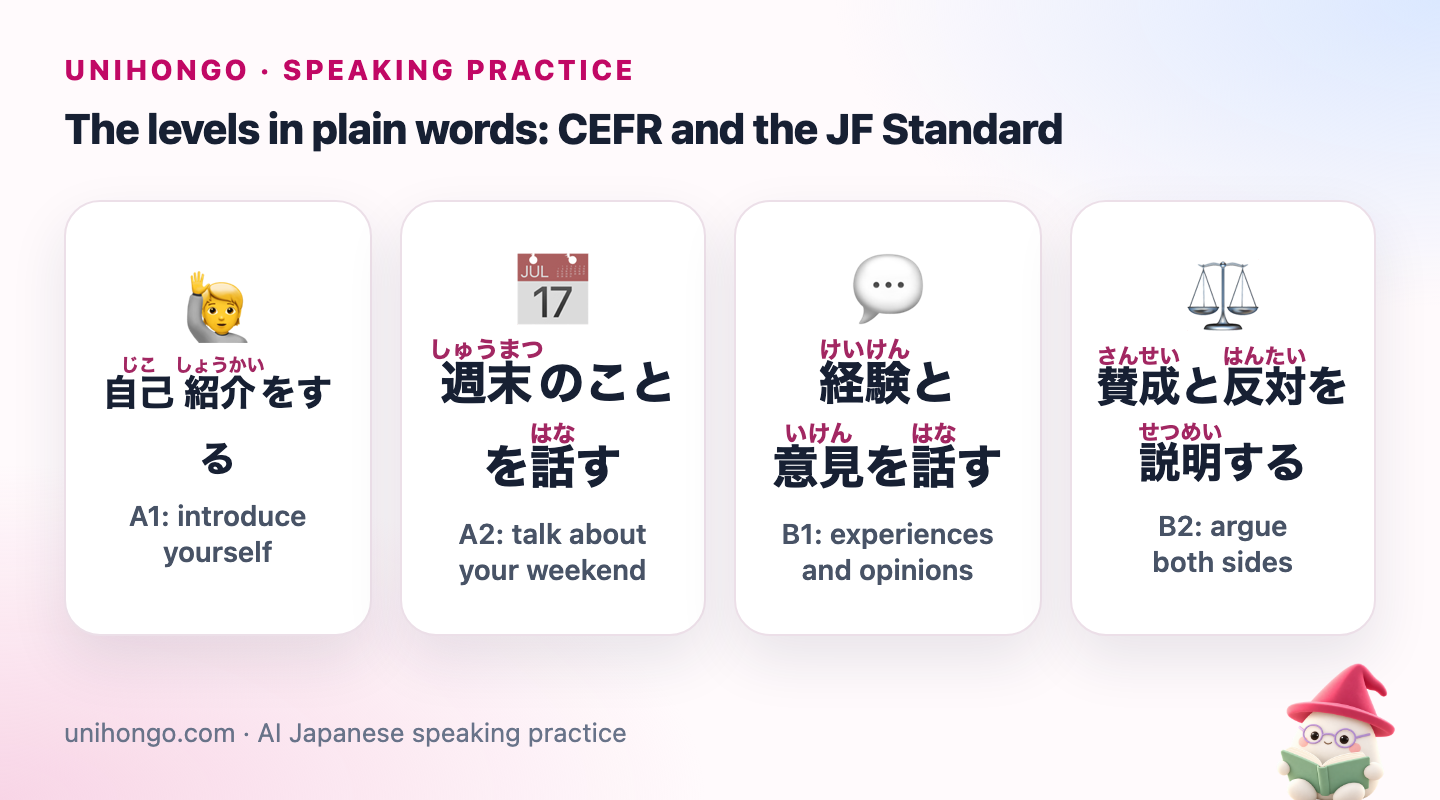
The CEFR describes six levels. The JF Standard uses the same six for Japanese and adds can-do statements written for Japanese situations. Below are the four levels most learners move through, each summarised by one speaking task. If you can do the task with pauses and some errors, you are at that level; if you can do it smoothly, you are moving past it.
| Japanese | Romaji | Meaning |
|---|---|---|
| 自己紹介をする | jikoshōkai o suru | A1: introduce yourself |
| 週末のことを話す | shūmatsu no koto o hanasu | A2: talk about your weekend |
| 経験と意見を話す | keiken to iken o hanasu | B1: experiences and opinions |
| 賛成と反対を説明する | sansei to hantai o setsumei suru | B2: argue both sides |
| Level | What you can do in speech | What it sounds like | Rough JLPT neighbour (knowledge only) |
|---|---|---|---|
| A1 | Introduce yourself, ask and answer simple personal questions, make basic requests | Single short sentences, long pauses, set phrases | Around N5 |
| A2 | Handle shopping, directions, routines; describe your day and past weekend simply | Short connected sentences, frequent pauses, polite forms | Around N4 |
| B1 | Tell a story, give an opinion with reasons, deal with most travel and work situations | Paragraph-length turns, some casual forms, self-correction | Around N3 to N2 |
| B2 | Discuss abstract topics, argue for and against, follow fast natural speech | Fluent with occasional searching, register switches on purpose | Around N2 to N1 |
The JLPT column is a rough neighbour, not a conversion. The JLPT does not test speaking, and many people sit above or below their certificate when they open their mouths.
How an oral proficiency interview works
Professional speaking interviews, including the OPI format used by trained raters, follow a shape you can copy. A warm-up puts you at ease with easy questions. Level checks confirm what you can do comfortably. Probes push one level higher, for example by asking you to narrate in the past or to argue a point, until your speech visibly breaks down: the sentences shorten, pauses lengthen, you fall back to your first language. Then the interviewer returns to comfortable ground so you leave feeling fine. Your level is the highest one you can sustain, not the one you briefly reached.
The useful part for self-testing is the breakdown. Do not avoid it. The moment where you cannot continue is the most informative thirty seconds of the recording.
| Interview stage | What the examiner does | What they are listening for |
|---|---|---|
| Warm-up | Easy personal questions | Comfort, pronunciation, basic accuracy |
| Level check | Tasks at your probable level | Can you complete the task consistently? |
| Probe | Tasks one level higher | Where and how does the speech break down? |
| Wind-down | Easy questions again | A relaxed end; nothing scored |
The self-test you can do today
You need a phone, a quiet ten minutes and the prompts below. Record one answer per prompt, from A1 to B2, speaking for as long as you can up to about ninety seconds each. Do not prepare, do not write notes, and do not stop the recording when you get stuck; say sumimasen, mō ichido and try again, because recovery is part of the score. Read the prompt aloud first so you hear a question, then answer it.
| Japanese | Romaji | Meaning |
|---|---|---|
| 自己紹介をしてください。 | Jikoshōkai o shite kudasai. | A1: Please introduce yourself. |
| 毎朝、何時に起きますか。 | Maiasa, nanji ni okimasu ka. | A1: What time do you get up every morning? |
| 先週の週末は何をしましたか。 | Senshū no shūmatsu wa nani o shimashita ka. | A2: What did you do last weekend? |
| あなたの町を紹介してください。 | Anata no machi o shōkai shite kudasai. | A2: Please describe your town. |
| 日本語を勉強している理由は何ですか。 | Nihongo o benkyō shite iru riyū wa nan desu ka. | B1: Why are you studying Japanese? |
| 最近うれしかったことを話してください。 | Saikin ureshikatta koto o hanashite kudasai. | B1: Tell me about something that made you happy recently. |
| 都会と田舎、どちらに住みたいですか。理由も教えてください。 | Tokai to inaka, dochira ni sumitai desu ka. Riyū mo oshiete kudasai. | B1: City or countryside, where would you rather live, and why? |
| 学校で制服は必要だと思いますか。賛成と反対の意見を説明してください。 | Gakkō de seifuku wa hitsuyō da to omoimasu ka. Sansei to hantai no iken o setsumei shite kudasai. | B2: Are school uniforms necessary? Explain the arguments for and against. |
Scoring yourself: what to listen for
Listen to each recording the next day and score four things. Did you complete the task, meaning did you actually answer the question with the content it asked for? How wide was the grammar, meaning did you use the past, reasons and connectors, or only desu? How long were the pauses, and were they thinking pauses or dead ends? And when you broke down, did you recover in Japanese or switch languages? Be concrete: count the filler words and the sentences that end in desu.

| Japanese | Romaji | Meaning |
|---|---|---|
| えーと、何と言えばいいか。 | Ēto, nan to ieba ii ka. | Um, how should I put it... |
| つまり、好きではないということです。 | Tsumari, suki de wa nai to iu koto desu. | In other words, I don't like it. (rephrasing) |
| 言い方が分からないので、簡単に言います。 | Iikata ga wakaranai node, kantan ni iimasu. | I don't know how to say it, so I'll say it simply. |
| Criterion | Listen for | A1 to A2 sign | B1 to B2 sign |
|---|---|---|---|
| Task completion | Did the answer contain what the question asked? | Partial, one or two points | Full, with examples |
| Grammar range | Tenses, reasons, connectors, conditionals | Mostly present tense and desu | Past, kara and node, kedo, tara |
| Pauses and fillers | Length of silences; ēto, anō | Pauses longer than the sentences | Short pauses, natural fillers |
| Recovery | What happens at a breakdown | Stop or switch languages | Rephrase in simpler Japanese |
| Register | Polite and casual used on purpose | Polite only | Switches to fit the listener |
The last two lines are recovery moves. A learner who can rephrase in simpler Japanese instead of stopping has crossed an important line, whatever their grammar.
A short interview, as it sounds
Here is a compressed example of a level check and a probe, so you can hear the shape. The examiner is polite and neutral; the learner is at a solid A2 and is probed into B1 territory at the end.
| Japanese | Romaji | Meaning |
|---|---|---|
| お仕事は何をしていますか。 | Oshigoto wa nani o shite imasu ka. | Examiner: What do you do for work? |
| 会社で働いています。マーケティングの仕事です。 | Kaisha de hataraite imasu. Māketingu no shigoto desu. | Learner: I work at a company. It's a marketing job. |
| 先週、仕事で何か大変なことがありましたか。 | Senshū, shigoto de nanika taihen na koto ga arimashita ka. | Examiner: Was there anything difficult at work last week? |
| はい。会議が多くて、とても忙しかったです。 | Hai. Kaigi ga ōkute, totemo isogashikatta desu. | Learner: Yes. There were many meetings and it was very busy. |
| その会議について、もう少し詳しく話してください。 | Sono kaigi ni tsuite, mō sukoshi kuwashiku hanashite kudasai. | Examiner: Tell me a little more about those meetings. (probe) |
| えーと、新しい商品について話しました。でも、難しい言葉が多くて... | Ēto, atarashii shōhin ni tsuite hanashimashita. Demo, muzukashii kotoba ga ōkute... | Learner: Um, we talked about a new product. But there were many difficult words and... |
The trailing ōkute is the breakdown: the learner can name the topic but not narrate it. That is the B1 boundary, and it is exactly what to work on next.
Mistakes that make a self-test useless
- Preparing the answers. A rehearsed answer tests memory, not speaking. Record cold.
- Stopping the recording when you get stuck. The breakdown is the data; keep going and recover in Japanese.
- Testing only easy prompts. If every recording is smooth, you did not probe high enough to find your level.
- Scoring immediately. Listen the next day; you will be kinder and more accurate.
- Comparing with other people. Compare with your own recording from three months ago, on the same prompts.
- Treating the result as a verdict. A level is a snapshot that tells you what to practise next, nothing more.