
I agree in Japanese: the four core phrases
Most agreement in Japanese happens with these four phrases. They go from the gentle everyday nod to a clear position in a decision.
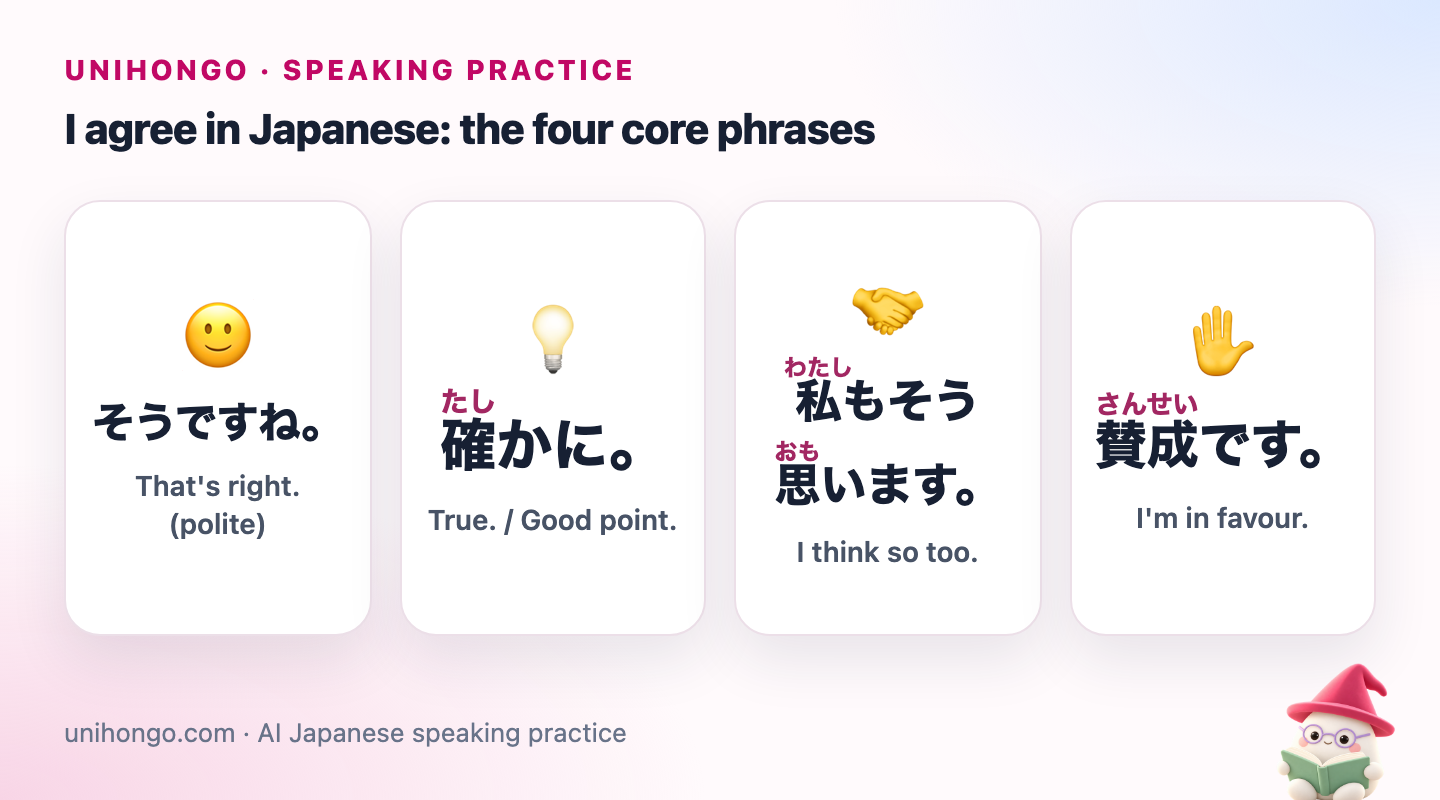
| Japanese | Romaji | Meaning |
|---|---|---|
| そうですね。 | Sō desu ne. | That's right. (polite) |
| 確かに。 | Tashika ni. | True. / Good point. |
| 私もそう思います。 | Watashi mo sō omoimasu. | I think so too. |
| 賛成です。 | Sansei desu. | I'm in favour. |
Sō desu ne agrees with a feeling or a comment, tashika ni with a point, watashi mo sō omoimasu with an opinion, and sansei desu with a proposal. Matching the phrase to what you are agreeing with is most of the skill.
Sō desu ne, sō da ne and da yo ne: everyday agreement
Sō desu ne is the first phrase most learners meet, and it really is everywhere. Said briskly with a short ne, it means that's right, I agree. Said slowly with a long, falling nē, it means well, let me think, and often comes before a polite no. Your tone decides which one you meant, so keep it short and bright when you agree.
With friends, the casual forms are sō da ne, sō sō, right, right, and da yo ne, right?, which agrees strongly, as if you had been thinking the same thing. Desu yo ne is the polite version of da yo ne and is great with colleagues. Among young people, honto sore, so true, is common slang; keep it for friends.
| Japanese | Romaji | Meaning |
|---|---|---|
| そうだね。 | Sō da ne. | Yeah, that's right. (casual) |
| そうそう! | Sō sō! | Right, right! (casual) |
| だよね。 | Da yo ne. | I know, right? (casual) |
| ですよね。 | Desu yo ne. | Exactly, isn't it? (polite) |
| ほんとそれ。 | Honto sore. | So true. (slang, friends only) |
Tashika ni and ossharu tōri: agreeing with a point
Tashika ni (確かに) means certainly or indeed. On its own it says that's a fair point, and it is one of the most natural agreement words for learners because it works at almost any level of politeness. Tashika ni sō desu ne is a little warmer and more polite.
Sono tōri desu, that's exactly it, agrees firmly. Ossharu tōri desu uses the respectful verb ossharu, to say, and means it is just as you say. It is the standard way to agree with a boss, a client or a teacher, but with a friend it sounds stiff or even sarcastic.
Naruhodo, I see, is often used as if it meant I agree, but it really shows understanding. It is a useful listening word; just know that it does not commit you to the other person's view.
| Japanese | Romaji | Meaning |
|---|---|---|
| 確かにそうですね。 | Tashika ni sō desu ne. | That's certainly true. |
| その通りです。 | Sono tōri desu. | That's exactly right. |
| おっしゃる通りです。 | Ossharu tōri desu. | It's just as you say. (respectful) |
| なるほど、そういうことですね。 | Naruhodo, sō iu koto desu ne. | I see, so that's what you mean. |
Onaji iken desu and sansei desu: opinions and proposals
When people are sharing opinions, watashi mo onaji iken desu, I have the same opinion, is clear and polite. Onaji kangae desu, the same idea, is similar and slightly softer. Both work well in class discussions and meetings.
Sansei (賛成) is for proposals: something that a group will do or decide. Sansei desu means I'm in favour, and its opposite is hantai desu, I'm against it. It sounds odd as a reply to a feeling: if a friend says it's cold today, sansei desu sounds like a vote. Zenmenteki ni sansei desu, I fully support it, and iron wa arimasen, I have no objection, are useful formal versions.
| Japanese | Romaji | Meaning |
|---|---|---|
| 私も同じ意見です。 | Watashi mo onaji iken desu. | I have the same opinion. |
| 山田さんの案に賛成です。 | Yamada-san no an ni sansei desu. | I support Mr Yamada's proposal. |
| 全面的に賛成です。 | Zenmenteki ni sansei desu. | I fully support it. |
| 異論はありません。 | Iron wa arimasen. | I have no objection. (formal) |
Partial agreement: yes, but
Real discussions are rarely all or nothing. Japanese has graceful ways to agree with part of something and leave room for your own view. Sō iu kangaekata mo arimasu ne, that's one way of looking at it, acknowledges the idea without fully adopting it. ~ to iu ten ni wa sansei desu, I agree on the point of ~, lets you pick the part you support.
The usual structure is agreement first, then tada, however, or demo, but, then your concern. Starting with agreement keeps the conversation friendly. Kimochi wa wakarimasu, I understand how you feel, is useful when you share the emotion but not the conclusion.
| Japanese | Romaji | Meaning |
|---|---|---|
| そういう考え方もありますね。 | Sō iu kangaekata mo arimasu ne. | That's one way of looking at it. |
| コストの点には賛成です。 | Kosuto no ten ni wa sansei desu. | I agree on the cost point. |
| ただ、時期は少し心配です。 | Tada, jiki wa sukoshi shinpai desu. | However, I'm a bit worried about the timing. |
| 気持ちはわかります。 | Kimochi wa wakarimasu. | I understand how you feel. |
| 半分は賛成です。 | Hanbun wa sansei desu. | I half agree. |
Agreeing in meetings
In a Japanese meeting, agreement is often expressed by naming the person and building on what they said. ~-san no go-iken ni sansei desu, I support ~'s view, is polite and clear. Tsukekuwaeru to, to add to that, lets you agree and contribute at the same time, which sounds more engaged than agreeing alone.
Silence and nodding are common in meetings, but they do not always mean agreement. If you do agree, say so in words, briefly, and give one reason. That makes your support count when the group decides.

| Japanese | Romaji | Meaning |
|---|---|---|
| 田中さんのご意見に賛成です。 | Tanaka-san no go-iken ni sansei desu. | I support Ms Tanaka's view. |
| 私も同じ考えです。理由は二つあります。 | Watashi mo onaji kangae desu. Riyū wa futatsu arimasu. | I think the same. There are two reasons. |
| 付け加えると、予算も足ります。 | Tsukekuwaeru to, yosan mo tarimasu. | To add to that, the budget is enough too. |
| では、その方向で進めましょう。 | Dewa, sono hōkō de susumemashō. | Then let's go in that direction. |
Softly not agreeing (briefly)
Disagreeing politely deserves its own guide, and the speaking practice article on disagreeing politely covers it in depth. The short version: start with partial agreement or a soft filler, then give your view as a suggestion or a question rather than a correction.
| Japanese | Romaji | Meaning |
|---|---|---|
| うーん、どうでしょう。 | Ūn, dō deshō. | Hmm, I'm not sure about that. |
| 少し違う意見なんですが。 | Sukoshi chigau iken nan desu ga. | I have a slightly different view, but... |
| そうですね。ただ、別の案もあるかもしれません。 | Sō desu ne. Tada, betsu no an mo aru ka mo shiremasen. | True. Though there may be another option. |
Mini dialogue and common mistakes
| Japanese | Romaji | Meaning |
|---|---|---|
| 来月から会議を朝にしませんか。 | Raigetsu kara kaigi o asa ni shimasen ka. | Colleague: Shall we move meetings to mornings from next month? |
| 賛成です。午後は忙しいですからね。 | Sansei desu. Gogo wa isogashii desu kara ne. | You: I'm in favour. Afternoons are busy, after all. |
| ですよね。九時はどうですか。 | Desu yo ne. Ku-ji wa dō desu ka. | Colleague: Right? How about nine? |
| 確かに。ただ、月曜日だけは少し遅くしたいです。 | Tashika ni. Tada, getsuyōbi dake wa sukoshi osoku shitai desu. | You: Good idea. Only, I'd like Mondays a bit later. |
- Dōi shimasu for everyday agreement: it means consent to terms. Use sō omoimasu or sansei desu.
- Sansei desu for a feeling or a comment: it sounds like a vote. Use sō desu ne.
- A long, falling sō desu nē when you mean yes: it sounds like hesitation.
- Ossharu tōri desu with friends: too formal, and it can sound sarcastic.
- Agreeing with only hai: hai often means I'm listening, not I agree.