
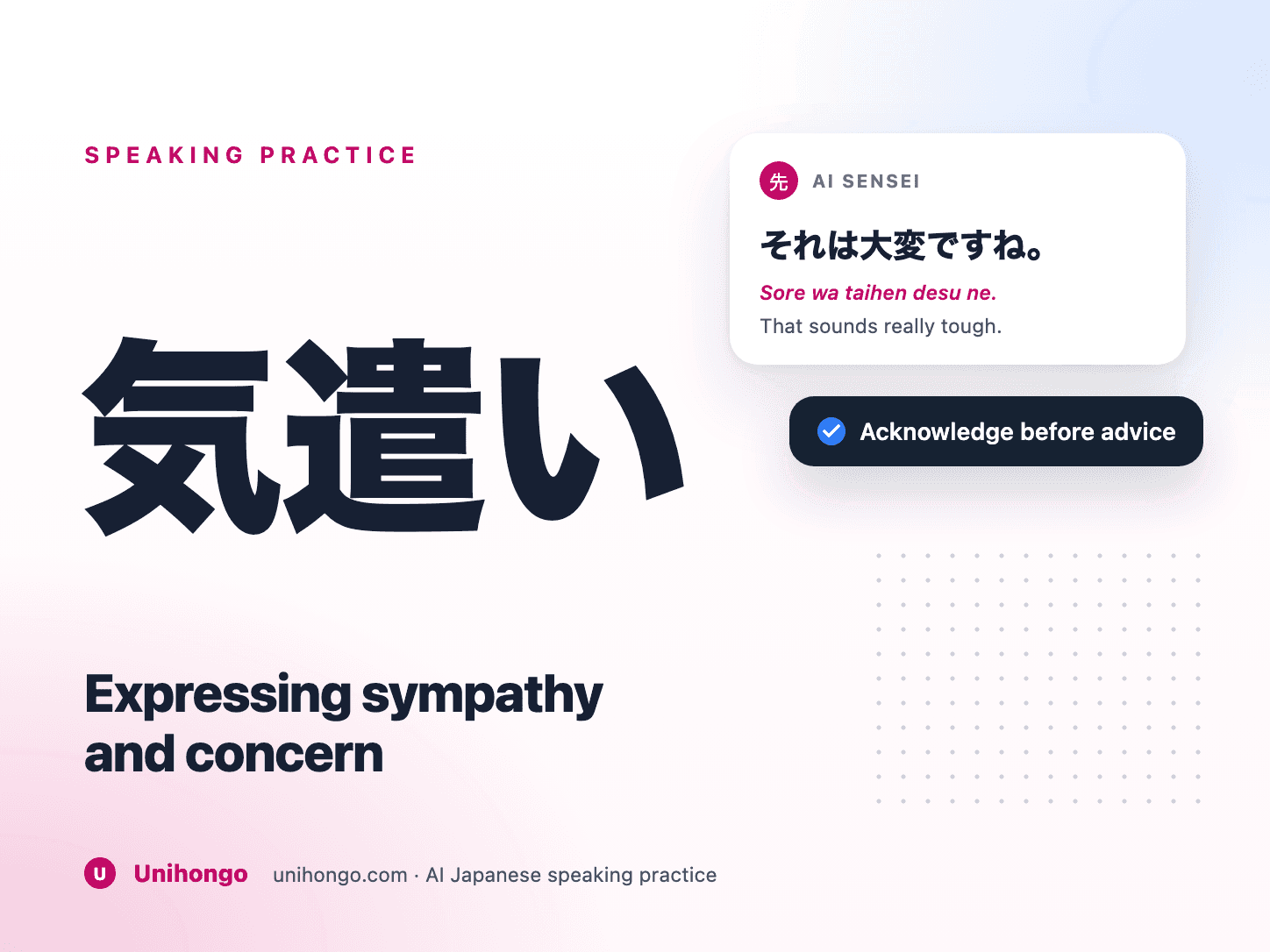
Acknowledge before anything else
The conventional shape of a sympathetic response in Japanese is acknowledge, then pause, then offer. The pause is real: leaving a beat before saying anything else signals that you took in what was said rather than moving straight to a reaction.
Learners frequently invert this, opening with a solution, a comparison, or an optimistic reframe. All three are well meant and all three step over the acknowledgement, which is the part the other person actually needed. Taihen desu ne followed by nothing is a complete and appropriate response.
| Japanese | Romaji | Meaning |
|---|---|---|
| それは大変ですね。 | Sore wa taihen desu ne. | That sounds really tough. |
| それは大変でしたね。 | Sore wa taihen deshita ne. | That must have been hard. |
| そうだったんですか。 | Sō datta n desu ka. | So that is what happened. |
| お気持ち、お察しします。 | Okimochi, osasshi shimasu. | I can imagine how you feel. |
| 言ってくれてありがとう。 | Itte kurete arigatō. | Thank you for telling me. |
| 何かあったら言ってくださいね。 | Nani ka attara itte kudasai ne. | Please tell me if anything comes up. |
When someone is unwell
Illness has its own set phrases, and the central one is odaiji ni, which means take care of yourself and is used at the end of an exchange with anyone who is ill. It is what pharmacists and doctors say to you and what you say to a colleague going home sick.
The other useful move is to remove pressure rather than to encourage. Muri shinaide kudasai, please do not push yourself, is more appropriate than any variant of get well soon that implies effort.
| Japanese | Romaji | Meaning |
|---|---|---|
| お大事に。 | Odaiji ni. | Take care of yourself. |
| 無理しないでください。 | Muri shinaide kudasai. | Please do not push yourself. |
| ゆっくり休んでください。 | Yukkuri yasunde kudasai. | Please rest properly. |
| 熱はどうですか。下がりましたか。 | Netsu wa dō desu ka. Sagarimashita ka. | How is your temperature? Has it come down? |
| こちらは大丈夫なので、心配しないでください。 | Kochira wa daijōbu na node, shinpai shinaide kudasai. | Things are fine here, so please do not worry. |
| 何か必要なものはありますか。 | Nani ka hitsuyō na mono wa arimasu ka. | Is there anything you need? |
Telling a sick colleague that work is covered is one of the kindest things you can say, because the thing they are actually worrying about is usually the work.
When someone is overloaded at work
Work stress is the most common situation you will respond to, and the conventional acknowledgement is otsukaresama desu, which does a great deal of quiet work. It recognises effort without commenting on the outcome, and it is appropriate whether the person succeeded or not.
Beyond that, the useful thing is a specific offer. General offers of help are polite and rarely accepted; a specific one is actionable. Ashita no shiryō, tetsudaimashō ka names a task and a time, which makes it easy to say yes to.
| Japanese | Romaji | Meaning |
|---|---|---|
| お疲れさまです。忙しそうですね。 | Otsukaresama desu. Isogashisō desu ne. | Thank you for your work. You look busy. |
| 大丈夫ですか。手伝えることはありますか。 | Daijōbu desu ka. Tetsudaeru koto wa arimasu ka. | Are you all right? Is there anything I can help with? |
| 明日の資料、手伝いましょうか。 | Ashita no shiryō, tetsudaimashō ka. | Shall I help with tomorrow's materials? |
| こっちは巻き取れるので、言ってください。 | Kocchi wa makitoreru node, itte kudasai. | I can absorb some of it, so just say the word. |
| 無理しないでくださいね。 | Muri shinaide kudasai ne. | Please do not overdo it. |
| ちょっと休憩しませんか。 | Chotto kyūkei shimasen ka. | Shall we take a short break? |
Genuinely bad news
For serious news that is not a death, the register rises and the phrases get shorter. Restraint is the convention: a brief acknowledgement, an offer, and then listening. Long expressions of feeling put the other person in the position of managing your reaction.
If you do not know what to say, saying that is acceptable and often better than reaching. Nan to ittara ii ka wakaranai n desu ga is honest and is understood as sincerity rather than as inadequacy.
| Japanese | Romaji | Meaning |
|---|---|---|
| 何と言ったらいいか分からないんですが。 | Nan to ittara ii ka wakaranai n desu ga. | I do not know what to say, but. |
| それは……本当に大変ですね。 | Sore wa... hontō ni taihen desu ne. | That is... really very hard. |
| 話したくなったら、いつでも聞きます。 | Hanashitaku nattara, itsu demo kikimasu. | If you ever want to talk, I will listen any time. |
| できることがあれば、遠慮なく言ってください。 | Dekiru koto ga areba, enryo naku itte kudasai. | If there is anything I can do, please do not hesitate. |
| 今は、何も考えなくて大丈夫ですよ。 | Ima wa, nani mo kangaenakute daijōbu desu yo. | For now, you do not have to think about anything. |
Condolences
A death has fixed language and the fixed language is correct. Goshūshō-sama desu is the standard spoken condolence, used at funerals and on first hearing the news. Okuyami mōshiagemasu is the formal version for a written message or a very formal setting.
Keep it brief and avoid speculation about causes or comfort about a better place. If you are close to the person, an offer of practical help after the funeral period is more useful than more words at the time.
| Japanese | Romaji | Meaning |
|---|---|---|
| ご愁傷様です。 | Goshūshō-sama desu. | My condolences. |
| お悔やみ申し上げます。 | Okuyami mōshiagemasu. | Please accept my sincere condolences. |
| 心よりお悔やみ申し上げます。 | Kokoro yori okuyami mōshiagemasu. | My deepest condolences. |
| どうかご無理をなさらないでください。 | Dōka gomuri o nasaranaide kudasai. | Please do not push yourself. |
| 落ち着かれましたら、また連絡します。 | Ochitsukaremashitara, mata renraku shimasu. | I will be in touch again once things have settled. |
At a funeral these are said quietly and briefly, often with a bow and nothing more. Elaboration is not expected and is not the custom.
The reflexes to avoid
Several instinctive responses land poorly, and they are worth naming because they are all well intentioned. Jumping to advice, comparing to your own experience, minimising with a bright side, and encouragement that implies more effort are the four most common.
Ganbatte deserves a specific mention. It is a warm word in the right context, before an exam or a match, and a difficult one for somebody exhausted, ill or grieving, because it asks for effort. Muri shinaide is almost always the safer choice.
- Do not open with advice; acknowledge first and let them ask
- Do not compare to your own experience in the first response
- Avoid silver linings such as mada mashi desu yo, at least it is not worse
- Avoid ganbatte with someone exhausted, ill or grieving
- Do not press for details; let them decide what to share
- Do not make a general offer you would not actually follow through on
When you are the one receiving sympathy
You will also be on the other side, and the conventional response is short thanks plus a light reassurance. Japanese modesty means people usually downplay their own difficulty, and matching that register keeps the exchange comfortable.
Accepting a specific offer of help is fine and does not require elaborate protest. Ja, okotoba ni amaete, taking you at your word, is the standard phrase for accepting an offer gracefully.
| Japanese | Romaji | Meaning |
|---|---|---|
| ありがとうございます。大丈夫です。 | Arigatō gozaimasu. Daijōbu desu. | Thank you. I am all right. |
| ご心配おかけしてすみません。 | Goshinpai okake shite sumimasen. | Sorry to have worried you. |
| お気遣いありがとうございます。 | Okizukai arigatō gozaimasu. | Thank you for your thoughtfulness. |
| じゃあ、お言葉に甘えて。 | Jā, okotoba ni amaete. | Then I will take you up on that. |
| おかげさまで、少しよくなりました。 | Okagesama de, sukoshi yoku narimashita. | Thanks to you, it has improved a little. |