
Four words on the offer
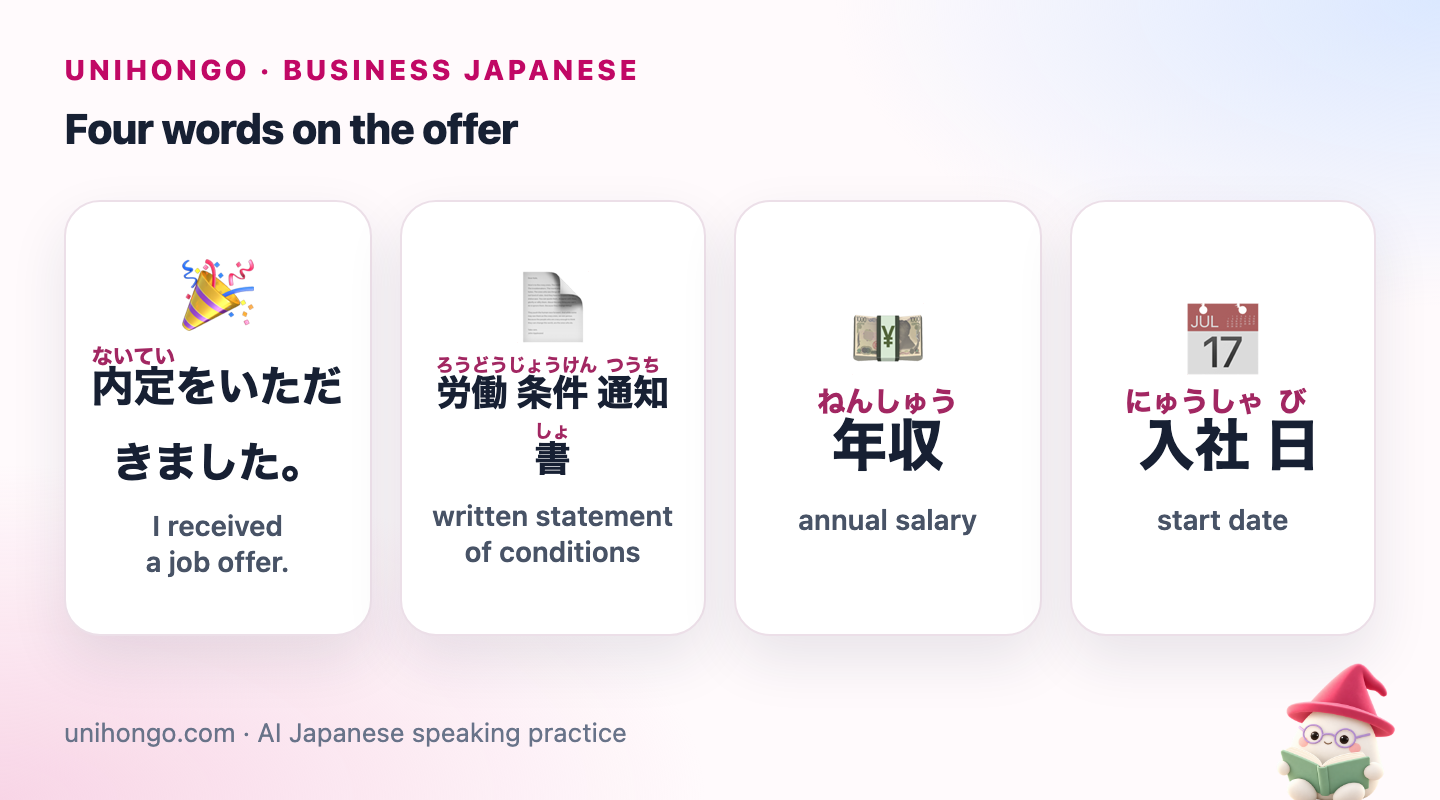
Naitei o itadakimashita, I received a job offer, is the humble way to tell people your news; itadaku shows respect to the company that gave it. The rōdō jōken tsūchisho (労働条件通知書) is the written statement of working conditions that an employer provides; some companies send a separate offer letter, an ofā retā, first. Nenshū (年収) is annual salary, the figure most offers are discussed in, and nyūshabi (入社日) is your start date. Two more words frame the decision: naitei shōdakusho (内定承諾書), the acceptance form, and naitei jitai (内定辞退), declining.
| Japanese | Romaji | Meaning |
|---|---|---|
| 内定をいただきました。 | Naitei o itadakimashita. | I received a job offer. |
| 労働条件通知書 | rōdō jōken tsūchisho | written statement of conditions |
| 年収 | nenshū | annual salary |
| 入社日 | nyūshabi | start date |
| 内定承諾書 | naitei shōdakusho | offer acceptance form |
| 内定辞退 | naitei jitai | declining an offer |
Receiving the offer: what to say first
The offer often comes by phone or email from HR, the jinji (人事). Whatever you feel, the first reply has three parts: thanks, pleasure, and a request for time to check the conditions. This is not stalling; it is expected, and it protects you. Then ask when they need an answer. All of it is in polite keigo, with yoroshii deshō ka softening every request.
| Japanese | Romaji | Meaning |
|---|---|---|
| 内定のご連絡、ありがとうございます。 | Naitei no gorenraku, arigatō gozaimasu. | Thank you for letting me know about the offer. |
| 大変うれしく思います。 | Taihen ureshiku omoimasu. | I'm very glad. |
| 条件を確認したうえでお返事してもよろしいでしょうか。 | Jōken o kakunin shita ue de ohenji shite mo yoroshii deshō ka. | May I reply after checking the conditions? |
| いつまでにお返事すればよろしいでしょうか。 | Itsu made ni ohenji sureba yoroshii deshō ka. | By when should I reply? |
| 労働条件通知書をいただけますか。 | Rōdō jōken tsūchisho o itadakemasu ka. | Could I have the written conditions? |
Reading the conditions sheet
The sheet is dense, but a handful of terms carry the meaning. Kihonkyū (基本給) is base salary, the number bonuses and overtime are calculated from. Shōyo (賞与) is the bonus, often paid twice a year and often expressed in months of base salary; ask whether it is guaranteed or performance-based. Kotei zangyōdai (固定残業代), also called minashi zangyō, is a fixed amount of overtime pay built into the salary; the sheet should state how many hours it covers. Shiyō kikan (試用期間) is the probation period, commonly a few months. Yūkyū kyūka (有給休暇) is paid leave, and shakai hoken (社会保険) is the social insurance package of health, pension and employment insurance.
| Japanese | Romaji | Meaning |
|---|---|---|
| 基本給 | kihonkyū | base salary |
| 賞与 | shōyo | bonus |
| 固定残業代 | kotei zangyōdai | fixed overtime pay |
| 試用期間 | shiyō kikan | probation period |
| 有給休暇 | yūkyū kyūka | paid leave |
| 社会保険 | shakai hoken | social insurance |
| Line on the sheet | What to check | Why it matters |
|---|---|---|
| 基本給 base salary | Is the headline figure base pay or base plus allowances? | Bonus and overtime are calculated from base pay |
| 固定残業代 fixed overtime | How many hours it covers, and what happens beyond them | A high salary with many fixed hours is lower than it looks |
| 賞与 bonus | Guaranteed or performance-based; how many months | Annual salary may assume a bonus that is not certain |
| 試用期間 probation | Length, and whether pay or benefits differ during it | Some companies pay less or delay benefits in probation |
| 通勤手当 commuting allowance | Full or capped | A long commute can cost you monthly |
Asking about conditions politely
Direct questions are fine, but open them with a cushion. Itten kakunin sasete itadakitai no desu ga, there is one thing I would like to confirm, signals a question is coming and that you know it is a small imposition. Then ask plainly. Questions about actual overtime, remote work and probation conditions are normal and show that you are serious. If you will need a visa or a change of status, ask now whether the company handles the paperwork.
| Japanese | Romaji | Meaning |
|---|---|---|
| 一点確認させていただきたいのですが。 | Itten kakunin sasete itadakitai no desu ga. | There's one thing I'd like to confirm. |
| 残業は月にどのくらいありますか。 | Zangyō wa tsuki ni dono kurai arimasu ka. | How much overtime is there per month? |
| 固定残業代は何時間分ですか。 | Kotei zangyōdai wa nanjikan bun desu ka. | How many hours does the fixed overtime cover? |
| 試用期間中も条件は同じですか。 | Shiyō kikan chū mo jōken wa onaji desu ka. | Are conditions the same during probation? |
| 在宅勤務は可能ですか。 | Zaitaku kinmu wa kanō desu ka. | Is working from home possible? |
| ビザの手続きはサポートしていただけますか。 | Biza no tetsuzuki wa sapōto shite itadakemasu ka. | Could you support the visa procedure? |
Negotiating salary without burning the bridge
Negotiation in Japan is a conversation about reasons, not a contest. Open by asking permission to discuss pay, then give one concrete anchor: your current salary, a competing offer, or the figure you stated at interview. Phrase the request as a question with the negative potential form, itadakenai deshō ka, which asks whether something might be possible rather than demanding it. If the answer is no, you can move to the start date, leave or a review after probation; many companies have more room there than in base pay.
Keep the tone warm throughout, and thank them for considering it whatever the result. The dialogue below shows one exchange with HR.

| Japanese | Romaji | Meaning |
|---|---|---|
| 給与についてご相談させていただけますか。 | Kyūyo ni tsuite gosōdan sasete itadakemasu ka. | You: May I discuss the salary? |
| 現職の年収と経験を考慮していただけないでしょうか。 | Genshoku no nenshū to keiken o kōryo shite itadakenai deshō ka. | You: Could you consider my current salary and experience? |
| 希望は面接でお伝えした金額です。 | Kibō wa mensetsu de otsutae shita kingaku desu. | You: My hope is the figure I gave at the interview. |
| 社内で確認して、改めてご連絡します。 | Shanai de kakunin shite, aratamete gorenraku shimasu. | HR: I'll check internally and get back to you. |
| 難しい場合は、入社日や休暇でご相談できますか。 | Muzukashii baai wa, nyūshabi ya kyūka de gosōdan dekimasu ka. | You: If that's difficult, could we discuss start date or leave? |
| ご検討いただき、ありがとうございます。 | Gokentō itadaki, arigatō gozaimasu. | You: Thank you for considering it. |
Mentioning another offer is acceptable if it is true and said neutrally: tasha kara mo naitei o itadaite imasu, I have also received an offer from another company. Do not invent one; recruiting circles in Japan are small.
Accepting the offer
Accept clearly, in writing as well as by phone if the company called. Shōdaku itashimasu is the humble verb for accepting. Then settle the start date; if you need time for handover, hikitsugi (引き継ぎ), at your current job, say so, since Japanese companies respect a proper handover and will usually wait. Close with a forward-looking line.
| Japanese | Romaji | Meaning |
|---|---|---|
| 内定を承諾いたします。 | Naitei o shōdaku itashimasu. | I accept the offer. |
| 入社日は4月1日でお願いいたします。 | Nyūshabi wa shigatsu tsuitachi de onegai itashimasu. | Please make the start date 1 April. |
| 現職の引き継ぎがあるため、少しお時間をいただきたいです。 | Genshoku no hikitsugi ga aru tame, sukoshi ojikan o itadakitai desu. | I need a little time for handover at my current job. |
| 入社までよろしくお願いいたします。 | Nyūsha made yoroshiku onegai itashimasu. | I look forward to working with you. |
| 一日も早く貢献できるよう努めます。 | Ichinichi mo hayaku kōken dekiru yō tsutomemasu. | I'll work to contribute as soon as I can. |
Declining with grace
Declining is common and companies are used to it, but speed and form matter: decide quickly, phone the recruiter if you can, and send a short email the same day. The structure is thanks, a reference to careful consideration, the decision, and a brief apology. You may give a reason in one line, such as choosing another company, but you do not have to. The humble zonjimasu, to think, makes jitai sasete itadakitaku zonjimasu the standard formula.
| Japanese | Romaji | Meaning |
|---|---|---|
| 慎重に検討した結果、今回は辞退させていただきたく存じます。 | Shinchō ni kentō shita kekka, konkai wa jitai sasete itadakitaku zonjimasu. | After careful thought, I must decline this time. |
| 貴重なお時間をいただき、ありがとうございました。 | Kichō na ojikan o itadaki, arigatō gozaimashita. | Thank you for your valuable time. |
| 他社とのご縁を選ぶことにいたしました。 | Tasha to no goen o erabu koto ni itashimashita. | I have decided to go with another company. |
| ご期待に応えられず、申し訳ございません。 | Gokitai ni kotaerarezu, mōshiwake gozaimasen. | I'm sorry I couldn't meet your expectations. |
Goen (ご縁) is a connection or bond, and Japanese business uses it to soften both acceptances and refusals. Choosing another company becomes choosing another connection, which blames nobody.
Common mistakes
- Accepting on the phone out of politeness, then trying to negotiate afterwards. Ask for time first; negotiation after acceptance is far harder.
- Negotiating with a demand. Hoshii desu, I want, sounds blunt; use itadakenai deshō ka and a reason.
- Reading nenshū as take-home pay. Annual salary figures are gross and may include an uncertain bonus; look for kihonkyū and shōyo separately.
- Ghosting after a decision. Not replying to an offer you will not take is remembered. A two-line decline keeps the door open for the future.
- Mixing registers in email. If you open with keigo, stay in it to the end; a casual closing line undoes a careful message.