
Four lines that carry a whole barbecue
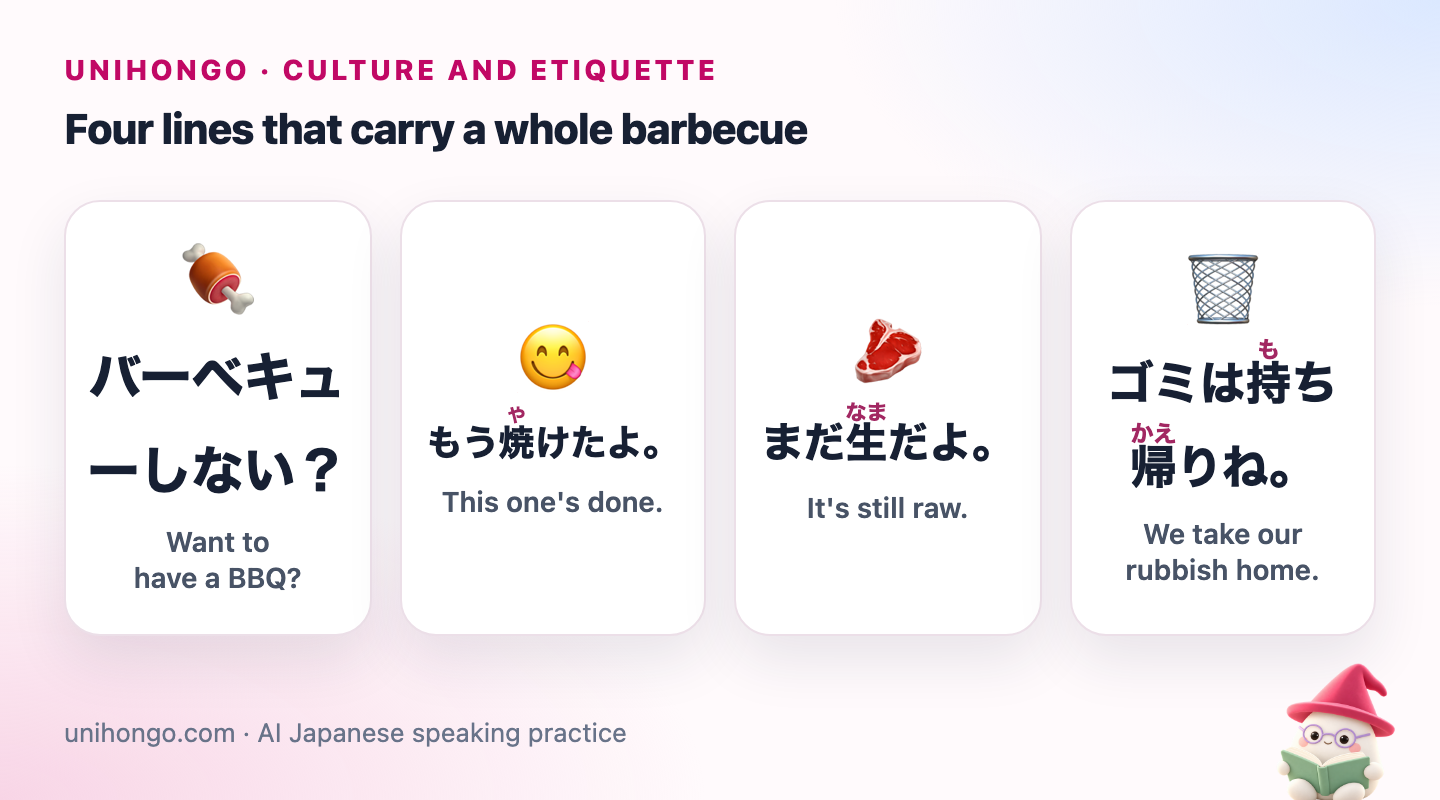
Most barbecue Japanese is casual, because barbecues are for friends. These four lines cover the invitation, the two questions everyone asks at the grill, and the rule that ends the day. They are all in plain form with a soft ending such as yo or ne, which makes them sound friendly rather than abrupt.
| Japanese | Romaji | Meaning |
|---|---|---|
| バーベキューしない? | Bābekyū shinai? | Want to have a BBQ? |
| もう焼けたよ。 | Mō yaketa yo. | This one's done. |
| まだ生だよ。 | Mada nama da yo. | It's still raw. |
| ゴミは持ち帰りね。 | Gomi wa mochikaeri ne. | We take our rubbish home. |
Bābekyū shinai? is a negative question, literally won't you barbecue?, and that is exactly what makes it an invitation rather than a demand. Its polite version, bābekyū o shimasen ka, works for coworkers. With seniors at work, the invitation usually comes from them, so the line you will need more is zehi sanka shitai desu: I'd love to join.
Planning: shopping, gear and splitting the cost
Before the day, someone acts as organiser and the group chat fills with questions about who buys what. The shopping trip is called kaidashi (買い出し), and it is often done together on the morning of the barbecue at a supermarket near the site. Splitting the bill equally afterwards is warikan (割り勘). Many sites also offer tebura (手ぶら) plans, literally empty-handed, where the grill, charcoal and sometimes the food are ready when you arrive.
When you are new to a group, offering to take one clear task is the easiest way to be useful. Drinks and ice are a classic choice, because they are heavy and nobody wants to carry them.
| Japanese | Romaji | Meaning |
|---|---|---|
| 買い出し、誰が行く? | Kaidashi, dare ga iku? | Who's going shopping? |
| 何を持っていけばいい? | Nani o motte ikeba ii? | What should I bring? |
| 飲み物は私が買っていくね。 | Nomimono wa watashi ga katte iku ne. | I'll buy and bring the drinks. |
| 氷も忘れないでね。 | Kōri mo wasurenaide ne. | Don't forget the ice too. |
| あとで割り勘にしよう。 | Ato de warikan ni shiyō. | Let's split it later. |
| 炭は向こうで買えるよ。 | Sumi wa mukō de kaeru yo. | We can buy charcoal there. |
On grill duty: yaku, yakeru and kogeru
The grill is where learners trip over one verb pair. Yaku (焼く) is what you do: you grill the meat. Yakeru (焼ける) is what the food does: it becomes cooked. So when you check a skewer and announce that it is ready, the natural word is yaketa, not yaita. The same pattern applies to burning. Kogasu (焦がす) is to burn something, kogeru (焦げる) is for it to get burnt, and kogechatta, with the regretful chau ending, is the line you will say at least once.
| Japanese | Romaji | Meaning |
|---|---|---|
| それ、ひっくり返して。 | Sore, hikkurikaeshite. | Flip that one, please. |
| もうちょっと焼いたほうがいいよ。 | Mō chotto yaita hō ga ii yo. | It needs a bit longer. |
| 焦げちゃった。 | Kogechatta. | Oops, it got burnt. |
| 火が強すぎるね。 | Hi ga tsuyosugiru ne. | The fire's too strong. |
| 炭、足そうか? | Sumi, tasō ka? | Shall I add charcoal? |
| 中まで火が通ってる? | Naka made hi ga tōtteru? | Is it cooked through? |
| You do it | It happens | At the grill |
|---|---|---|
| 焼く yaku: to grill | 焼ける yakeru: to get cooked | Yaketa yo: it's done |
| 焦がす kogasu: to burn | 焦げる kogeru: to get burnt | Kogechatta: oops, it burnt |
| ひっくり返す hikkurikaesu: to flip | ひっくり返る hikkurikaeru: to flip over | Hikkurikaeshite: flip it, please |
Hi ga tōru, literally fire passes through, is the everyday way to say food is cooked through. It matters most with chicken and sausages, and saying mada nama da yo when you are not sure is never rude.
Serving others before yourself
At a Japanese barbecue, the person at the grill usually puts food straight onto other people's plates instead of waiting for everyone to help themselves. Guests, in turn, often offer to take a turn at the grill so the cook can eat. You do not have to follow this perfectly, but offering food to others first is noticed and appreciated, and it gives you an easy reason to talk to everyone in the group.
Enryo (遠慮) is the habit of holding back out of politeness. A host who says enryo shinaide is telling you to stop holding back and eat. With friends this is casual; with seniors at a work barbecue, use the polite forms below.
| Japanese | Romaji | Meaning |
|---|---|---|
| 焼けたよ、どうぞ。 | Yaketa yo, dōzo. | It's done, here you go. |
| お皿ちょうだい。 | Osara chōdai. | Pass me your plate. |
| お肉、取ろうか? | Oniku, torō ka? | Shall I get you some meat? |
| 野菜も食べてね。 | Yasai mo tabete ne. | Eat some vegetables too. |
| 遠慮しないで。 | Enryo shinaide. | Don't hold back. |
| 代わりましょうか。 | Kawarimashō ka. | Shall I take over? (polite) |
| 焼けましたよ、どうぞ。 | Yakemashita yo, dōzo. | It's ready, please. (polite) |
Mini dialogue: keeping the talk going at the grill
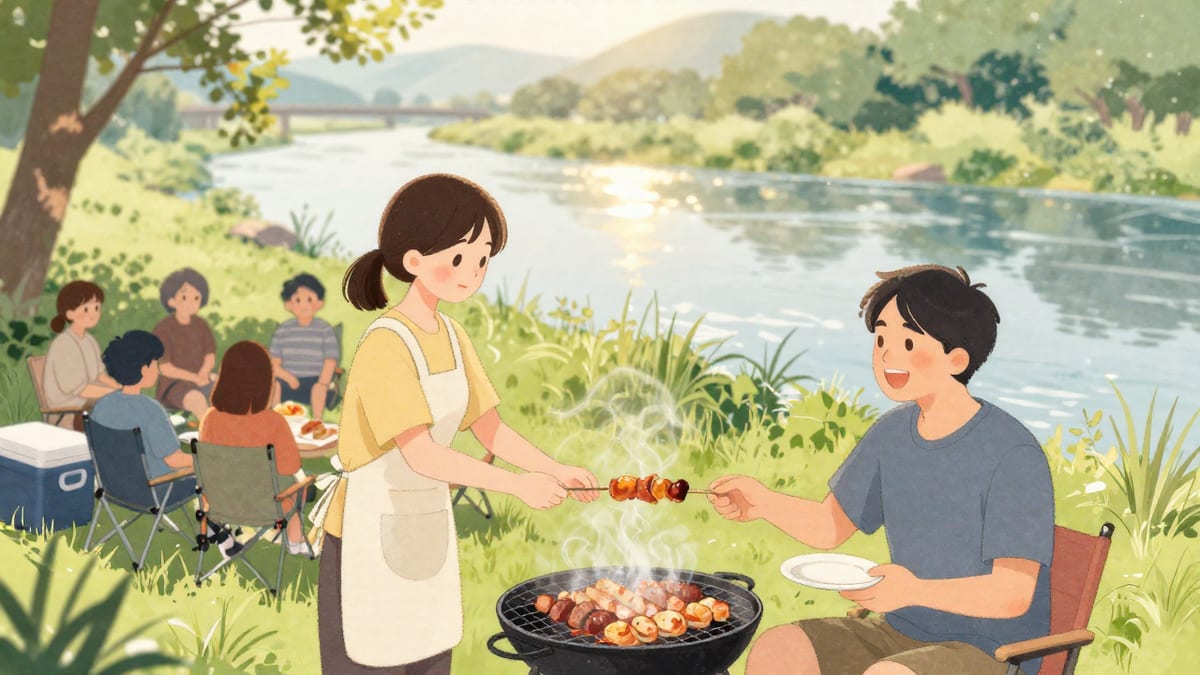
Grill duty is the perfect position for a learner: people come to you, and you always have something to say. In this exchange you are cooking and a friend of a friend comes over with a plate. Notice how short every line is, and how the questions move from the food to the person.
| Japanese | Romaji | Meaning |
|---|---|---|
| お肉、焼けてる? | Oniku, yaketeru? | Friend: Is the meat ready? |
| これはもう大丈夫。どうぞ。 | Kore wa mō daijōbu. Dōzo. | You: This one's fine now. Here. |
| ありがとう。焼くの上手だね。 | Arigatō. Yaku no jōzu da ne. | Friend: Thanks. You're good at grilling. |
| いやいや、さっき一本焦がしたよ。 | Iya iya, sakki ippon kogashita yo. | You: No, no, I burnt one just now. |
| バーベキューはよくするの? | Bābekyū wa yoku suru no? | Friend: Do you barbecue a lot? |
| 国ではよくやってた。今日は誘ってくれてありがとう。 | Kuni de wa yoku yatteta. Kyō wa sasotte kurete arigatō. | You: I did back home. Thanks for inviting me. |
Iya iya is the standard modest reply to a compliment. Kogashita here is the transitive verb on purpose: you are admitting that you burnt it.
Rules and cleanup: the part people remember
Barbecue rules in Japan are local, and they matter. Some riverbanks ban barbecues entirely, some allow them only in a designated area, and many forbid fires directly on the ground, which is jikabi kinshi (直火禁止), so you need a grill on legs. Charcoal is usually taken home or put in a special container on site, never buried or thrown in the river. Rubbish is the biggest issue: at many free sites there are no bins at all, and the rule is that everyone takes their rubbish home, gomi wa mochikaeri.
Japanese households sort rubbish carefully, so a group often separates burnables, cans and plastic bottles before leaving. Volunteering for cleanup with katazukeyō, let's tidy up, is one of the fastest ways to earn a second invitation.
| Japanese | Romaji | Meaning |
|---|---|---|
| ここでバーベキューしてもいいですか。 | Koko de bābekyū shite mo ii desu ka. | Can we barbecue here? |
| 炭はどこに捨てればいいですか。 | Sumi wa doko ni sutereba ii desu ka. | Where should we dispose of charcoal? |
| ゴミ袋、もう一枚ある? | Gomibukuro, mō ichimai aru? | Is there another rubbish bag? |
| 缶とペットボトルは分けよう。 | Kan to petto botoru wa wakeyō. | Let's separate cans and plastic bottles. |
| そろそろ片付けようか。 | Sorosoro katazukeyō ka. | Shall we start tidying up? |
Saying thanks and common learner mistakes
When the day ends, thank the organiser and the cooks by name. Junbi arigatō (thanks for organising) and mata yarō ne (let's do it again) are the lines that turn one barbecue into a regular invitation.
| Japanese | Romaji | Meaning |
|---|---|---|
| 準備ありがとう。 | Junbi arigatō. | Thanks for setting it all up. |
| 今日は楽しかった! | Kyō wa tanoshikatta! | Today was fun! |
| またやろうね。 | Mata yarō ne. | Let's do it again. |
- Saying niku ga yaita for the meat is done. Use yaketa: the meat became cooked.
- Using chōdai with a manager. Keep it for friends, and use polite forms at work events.
- Assuming a riverbank is free to use. Ask or check first, because many are not.
- Leaving rubbish in a public bin. At many sites the rule is to take everything home.