
The recipes at a glance
Almost every Japanese nickname comes from one of three moves. Clip the name and add a friendly suffix. Double a short piece of the name. Or blend the first beats of the family name and the given name. The results are usually two to four beats long, the rhythm Japanese ears like best.
The word for all of these is adana (あだ名). The cards show the word and one nickname from each recipe.
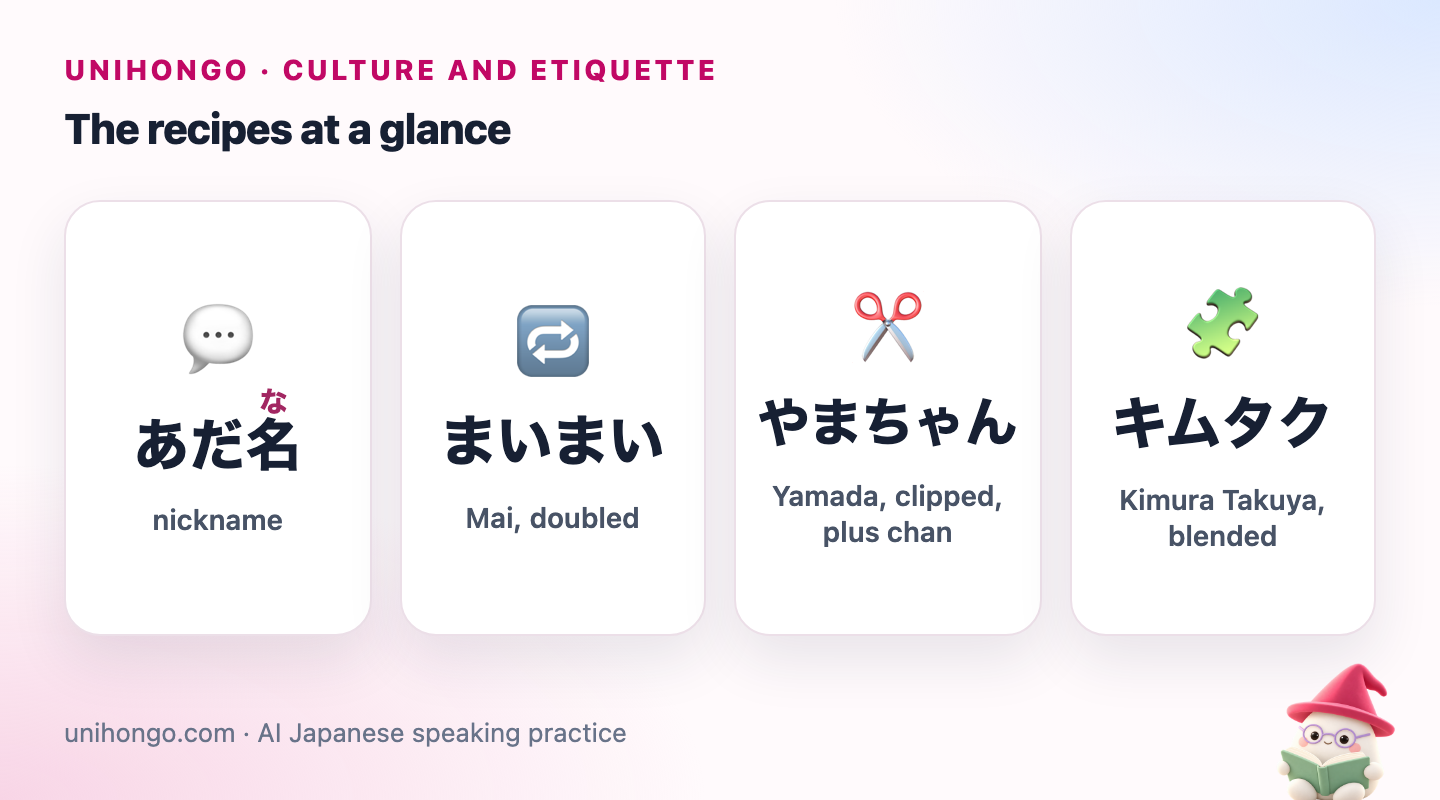
| Japanese | Romaji | Meaning |
|---|---|---|
| あだ名 | adana | nickname |
| まいまい | Maimai | Mai, doubled |
| やまちゃん | Yama-chan | Yamada, clipped, plus chan |
| キムタク | Kimutaku | Kimura Takuya, blended |
Recipe 1: clip the name and add a suffix
Take the first one or two beats of the given name and attach a suffix. Chan is affectionate and is used for children, for girls and women among friends, and for close friends of any gender. Kun is typical for boys and younger men. Playful endings such as tchi, rin, pī, pon and tan are cute and belong mostly to young people, idols and close groups.
A second pattern stretches the name itself: add a small tsu after the first beat and lengthen the vowel at the end. Yuki becomes Yukkī, Akira becomes Akkī. Nobody needs a suffix after that; the shape already says nickname.
| Japanese | Romaji | Meaning |
|---|---|---|
| たかちゃん | Taka-chan | from Takashi or Takako |
| たっくん | Takkun | from Takuya or Takumi |
| ゆっきー | Yukkī | from Yuki or Yukiko |
| あっきー | Akkī | from Akira or Akiko |
| まりりん | Maririn | from Mari or Mariko |
| のりぴー | Noripī | from Noriko |
| ゆうっち | Yūtchi | from Yū or Yūta |
One nickname can come from several names, and one name can produce several nicknames. Which one sticks is decided by the friends, not by a rule.
Recipe 2: doubling
A name of one or two beats is often simply repeated. The result has four beats and sounds soft and childlike, so doubled nicknames are common for small children, pets and idols, and between close friends. A related pattern lengthens the first beat and adds chan: Mī-chan can be a Miki, a Misaki or a Miho.
| Japanese | Romaji | Meaning |
|---|---|---|
| けんけん | Kenken | from Ken or Kenta |
| じゅんじゅん | Junjun | from Jun or Junko |
| みーちゃん | Mī-chan | from Miki, Misaki or Miho |
Recipe 3: surnames and blends
Surnames get the same treatment, especially among classmates and colleagues who started on surname terms. Take the first kanji's reading and add chan or san: Yama-chan, Matchan. Because many surnames share a first kanji, one office can only have one Yama-chan at a time.
Blends take about two beats from the family name and two from the given name. The singer and actor Kimura Takuya is Kimutaku to the whole country, Matsumoto Jun is Matsujun, and even foreign stars are blended: Brad Pitt is Burapi. Product and show titles are shortened by the same recipe, which is why it feels so natural for names.
| Japanese | Romaji | Meaning |
|---|---|---|
| まっちゃん | Matchan | from Matsumoto or Matsuda |
| はまちゃん | Hama-chan | from Hamada |
| 松潤 | Matsujun | Matsumoto Jun, blended |
| ブラピ | Burapi | Brad Pitt, blended |
Yobisute: when the suffix disappears
Yobisute (呼び捨て) is calling someone by name with nothing attached. It can be the warmest way to address a person or the coldest. Between close friends, partners and siblings, the bare given name means there is no distance left. From a teacher, a coach or a boss to someone junior, the bare surname marks rank. From someone who has not earned it, yobisute feels like being grabbed by the collar.
The opposite is san-zuke (さん付け), adding san. Moving from san to a nickname or to yobisute is a step people often say aloud, and it is perfectly normal to ask permission.
| Japanese | Romaji | Meaning |
|---|---|---|
| 呼び捨て | yobisute | using a name with no suffix |
| さん付け | san-zuke | adding san to a name |
| 呼び捨てでいいよ。 | Yobisute de ii yo. | No need for san with me. (casual) |
| 呼び捨てにしてもいい? | Yobisute ni shite mo ii? | Is it OK if I drop the san? (casual) |
Asking what to call someone
The safe opening with a new acquaintance is to ask. These lines are polite and work at a language exchange, a share house or a new workplace.
| Japanese | Romaji | Meaning |
|---|---|---|
| 何て呼べばいいですか。 | Nante yobeba ii desu ka. | What should I call you? |
| 何て呼ばれていますか。 | Nante yobarete imasu ka. | What do people call you? |
| あだ名はありますか。 | Adana wa arimasu ka. | Do you have a nickname? |
| 下の名前で呼んでもいいですか。 | Shita no namae de yonde mo ii desu ka. | May I call you by your first name? |
| 私もそう呼んでいいですか。 | Watashi mo sō yonde ii desu ka. | May I call you that too? |
Offering your own nickname
Foreign names grow long in katakana, because extra vowels are added: Christopher becomes Kurisutofā, six beats. Japanese friends will be relieved if you offer something short. Give the short form yourself and the question of what to call you is solved.
| Japanese | Romaji | Meaning |
|---|---|---|
| サムって呼んでください。 | Samu tte yonde kudasai. | Please call me Sam. |
| 友達にはサムと呼ばれています。 | Tomodachi ni wa Samu to yobarete imasu. | My friends call me Sam. |
| サムでいいですよ。 | Samu de ii desu yo. | Just Sam is fine. |
| 好きに呼んでください。 | Suki ni yonde kudasai. | Call me whatever you like. |
Be ready for chan or san to be added to whatever you offer. Samu-san from a colleague is ordinary politeness, not a refusal of your nickname.
When a nickname is too familiar
| Situation | Safe choice | Risky choice |
|---|---|---|
| First meeting | Surname plus san | A nickname you invented |
| Colleague of similar age | Surname plus san until invited | Chan, or the bare given name |
| Boss or teacher | Surname plus a title, or sensei | Any nickname at all |
| Friend who offered a nickname | The nickname they offered | A different one you prefer |
| A friend's small child | Given name plus chan or kun | The bare name |
Attitudes are also shifting. Some workplaces ask staff to use san for everyone, and some primary schools have reportedly asked pupils to do the same so that nicknames are not used to tease. When in doubt, asking is always the polite move.