

Jōdan desu and jōdan da yo: the plain way to say it was a joke
The word jōdan means a joke, and jōdan desu simply states that what you said was one. It is the phrase to reach for when you need to be clear, because there is no ambiguity in it. With friends the casual jōdan da yo or the even shorter jōdan is more natural. Both are said after the joking line, often while the other person is still deciding how to react.
You can also use jōdan before a joke as a warning: jōdan desu kedo, it's a joke but, tells the listener not to take the next sentence at face value. It is one of the safer patterns at work and with people who do not know your sense of humour yet.
| Japanese | Romaji | Meaning |
|---|---|---|
| 冗談です。 | Jōdan desu. | It's a joke. (polite) |
| 冗談だよ。 | Jōdan da yo. | Just kidding. (casual) |
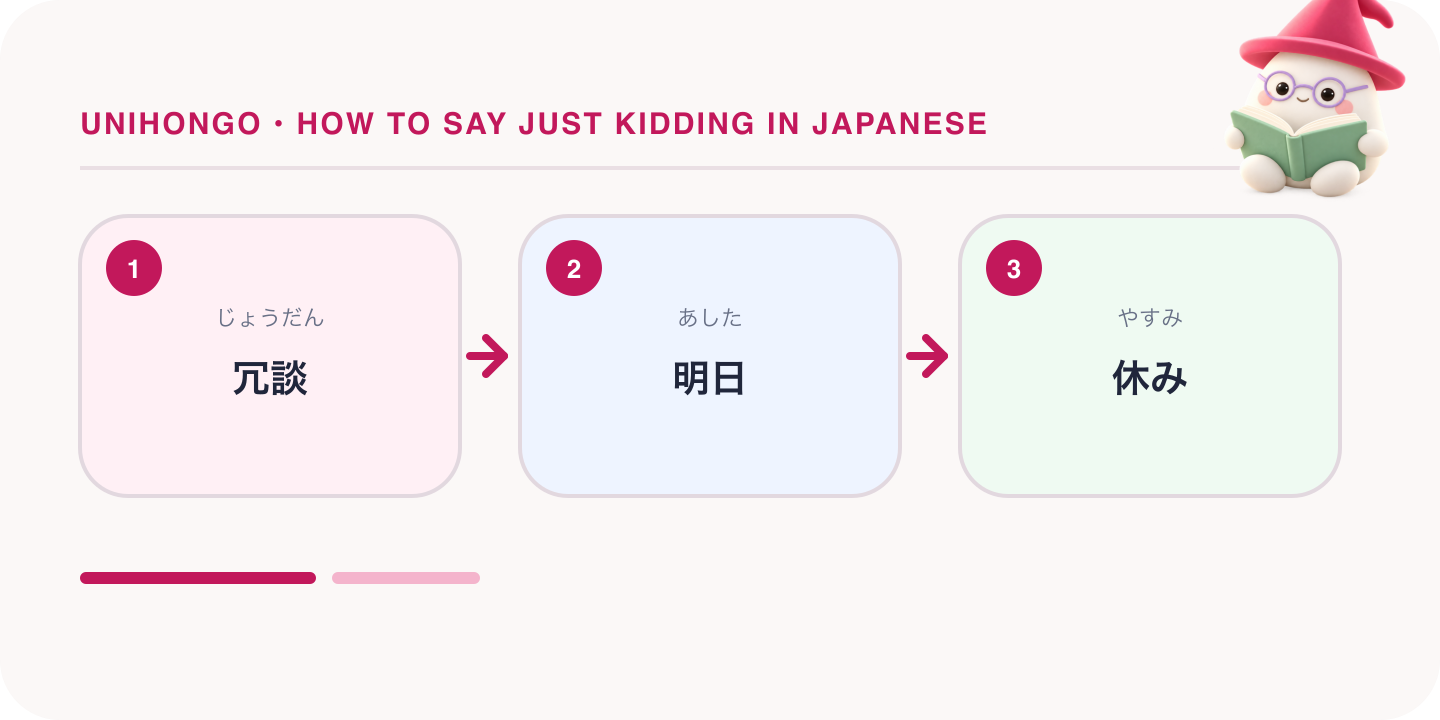
| 冗談ですけど、明日休みにしませんか。 | Jōdan desu kedo, ashita yasumi ni shimasen ka. | Joking, but shall we make tomorrow a day off? |
| 冗談、冗談。 | Jōdan, jōdan. | Kidding, kidding. |
| 冗談のつもりでした。 | Jōdan no tsumori deshita. | I meant it as a joke. |
Nante ne: taking it back inside the sentence
Nante ne is the phrase most learners have heard but find hardest to place. It goes at the very end of the joking sentence, usually after a tiny pause, and it works like a wink. Nante means something like or such a thing, and ne asks the listener to share the feeling, so together they say I said that but do not hold me to it.
The classic pattern is to say something slightly exaggerated or boastful, then deflate it: kyō wa watashi ga ogoru yo, nante ne. It is also used for self-deprecating humour and for pretending to be sulky. Because it undercuts your own sentence, it is far gentler than a joke at someone else's expense, which is why it is such a common way to be funny without risk.
Nante ne is casual. Keep it for friends, family and relaxed workmates; with clients or in a formal meeting it sounds out of place.
| Japanese | Romaji | Meaning |
|---|---|---|
| 今日は私がおごるよ。なんてね。 | Kyō wa watashi ga ogoru yo. Nante ne. | Today it's on me. Just kidding. |
| もう会社辞めようかな、なんてね。 | Mō kaisha yameyō ka na, nante ne. | Maybe I'll quit the company, or so I say. |
| 実は天才なんです、なんてね。 | Jitsu wa tensai nan desu, nante ne. | Actually I'm a genius, just kidding. |
| 怒ってるよ、なんてね。 | Okotteru yo, nante ne. | I'm angry, kidding. |
| なんてね、冗談だよ。 | Nante ne, jōdan da yo. | Just kidding, it's a joke. |
Uso uso and uso da yo: correcting something untrue
Uso means a lie or something untrue, and doubling it, uso uso, is a quick way to say that the last thing you said was not true and you are taking it back. It is the right phrase when you stated a false fact on purpose to get a reaction: I got fired, I'm moving to Osaka, the meeting is cancelled. Once the other person's eyebrows go up, uso uso, jōdan brings them down again.
The difference from jōdan desu is the target. Jōdan desu labels the intention, it was meant as a joke, while uso uso labels the content, that was not true. They are often used together, and uso da yo is a slightly fuller casual form. In polite speech you would say uso desu, but it sounds a little blunt, so many people prefer jōdan desu at work and keep uso uso for friends.
Uso also has a separate life as a reaction, no way, really, when someone else says something surprising. That use is explained in the guide to the word uso on this site; here we only need the version where you correct yourself.
| Japanese | Romaji | Meaning |
|---|---|---|
| うそうそ、冗談だよ。 | Uso uso, jōdan da yo. | Not true, not true, I'm joking. |
| 会議は中止だって。うそだよ。 | Kaigi wa chūshi datte. Uso da yo. | They say the meeting's cancelled. Just kidding. |
| ごめん、今のはうそ。 | Gomen, ima no wa uso. | Sorry, that wasn't true. |
| うそです、すみません。 | Uso desu, sumimasen. | That wasn't true, sorry. (polite) |
Honki ni shinaide and other ways to say don't take it seriously
Sometimes you do not want to say it was a joke exactly, only that it should not be taken to heart. Honki ni shinaide, or honki ni shinaide kudasai in polite speech, means do not take it seriously. Honki is seriousness or one's true intention, so honki ni suru means to take something as real. Ma ni ukenaide is similar and slightly more formal, and it is common with the polite ending kudasai.
Jōdan hanbun desu, I'm half joking, is useful when the joke had a grain of truth in it. Karuku itta dake, I only said it lightly, lowers the stakes after a remark that came out sharper than intended.
| Japanese | Romaji | Meaning |
|---|---|---|
| 本気にしないでね。 | Honki ni shinaide ne. | Don't take it seriously, okay? |
| 本気にしないでください。 | Honki ni shinaide kudasai. | Please don't take it seriously. |
| 真に受けないでください。 | Ma ni ukenaide kudasai. | Please don't take it at face value. |
| 軽い冗談です。 | Karui jōdan desu. | It's just a light joke. |
| 冗談半分で言っただけです。 | Jōdan hanbun de itta dake desu. | I only said it half in jest. |
| 軽く言っただけだよ。 | Karuku itta dake da yo. | I only said it lightly. |
Tone, timing and the little signals that carry the joke
Japanese jokes rely less on the words and more on delivery, and the take-back phrases are no different. Three things matter. Speed: nante ne and uso uso work when they come quickly, almost in the same breath. The face: a smile or a small laugh tells the listener what to do. A gesture: many people wave a hand in front of the face, palm out, while saying jōdan jōdan, the same gesture used for no or it's nothing.
Listen for the reaction too. A laugh may be quiet, or a flat nani sore, what's that, said with a grin. Silence, a polite sō desu ka or a change of subject means the joke has not landed, and the recovery phrases in the last section are what you need.
- Say the take-back within a second, not after a long pause
- Smile or laugh lightly while saying jōdan or nante ne
- A hand waved in front of the face reinforces jōdan jōdan
- Start with jokes about yourself, not about the listener
- Watch for silence or a flat sō desu ka, which means it missed
With friends versus at work
Among friends, every phrase in this guide is available. Teasing a close friend with a false claim and then uso uso is normal, and nante ne appears constantly in casual chat and in text messages.
At work the range narrows. Jokes about a colleague's work, appearance, age or private life are risky in any language and more so in a Japanese office, where people may laugh politely and remember. Self-deprecating jokes, jokes about the weather, the trains or the office coffee are safe. Mark the joke immediately with jōdan desu or jōdan desu kedo, and keep nante ne and uso uso for colleagues you already joke with outside meetings. With clients, seniors you do not know well and in formal settings, the simplest advice is to skip the joke unless they joke first.
| Phrase | Reading | Where it fits |
|---|---|---|
| 冗談です | Jōdan desu | Polite; colleagues, acquaintances, most work situations |
| 冗談だよ | Jōdan da yo | Casual; friends, family, close colleagues |
| 冗談ですけど | Jōdan desu kedo | Polite warning before a joke; safe at work |
| なんてね | Nante ne | Casual retraction; friends, texting, relaxed workmates |
| うそうそ | Uso uso | Casual; friends, after a made-up claim |
| うそです | Uso desu | Polite but blunt; use jōdan desu instead at work |
| 本気にしないで | Honki ni shinaide | Casual; when the listener looks unsure |
| 真に受けないでください | Ma ni ukenaide kudasai | Polite; when a remark might be taken literally |
| 軽く言っただけ | Karuku itta dake | Casual; after a remark that came out sharp |
Common mistakes learners make
The first mistake is translating just kidding word for word with karakau. Karakau means to tease someone, so karakatta dake describes teasing rather than retracting a joke, and it can sound as if you are admitting you were making fun of the listener.
The second is using uso as the take-back for every kind of joke. If your joke was an exaggeration or a bit of sarcasm rather than a false claim, uso uso does not quite fit, because nothing untrue was said. Nante ne or jōdan desu is the better match.
The third is overusing nante ne until it becomes a verbal tic. If everything you say ends in nante ne, the listener stops knowing when you mean things.
| Japanese | Romaji | Meaning |
|---|---|---|
| からかっただけだよ。 | Karakatta dake da yo. | I was only teasing you. (about the listener) |
| 大げさに言っただけです。 | Ōgesa ni itta dake desu. | I was only exaggerating. |
| ちょっとふざけただけ。 | Chotto fuzaketa dake. | I was just messing around. |
When the joke lands badly
Every learner will at some point make a joke that does not land, and the recovery is more important than the joke. The pattern is short: apologise, state that it was a joke, say what you actually meant if it matters, and move on. Gomen, jōdan no tsumori datta with friends, or sumimasen, jōdan no tsumori deshita in polite speech, covers the first two steps. Do not explain why the joke was funny; explanations make the moment longer.
If the joke touched something sensitive, such as someone's work or family, add a real apology: fukai na omoi o sasete sumimasen, sorry for making you feel uncomfortable, then change the subject. If a colleague looks hurt, a quick sakki wa sumimasen deshita, sorry about earlier, later in the day repairs more than a long apology on the spot.
If you are the one who took a joke seriously, jōdan desu ka, was that a joke, checks lightly without making either of you look foolish.
| Japanese | Romaji | Meaning |
|---|---|---|
| ごめん、冗談のつもりだった。 | Gomen, jōdan no tsumori datta. | Sorry, I meant it as a joke. |
| すみません、冗談のつもりでした。 | Sumimasen, jōdan no tsumori deshita. | Sorry, I meant that as a joke. (polite) |
| 不快な思いをさせてすみません。 | Fukai na omoi o sasete sumimasen. | Sorry for making you feel uncomfortable. |
| さっきはすみませんでした。 | Sakki wa sumimasen deshita. | Sorry about earlier. |
| 冗談ですか。 | Jōdan desu ka. | Was that a joke? |
| あ、冗談か。びっくりした。 | A, jōdan ka. Bikkuri shita. | Oh, it was a joke. You got me. |