
What Kansai-ben is and where you hear it
Kansai is the region of western Honshu that includes Osaka, Kyoto, Kobe and Nara. The speech of the area is usually grouped together as Kansai-ben, though people who live there hear clear differences between an Osaka merchant, a Kyoto shopkeeper and a Kobe student, and between a grandmother and her grandchildren. Treat every feature in this guide as a strong tendency rather than a fixed rule, and expect the mix to shift by city, age and situation.
Standard Japanese, the Tokyo-based variety taught in textbooks, is understood everywhere, and Kansai speakers switch toward it in formal or written contexts. In daily life, however, most of them speak the dialect with family, friends and colleagues, and they do not tone it down for a foreigner who seems to be following. That is why comprehension matters long before production. If you can decode ya, hen and a short list of everyday words, the rest of the sentence is usually the Japanese you already know.
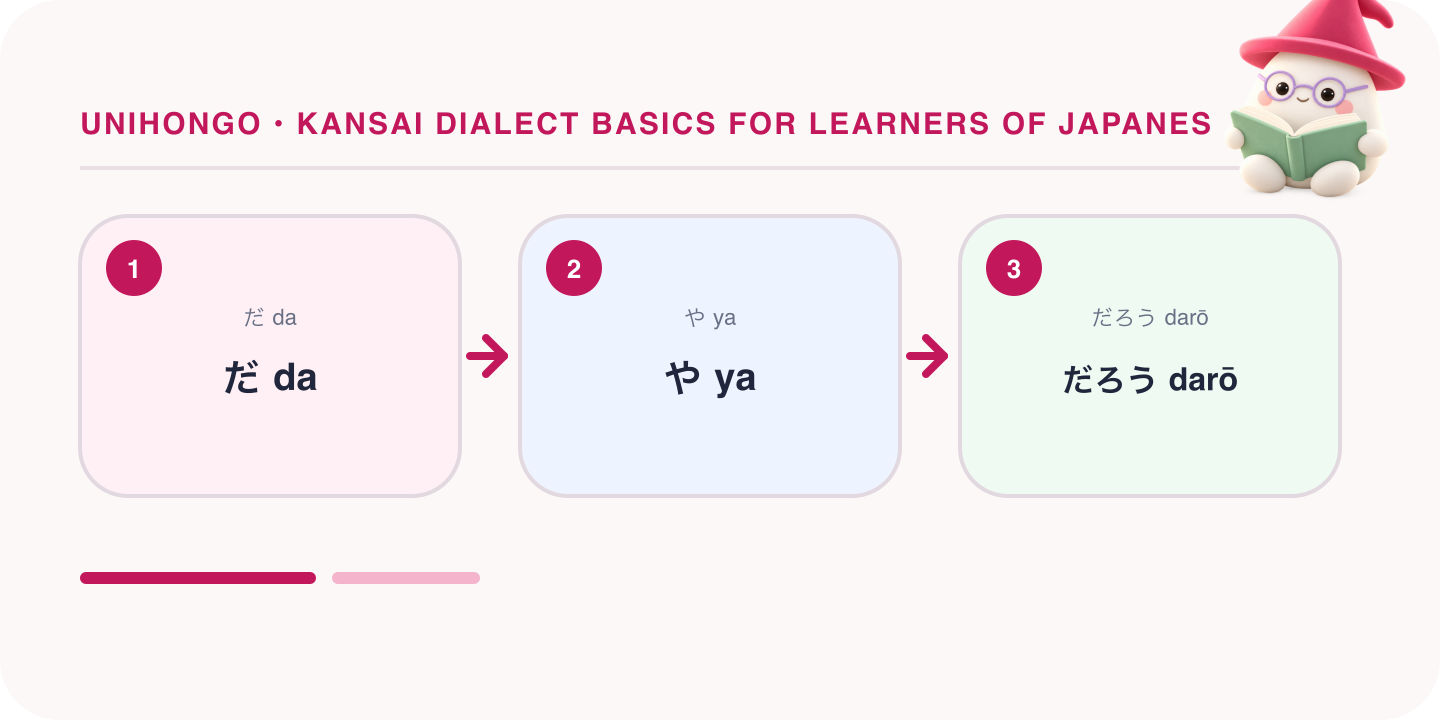
Standard and Kansai forms side by side
| Standard Japanese | Kansai form | Meaning |
|---|---|---|
| だ da | や ya | is, plain copula |
| だろう darō | やろ yaro | probably, right? |
| じゃない ja nai | やない ya nai / ちゃう chau | is not, that's wrong |
| ない nai (verb negative) | へん hen | does not |
| わからない wakaranai | わからへん wakarahen | I don't understand |
| できない dekinai | できひん dekihin / できへん dekihen | cannot |
| 来ない konai | 来(け)ーへん kēhen | does not come |
| しない shinai | せーへん sēhen | does not do |
| いい ii | ええ ee | good, fine |
| だめ dame | あかん akan | no good, not allowed |
| 本当 hontō | ほんま honma | really, true |
| とても totemo | めっちゃ meccha | very |
| いくら ikura | なんぼ nanbo | how much |
| ありがとう arigatō | おおきに ōkini | thank you |
| 違う chigau | ちゃう chau | no, that's different |
| そうだ sō da | せや seya | that's right |
| じゃあ jā | ほな hona | well then |
| 面白い omoshiroi | おもろい omoroi | funny, interesting |
| たくさん takusan | ようけ yōke | a lot |
| 疲れる tsukareru / つらい tsurai | しんどい shindoi | tiring, exhausting |
| どう dō | どない donai | how |
Read the table as a decoder, not as a vocabulary list to reproduce. A few of these, such as meccha and shindoi, have spread far beyond Kansai among younger speakers nationwide, so you may already know them. Others, such as ōkini and yōke, are heard more from older speakers or in traditional shops, and a twenty-year-old in Osaka may say arigatō and takusan just like a Tokyo friend.
Ya for da: the Kansai copula
The clearest marker of Kansai speech is the plain copula. Where standard casual Japanese ends a noun or na-adjective sentence with da, Kansai uses ya. The past form datta becomes yatta, the guess darō becomes yaro, and the softened explanation n da becomes nen or ya nen. Sentence-final de and yan are attached in the same slot: ya de asserts, ya yan asks for agreement. Once you hear the ya, you know the rest follows Kansai patterns. Polite desu is used as in standard Japanese, so the difference is loudest between friends.
| Japanese | Romaji | Meaning |
|---|---|---|
| そうだよ。 | Sō da yo. | That's right. (standard, casual) |
| そうやで。 | Sō ya de. | That's right. (Kansai, casual) |
| 学生だった。 | Gakusei datta. | I was a student. (standard, casual) |
| 学生やった。 | Gakusei yatta. | I was a student. (Kansai, casual) |
| 明日は休みだろう? | Ashita wa yasumi darō? | Tomorrow's a day off, right? (standard, casual) |
| 明日は休みやろ? | Ashita wa yasumi yaro? | Tomorrow's a day off, right? (Kansai, casual) |
| 好きなんだ。 | Suki nan da. | The thing is, I like it. (standard, casual) |
| 好きやねん。 | Suki ya nen. | The thing is, I like it. (Kansai, casual) |
Hen for nai: the Kansai negative
Kansai negatives replace the ending nai with hen, attached to the same stem, so wakaranai becomes wakarahen and ikanai becomes ikahen. Some verbs change more: dekinai is often dekihin or dekihen, konai becomes kēhen, and shinai becomes sēhen, with the exact vowel varying by city. The plain n negative, as in wakaran and shiran, is also common and is shared with much of western Japan. Past negatives usually take katta after these forms: wakarahenkatta or wakarankatta.
The idiom shiran kedo, literally I don't know though, has become a popular way to hedge a confident-sounding claim, and you will hear it from young speakers well outside Kansai. Be careful with kamahen, which means it does not matter or go ahead, from standard kamawanai. It sounds like a refusal to a beginner but is in fact permission, so the safest reply is a polite thank you.
| Japanese | Romaji | Meaning |
|---|---|---|
| わからない。 | Wakaranai. | I don't understand. (standard, casual) |
| わからへん。 | Wakarahen. | I don't understand. (Kansai, casual) |
| 今日は行かない。 | Kyō wa ikanai. | I'm not going today. (standard, casual) |
| 今日は行かへん。 | Kyō wa ikahen. | I'm not going today. (Kansai, casual) |
| 田中さんは来ないよ。 | Tanaka-san wa konai yo. | Tanaka isn't coming. (standard, casual) |
| 田中さんはけーへんで。 | Tanaka-san wa kēhen de. | Tanaka isn't coming. (Kansai, casual) |
| 知らないけど。 | Shiranai kedo. | I don't know, though. (standard, casual) |
| 知らんけど。 | Shiran kedo. | I don't know, though. (Kansai, casual) |
| 気にしないよ。 | Ki ni shinai yo. | I don't mind. (standard, casual) |
| かまへんよ。 | Kamahen yo. | I don't mind, go ahead. (Kansai, casual) |
The everyday words that carry the flavour
Most of what makes a conversation sound Kansai is a small set of substitutions. Honma replaces hontō, so honma ni means truly and honma? on its own means really? Akan replaces dame and covers everything from a spoilt plan to a child reaching for a socket. Meccha intensifies like sugoku. Nanbo asks how much and is heard at markets and in shops, though a polite shopper will still hear ikura desu ka in return. Ōkini is the traditional thank you of the region and survives most strongly among shopkeepers and older speakers.
Chau deserves special attention because it does two jobs. On its own, often doubled as chau chau, it means no, that's wrong, from standard chigau. Attached to a verb, as when itte shimau contracts to icchau, the same sound is ordinary standard Japanese for doing something completely or regrettably, so listen for whether it stands alone. Nande ya nen, literally why is that, is the classic comic retort of Osaka comedy and is said with a downward chop of the hand. Enjoy it when you hear it; do not reach for it yourself.
| Japanese | Romaji | Meaning |
|---|---|---|
| 本当ですか? | Hontō desu ka? | Really? (standard, polite) |
| ほんまですか? | Honma desu ka? | Really? (Kansai, polite) |
| それはだめだよ。 | Sore wa dame da yo. | That's no good. (standard, casual) |
| それはあかんで。 | Sore wa akan de. | That's no good. (Kansai, casual) |
| とてもおいしい。 | Totemo oishii. | It's very tasty. (standard, casual) |
| めっちゃうまい。 | Meccha umai. | It's really tasty. (Kansai, casual) |
| これはいくらですか? | Kore wa ikura desu ka? | How much is this? (standard, polite) |
| これ、なんぼ? | Kore, nanbo? | How much is this? (Kansai, casual) |
| ありがとうございます。 | Arigatō gozaimasu. | Thank you. (standard, polite) |
| おおきに。 | Ōkini. | Thanks. (Kansai, traditional) |
| どうしたの? | Dō shita no? | What's the matter? (standard, casual) |
| どないしたん? | Donai shitan? | What's the matter? (Kansai, casual) |
The melody: intonation and pitch accent
Kansai speech is often described as more musical than Tokyo speech. Pitch moves over a wider range within a phrase, sentence-final particles such as na and de are stretched, and short one-mora nouns are commonly lengthened, so te for hand and me for eye can sound like tē and mē. The u in desu and masu, which Tokyo speakers usually whisper, is often voiced clearly. None of this is sloppy; it is a different system, and it is the part learners find hardest to copy convincingly.
Pitch accent differs as well. Standard Japanese sorts words into heiban, atamadaka, nakadaka and odaka patterns, and Kansai assigns many words a different one. The textbook example is hashi. In Tokyo, HAshi with the drop after the first mora is chopsticks, and haSHI with the rise is bridge; in much of Kansai this pair is famously reversed. Other classic pairs such as ame for rain and candy also differ, but the exact patterns vary by city, so do not assume a simple rule. In this guide capital letters mark the high morae.
| Japanese | Romaji | Meaning |
|---|---|---|
| 箸を取ってください。 | HAshi o totte kudasai. | Please pass the chopsticks. (Tokyo pitch) |
| 橋を渡ります。 | HaSHI o watarimasu. | I cross the bridge. (Tokyo pitch) |
| 手が冷たいです。 | Te ga tsumetai desu. | My hands are cold. (standard length) |
| 手ぇが冷たいわ。 | Tē ga tsumetai wa. | My hands are cold. (Kansai, lengthened te) |
Wa in that last line is worth a note. In Tokyo speech a sentence-final wa is associated with feminine soft assertion. In Kansai it is used by everyone, men included, with a falling tone, and it simply adds a light emphasis. If a male colleague from Osaka ends a sentence with wa, hear it as a regional marker, not a gender one.
Why understand it long before you speak it
Dialect is identity. Kansai speakers grew up with the rhythm, the timing of a joke and the exact vowel in dekihin, and they hear instantly when someone is performing rather than speaking. A learner who has spent a month in Osaka and starts sprinkling honma and akan over a Tokyo-textbook accent usually produces an effect closer to a comedian's impression than to warmth. People are kind about it, and some will find it charming, but you will not be taken more seriously, and in a workplace it can read as flippant.
There is also a practical trap. The dialect's grammar shifts are consistent, but its melody is not something you can learn from a table, and a Kansai word delivered with standard pitch sounds odd to local ears. The safe path is the one Japanese people from other regions take when they move to Osaka: understand everything, answer in standard Japanese, and let a few features arrive on their own after years of listening. If a friend teaches you a line and asks you to say it, do it with a smile and treat it as a shared joke.
Replying in standard Japanese when you hear Kansai-ben
The lines below are pairs. The first is something a Kansai speaker might say to you; the second is a natural standard reply in polite form. Notice that the reply never echoes the dialect. You are not being stiff; you are simply speaking your own Japanese, which is exactly what a person from Sendai or Fukuoka would do. Yūte in the first pair is the Kansai te-form of iu, which becomes itte in standard speech; the same change turns katta into kōta for some speakers.
| Japanese | Romaji | Meaning |
|---|---|---|
| わからへんかったら言うてな。 | Wakarahenkattara yūte na. | If you don't understand, just say so. (Kansai, casual) |
| はい、ありがとうございます。わからないときは聞きます。 | Hai, arigatō gozaimasu. Wakaranai toki wa kikimasu. | Thank you. I'll ask when I don't understand. (your reply) |
| 日本語、めっちゃうまいなあ。 | Nihongo, meccha umai nā. | Your Japanese is really good. (Kansai, casual) |
| いえいえ、まだまだです。 | Ieie, madamada desu. | Oh no, I still have a long way to go. (your reply) |
| どこから来たん? | Doko kara kitan? | Where are you from? (Kansai, casual) |
| ベトナムから来ました。 | Betonamu kara kimashita. | I'm from Vietnam. (your reply) |
| ほんま? | Honma? | Really? (Kansai, casual) |
| はい、本当です。 | Hai, hontō desu. | Yes, really. (your reply) |
| それはあかんわ。 | Sore wa akan wa. | That won't work. (Kansai, casual) |
| すみません。どうすればいいですか? | Sumimasen. Dō sureba ii desu ka? | Sorry. What should I do? (your reply) |
| ほな、また明日な。 | Hona, mata ashita na. | Right then, see you tomorrow. (Kansai, casual) |
| はい、また明日。お疲れ様でした。 | Hai, mata ashita. Otsukaresama deshita. | Yes, see you tomorrow. Good work today. (your reply) |
| おおきに。 | Ōkini. | Thanks. (Kansai, from a shopkeeper) |
| こちらこそ、ありがとうございました。 | Kochira koso, arigatō gozaimashita. | Thank you too. (your reply) |
| ぼちぼちやな。 | Bochibochi ya na. | So-so, getting by. (Kansai, casual) |
| そうですか。私もぼちぼちです。 | Sō desu ka. Watashi mo bochibochi desu. | I see. I'm getting by too. (your reply) |
Bochibochi, meaning so-so or little by little, is one of the few Kansai words that sits comfortably in a learner's mouth, because it is now understood nationwide and carries no comic edge. Even so, use it once you have heard it from the person you are talking to, not before. The old exchange about business going bochibochi that appears in every guidebook is a cliché that people in Osaka rarely say seriously.
Where Kansai-ben shows up in media
The dialect is everywhere on Japanese television because a large share of the country's comedians come from Osaka. Manzai, the two-person stand-up format built on a straight man and a fool, is performed largely in Kansai-ben, and its retorts such as nande ya nen have become national catchphrases. Variety shows, morning dramas set in Osaka merchant families, and countless anime and manga characters use the dialect as a shortcut for a personality: loud, funny, warm, shrewd about money, or all four at once.
This is useful for listening practice and misleading as a model. Fiction exaggerates the features and freezes them in an older form, so a manga character may say ōkini and dekimahen far more than any real person under fifty. Watch for the substitutions, enjoy the rhythm, and then check your impressions against real speech, for example interviews with Kansai athletes or local news segments, where the dialect is lighter and blends with polite standard forms.
- Listen for ya and hen first; if you catch them, the sentence is Kansai and you can decode the rest.
- Note which words your favourite character uses that this guide calls old-fashioned, and treat them as flavour.
- Compare a comedy clip with a local news clip from the same city to hear the difference between performance and daily speech.
- Write down one new Kansai form a week with its standard equivalent, and say the standard version aloud.
How to check yourself
Your goal is fast recognition, so test that rather than imitation. Record yourself reading the standard line of each pair in this guide, then play a Kansai clip or ask a Kansai friend to say the dialect version, and check whether you can translate it back to the standard form within a second. If a pair still stalls you, the problem is usually the melody rather than the word, so listen to it three more times before moving on.
For your own pronunciation, keep working on the standard patterns, including the four pitch accent types, because they are what you will use in every region. Your AI Sensei in Unihongo's immersive 3D classroom gives pronunciation coaching on those standard forms and can explain a Kansai line you paste in from a show, and roleplay missions in a cafe or hotel let you practise the polite replies from this guide until they come out without hesitation.