
Name readings in four names
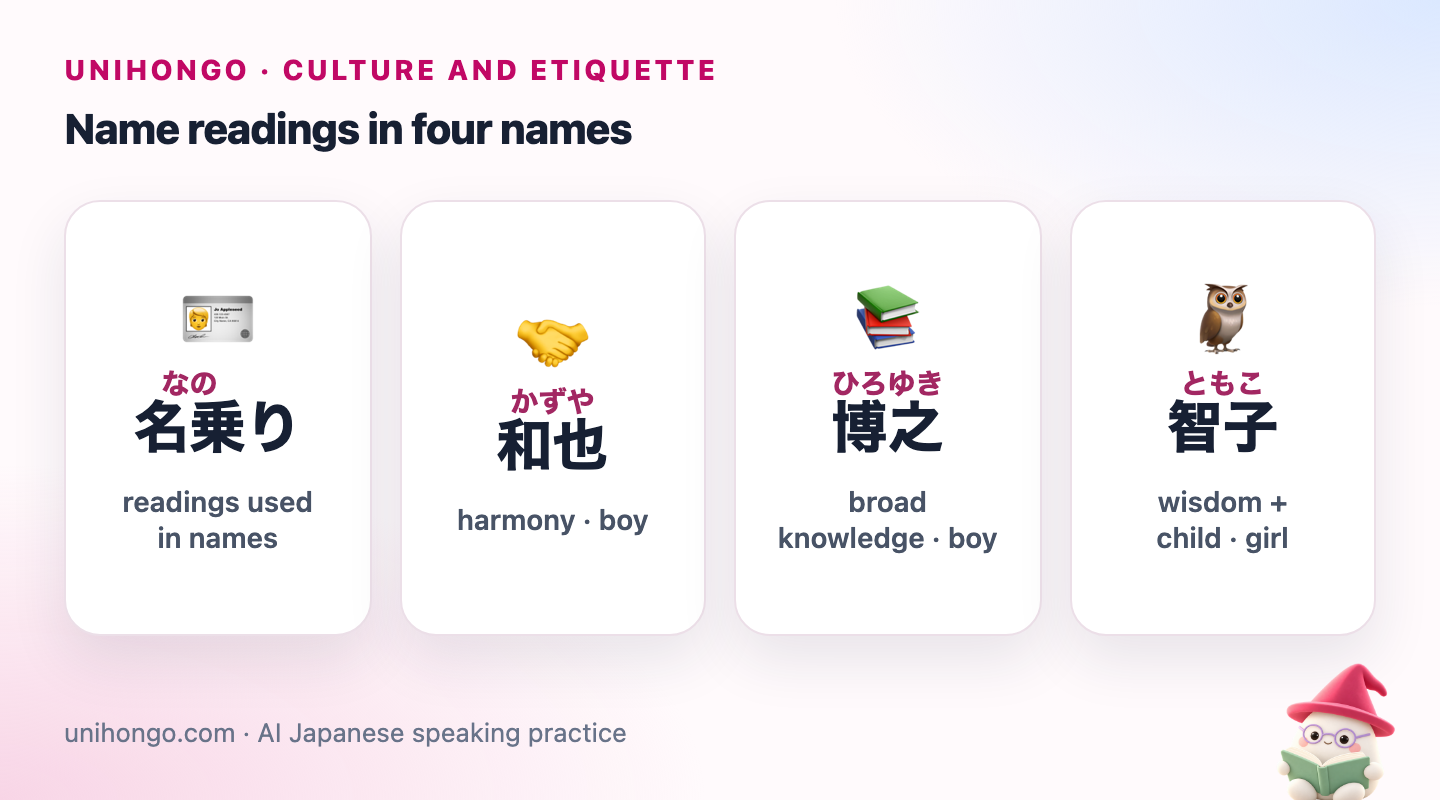
Nanori literally means naming yourself, and it is the word for the readings kanji take in personal names. In the names below, the first kanji is read with a nanori, a reading you will rarely meet in ordinary words. The second part is easy: ya, yuki, ko.
| Japanese | Romaji | Meaning |
|---|---|---|
| 名乗り | nanori | readings used in names |
| 和也 | Kazuya | harmony · boy |
| 博之 | Hiroyuki | broad knowledge · boy |
| 智子 | Tomoko | wisdom + child · girl |
In words, these kanji read wa (和食, washoku, Japanese food), haku (博物館, hakubutsukan, museum) and chi (智恵, chie, wisdom). In names, older readings take over. Where each name reading came from is often unclear, and dictionaries simply list them, so the practical approach is to learn the common ones as they come.
The name readings you will meet most
The table gives the everyday reading you probably know, the name reading, and a typical name. These are the nanori you will meet again and again in colleagues, teachers and neighbours, especially among people born in the twentieth century.
| Japanese | Romaji | Meaning |
|---|---|---|
| 秀樹 | Hideki | excellent + tree · boy |
| 信夫 | Nobuo | trust + man · boy |
| 紀子 | Noriko | record + child · girl |
| 敏夫 | Toshio | quick-witted + man · boy |
| 康子 | Yasuko | peace, health + child · girl |
| 孝 | Takashi | devotion to parents · boy |
| Kanji | Everyday reading | Name reading | Example name |
|---|---|---|---|
| 和 (harmony) | wa | kazu, masa | 和夫 Kazuo |
| 博 (broad) | haku | hiro | 博之 Hiroyuki |
| 秀 (excellent) | shū | hide | 秀樹 Hideki |
| 信 (trust) | shin | nobu | 信夫 Nobuo |
| 智 (wisdom) | chi | tomo, satoshi | 智子 Tomoko |
| 紀 (record) | ki | nori | 紀子 Noriko |
| 孝 (filial duty) | kō | taka | 孝 Takashi |
| 敏 (quick) | bin | toshi | 敏夫 Toshio |
| 義 (righteousness) | gi | yoshi | 義男 Yoshio |
| 康 (health, peace) | kō | yasu | 康子 Yasuko |
Many kanji, one sound: the Hiroshi problem
Name readings work in both directions. One kanji can have several readings, and one reading can belong to many kanji. Hiroshi is the classic example. All of the names below are read Hiroshi, all are boys' names, and each family chose its kanji for the meaning: broad, vast like water, wide like a bow drawn, generous.
| Japanese | Romaji | Meaning |
|---|---|---|
| 博 | Hiroshi | broad, learned · boy |
| 浩 | Hiroshi | vast, like water · boy |
| 弘 | Hiroshi | wide, spreading · boy |
| 寛 | Hiroshi | generous, relaxed · boy |
| 洋 | Hiroshi | ocean · boy |
The same thing happens with other name sounds. Taka can be 孝, 隆, 貴 or 崇. Yoshi can be 義, 良, 佳, 芳 or 吉. Tomo can be 友, 智, 知 or 朋. This is why, when you hear a name, you cannot write it until you ask, and why Japanese people expect the question. It is also why two colleagues called Hiroshi rarely mind being told apart by their kanji.
One kanji, many names
Going the other way, a single kanji can be read differently in different names, and only the family knows which reading they chose. 和 is a good example: Kazu in many boys' names, Nodoka as a girl's name on its own, and Masa in some older names. 美 is mi in most girls' names, but yoshi in some.
| Japanese | Romaji | Meaning |
|---|---|---|
| 和 | Nodoka | calm, peaceful · girl |
| 和人 | Kazuto | harmony + person · boy |
| 一 | Hajime | the first, the beginning · boy |
| 一樹 | Kazuki | one tree · boy |
| 由美 | Yumi | reason + beauty · girl |
| 美子 | Yoshiko | beauty + child · girl |
美子 is the tricky one: it is usually read Yoshiko, but a learner who knows 美 as mi would guess Miko, and the name Yoshiko is more often written 良子 or 佳子 anyway. This is a real situation Japanese teachers face on the first day of school, and the reason class lists in Japan carry furigana.
Endings that use name readings
Some name endings are themselves name readings, and they are a great clue that you are looking at a given name, not a word. They are especially common in boys' names from older generations.
| Japanese | Romaji | Meaning |
|---|---|---|
| 和彦 | Kazuhiko | harmony + prince · boy |
| 美紀 | Miki | beauty + record · girl |
| 義男 | Yoshio | righteous man · boy |
| Ending | Name reading | Feel | Example |
|---|---|---|---|
| 之 | yuki | Classic boys' ending | 博之 Hiroyuki |
| 夫 | o | Classic boys' ending, man | 和夫 Kazuo |
| 男 | o | Classic boys' ending, man | 義男 Yoshio |
| 彦 | hiko | Old, dignified boys' ending | 和彦 Kazuhiko |
| 紀 | ki or nori | Girls and boys | 美紀 Miki |
Women's names use name readings too, though more often in the first kanji than the ending: 紀 nori in Noriko, 智 tomo in Tomoko and 秀 hide in Hidemi. Once you know the starter set in this guide, you will find you can read most names on a staff list or class register, and ask confidently about the rest.
In everyday vocabulary, 之 almost never appears, 夫 is otto (husband) and 男 is otoko (man). Meeting them at the end of a name tells you to switch into name mode.
How people explain which kanji they use
Because so many names share a sound, Japanese people have a standard way to explain their kanji: they name a familiar word that contains it. Hakubutsukan no haku means the haku of museum, the kanji 博. Learners can use exactly the same trick, and it is one of the most natural pieces of Japanese you can practise.
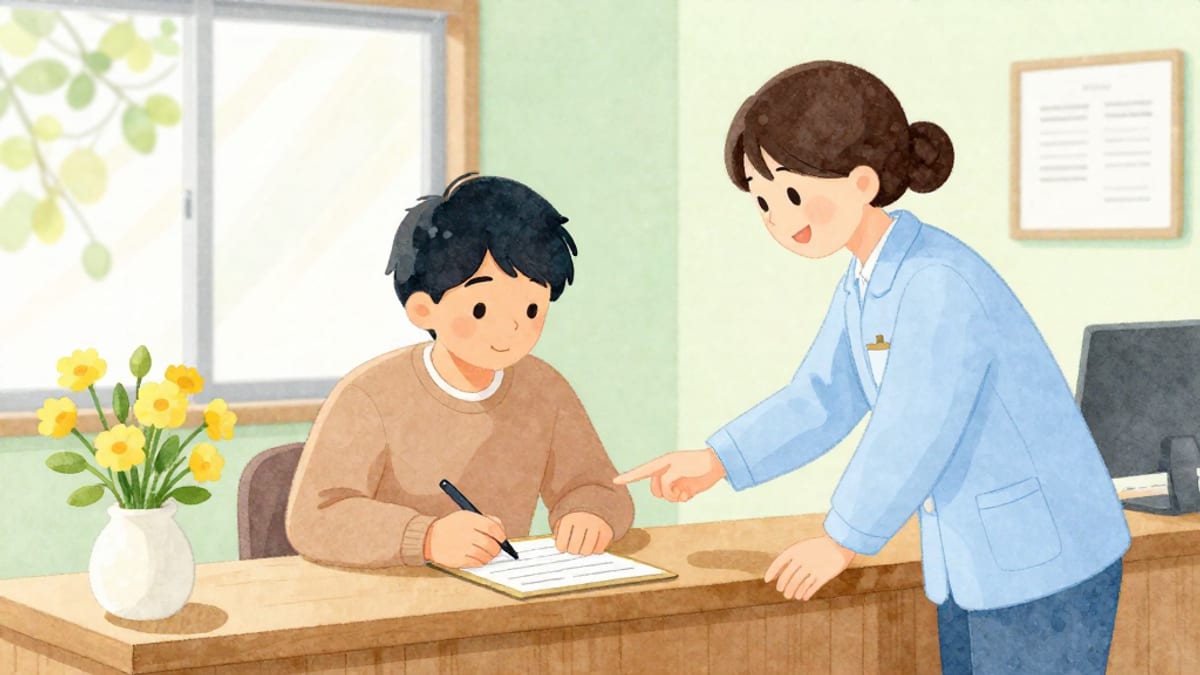
You will also need this at any counter with forms: banks, clinics, city halls. Forms have a box for furigana, the reading, above the kanji, and staff may confirm the kanji over the phone by asking which word it comes from.
| Japanese | Romaji | Meaning |
|---|---|---|
| どの「ひろし」ですか。 | Dono "Hiroshi" desu ka. | Which Hiroshi? (which kanji) |
| 博物館の「博」です。 | Hakubutsukan no "haku" desu. | The haku of hakubutsukan, museum. |
| 智子の「智」は、「知る」に「日」です。 | Tomoko no "tomo" wa, "shiru" ni "hi" desu. | The tomo of Tomoko is 'know' over 'sun'. |
| 紀子の「紀」は、世紀の「紀」です。 | Noriko no "nori" wa, seiki no "ki" desu. | The nori of Noriko is the ki of century. |
| ふりがなもお願いします。 | Furigana mo onegai shimasu. | Staff: Please add the reading, too. |
| 名前は「ケビン」で、カタカナです。 | Namae wa "Kebin" de, katakana desu. | My name is Kevin, written in katakana. |
Mini dialogue: reading a business card
A new colleague hands you a business card with 秀樹 on it. You know 秀 as shū and 樹 as ju, but you suspect a name reading.
| Japanese | Romaji | Meaning |
|---|---|---|
| すみません、下のお名前は何とお読みしますか。 | Sumimasen, shita no onamae wa nan to oyomi shimasu ka. | You: Excuse me, how is your given name read? |
| 「ひでき」です。 | "Hideki" desu. | Colleague: It's Hideki. |
| 「秀」という字は「ひで」と読むんですね。 | "Shū" to iu ji wa "hide" to yomu n desu ne. | You: So the kanji 秀 is read hide. |
| そうなんです。名前ではよくある読み方ですよ。 | Sō nan desu. Namae de wa yoku aru yomikata desu yo. | Colleague: That's right. It's a common reading in names. |
| 勉強になります。ありがとうございます。 | Benkyō ni narimasu. Arigatō gozaimasu. | You: That's good to know. Thank you. |
Build a name-reading deck with Mocchi
- Type "/kanji 和" and Mocchi lists the meaning, its readings and common words, so you see where kazu sits next to wa.
- Then ask, "Make flashcards for the twelve name readings in this post, with an example name on each card." Mocchi builds them for your Flash Card list, with a photo you pick for each, and reviews them with spaced repetition, so Hideki and Nobuo come back sooner if you miss them.
- Once the deck feels easy, play Mocchi Flight with your own flashcards and steer through the gate with the right reading.
Mistakes learners make with name readings
- Reading a name with on'yomi by default. 秀樹 is not Shūju. In names, try the name reading first, then ask.
- Assuming one reading per name. The same kanji can be read differently in two people's names, so always check each person.
- Writing a name in kanji after only hearing it. Hiroshi could be any of a dozen kanji; ask before you write it on a card or an email.
- Feeling embarrassed to ask. Japanese adults ask each other all the time, and staff at counters ask everyone.
- Using nanori in ordinary words. Kazu for 和 belongs to names; in words 和 is still wa.