
Four lines for the first week of January
Business New Year greetings rest on four pieces: a subject that marks the email as a greeting, thanks for last year, a request for this year, and, in person, the reason for your visit. The general New Year greeting itself, akemashite omedetō gozaimasu, comes first in speech and at the top of the email body; the lines below are what turns it into a business greeting.
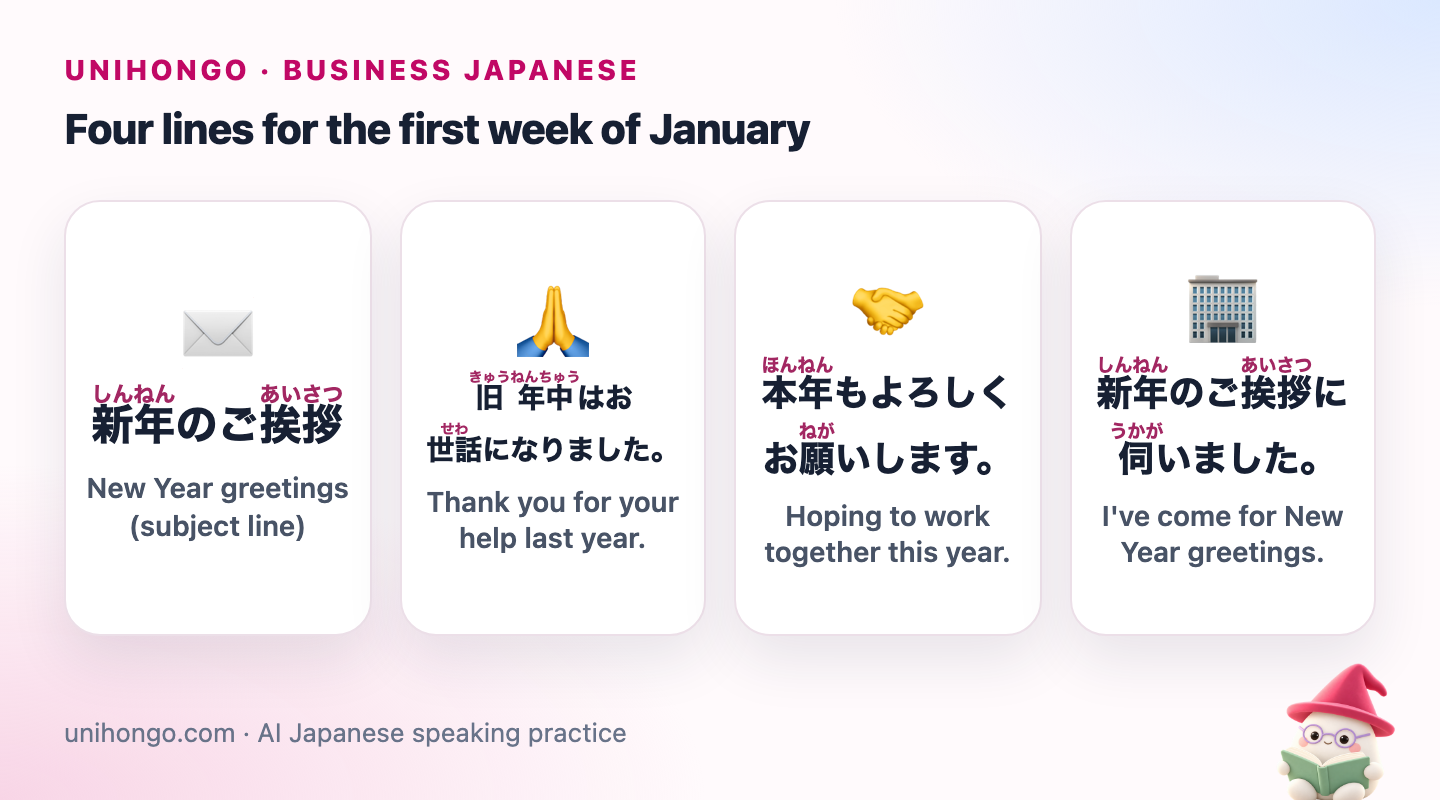
| Japanese | Romaji | Meaning |
|---|---|---|
| 新年のご挨拶 | Shinnen no goaisatsu | New Year greetings (subject line) |
| 旧年中はお世話になりました。 | Kyūnenchū wa osewa ni narimashita. | Thank you for your help last year. |
| 本年もよろしくお願いします。 | Honnen mo yoroshiku onegai shimasu. | Hoping to work together this year. |
| 新年のご挨拶に伺いました。 | Shinnen no goaisatsu ni ukagaimashita. | I've come for New Year greetings. |
When the New Year greeting fits
The greeting belongs to the start of the year. In business it is used in the first emails, calls and meetings after the holiday, which for many offices begins around 4 or 5 January. Many people keep using it through Matsu no uchi, the period when New Year decorations stay up. That period commonly ends on 7 January, while some regions, including parts of Kansai, traditionally keep it until around 15 January, so practice varies.
After that, the full greeting starts to sound late. A single line, honnen mo yoroshiku onegai itashimasu, still works with someone you are contacting for the first time that year. If you are writing very late, acknowledge it politely.
| Japanese | Romaji | Meaning |
|---|---|---|
| 新年のご挨拶が遅くなりましたが、本年もよろしくお願いいたします。 | Shinnen no goaisatsu ga osoku narimashita ga, honnen mo yoroshiku onegai itashimasu. | Belatedly, I look forward to working with you this year. |
| Timing | Email opening | Notes |
|---|---|---|
| First working days | Akemashite omedetō gozaimasu, then the business opener | The standard period |
| Until about 7 January (later in some regions) | The New Year greeting is still natural | Matsu no uchi |
| Mid to late January, first contact this year | Usual opener, then honnen mo yoroshiku | Skip omedetō |
| Very late first contact | Shinnen no goaisatsu ga osoku narimashita ga | Apologise briefly |
Opening lines, from formal to friendly
Company-wide emails and formal notices often begin with the very formal tsutsushinde shinnen no oyorokobi o mōshiagemasu, respectfully, we offer our New Year congratulations. Personal emails to clients usually start with akemashite omedetō gozaimasu, followed by the regular opener and your name. With contacts you write to every day, the greeting can be lighter, but avoid akeome, the casual short form, in business.
You will often see shinnen akemashite omedetō gozaimasu. It is widespread, but some people consider it redundant because shinnen and akemashite say the same thing, so formal writers often avoid it.
| Japanese | Romaji | Meaning |
|---|---|---|
| 謹んで新年のお慶びを申し上げます。 | Tsutsushinde shinnen no oyorokobi o mōshiagemasu. | Respectfully, we wish you a happy New Year. (very formal) |
| あけましておめでとうございます。 | Akemashite omedetō gozaimasu. | Happy New Year. (standard) |
| 新年おめでとうございます。 | Shinnen omedetō gozaimasu. | Happy New Year. (polite, slightly formal) |
| 本日より通常営業しております。 | Honjitsu yori tsūjō eigyō shite orimasu. | We are open as usual from today. |
Looking back and looking forward
After the greeting, the email thanks the reader for last year and asks for their support this year. These two lines are the heart of the business New Year greeting, and they come in the same formal levels as the year-end email. A third line, wishing the reader health and prosperity, is common in company notices and senior people's emails.
As in December, one concrete sentence makes a personal email feel real: a project you will start, or a plan you discussed before the break.
| Japanese | Romaji | Meaning |
|---|---|---|
| 旧年中は格別のご高配を賜り、厚く御礼申し上げます。 | Kyūnenchū wa kakubetsu no gokōhai o tamawari, atsuku onrei mōshiagemasu. | We are deeply grateful for your special support last year. (very formal) |
| 旧年中は大変お世話になりました。 | Kyūnenchū wa taihen osewa ni narimashita. | Thank you very much for your help last year. |
| 本年も変わらぬご愛顧のほど、よろしくお願い申し上げます。 | Honnen mo kawaranu goaiko no hodo, yoroshiku onegai mōshiagemasu. | We hope for your continued patronage this year. (formal) |
| 皆様のご健康とご多幸をお祈り申し上げます。 | Minasama no gokenkō to gotakō o oinori mōshiagemasu. | We wish you all good health and happiness. |
| 春からの新しいプロジェクトも、どうぞよろしくお願いいたします。 | Haru kara no atarashii purojekuto mo, dōzo yoroshiku onegai itashimasu. | We look forward to the new project starting this spring. |
A short sample for a regular client
Here is a first email of the year to a client you work with often. It greets, thanks, looks forward, and only then moves to the actual business, which can follow in the same email. Each row is one line of the body.
| Japanese | Romaji | Meaning |
|---|---|---|
| 山田様 | Yamada sama | Dear Mr or Ms Yamada, |
| あけましておめでとうございます。さくら物産の佐藤です。 | Akemashite omedetō gozaimasu. Sakura Bussan no Satō desu. | Happy New Year. This is Sato from Sakura Bussan. |
| 旧年中は大変お世話になりました。 | Kyūnenchū wa taihen osewa ni narimashita. | Thank you very much for your help last year. |
| 本年もどうぞよろしくお願いいたします。 | Honnen mo dōzo yoroshiku onegai itashimasu. | We look forward to working with you this year. |
| さて、年末にご相談した件ですが、 | Sate, nenmatsu ni gosōdan shita ken desu ga, | Now, about the matter we discussed in December, |
In person: the first visit and the first call
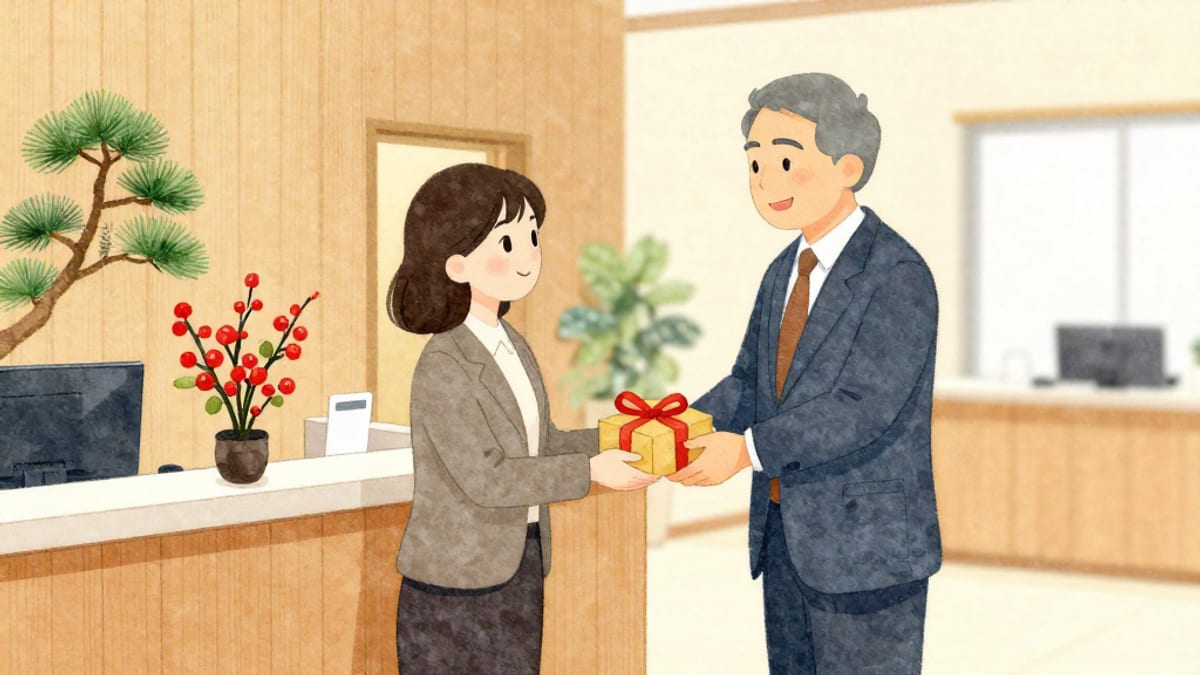
Some companies, especially in sales, keep the custom of nenshi mawari, short New Year visits to important clients in the first week or two of January. The visit is not a meeting. You arrive at an agreed time, say the greeting, sometimes hand over a small gift such as a company calendar or towel, and leave after a few minutes, because the client is receiving other visitors too. Customs vary by industry, and many offices now do the same by email or video call.
Phone calls follow the same order: the greeting, last year, this year, and only then the business. With colleagues in your own office, a simple akemashite omedetō gozaimasu, kotoshi mo yoroshiku onegai shimasu on the first morning is enough.
| Japanese | Romaji | Meaning |
|---|---|---|
| あけましておめでとうございます。新年のご挨拶に伺いました。 | Akemashite omedetō gozaimasu. Shinnen no goaisatsu ni ukagaimashita. | You: Happy New Year. I've come to give my New Year greetings. |
| わざわざありがとうございます。 | Wazawaza arigatō gozaimasu. | Client: Thank you for taking the trouble to come. |
| ささやかですが、弊社のカレンダーです。 | Sasayaka desu ga, heisha no karendā desu. | You: It's only small, but here is our company calendar. |
| 本年もどうぞよろしくお願いいたします。 | Honnen mo dōzo yoroshiku onegai itashimasu. | You: We look forward to working with you this year. |
| こちらこそ、よろしくお願いいたします。 | Kochira koso, yoroshiku onegai itashimasu. | Client: Likewise, we look forward to it. |
| お忙しいところ、失礼いたしました。 | Oisogashii tokoro, shitsurei itashimashita. | You: Thank you for your time. (as you leave) |
When someone is in mourning
In Japan, a family that lost someone during the year is in mochū, mourning, and usually does not celebrate the New Year. Many people send a mourning postcard in November or December so that others know not to send New Year cards. In business, the custom is applied more loosely, but it is kind to adjust if you know.
The fix is simple: drop omedetō and the celebratory opening, and keep the forward-looking line. If you are the one in mourning, you can write the same way, and nobody will think it cold.
| Japanese | Romaji | Meaning |
|---|---|---|
| 喪中 | mochū | in mourning |
| 旧年中は大変お世話になりました。本年もよろしくお願いいたします。 | Kyūnenchū wa taihen osewa ni narimashita. Honnen mo yoroshiku onegai itashimasu. | Thank you for last year; we look forward to this year. (no omedetō) |
Common mistakes in January emails
- Starting the first email of the year straight with business. Put the greeting and the two set lines first, even in a short email.
- Writing kyūnenchū in December, or honnen to mean last year in January. The words shift on 1 January.
- Using akeome or kotoyoro with clients. These casual short forms are for friends.
- Sending a full New Year greeting at the end of January. By then, a brief honnen mo yoroshiku is enough.
- Staying long on a New Year visit. A few minutes is polite; the client may have a queue of visitors.
- Writing omedetō to someone you know is in mourning.
Rehearse the first visit with AI Sensei
Reading the lines is not the same as saying them while bowing in a lobby. Choose Yamada-sensei in AI Sensei and ask: please play a client's manager receiving New Year visitors, polite Japanese, and let me give my greeting and a small gift. Then switch the role to a client on the phone. Afterwards, the session report lists your corrections and the vocabulary you used.
Before the session, ask Mocchi to /quiz you on kyūnenchū, honnen and kotoshi in short email lines. Mocchi notes the word you keep swapping and slips it into your next review, so the year-end and New Year words stay separate in your head.