
The kanji and the core idea
Omoiyari comes from the verb omoiyaru (思いやる). Omou (思う) means to think or to feel, and yaru (やる) means to send or to give, so the image is sending your thoughts out toward someone else. Omoiyari is the noun: the act or the quality of doing that.
In everyday use it means two things at once. First, you imagine the other person's position: they are tired, they are new, they are nervous. Second, you act on it in a way that helps, usually quietly. A person who only feels sympathy but does nothing is not really showing omoiyari; neither is someone who helps in a way that embarrasses the other person.
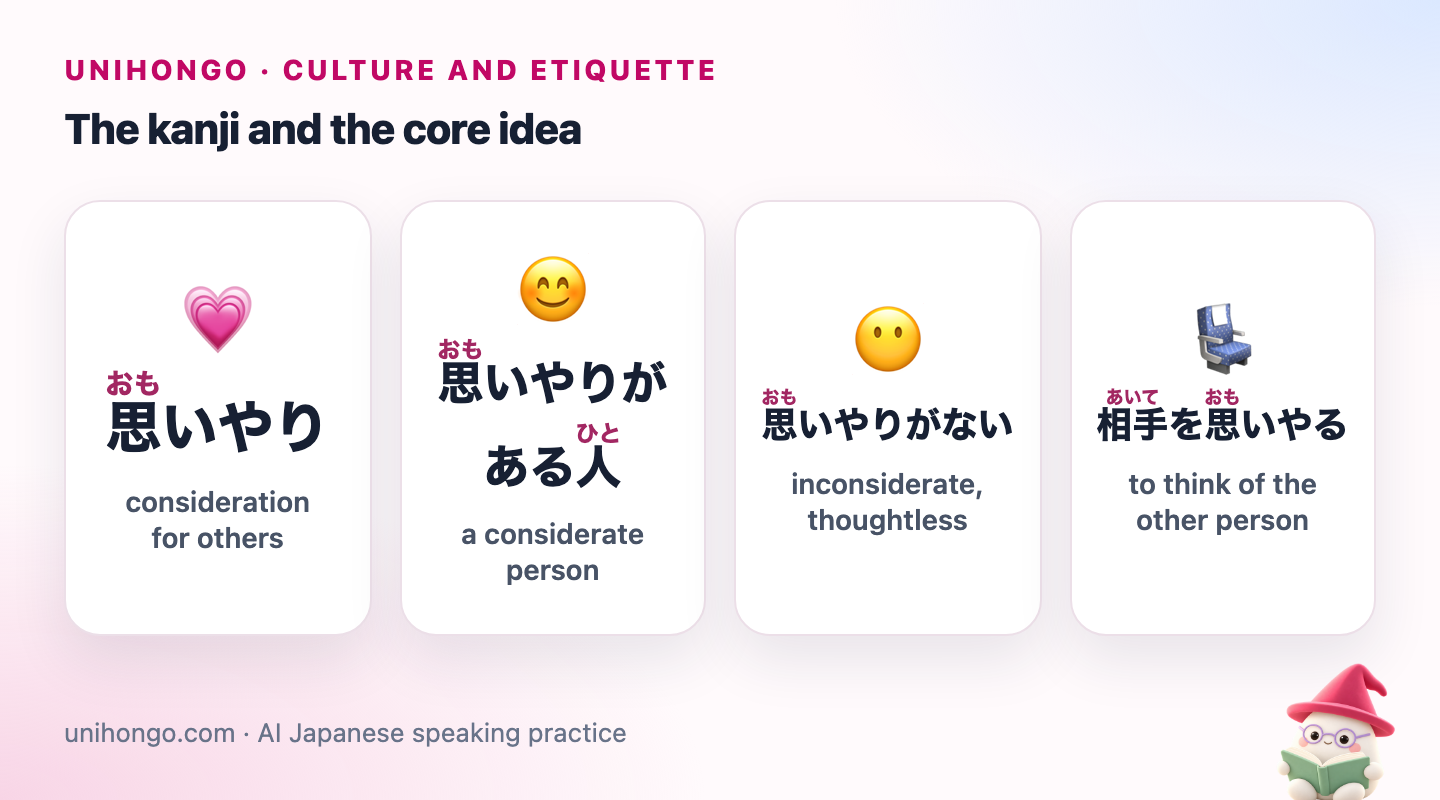
| Japanese | Romaji | Meaning |
|---|---|---|
| 思いやり | omoiyari | consideration for others |
| 思いやりがある人 | omoiyari ga aru hito | a considerate person |
| 思いやりがない | omoiyari ga nai | inconsiderate, thoughtless |
| 相手を思いやる | aite o omoiyaru | to think of the other person |
Omoiyari in everyday life
You see omoiyari most clearly in small daily moments. Many of them are about not causing trouble for others, and many are about noticing what someone needs before they ask. Japanese children learn the word early, at home and in school, where being kind to classmates is often framed as omoiyari.
| Japanese | Romaji | Meaning |
|---|---|---|
| どうぞ、座ってください。 | Dōzo, suwatte kudasai. | Please, take a seat. |
| 傘、一緒に入る? | Kasa, issho ni hairu? | Want to share my umbrella? (casual) |
| 無理しないでね。返信はいらないよ。 | Muri shinaide ne. Henshin wa iranai yo. | Don't push yourself. No need to reply. |
| 後の人のために、きれいに使いましょう。 | Ato no hito no tame ni, kirei ni tsukaimashō. | Let's keep it clean for the next person. |
- Giving your seat on a train to an older person, a pregnant woman or someone with a child.
- Speaking quietly on public transport and keeping phone calls short.
- Lending an umbrella, or sharing yours, when a friend is caught in the rain.
- Sending a short message to a colleague who is off sick, without asking them to reply.
- Choosing words that let someone save face, instead of pointing out their mistake in front of others.
- Leaving a shared space, such as an office kitchen or a public toilet, clean for the next person.
A common thread runs through these examples: omoiyari often means acting before anyone asks, and doing it in a way that does not make the other person feel indebted. Offering a seat with a quiet dōzo and then looking away is more omoiyari than a big gesture that draws the whole carriage's attention. Many Japanese people value help that is almost invisible.
You will also see the word in public life. Schools use it in lessons about getting along with classmates, some local governments promote omoiyari parking spaces for people who need to park close to the entrance, and public campaigns about manners on trains or roads often use it. In each case the message is the same: imagine the other person, then adjust what you do.
Praising it and noticing its absence
Omoiyari is mainly a word of praise. You will hear it about colleagues, partners, children and staff, and as a quality people look for in a friend or a spouse. In compliments it usually appears as omoiyari ga aru or omoiyari no aru, with the second slightly more written.
The negative, omoiyari ga nai, is a real criticism. Saying it directly to someone, omoiyari ga nai ne, can sting, especially in a quarrel. Softer versions such as mō sukoshi omoiyari ga attara ii na, it would be nice to have a little more consideration, are gentler. Among friends you might hear it about third parties: that driver, that customer, that comment.
| Japanese | Romaji | Meaning |
|---|---|---|
| 田中さんは思いやりのある人ですね。 | Tanaka-san wa omoiyari no aru hito desu ne. | Tanaka-san is a really considerate person. |
| 思いやりのある言葉、ありがとう。 | Omoiyari no aru kotoba, arigatō. | Thanks for your kind words. |
| それはちょっと思いやりがないよ。 | Sore wa chotto omoiyari ga nai yo. | That's a bit inconsiderate. (casual, direct) |
| もう少し思いやりがあったらいいな。 | Mō sukoshi omoiyari ga attara ii na. | I wish there were a bit more consideration. |
| 相手の気持ちを思いやることが大切です。 | Aite no kimochi o omoiyaru koto ga taisetsu desu. | It's important to think about how others feel. |
Avoid describing yourself as omoiyari ga aru. As with most compliments in Japanese, it sounds better from others than from your own mouth.
Omoiyari vs kizukai, kikubari, hairyo and yasashisa
These words share a lot of ground, and you will often hear them together. The table shows the main difference in focus and register.
| Japanese | Romaji | Meaning |
|---|---|---|
| 気遣いができる人 | kizukai ga dekiru hito | someone who notices and takes care of small needs |
| 気配りが上手ですね。 | Kikubari ga jōzu desu ne. | You're so good at looking after everyone. |
| ご配慮いただき、ありがとうございます。 | Gohairyo itadaki, arigatō gozaimasu. | Thank you for your consideration. (formal) |
| お気遣いありがとうございます。 | Okizukai arigatō gozaimasu. | Thank you for your concern. |
| お心遣い、感謝いたします。 | Okokorozukai, kansha itashimasu. | I'm grateful for your thoughtfulness. (humble) |
| Word | Focus | Register and typical use |
|---|---|---|
| Omoiyari (思いやり) | Imagining others' feelings and acting kindly | Everyday and moral; praise for character |
| Kizukai (気遣い) | Attentive, practical care in the moment | Everyday; hosting, work, small gestures |
| Kikubari (気配り) | Paying attention to everyone around you | Everyday; often said of good organisers |
| Hairyo (配慮) | Taking something into account, accommodation | Formal; business, official notices |
| Yasashisa (優しさ) | Kindness, gentleness in general | Everyday; the broadest word |
| Kokorozukai (心遣い) | A thoughtful gesture, often a gift | Polite; thanking someone |
How to reply when someone shows you omoiyari
When someone does something considerate for you, Japanese tends to acknowledge both the act and the thought behind it. Simple thanks is always fine. To sound warmer, mention their kindness itself. If you feel they went out of their way, a light apology-style thanks such as sumimasen, wazawaza arigatō gozaimasu is natural, since Japanese often thanks by acknowledging the trouble caused.
| Japanese | Romaji | Meaning |
|---|---|---|
| 気を遣ってくれてありがとう。 | Ki o tsukatte kurete arigatō. | Thanks for being so thoughtful. (casual) |
| 優しいね。 | Yasashii ne. | You're so kind. (casual) |
| すみません、わざわざありがとうございます。 | Sumimasen, wazawaza arigatō gozaimasu. | Sorry, thank you for going out of your way. |
| そんなに気を遣わないでください。 | Sonna ni ki o tsukawanaide kudasai. | Please don't worry about me so much. |
A short dialogue: a coworker under the weather
Two coworkers talk at the end of the day. One of them has a cold, and the other one shows omoiyari without making a fuss.

| Japanese | Romaji | Meaning |
|---|---|---|
| 大丈夫?顔色悪いよ。 | Daijōbu? Kaoiro warui yo. | Coworker: Are you OK? You look pale. |
| ちょっと風邪気味で。 | Chotto kazegimi de. | Colleague: I think I'm coming down with a cold. |
| これ、温かいお茶。よかったら。 | Kore, atatakai ocha. Yokattara. | Coworker: Here's a warm tea, if you like. |
| ありがとう。気を遣ってくれて。 | Arigatō. Ki o tsukatte kurete. | Colleague: Thanks for thinking of me. |
| 今日の残り、私がやっておくよ。 | Kyō no nokori, watashi ga yatte oku yo. | Coworker: I'll take care of the rest for today. |
| 本当に思いやりがあるね。 | Hontō ni omoiyari ga aru ne. | Colleague: You're really considerate. |
Common mistakes
| Japanese | Romaji | Meaning |
|---|---|---|
| 思いやりを持って接してください。 | Omoiyari o motte sesshite kudasai. | Please treat others with consideration. |
| 親切にしてくれてありがとう。 | Shinsetsu ni shite kurete arigatō. | Thank you for helping me. (casual) |
- Saying omoiyari suru. The noun does not take suru; use the verb omoiyaru, or omoiyari o motsu (to have consideration).
- Praising a superior with omoiyari ga arimasu ne. It can sound like you are evaluating them; okizukai arigatō gozaimasu is safer.
- Using hairyo in casual chat. It sounds like a company notice; use kizukai or omoiyari instead.
- Translating every kind act as shinsetsu. Shinsetsu (親切) is helpfulness, often to strangers, like giving directions; omoiyari is deeper and more about feelings.