
What a kirakira name looks like
Kirakira (キラキラ) is the Japanese sound word for sparkling, the same word you hear for stars or glitter. A kirakira name is a given name that uses ordinary kanji, usually kanji with lovely meanings, but reads them in a way nobody would guess from the characters alone. The reading often comes from a foreign word, from the image of the kanji, or from cutting a longer reading short.
The three examples below are the kind people quote when they explain the idea. Each one is built from simple kanji that every adult can read, and that is exactly why the reading surprises people.
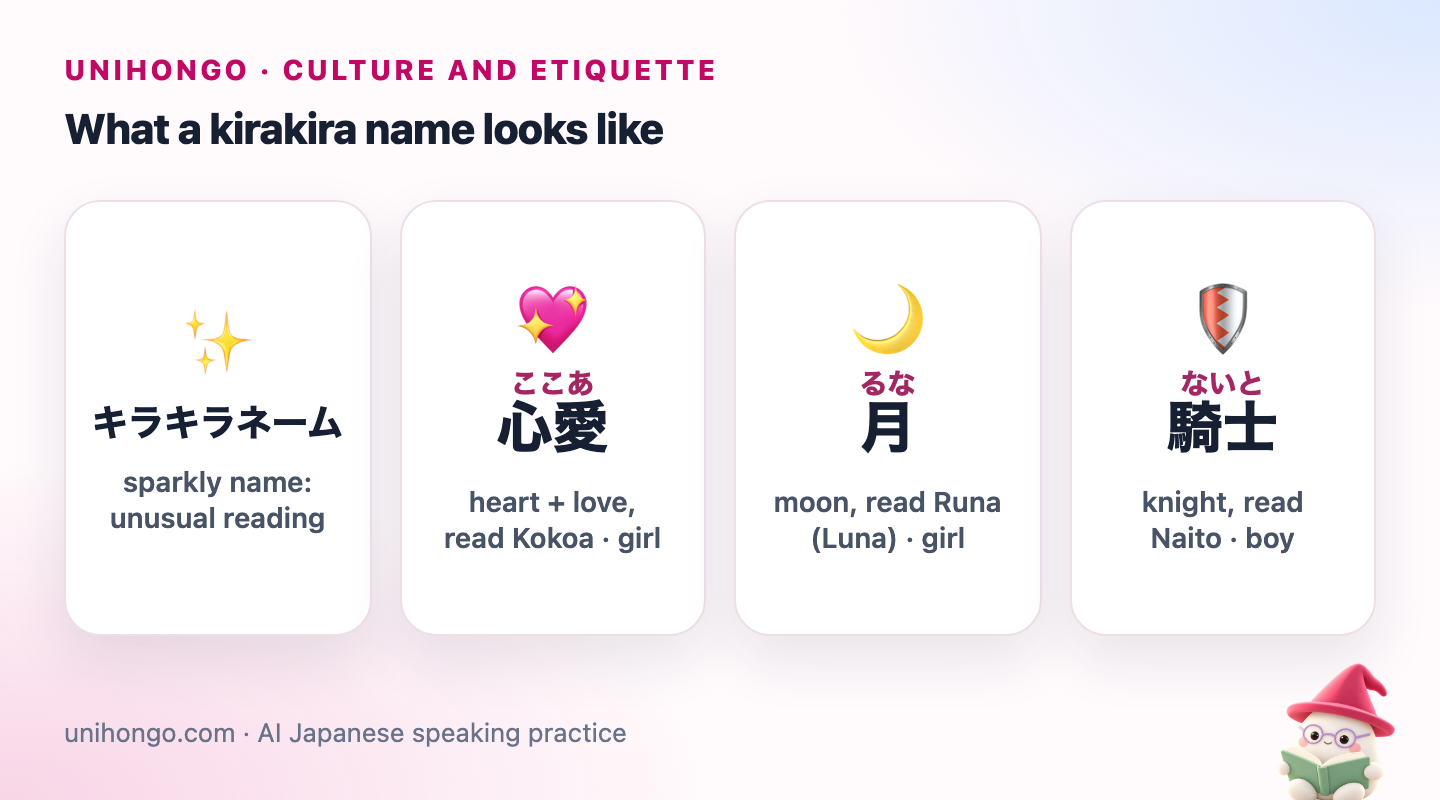
| Japanese | Romaji | Meaning |
|---|---|---|
| キラキラネーム | kirakira nēmu | sparkly name: unusual reading |
| 心愛 | Kokoa | heart + love, read Kokoa · girl |
| 月 | Runa | moon, read Runa (Luna) · girl |
| 騎士 | Naito | knight, read Naito · boy |
心愛 joins koko, the start of kokoro (heart), with a, the start of ai (love), and the result sounds like the drink cocoa. 月 normally reads tsuki or getsu, but Runa comes from Luna, the moon in Latin and several other languages. 騎士 is the everyday word kishi (knight), but here it is read with the English word knight. None of these readings appears in a dictionary entry for the kanji.
How sparkly readings are built
Most kirakira readings follow a handful of patterns. Once you know them, you can often work out a strange reading after hearing it once, and you will understand why people find some readings natural and others a stretch.
| Japanese | Romaji | Meaning |
|---|---|---|
| 大空 | Sukai | big sky, read Sukai (sky) · boy |
| 希空 | Noa | hope + sky, read Noa · unisex |
| 心 | Hāto | heart, read Hāto · girl |
| 海 | Marin | sea, read Marin (marine) · girl |
| 光宙 | Pikachū | light + space · an often-quoted extreme |
| Pattern | How it works | Typical example |
|---|---|---|
| Meaning to foreign word | The kanji is read with a foreign word that means the same thing | 大空 (big sky) read Sukai |
| Cut readings | Only the first sound of each kanji's reading is used | 希空 read Noa: no from nozomi, a from aku |
| Image reading | The kanji is read with something it reminds people of | 心 read Hāto (heart) |
| Sound only | Kanji are picked for sound alone, sometimes ignoring meaning | Names that spell out a foreign name syllable by syllable |
The last example, a name read like a famous game character, is quoted again and again in Japanese articles about kirakira names. Whether many children really carry it is hard to know, and it now works more as a symbol of the debate than as a real naming trend. Most kirakira names are much gentler: a single vowel shortened, or one kanji read with a short English word.
Unusual readings are nothing new
It would be wrong to think Japanese names were once easy to read and only recently became hard. Names have always used readings you do not learn at school. There is a whole set of readings called nanori (名乗り) that are used almost only in names, such as kazu for 和 or hiro for 博. There are also old words read as a whole, like the place and given name 大和 (Yamato), where neither kanji has that reading on its own.
Surnames can be even harder. 小鳥遊 is a real surname read Takanashi, which you can puzzle out as a riddle: where there are no hawks (taka nashi), little birds can play. Japanese people enjoy this kind of name puzzle, and quiz programmes are built around them.
| Japanese | Romaji | Meaning |
|---|---|---|
| 和 | Kazu | harmony · a classic name reading |
| 大和 | Yamato | old name of Japan · boy |
| 飛鳥 | Asuka | flying bird · girl or unisex |
| 小鳥遊 | Takanashi | little birds play · surname |
So where is the line? Most people accept a reading if it has some link to the kanji's meaning, its known readings, or a long tradition. The argument starts when the link becomes very thin, or when the reading comes entirely from another language. Different people draw that line in different places, which is why the debate never ends.
Why people argue about kirakira names
The debate is real but much less dramatic than some articles suggest. Most Japanese people simply notice when a name is hard to read, ask how to read it, and move on. Still, you will hear these arguments on both sides, in news features, parenting forums and family conversations.
| What supporters say | What critics say |
|---|---|
| A name is a gift of hope, and parents may choose freely | The child, not the parent, lives with the name every day |
| A unique name helps a child stand out | Teachers, doctors and offices keep misreading it |
| Readings have always been creative in Japan | A reading with no link to the kanji is no longer a reading |
| Foreign-sounding names suit an international future | A name that sounds cute for a baby may feel awkward for an adult |
A famous moment in this debate came in 1993, when a father in the Tokyo area tried to register his son with the kanji for devil, akuma, and after a long dispute the registration did not go through. The case became national news, and in the end the child was given a different name. It is still mentioned whenever people discuss how far naming freedom should go.
There is also a newer counter-trend. Some young parents now choose simple, classic names, and the joking term shiwashiwa nēmu (wrinkly names) appeared online for old-fashioned names such as those ending in -ko or -rō. Fashion in names swings back and forth, in Japan as everywhere.
The 2025 rule: readings go into the family register
Until recently, the Japanese family register, the koseki (戸籍), recorded only the kanji of a name, not its reading. A revised Family Register Act took effect on 26 May 2025, and now the reading in katakana, the furigana, is recorded too. People already registered received a notice with the reading the office had on file and could report a correction within a set period.
The law says the reading must be one generally accepted for the characters used in names. Ministry of Justice guidance explains this with examples of readings that would not be accepted: a reading that means the opposite of the kanji, a reading that could be confused with a different, ordinary reading, and a reading that has no connection to the kanji at all. Readings linked to the kanji's meaning are not automatically ruled out, so many creative names remain possible. Each case is checked by the local office, and the details are best confirmed with the municipality.
| Japanese | Romaji | Meaning |
|---|---|---|
| 戸籍 | koseki | family register |
| 氏名の振り仮名 | shimei no furigana | the reading of a full name |
| 読み方を届け出ます。 | Yomikata o todokedemasu. | I'll report the reading. |
| この読み方は使えますか。 | Kono yomikata wa tsukaemasu ka. | Can this reading be used? |
The change does not ban kirakira names. It mainly means that each name now has one official reading, which helps with digital records and with checking identity. People with very unusual readings simply have them written down for the first time.
Asking how a name is read, politely
This is the most useful part for a learner. In Japan, asking how a name is read is completely normal: Japanese people ask each other every day, at clinics, schools and offices. The key is to ask the question neutrally, without any comment on the name itself. Then repeat it back once and use it correctly afterwards.
| Japanese | Romaji | Meaning |
|---|---|---|
| 失礼ですが、お名前の読み方を伺ってもよろしいですか。 | Shitsurei desu ga, onamae no yomikata o ukagatte mo yoroshii desu ka. | Excuse me, may I ask how your name is read? (very polite) |
| これは何て読むの? | Kore wa nante yomu no? | How do you read this? (casual, to a friend) |
| ないとくん、ですね。 | Naito kun, desu ne. | So it's Naito, right? |
| 素敵な響きですね。 | Suteki na hibiki desu ne. | It has a lovely sound. |
| どんな意味が込められているんですか。 | Donna imi ga komerarete iru n desu ka. | What meaning did they put into it? |
| よく読み間違えられるんです。 | Yoku yomi machigaerareru n desu. | Name owner: People often misread it. |
Notice that the compliment is about the sound, hibiki, or the meaning, not about the name being unusual. Suteki na hibiki desu ne is warm and safe for any name.
Mini dialogue: a new child at nursery
A foreign parent meets another parent at nursery pickup and sees the child's name written on a bag.
| Japanese | Romaji | Meaning |
|---|---|---|
| こんにちは。お子さんのお名前、何てお読みするんですか。 | Konnichiwa. Okosan no onamae, nante oyomi suru n desu ka. | You: Hello. How do you read your child's name? |
| 「るな」です。月って書いて、るな。 | "Runa" desu. Tsuki tte kaite, runa. | Parent: It's Runa. Written with the moon kanji. |
| るなちゃん。かわいい名前ですね。 | Runa chan. Kawaii namae desu ne. | You: Runa. What a sweet name. |
| ありがとうございます。満月の夜に生まれたんです。 | Arigatō gozaimasu. Mangetsu no yoru ni umareta n desu. | Parent: Thank you. She was born on a full-moon night. |
| だから月なんですね。覚えやすいです。 | Dakara tsuki nan desu ne. Oboe yasui desu. | You: So that's why it's the moon. It's easy to remember. |
Make name readings click with Mocchi
After you sign in, type /kanji 空 to Mocchi and you get the meaning, the normal readings and everyday words for the kanji. Then ask, "Quiz me on the name readings in this kirakira post, and tell me which reading pattern each one uses." Mocchi gives one name at a time, explains the ones you miss, and keeps a note of them, so a later review brings back the readings that tripped you up.
To practise the real moment, open AI Sensei, pick Ibuki-sensei and ask her to play a nursery teacher reading out a class list. Every time she reads a name, ask how it is written and repeat it back; the session report afterwards points out where your question could be more polite.
Mistakes to avoid
- Calling someone's name a kirakira name. Even said kindly, it implies the name is odd. Ask how to read it instead.
- Guessing a reading out loud and laughing when you are wrong. A neutral question is always better than a guess.
- Assuming every hard reading is kirakira. Many are traditional nanori or old readings that Japanese adults also have to ask about.
- Thinking the 2025 rule bans creative names. It records one official reading and rules out only readings with no accepted link to the kanji.
- Forgetting the reading after asking. Write it in your phone with the kanji, so you can greet the person correctly next time.